
Strategic Reserves Running Dry: How Much Oil Insurance Is Left After the 2026 Releases

Driss EFFINA, PhD Independent Researcher, Global Strategy Files Decoded, analysis note No. 20, 24 October 2026. Reading time: about 55 minutes
Key takeaways
- The 2026 IEA collective action, 426 million barrels pledged and about 331 million delivered by 15 October, replaced roughly one lost barrel in five at the worst of the Hormuz disruption.
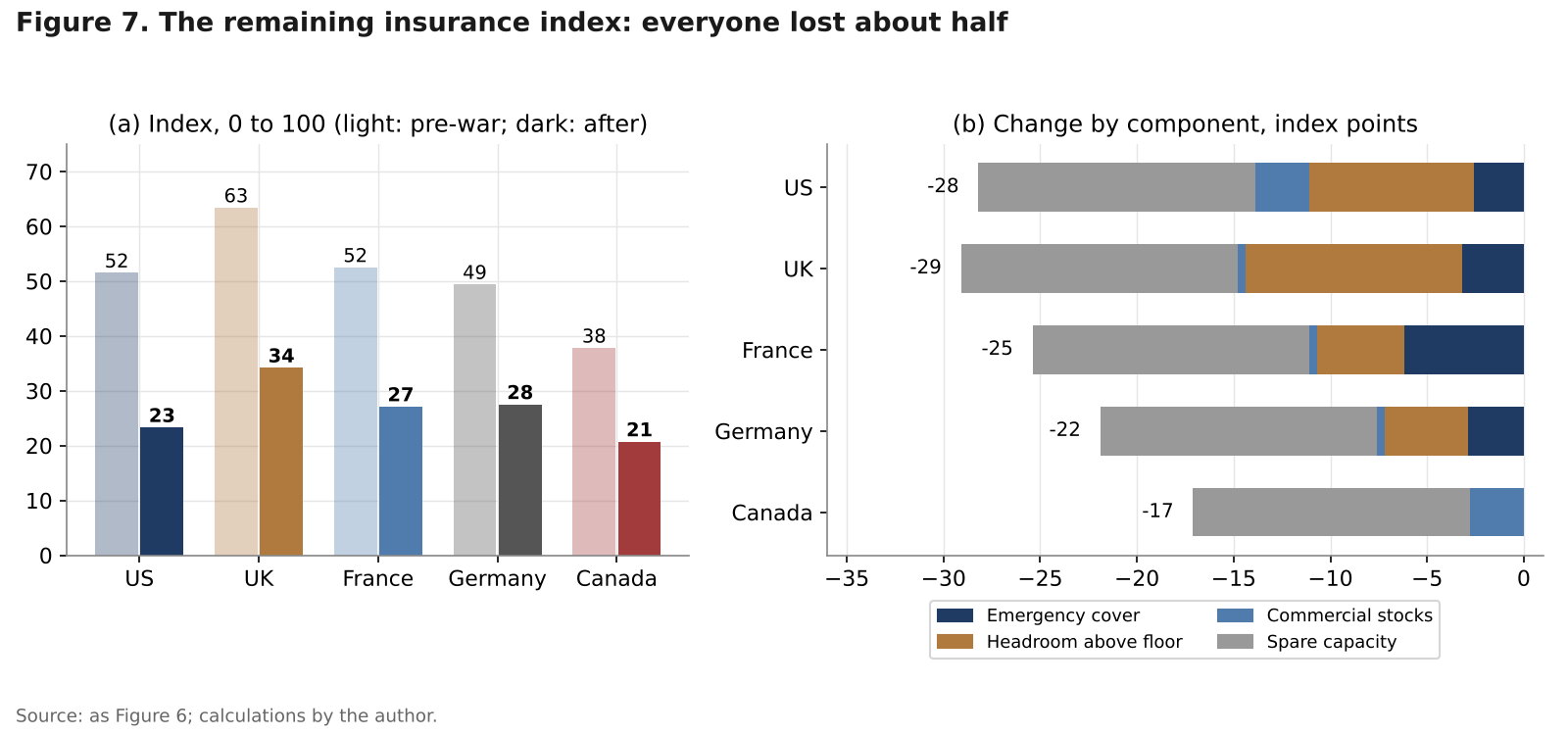
- On the author’s remaining insurance index, cover has roughly halved in all five countries: the United States falls from 51.5 to 23.3, the United Kingdom from 63.4 to 34.2, France from 52.5 to 27.1, Germany from 49.4 to 27.5 and Canada from 37.8 to 20.7.
- Germany drops to about 83 days of net imports and France to 73 to 82 days, below the 90-day rule; the US reserve, at 282.7 million barrels, heads for about 243 million before loaned barrels return between November 2026 and September 2028.
- Deployable emergency stocks fall by a third, to about 579 million barrels: a renewed closure could be cushioned for about 6 months, not covered. Refilling costs about 36 billion dollars at forward prices; stocks stay below pre-war levels at end-2027 with 90 percent probability.
Abstract
In March 2026 the members of the International Energy Agency (IEA) agreed to release 400 million barrels of emergency oil stocks, the largest collective action in the agency’s history, and pledged 426 million. By 15 October about 331 million barrels had been delivered and the G7 had asked for the remaining 100 million, including more than 20 million barrels of diesel, within four months. This note asks what is left of the insurance policy once the claim has been paid. It measures emergency cover before and after the releases for the United States, the United Kingdom, France, Germany and Canada on two bases, days of consumption and days of net imports; builds a remaining insurance index from five components (emergency cover, headroom above legal or operational floors, self-sufficiency, commercial stocks and spare production capacity); simulates how long the IEA system could absorb a renewed closure of the Strait of Hormuz with the stocks that remain; prices the refill at forward prices; and sets out four scenarios to the end of 2027 with probabilities. The answer is that roughly half of the insurance has gone. Public and obligated stocks in IEA countries fall from about 1.85 billion barrels before the war to about 1.42 billion once the action is complete, but the usable part falls by a third, because the US reserve is close to its floor, while spare production capacity has all but vanished. A renewed closure could be cushioned for about six months, not fully covered for one. All projections and scenarios are the author’s.
Keywords: strategic petroleum reserve, emergency oil stocks, IEA collective action, days of cover, Strait of Hormuz, SAGESS, EBV, stockholding obligation, refill, backwardation, energy security
Key findings
1. The insurance index has roughly halved in all five countries. On the author’s remaining insurance index (0 to 100), the United States falls from 51.5 before the war to 23.3 after full delivery of the 2026 action, the United Kingdom from 63.4 to 34.2, France from 52.5 to 27.1, Germany from 49.4 to 27.5 and Canada from 37.8 to 20.7, declines of 44 to 55 percent. The loss of spare production capacity, which is global, explains 14.3 points in each country. Excluding it, the United States and the United Kingdom lose the most (13.9 and 14.9 points), because their stocks fell closest to their floors.
2. Europe’s two largest economies are below their own 90-day rule. On the EU directive basis, Germany falls from 95.2 days of net imports in March to about 83.0 after releasing its full 19.5 million barrels, which is why the obligation of its stockholding agency was cut temporarily to 82 days. France falls from 94.5 to between 81.8 and 73.1 days, depending on whether October’s 10 million barrels of diesel count inside its March pledge. Restoring 90 days requires 11.2 million barrels in Germany and 9.4 to 19.5 million in France. The United Kingdom keeps about 99 days because its obligation is held by industry on a larger base.
3. The US reserve is lent, not spent, but it is at its floor until 2028. The Strategic Petroleum Reserve fell from 415.4 million barrels on 6 March to 282.7 million on 16 October, 39.6 percent of authorised capacity, and the Department of Energy expects a bottom near 243 million after the final tranche. In-kind returns of about 216 million barrels, including about 43 million premium barrels, would lift it to about 459 million, above its pre-war level, but the return window runs to 30 September 2028 and the physical fill rate alone takes at least 322 days. Filling to effective capacity would cost about 16.7 billion dollars at December 2027 futures; the 2025 budget law provides 171 million.
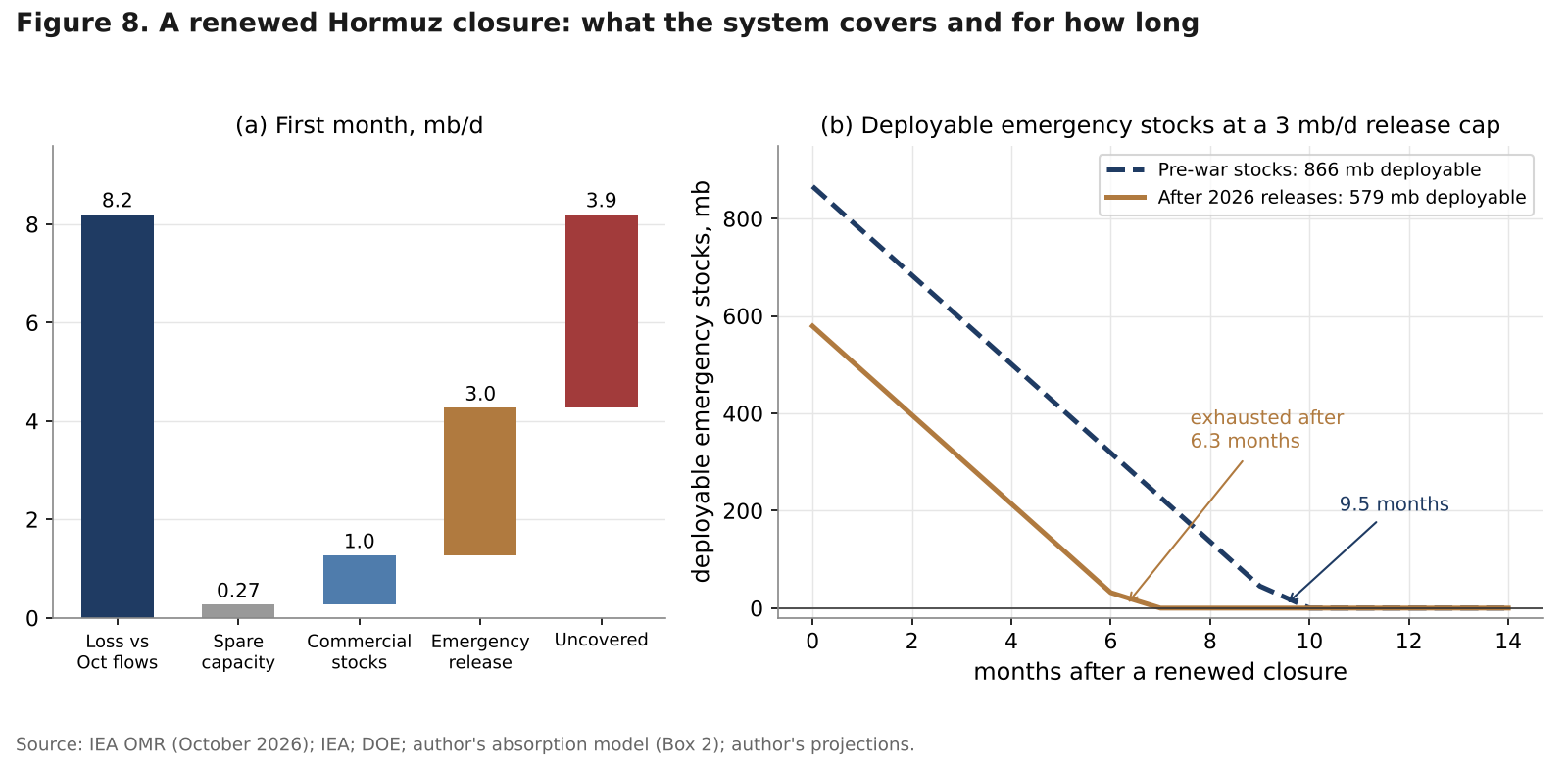
4. A renewed Hormuz closure could be cushioned for about six months but not covered. The author’s absorption model puts deployable IEA emergency stocks at about 579 million barrels after the 2026 action, against 866 million before the war, a fall of 33 percent. A return of Hormuz flows to their March to May average would remove 8.2 million barrels a day relative to September. At a sustained release rate of 3 million barrels a day, stocks would run for 6.3 months (4.2 to 8.6 on alternative assumptions), against 9.5 months with pre-war stocks, and still leave 3.9 million barrels a day in the first month, about 4 percent of world demand, to be rationed by price.
5. Backwardation rewards patience, and the refill is affordable; the risk is time, not money. At spot prices, rebuying the barrels released by the United Kingdom, Germany and France would cost about 10.0 billion dollars; at December 2027 futures, about 5.8 billion, a saving of 4.2 billion. For the IEA as a whole, refilling about 404 million barrels costs about 36 billion dollars forward against 56 billion at spot. In the author’s scenarios, the probability-weighted US reserve at the end of 2027 is 326 million barrels and IEA emergency stocks 1.59 billion; the chance that IEA stocks are still below their pre-war level at the end of 2027 is 90 percent, and that France is still below 90 days, 60 percent.
1. Introduction: insurance that was meant to be used once
Emergency oil stocks are an insurance policy with an unusual feature: the premium is paid every year, in storage costs and capital tied up in barrels, but the claim is paid only a few times a century. Since the IEA was created in 1974 its members had acted collectively five times, in 1991, 2005, 2011 and twice in 2022. The sixth, on 11 March 2026, was larger than all of them. The war that began on 28 February cut oil flows through the Strait of Hormuz from about 20 million barrels a day in 2025, about a quarter of world seaborne oil trade, to less than a tenth of that level within days. The IEA called it the largest supply disruption in the history of the oil market.
Seven months later the first half of the story is known. The releases worked as designed: they arrived, they were large, and they bought time for rerouting, for demand to adjust and for flows to partly recover, to 10.9 million barrels a day in September. The second half is not known, and it is the subject of this note. Insurance that has been claimed must be rebuilt before the next accident. If the strait closes again in 2027, or if another supplier fails, how much cover is left, in which countries, and how quickly can it be restored?
The question matters now for three reasons. First, the stocks were drawn when commercial inventories were also falling: by the end of September global observed stocks were 509 million barrels below their end-February level, and on-land stocks were at their lowest since at least 2016. Second, spare production capacity, the other layer of insurance, has almost disappeared: OPEC+ effective spare capacity was 0.27 million barrels a day in September. Third, the rules are being rewritten: the European Commission plans a regulation to replace the 2009 oil stocks directive, with a proposal expected before the end of 2026, while Germany has lowered its stockholding obligation and the United States is refilling by loan rather than purchase.
Figure 1 sets out the framework used throughout. A supply loss is met first by rerouting and spare capacity, then by commercial stocks, then by emergency stocks, and finally by price. Only the third layer is in the direct control of governments, and it is the layer whose depletion this note measures. Previous notes in this series covered the energy mix to 2030 (Foresight No. 8), the diesel shock (Decoded No. 16) and the European gas winter (Decoded No. 14); this note does not repeat them and refers to the last only for gas storage.
The note proceeds in nine steps. Section 2 reconstructs the 2026 releases. Section 3 describes the five national systems. Section 4 measures days of cover before and after. Section 5 builds the remaining insurance index. Section 6 asks how many months of a renewed disruption the system could absorb. Section 7 prices and times the refill. Section 8 links briefly to gas storage. Section 9 sets out scenarios to the end of 2027, and Sections 10 to 12 give a dashboard, implications and a calendar.
2. The 2026 drawdown: what was released, by whom and how fast
2.1 The decision and the pledges
On 11 March 2026 the 32 IEA members unanimously agreed to make 400 million barrels available from emergency reserves. At that date they held more than 1.2 billion barrels of public emergency stocks and about 600 million barrels of industry stocks held under government obligation; the March Oil Market Report put government stocks at about 1.25 billion barrels. Asian members released immediately; the Americas and Europe began at the end of March.
The national contributions confirmed on 19 March added up to 426 million barrels: 280 million from public stocks, 119 million from obligated industry stocks and 28 million of extra production, of which 301 million were crude and 125 million products (Table 1). The five countries of this note pledged 243.9 million barrels, 57.3 percent of the total. The United States alone pledged 172.2 million barrels, 40.4 percent, all crude from the Strategic Petroleum Reserve (SPR). Germany pledged 19.5 million from public stocks, France 14.6 million, the United Kingdom 14.0 million from company stocks (4.3 million crude and 9.7 million products) and Canada 23.6 million barrels of extra production rather than stocks.
Table 1. The 2026 collective action in numbers. Sources: IEA (11, 15 and 19 March, 11 and 15 October 2026); Bruegel (15 June 2026); S&P Global (15 October 2026); EIA; DOE; Bundesrat Drucksache 583/26; Government of France (7 October 2026); calculations by the author.
| Item | Value | Date |
|---|---|---|
| Volume agreed | 400 mb | 11 Mar 2026 |
| Volume pledged | 426 mb (public 280, industry 119, extra production 28) | 19 Mar 2026 |
| Crude and products in pledges | 301 mb crude, 125 mb products | 19 Mar 2026 |
| IEA emergency stocks before the war | over 1.2 bn bbl public, about 600 mb obligated industry | 11 Mar 2026 |
| Released | about 164 mb; 290 mb; 331 mb | 8 May; 21 Jul; 15 Oct 2026 |
| Of which public and industry | about 240 mb and 91 mb | to 15 Oct 2026 |
| Released in September | 8 mb | Sep 2026 |
| Remaining, incl. more than 20 mb of diesel | about 100 mb, within four months | G7, 2 Oct; IEA, 15 Oct 2026 |
| United States | 172.2 mb pledged; SPR down 132.7 mb | 6 Mar to 16 Oct 2026 |
| Germany | 19.5 mb pledged (4.9%); 3.5 mb delivered; obligation cut to 82 days | 9 and 16 Oct 2026 |
| France | 14.6 mb pledged; 10 mb of diesel announced over three months | 19 Mar; 7 Oct 2026 |
| United Kingdom | 14.0 mb pledged from company stocks | 19 Mar 2026 |
| Canada | 23.6 mb of extra production | 19 Mar 2026 |
Note: mb = million barrels; bn bbl = billion barrels.
Figure 2 places the action in context. Brent averaged 69.1 dollars a barrel in 2025, 103 in March 2026, 117 in April and 127 in October (panel a). Hormuz flows fell from 20 million barrels a day to an average of 2.7 million between March and May, and recovered to 10.9 million in September (panel b). Cumulative releases rose quickly, then stalled (panel c), and the US reserve fell to its lowest level since 1982 (panel d).
2.2 The pace: front-loaded, then stalled
The release was fast at first. From the start of deliveries around 20 March to 8 May about 164 million barrels reached the market, an average of 3.35 million barrels a day. Between 8 May and 21 July the pace halved to 1.70 million barrels a day, as the initial flows were absorbed and exchanges ran into weak demand. It then almost stopped: from 21 July to the end of August about 0.24 million barrels a day, and only 8 million barrels in September. A June US offer of 40 million barrels drew bids for only about 0.5 million. By mid-October, 77.7 percent of the pledged volume had been delivered.
The slowdown was not a failure of the stocks but a sign of how the market used them. In the spring, prompt barrels were scarce and buyers took them; by the summer Brent had fallen to about 84 to 85 dollars a barrel, Hormuz flows were recovering and refiners saw less value in borrowing crude they would have to return with a premium. The renewed tightening of September and October, led by diesel, then brought the G7 back to the stocks. On 2 October the G7 leaders agreed to release the outstanding volumes within four months, with a fast release of diesel in the first 20 days and no export restrictions among members. On 11 October the IEA Executive Director asked members to accelerate and to consider additional diesel releases, and on 15 October the Governing Board noted about 330 million barrels released and agreed to accelerate the remainder, including more than 20 million barrels of diesel.
2.3 One barrel in five
How much of the shock did the stocks absorb? In March to May, Hormuz flows were 17.3 million barrels a day below their 2025 level. The release averaged 3.35 million barrels a day over the same period, 19.4 percent of the lost flow. Cumulatively, the author estimates releases of about 254 million barrels by the end of June, 19.6 percent of the more than 1.3 billion barrels of Middle East supply lost by June according to the IEA. Emergency stocks replaced roughly one lost barrel in five. The rest came from rerouting (bypass exports reached 5.6 million barrels a day in September), from commercial stocks and from a fall in demand: the IEA expects world demand to fall by 2.6 million barrels a day in 2026, the first annual decline since 2020.
That ratio is the first benchmark of this note. The insurance did its job at the margin, and the margin matters: in a market where demand responds little in the short run, one-fifth of the gap is the difference between a price spike and a physical shortage. But it also shows that stocks cannot replace a closed strait; they can only buy time for other adjustments.
Figure 3 shows the pledges in barrels and relative to each country’s own consumption. Measured in days of consumption, the American contribution, 8.9 days, was the smallest of the five; Germany and Canada each pledged about 10 days and the United Kingdom 11.2. France, if the October diesel release is added to its March pledge, released 21.3 days of its consumption, the largest effort by far; on its March pledge alone, 12.6 days.
A first look at the results
The full note goes much further, with original models, scenarios and a dashboard of leading indicators. Two of its 14 charts and diagrams are shown below.
Continue reading
Get the full note: 25 pages, 14 charts and diagrams, 9 tables
This page shows the first part of the note. The full PDF adds: five national systems; days of cover before and after; a remaining insurance index; how long could the system absorb a renewed Hormuz disruption?; the refill: cost, timing and the forward curve; gas storage: the second insurance policy; scenarios to end-2027; a dashboard of leading indicators; implications for policy, markets and firms.
29 USD, instant PDF download, secure card payment.
Buy the full noteNeed this analysis for your organisation?
We prepare confidential briefings, executive talks and studies on countries, markets and policies, built on the same method as this article.
Request a briefingSupport independent analysis
Our studies are free to read and carry no advertising. If this one was useful, a small contribution helps us publish the next.
Support our workGo further: books by Global Strategy Files

Frequently asked questions
How much oil was released from strategic reserves in 2026?
IEA members agreed on 11 March 2026 to release 400 million barrels and pledged 426 million, the largest collective action in the agency’s history. About 331 million barrels had been delivered by 15 October, roughly 240 million from public stocks and 91 million from obligated industry stocks. The G7 asked for the remaining 100 million, including more than 20 million barrels of diesel, to be released within four months.
How low is the US Strategic Petroleum Reserve in 2026?
The SPR held 282.7 million barrels on 16 October 2026, down from 415.4 million on 6 March and its lowest level since 1982, about 40 percent of authorised capacity. The Department of Energy expects a bottom near 243 million barrels after the final 40 million barrel exchange. Because the release was a loan, about 216 million barrels, including premiums, are due back between November 2026 and September 2028.
Do Germany and France still meet the 90-day oil stock obligation?
Not after their full releases. On the EU directive basis Germany falls from 95.2 days of net imports in March 2026 to about 83 days, and its stockholding agency’s obligation was cut temporarily to 82 days. France falls from 94.5 days to between about 73 and 82 days, depending on how its October diesel release is counted. Restoring 90 days needs about 11 million barrels in Germany and 9 to 20 million in France.
How long could emergency oil stocks cover a new Hormuz closure?
On the author’s model, deployable IEA emergency stocks are about 579 million barrels in early 2027, a third less than before the war. If Hormuz flows fell back to their spring 2026 level, a loss of 8.2 million barrels a day, stocks released at 3 million barrels a day would last about 6 months, against 9.5 months with pre-war stocks, and about 4 million barrels a day would still have to be rationed by price.
Sources
- International Energy Agency: “IEA Member countries to carry out largest ever oil stock release amid market disruptions from Middle East conflict” (11 March 2026); “Update on IEA collective action decision of 11 March 2026” (15 March 2026); “IEA confirms Member country contributions to collective action to release oil stocks in response to Middle East disruptions” (19 March 2026); “IEA statement on responding to the global diesel market situation” (11 October 2026); Oil Market Report, 12 March, 13 May and 14 October 2026; Oil Stocks of IEA Countries data tool.
- S&P Global Commodity Insights, “IEA accelerates oil stock release plans, over 20 mil barrels of diesel” (15 October 2026); “US strategic oil reserve falls to lowest level since 1983” (15 July 2026).
- Bruegel, Mramor, Roth, Tagliapietra and Zachmann, “Europe must prepare for a possible oil supply crunch” (15 June 2026).
- US Department of Energy, Office of Petroleum Reserves: exchange award releases (17 April and 11 May 2026); “The United States Energy Department continues execution of strategic reserve release commitments” (29 September 2026).
- US Energy Information Administration: Weekly Petroleum Status Report via Rigzone (22 October 2026) and Political.org (19 October 2026); Short-Term Energy Outlook (6 October 2026); Today in Energy on OPEC+ capacity (23 June 2026); crude oil exports in 2025 via AJOT (10 March 2026); petroleum trade via Eco3min (9 October 2026); weekly natural gas storage via Trading Economics (15 October 2026).
- Argus Media, “US starts emergency crude release from SPR” (21 March 2026). Oil and Gas Journal, “US seeks to release another 40 million bbl from SPR despite low inventory levels” (30 September 2026). Oilprice.com, M. Kern, “How low can the Strategic Petroleum Reserve actually go?” (11 October 2026). Newsquawk on Secretary Wright (12 March 2026). AOL/Reuters on SPR funding in the 2025 budget law (9 March 2026).
- Bundesrat, Drucksache 583/26, Siebte Verordnung ueber die Freigabe von Vorraeten des Erdoelbevorratungsverbandes (9 October 2026). Erdoelbevorratungsverband, Mineraloelpflichtbevorratung (March 2026).
- Government of France and AFP via Connaissance des Energies (2, 8 and 9 October 2026); Selectra, “Stocks strategiques de petrole: SAGESS et 90 jours” (9 October 2026); Energies et Mobilites, Approvisionnement de la France en energies liquides (June 2026).
- UK Government, “UK joins IEA members in coordinated oil stock release” (11 March 2026); IOM3 (12 March 2026); DESNZ, DUKES 2026 Chapter 3; Fuel Oil News on UK stocking obligations (17 March 2023).
- Canada Energy Regulator, Market Snapshots on crude oil imports in 2025 (15 July 2026) and record crude production in 2025; Canada Powered by Women (21 March 2026).
- European Commission oil stocks directive revision, as reported by Petro Online (26 September 2026); Council Directive 2009/119/EC.
- Eurostat, Emergency oil stocks in days equivalent (nrg_stk_oem), as compiled by globaloilshock.com.
- OPEC, Monthly Oil Market Report (September 2026) and statement to the IMFC (October 2026); Rystad Energy via Air Freight News (30 April 2026).
- Futures settlements: Commodity Board market reports of 1, 6 and 22 October 2026 (ICE Brent, NYMEX WTI).
- Energy Institute, Statistical Review of World Energy 2026, via Rigzone (3 July 2026); BP data via CEIC.
- Global Strategy Files: Decoded No. 14, “The Thin Cushion” (gas storage data); Decoded No. 16 (diesel crack spreads from FRED).
- Data series: FRED DCOILBRENTEU; IMF WEO October 2026 NGDPD. Retrieved 20 to 24 October 2026.
Books from Global Strategy Files
Go further on this topic


