
The 2025 JFK Files: What the Declassified Kennedy Assassination Records Reveal, and What They Do Not

Driss EFFINA, PhD Independent Researcher, Global Strategy Files Analysis, 25 October 2026.
In 2025 the United States government removed most of the remaining secrecy around the records of President John F. Kennedy’s assassination. More than 94,000 pages have been posted since March 2025. This article measures what was released, sets out what researchers actually found, and explains why the documents illuminate the Cold War state far more than they resolve the events of 22 November 1963.
Key takeaways
- Executive Order 14176, signed on 23 January 2025, triggered five National Archives releases between 18 March and 3 April 2025 (83,621 pages in 2,569 PDF files) and a further release of 11,022 pages on 30 January 2026.
- Most of these pages were not new documents. They were complete versions of records that had been public for years with passages blacked out, so the real gain lies in the removed redactions, not in the page count.
- The newly visible passages document CIA covert operations, the scale of its personnel under diplomatic cover, joint wiretapping with Mexican authorities, and the conduct of officers who later dealt with official investigators. None of the material reviewed by journalists and historians so far identifies a second gunman or overturns the finding that Lee Harvey Oswald fired the shots.
- The records strengthen a different and better documented conclusion: U.S. agencies knew a great deal about Oswald before Dallas, and parts of the CIA withheld relevant information from later investigators. That is a finding about institutional conduct, and it should be read as such.
Why 2025 mattered: from the 1992 Act to Executive Order 14176
To understand the 2025 releases, one has to start with the law that governs them. The President John F. Kennedy Assassination Records Collection Act was signed by President George H. W. Bush on 26 October 1992. It directed the National Archives and Records Administration (NARA) to assemble a single collection of government records on the assassination at its College Park, Maryland facility, and it set a deadline: every record was to be disclosed in full by 26 October 2017, unless the sitting president certified that postponement was necessary because an identifiable harm to defense, intelligence operations, law enforcement or foreign relations outweighed the public interest.
The Act also created an independent body, the Assassination Records Review Board, which operated from 1 October 1994 to 30 September 1998. The Board ruled on contested withholding requests document by document. NARA describes the collection today as more than six million pages of records, plus photographs, films, sound recordings and artifacts, and states that the vast majority of it was declassified and public well before 2025.
The 2017 deadline did not produce full disclosure. President Donald Trump allowed releases throughout 2017 and 2018 but accepted agency requests to keep some passages withheld. President Joe Biden extended the postponements in October 2021, ordered releases in December 2021 and December 2022, and in June 2023 approved “transparency plans” under which agencies would release remaining information as specific harms faded. The White House stated at that point that 99 percent of the records had been made public.
The remaining one percent is where public attention concentrated, and it is the subject of the 2025 story. On 23 January 2025, President Trump signed Executive Order 14176, on the declassification of records concerning the assassinations of President Kennedy, Senator Robert F. Kennedy and the Reverend Dr. Martin Luther King Jr. The order stated that it was in the national interest to “finally release all records related to these assassinations without delay.” It required the Director of National Intelligence, working with the Attorney General, to present a release plan for the Kennedy records within 15 days, and plans for the Robert F. Kennedy and King records within 45 days.
Two developments followed before any documents appeared. On 11 February 2025, the FBI announced that a new search had located about 2,400 related records not previously in the collection. On 28 February, NARA launched a new landing page and reported that more than 700,000 pages had been digitized since 2023. On 17 March, the President announced the release, and NARA’s release page cites that directive as the basis for publishing all records previously withheld for classification.
The release timeline: dates, files and page counts
The table below reproduces the figures on NARA’s official release page, last modified on 30 January 2026. Figures reported on release night differ slightly (early reports put the second tranche at about 31,400 pages in 1,059 files), which suggests NARA revised its counts after posting. This article uses NARA’s current figures.
| Release (Eastern Time) | Pages | PDF files | Average pages per file |
|---|---|---|---|
| 18 March 2025, 7:00 PM | 31,419 | 1,123 | 28.0 |
| 18 March 2025, 10:30 PM | 37,127 | 1,062 | 35.0 |
| 20 March 2025, 9:30 PM | 14,318 | 161 | 88.9 |
| 26 March 2025, 3:30 PM | 53 | 16 | 3.3 |
| 3 April 2025, 7:00 PM | 704 | 207 | 3.4 |
| Subtotal 2025 | 83,621 | 2,569 | 32.6 |
| 30 January 2026, 10:00 AM | 11,022 | 140 | 78.7 |
| Total to date | 94,643 | 2,709 | 34.9 |
Table 1. Source: NARA, “JFK Assassination Records, 2025 Documents Release”. Averages and totals are the author’s calculations.
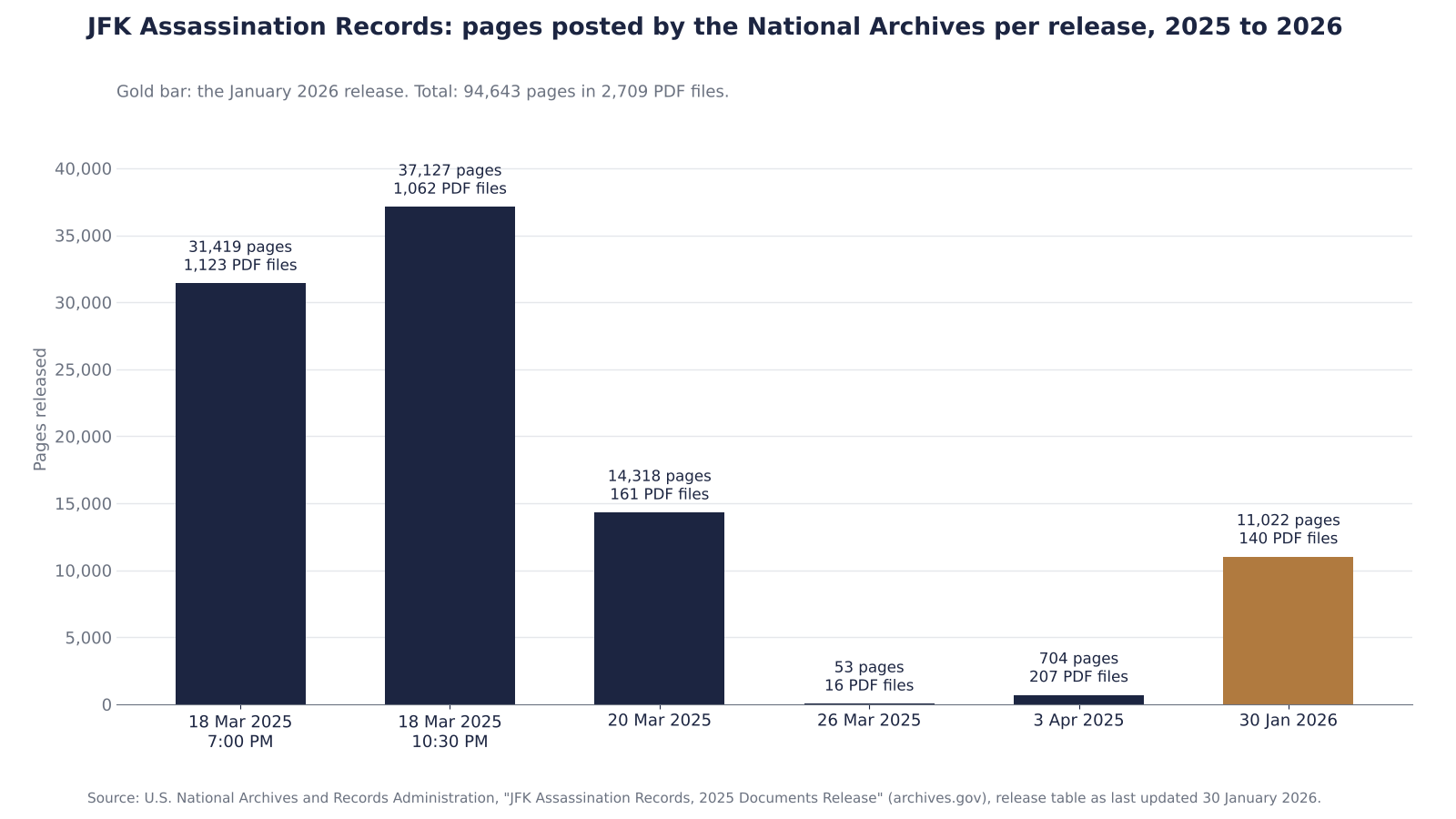
Three features of this timeline deserve attention. First, the release was front-loaded. The two tranches of 18 March represent 82 percent of the 2025 pages, and the three releases between 18 and 20 March represent 87.6 percent of everything posted to date. NARA later noted that in the eight days after the release the files were the most downloaded files on any federally hosted website, and called the publication of more than 80,000 pages in under 24 hours one of the largest single releases of records in U.S. history. Speed of this kind has consequences, which are discussed below in the section on privacy failures.
Second, the files are uneven. The March 20 tranche averaged almost 89 pages per PDF, compared with 28 to 35 pages for the March 18 tranches, and the small releases of 26 March and 3 April averaged about three pages per file. Such differences usually reflect different record types: long reports, files that had to be digitized from paper, or short single documents and corrections. Readers should not assume that a large page count signals a large amount of new information.
Third, the January 2026 release, at 11,022 pages in 140 files, is the only post-2025 entry on NARA’s release page as of this writing. The Mary Ferrell Foundation, an independent research archive that tracks every release under the Act, records it as a batch of 139 documents. Public reporting on its contents has been limited, and this article does not characterize them beyond these counts.
How do these numbers compare with the total collection? The 94,643 pages posted since March 2025 equal at most about 1.6 percent of the more than six million pages NARA reports for the collection. That ratio is a useful antidote to the idea that the “real” Kennedy files were hidden until 2025. The overwhelming majority of the documentary record, including the Warren Commission and House Select Committee materials, was open long before.
What was still secret before March 2025
To judge the 2025 releases fairly, one has to know what was still withheld before them. The figures below come from NARA, the Mary Ferrell Foundation and wire reports, and they are not perfectly consistent with one another because different counts use different units (documents, records or pages) and different dates.
| Date | Status of withheld material | Source |
|---|---|---|
| 24 July 2017 | 3,810 documents released: 441 previously withheld in full, 3,369 previously redacted | NARA |
| 26 April 2018 | 19,045 documents released; no document subject to section 5 of the Act still withheld in full | NARA |
| 15 December 2021 | 1,491 documents released; agencies proposed continued postponement for more than 14,000 documents | NARA |
| 15 December 2022 | 13,173 records released; 515 still withheld in full and 2,545 withheld in part (3,060 in total) | NARA, National Declassification Center |
| June 2023 | White House states that 99 percent of the records are public | CNN |
| Early 2025 | About 3,500 documents in the collection still carried redactions; researchers estimated 3,000 to 3,500 files not fully released | CBS News, Associated Press |
Table 2. The residue of secrecy before the 2025 order.

Aggregating the official release figures by year gives 34,873 documents in 2017, 19,045 in 2018, 1,491 in 2021, 13,173 in 2022 and 2,693 in 2023, for a total of 71,275. Almost half (48.9 percent) came in 2017 alone. Two cautions apply. A document can appear in more than one release as successive redactions are lifted, so these figures count release events rather than unique documents. And most of these documents were already public in redacted form; the releases removed passages rather than revealing whole unknown files.
The key analytical point is this: by early 2025 the remaining secrecy was concentrated in a few thousand documents, overwhelmingly from the CIA and the FBI, and the withheld passages tended to protect names of sources and officers, locations of stations, liaison relationships with foreign services and technical methods. That pattern predicted, correctly, what the 2025 releases would contain. CBS News reported that about 75 percent of the records released in March 2025 came from the CIA, and that the first tranche alone released in full roughly a third of the documents that still carried redactions.
What 2025 did not touch is also defined by law. Section 10 of the Act covers information under court seal, including grand jury material, and section 11 covers tax return information protected by the Internal Revenue Code and records deeded to the government by private citizens. These categories were outside the scope of a classification decision. CBS News reported that more than 500 Internal Revenue Service records remained withheld in full for this reason, and that NARA and the Justice Department were working on the procedure for unsealing them.
What researchers found: the CIA’s Cold War machinery
The most consistent finding of early reviews was that the newly visible passages concern the CIA’s covert operations in the early 1960s far more than the assassination itself. The Associated Press, after reviewing more than 63,000 pages, reported that some of the material concerned covert operations, especially in Cuba, and that nothing in the documents it had examined challenged the conclusion that Oswald acted alone. The National Security Archive at George Washington University, which has studied CIA covert action for decades, reached a similar conclusion in its first briefing book on 19 March 2025: most documents had been released before with key passages redacted, and the new versions of covert-operations records were now unredacted.
The documents that drew the most attention illustrate this pattern.
The Schlesinger memorandum of June 1961. Arthur Schlesinger Jr., a historian serving as a special assistant to President Kennedy, sent him a memorandum on CIA reorganization two months after the failed Bay of Pigs invasion. Earlier versions concealed its numbers. The full version, as summarized by the National Security Archive, states that on the day of Kennedy’s inauguration 47 percent of the political officers in U.S. embassies were CIA officers under diplomatic cover, that in Paris 123 “diplomats” were CIA undercover personnel, and that in Chile 11 of 13 embassy political officers belonged to the agency. It estimates about 3,900 CIA personnel under official cover abroad. Schlesinger’s concern was institutional: covert activities were absorbing the functions of the State Department. The memorandum is important because it shows the Kennedy White House actively questioning the CIA’s place in foreign policy, a tension that researchers have long discussed but could not quantify.
Briefings to the President’s Foreign Intelligence Advisory Board, 1962 to 1963. Minutes of CIA Director John McCone’s briefings, now readable in full, describe political action programs, including covert financial support to political parties opposing communism in several countries.
The 1964 Inspector General survey of the Mexico City station. This survey offers one of the most detailed descriptions available of how a major CIA station organized its operations on the ground. It is discussed in the next section.
The 1973 “Family Jewels” memorandum. Part of the CIA’s internal inventory of activities that exceeded its charter, this memorandum describes, among other things, an operation against the French embassy in Washington involving break-ins and the removal of documents.
A CIA history of the Western Hemisphere Division and a 1967 Inspector General report on the 1961 killing of Dominican dictator Rafael Trujillo. The first details station expenditures in Latin America and influence operations in Bolivia; the second names officers and others who assisted the plotters.
Peter Kornbluh of the National Security Archive argued that the JFK Records Act has done more to expand public knowledge of CIA covert operations than any other declassification effort. These documents rarely mention Oswald; their relevance to the assassination lies in the institutional environment and habits of secrecy within which later investigations worked.
Historians emphasized the same point. Timothy Naftali of Columbia University, quoted by the Associated Press, said scholars now have more detail on U.S. intelligence under Kennedy than under any other president. He also noted that the unredacted version of President Lyndon Johnson’s daily intelligence checklist from the days after the assassination now shows exactly what Johnson was reading.
Oswald under observation: what the surveillance record shows
The most consequential question for the assassination itself is not whether the CIA had covert operations, which was known, but how closely U.S. agencies were following Oswald before 22 November 1963, and what they did with what they knew.
The basic facts were established long before 2025. Oswald, a former Marine, lived in the Soviet Union as a defector from October 1959 to June 1962. U.S. agencies took note of him from the moment of his defection. Reporting in the Washington Post in July 2025 summarized the record: the CIA was reading Oswald’s mail from 1959 onward, and researcher Jefferson Morley of the Mary Ferrell Foundation estimates that at least 35 CIA employees handled reports about him between 1959 and 1963.
The 2025 releases added detail rather than a new picture. At a House hearing on 1 April 2025, held by the Task Force on the Declassification of Federal Secrets under Representative Anna Paulina Luna, Morley pointed to nine memoranda concerning James Angleton, the CIA’s counterintelligence chief, that had been fully declassified on 18 March. Representative Luna stated at the hearing that agencies had monitored Oswald for four years, up to a week before the assassination. These are characterizations made at a political hearing, summarized in a majority press release, and should be tested against the documents rather than treated as established findings.
An older document, newly circulated, adds a counterweight. A November 1991 cable from the CIA’s station in St. Petersburg, cited by PBS NewsHour, reports that a KGB official had reviewed five thick volumes of Soviet files on Oswald. The official was described as “confident that Oswald was at no time an agent controlled by the KGB,” and the same cable noted that Oswald had been a poor shot during target practice in the Soviet Union. It is a single secondhand report and must be weighed as such.
The author Philip Shenon, who published a book on the assassination in 2013, offered the interpretation that best fits the evidence so far. Speaking to the Associated Press, he said “Nothing points to a second gunman.” He also suggested that the government may have kept its pre-assassination knowledge of Oswald secret partly to hide official incompetence, and asked why the CIA and FBI did not act on information already in their own files. That question, which concerns failures of follow-up and coordination, is better supported by the documents than any theory of direction or control.
Mexico City: the station, the wiretaps and the Oswald visit
At the end of September 1963, less than two months before the assassination, Oswald travelled to Mexico City, where he visited Soviet and Cuban diplomatic facilities. CBS News, summarizing the March 2025 documents, reported that he sought a visa to return to the Soviet Union, that the CIA intercepted a call he made to the Soviet embassy in October 1963, and that technical details of the agency’s surveillance of Soviet and Cuban officials appeared for the first time. An April 1975 memorandum, according to the Associated Press, states that the CIA recorded three telephone calls between Oswald and a guard at the Soviet embassy, and that Oswald identified himself only in the last one.
The 2025 releases matter here mainly because they expose the surveillance architecture itself. In a briefing book published on 19 May 2025, the National Security Archive documented the joint CIA and Mexican wiretapping program known as LIENVOY. According to the 1964 Inspector General survey, the program originated in an approach from President Adolfo López Mateos about six years earlier, and its staff consisted of Mexican Army personnel. A monthly operational report dated 8 October 1963 lists taps during September 1963 on the Cuban, Soviet, Yugoslav and Czechoslovak embassies, as well as on former president Lázaro Cárdenas and the painter David Alfaro Siqueiros. A CIA document from December 1994 indicates that joint coverage of the Cuban and Russian embassies continued at least until that year.
Some details are technical, but they explain why the CIA fought so long to keep them secret. ABC News reported that the unredacted pages describe wiretap instructions including chemical markings on telephone devices visible only under ultraviolet light, the recruitment of Soviet personnel as double agents, and the names and positions of those recruited. One memorandum listing tapped numbers refers to surveillance of an American described as a communist, but it does not name Oswald.
A further disclosure concerns Mexico’s own leadership. According to the Associated Press, a 1975 memorandum that had been redacted as recently as 2023 identifies the CIA’s security contact in Mexico, in connection with Oswald, as Luis Echeverría Alvarez, who was president of Mexico from 1970 to 1976 and died in 2022. The same document shows that Mexico’s government had penetrated the Cuban embassy.
What does this change? It confirms that Oswald’s Mexico City visit took place inside one of the densest surveillance environments the CIA operated anywhere in the hemisphere, and that the station had the technical means to monitor him closely. That, in turn, sharpens the old question of how the station and CIA headquarters handled his file in October and November 1963. It does not, on the evidence published so far, answer it. The released material shows capability and coverage. It does not show what any official intended.
Cuba operations and the Castro question
Cuba is the thread running through much of the material. The March 2025 documents include details on three CIA officers carrying out technical intelligence collection in Cuba, a memorandum on CIA relations with Miami newspapers, and further records on the anti-Castro program known as Operation Mongoose. The Nation, summarizing early reviews, also listed CIA surveillance of the columnist Jack Anderson, financing related to Bolivia’s 1966 election and funding of protests in British Guiana among the newly visible operations.
One newly visible item concerns the period after Kennedy’s death. A 1964 document, as described by ABC News, records two intelligence assets discussing a possible assassination of Fidel Castro under President Johnson, and says the plan had been shelved because of opposition from Attorney General Robert F. Kennedy. Another message from December 1963, relayed from Cuba to the CIA director’s office, reported the receipt of pistols without ammunition. Neither document links these operations to the events in Dallas.
The value of the Cuba material is to restore context. The Kennedy administration presided over an aggressive covert campaign against the Castro government, involving agencies, exile groups and, as earlier releases established, contacts with organized crime. Many of the officials who later handled the investigation had operational secrets to protect that had nothing to do with Oswald. The 2025 releases make that environment far more visible. They do not show that the campaign produced the assassination.
Agency conduct: the Joannides file
The most significant single development of 2025 for the history of the investigations, as distinct from the history of the crime, did not come from the March tranches. In early July 2025, following requests from the House task force, the CIA released about 40 documents concerning George Joannides, an officer who died in 1990. According to Axios and the Washington Post, the documents show that in 1963 Joannides was deputy chief of the CIA’s Miami branch in charge of political action and psychological warfare, that he covertly funded and directed the anti-Castro Cuban Student Directorate (known by its Spanish initials, DRE), and that a memorandum of 17 January 1963 authorized him to use the alias “Howard Gebler” with a false driver’s license.
Why does this matter? On 9 August 1963, DRE members confronted Oswald in New Orleans while he was handing out pro-Castro leaflets, and on 21 August Oswald debated DRE activists in a local broadcast. After the assassination, the DRE quickly publicized Oswald’s pro-Castro activities, and the story appeared in major newspapers. DRE members later said their CIA contact was called “Howard.” For decades the CIA did not acknowledge that Joannides was that contact.
In 1978, the CIA assigned Joannides as its liaison to the House Select Committee on Assassinations. Former committee staff have said that Joannides did not disclose his own role with the DRE and obstructed their access to records. The committee’s chief counsel, G. Robert Blakey, has testified that Joannides told him no record of a “Howard” working with the DRE could be found, and the former investigator Dan Hardway testified in 2025 that Joannides worked to undermine the inquiry. The CIA told the committee in 1978 that “Howard” did not exist. In 1981 the CIA awarded Joannides a career intelligence medal, in part for his work with the DRE group and as liaison to the committee. Jefferson Morley’s reaction, quoted by Axios, was blunt: “The cover story for Joannides is officially dead.” Gerald Posner, a prominent defender of the single-gunman conclusion, described the agency’s conduct as typical of the CIA.
The careful reading is this. The Joannides documents establish that the CIA placed an officer with an undisclosed connection to a group that had dealt with Oswald in the role of liaison to the congressional body investigating the assassination, and that the agency misinformed that body. The same reporting stresses that none of the files indicate CIA involvement in the assassination itself, and no document so far explains why the agency concealed Joannides’s role. The documents are evidence of obstruction of an investigation. They are not evidence of the crime that investigation was examining. Keeping those two questions separate is the single most important discipline for anyone reading the 2025 records.
The release as an event: speed, privacy and process
The 2025 releases also need to be assessed as an administrative act, because their execution shaped what readers can and cannot rely on.
The decision to release without redactions exposed personal information. A Washington Post review of about 60,000 pages, reported on 21 March 2025, found unredacted Social Security numbers of more than 400 people, with more than 3,500 instances because some numbers appeared repeatedly. Many belonged to former staff of the Senate’s Church Committee and of the House Select Committee on Assassinations. The White House acknowledged the problem. The administration said the Social Security Administration would issue new numbers to affected living individuals and that NARA would offer credit monitoring in the meantime; NARA’s release page still invites affected people to contact it. The Mary Ferrell Foundation, which had pressed for full release for years, called the exposure “indefensible and reckless.”
The posting itself was also uneven. Reviewers noted that records were placed online as they were digitized, that some were initially available only in hard copy at College Park, and that page counts were revised after the first night. The FBI’s 2,400 newly located records were not part of the first release; the Mary Ferrell Foundation reports that FBI files not previously in the collection were added during the 2025 releases. The Foundation also notes that the collection’s database lists 319,106 records and that accounting anomalies make it impossible to determine the exact status of every one of them. The Foundation has filed a federal lawsuit concerning the Act’s implementation.
The Kennedy releases were also part of a broader program under the same order. Records on the assassination of Senator Robert F. Kennedy were released in several batches from spring 2025, including about 10,000 pages in April according to the Associated Press, and on 21 July 2025 NARA released more than 230,000 pages on the assassination of Dr. Martin Luther King Jr., including FBI investigative files. The Associated Press reported that the King family opposed that release. These parallel releases matter for interpretation because they show that the 2025 policy was a general disclosure decision, not a targeted response to new evidence in the Kennedy case.
What remains unknown or unreleased
After the 2025 and 2026 releases, the situation can be summarized in three categories.
Material withheld by law. Records covered by sections 10 and 11 of the Act, including grand jury material, sealed court records and tax information, remain outside the classified releases. The roughly 500 IRS records reported by CBS News fall into this category.
Material whose existence or completeness is disputed. Researchers continue to ask for files they believe exist but have not seen, such as complete personnel files of officers involved in the Oswald case. At the April 2025 hearing, Morley asked for Angleton’s personnel file and for an explanation of why three CIA officers appear to have misled investigators. The absence of a record is not proof that it was destroyed or hidden, but the Joannides episode shows that requests of this kind can succeed when an agency is pressed.
Questions that documents may never answer. Even a complete archive records what officials wrote, not what they thought or said off the record. The central interpretive questions, such as why the Mexico City station and headquarters handled Oswald’s file as they did in late 1963, or why the CIA concealed Joannides’s role in 1978, may not be answerable from paper alone. Many of the participants are dead.
In short, with the narrow legal exceptions above, the classified portion of the collection held by NARA has essentially been released. The open questions now concern the completeness of what agencies transferred, and interpretation.
How the official conclusions stand
The two official investigations reached partly different conclusions, and the 2025 records need to be read against both.
| Inquiry | Date | Main finding on the assassination |
|---|---|---|
| Warren Commission (Executive Order 11130 of 29 November 1963) | Report transmitted 24 September 1964 | Oswald fired the shots and acted alone; no evidence of a conspiracy |
| House Select Committee on Assassinations (created September 1976) | Final report 1979 | Oswald fired three shots, of which the second and third hit the President; Kennedy was “probably assassinated as a result of a conspiracy,” based largely on acoustic evidence; the committee could not identify other gunmen or the extent of a conspiracy |
| HSCA on specific groups | 1979 | The Soviet and Cuban governments were not involved; organized crime and anti-Castro groups were not involved as groups, though individual members were not excluded |
| National Academy of Sciences, Committee on Ballistic Acoustics | 1982 | The acoustic analysis that underpinned the HSCA’s conspiracy finding was mistaken |
| Department of Justice (letter to the House Judiciary Committee) | 1988 | No persuasive evidence identified to support a conspiracy theory |
| Assassination Records Review Board | Final report 30 September 1998 | Did not reinvestigate the crime; its mandate was disclosure of records |
Table 3. Official findings and their status. Sources: NARA, HSCA final report as summarized in standard references, ARRB.
Read against this table, the 2025 releases have three effects.
They do not overturn the core forensic and evidentiary finding shared by both investigations, namely that Oswald fired the shots that killed the President. Nothing reported from the 2025 material identifies another shooter. The HSCA’s conspiracy finding, which rested principally on acoustic evidence later judged mistaken by the National Academy of Sciences, is not revived by anything in the new documents either.
They do reinforce a criticism that applies to both investigations: neither received full cooperation from the intelligence agencies. In 1976 the Senate’s Church Committee concluded that the CIA and the FBI had been deficient in how they reached their own conclusions and in how they supplied information to the Warren Commission. The HSCA, as the Joannides documents now confirm, worked with a CIA liaison who concealed relevant facts. An investigation can reach a correct conclusion on the central question while being misled on context, and the record now shows that both investigations were misled on context.
They change the balance of what is documented. Before 2025, claims that the CIA misled investigators about its relationship with groups around Oswald were contested inferences. After 2025, at least the Joannides part of that claim is documented by the agency’s own records. That is a real change, and it explains why public distrust has not been dispelled by the releases. A Pew Research figure cited at the April 2025 hearing put trust in the federal government at 22 percent in 2025, compared with 74 percent in 1958. Documents that show concealment, even concealment unrelated to the crime itself, tend to confirm distrust rather than settle it.
How to read the JFK records critically
Because the records are now online and searchable, many readers will encounter individual pages through social media, often stripped of context. The following checks, drawn from standard archival practice, reduce the risk of misreading.
| Check | Question to ask | Why it matters |
|---|---|---|
| Release status | Was this page new in 2025, or a complete version of a page already public with redactions? | Most 2025 pages were previously released; the novelty is often a single name or number |
| Provenance | Which agency created the record, when, and for whom? | A field report, a headquarters summary and a later internal review carry different weight |
| Proximity | Is the author reporting what he saw, what a source said, or what he read elsewhere? | Raw intelligence often repeats unverified leads; the FBI pursued many that went nowhere |
| Date | Was the document written before or after 22 November 1963? | Post-assassination documents may reflect hindsight, rumor or institutional self-protection |
| Corroboration | Is the claim supported by other independent records? | A single cable, however striking, is a lead, not a conclusion |
| Purpose of secrecy | What was the redaction protecting: a source, a method, a foreign partner, or an embarrassment? | Most redactions protected sources and liaison relationships, not hidden explanations of the crime |
| Inference chain | Does the conclusion require several unproven steps? | Each step multiplies uncertainty |
Table 4. A checklist for reading declassified intelligence records.
Two practical habits follow. First, start from the redaction, not from the page: comparing a 2023 version of a document with its 2025 version shows exactly what was hidden. Second, separate three questions that are often merged: who fired the shots; whether anyone else knew of or assisted the plan; and how the institutions behaved before and after the event. The 2025 records add substantially to the third question, add context to the second, and add almost nothing to the first.
Going further: the book “Kill Kennedy”
Readers who want to place the 2025 declassification within a broader analysis of power can turn to the book Kill Kennedy: The Secret JFK Assassination Files, available here: Kill Kennedy. Where this article measures the releases and tests what they prove, the book works at the level of structure: it follows the intelligence surveillance of Oswald before Dallas, the Cold War contest between the presidency and the security state, the management of political narratives and the problem of missing documents and contested testimony, asking how modern power systems handle truth, secrecy and historical memory. The book is also available in French as Tuez Kennedy, in Spanish as Matar a Kennedy and in German as Kennedy töten.
Conclusion
The 2025 declassification was a genuine event in the history of government transparency: by January 2026, NARA had posted 94,643 pages and removed most of the redactions that had survived the 1992 Act and the 2017 deadline.
What the releases changed is specific. They exposed, in unusual detail, the CIA’s Cold War machinery: its personnel under diplomatic cover, its political funding, its partnerships with foreign governments and its surveillance of embassies in Mexico City. They documented that a CIA officer with an undisclosed link to a group that had dealt with Oswald served as the agency’s liaison to the House investigation. They confirmed that U.S. agencies had followed Oswald for years.
What the releases did not change is equally specific. They have not identified a second shooter, a sponsor, or an order. The conclusion that Oswald fired the shots stands where it stood. The documents show institutions protecting secrets, many of which concerned operations that had nothing to do with Dallas, and in at least one case misleading investigators. For historians, that is not a disappointment. It is the actual story the archive tells, and it is a serious one: the lasting damage of the Kennedy assassination lies partly in what happened in Dealey Plaza and partly in how the state managed what it knew afterwards.
Frequently asked questions
Were all the JFK files released in 2025? Almost all classified material was. NARA released 83,621 pages in five releases between 18 March and 3 April 2025, and 11,022 more pages on 30 January 2026. Records under court seal, grand jury secrecy or tax confidentiality, including about 500 IRS records, were outside the scope of the classification decision.
Do the 2025 JFK files prove a conspiracy? No. Journalists and historians who reviewed the material reported nothing that identifies a second gunman or overturns the finding that Oswald fired the shots. The files do document CIA covert operations and, in the Joannides case, the misleading of congressional investigators.
What was the most important new finding? For the history of the investigations, the July 2025 CIA documents on George Joannides, which confirm that the agency’s liaison to the House committee had secretly run the anti-Castro group that clashed with Oswald in 1963. For the history of intelligence, the unredacted material on CIA cover, funding and the Mexico City wiretap program.
Where can I read the declassified JFK records? On the National Archives website (archives.gov/jfk), with all records also available in person at the National Archives at College Park, Maryland. The Mary Ferrell Foundation and the National Security Archive provide searchable versions and expert commentary.
Sources
- U.S. National Archives and Records Administration (NARA), “JFK Assassination Records, 2025 Documents Release” (release table, last modified 30 January 2026). https://www.archives.gov/research/jfk/release-2025
- NARA, press release NR25-05, “National Archives Launches New JFK Assassination Records Landing Page,” 28 February 2025. https://www.archives.gov/press/press-releases/2025/nr25-05
- NARA News, “National Archives Releases JFK Records,” 27 March 2025. https://www.archives.gov/news/articles/jfk-records-release
- NARA, “JFK Assassination Records” landing page and text of Executive Order 14176. https://www.archives.gov/jfk
- NARA, press release, 24 July 2017. https://www.archives.gov/press/press-releases/2017/nr17-68
- NARA, press release, 26 April 2018. https://www.archives.gov/press/press-releases/2018/nr18-45
- NARA, press release, 15 December 2021. https://www.archives.gov/press/press-releases/2022/nr22-15
- NARA National Declassification Center, “NARA Releases More JFK Records, as President Biden Approves Few Delays,” 19 December 2022. https://transforming-classification.blogs.archives.gov/2022/12/19/nara-releases-more-jfk-records-as-president-biden-approves-few-delays/
- NARA, “JFK Assassination Records Processing Project, 2022 Update.” https://www.archives.gov/research/jfk/processing-project-2022
- NARA, press release NR23-43, 30 June 2023. https://www.archives.gov/press/press-releases/2023/nr23-43
- NARA News, release of more than 230,000 pages of Martin Luther King Jr. assassination records, July 2025. https://www.archives.gov/news/articles/nara-releases-230k-mlk-assassination-files
- NARA, Warren Commission Report, letter of transmittal, 24 September 1964. https://www.archives.gov/research/jfk/warren-commission-report/letter.html
- Mary Ferrell Foundation, “JFK Act Releases.” https://maryferrell.org/pages/JFK_Act_Releases.html
- National Security Archive, “CIA Covert Ops: Kennedy Assassination Records Lift Veil of Secrecy,” 19 March 2025. https://nsarchive.gwu.edu/briefing-book/2025-03-19/cia-covert-ops-kennedy-assassination-records-lift-veil-secrecy
- National Security Archive, “JFK Files Detail Close Intelligence Collaboration Between CIA and Mexico,” 19 May 2025. https://nsarchive.gwu.edu/briefing-book/mexico/2025-05-19/jfk-files-detail-close-intelligence-collaboration-between-cia-and
- CBS News, “JFK files related to assassination released by Trump administration,” March 2025. https://www.cbsnews.com/news/trump-jfk-assassination-files-released-2025/
- Associated Press (via ABC News), “Newly released JFK assassination files reveal more about CIA but don’t yet point to conspiracies,” March 2025. https://abcnews.go.com/US/wireStory/newly-released-jfk-assassination-files-reveal-cia-point-119965696
- ABC News, “JFK files key takeaways: What we learned and didn’t,” March 2025. https://abc7news.com/post/jfk-document-release-key-takeaways-what-learned-didnt/16049744/
- PBS NewsHour (Associated Press), “JFK files send history buffs hunting for new clues,” March 2025. https://www.pbs.org/newshour/nation/jfk-files-send-history-buffs-hunting-for-new-clues
- Associated Press (via WFIE 14 News), “FBI says it found 2,400 new JFK assassination records,” 11 February 2025. https://www.14news.com/2025/02/11/fbi-says-it-found-2400-new-jfk-assassination-records/
- Washington Post (via Anchorage Daily News), “White House scrambles after JFK files expose Social Security numbers,” 21 March 2025. https://www.adn.com/nation-world/2025/03/21/white-house-scrambles-after-jfk-files-expose-social-security-numbers
- Peter Kornbluh, “JFK Assassination: The Final Secrets,” The Nation, 21 March 2025. https://www.thenation.com/article/society/jfk-assassination-files-final-release/
- U.S. House Committee on Oversight and Government Reform, hearing wrap-up, Task Force on the Declassification of Federal Secrets, 1 April 2025. https://oversight.house.gov/release/hearing-wrap-up-task-force-examines-newly-declassified-jfk-files-vows-more-transparency-for-the-american-people
- Axios, “CIA admits shadowy officer monitored Oswald before JFK assassination, new records reveal,” July 2025. https://www.axios.com/2025/07/05/cia-agent-oswald-kennedy-assassination
- Tom Jackman, Washington Post, “The CIA reveals more of its connections to Lee Harvey Oswald,” July 2025 (reproduced by the Assassination Archives and Research Center). https://aarclibrary.org/the-cia-reveals-more-of-its-connections-to-lee-harvey-oswald/
- Wikipedia, “United States House Select Committee on Assassinations” (1979 findings, 1982 NAS review, 1988 Justice Department letter). https://en.wikipedia.org/wiki/United_States_House_Select_Committee_on_Assassinations
- Wikipedia, “President John F. Kennedy Assassination Records Collection Act of 1992.” https://en.wikipedia.org/wiki/President_John_F._Kennedy_Assassination_Records_Collection_Act_of_1992
- Wikipedia, “Executive Order 14176.” https://en.wikipedia.org/wiki/Executive_Order_14176
- CNN (via KTVZ), “National Archives concludes review of JFK assassination documents with 99% made public,” 30 June 2023. https://ktvz.com/politics/cnn-us-politics/2023/06/30/national-archives-concludes-review-of-jfk-assassination-documents-with-99-made-public/
- Infodocket, “NARA Releases Approx. 2,800 JFK Assassination Records,” 26 October 2017. https://www.infodocket.com/2017/10/26/documents-now-online-nara-releases-approx-2800-jfk-assassination-records/
- Mary Ferrell Foundation, “Church Committee” (including Book V, The Investigation of the Assassination of President John F. Kennedy: Performance of the Intelligence Agencies, 23 April 1976). https://maryferrell.org/pages/Church_Committee.html
Books from Global Strategy Files
Go further on this topic
 Kill KennedyWhat the 2025 declassified files reveal about the machinery of American power.20 USD, see the book
 Tuez KennedyLes secrets révélés, Comment la vérité sur l’assassinat de JFK a survécu à 60 ans de silence CIA, État profond, dossiers déclassifiés,20 USD, see the book
 The Trump ProphecyPopulism, power and the remaking of US politics.20 USD, see the book
