Can an Investment Boom Become Durable Growth?
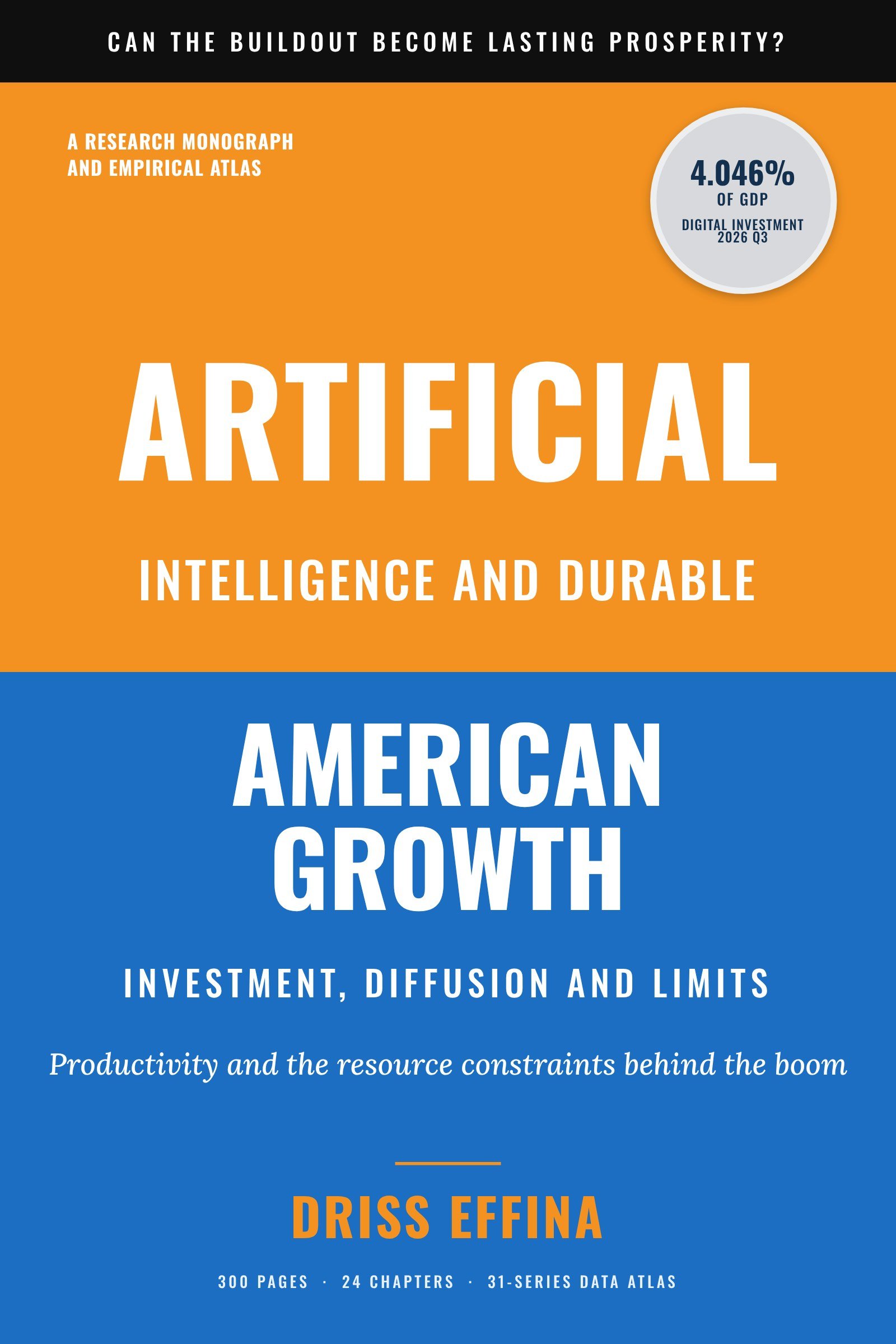
A server purchase is an investment transaction today. A reliable improvement in a hospital, a factory or a legal workflow can deliver useful services for years. In Artificial Intelligence and Durable American Growth, Dr. Driss Effina asks whether the American AI buildout can cross that distance, and under which conditions an optimistic reading could fail.
The empirical core tracks hardware and software investment, data-center construction, production, hours, equipment prices and adoption. GDP and investment data end in 2026 Q3, and the data snapshot was retrieved on November 3, 2026. No missing productivity quarter is invented.
Selected Findings
- Hardware and software investment account for 4.046 percent of nominal GDP in 2026 Q3, and data-center construction reaches a preliminary $96.462 billion annual pace in September. These are broad observed categories, not an official all-AI investment total.
- A share-weighted approximation gives a 0.950 percentage-point gross hardware-plus-software contribution to annualized quarterly growth, including non-AI activity.
- Hardware quantities exceed two pre-2020 trend extrapolations by about 2.11 to 2.55 times, while software quantities lie much closer to those baselines.
- A one-standard-deviation digital investment movement is associated with 0.434 log-percent more GDP after four quarters, while the productivity estimate, -0.051, has an interval spanning both signs.
- Richer retrospective forecasts do not beat historical-mean benchmarks over the full evaluation.
- At 30 percent depreciation and a 2 percent operating-cost rate, the narrow service-yield threshold is 32 percent before financing.
Key Questions
- How large is the AI buildout in the national accounts, and what can and cannot be attributed to it?
- Can semiconductors, construction and electrical equipment keep pace with demand?
- Why do output, productivity and hours not tell one story?
- What service yield must AI capital deliver to cover depreciation, operating costs and replacement?
- Who gains: workers, households or capital owners?
Inside the Book
24 chapters, each with four analytical sections, one figure page and one evidence-table page. The appendices hold 31 source-series profiles, 37 annual records from 1990 to 2026, 25 quarterly horizon records, 16 technical notes, sources and a glossary.
Written for economists, investors, policymakers, researchers, students and readers who want a rigorous, evidence-based account of what the AI boom can deliver for American growth.
Author: Dr. Driss Effina
Format: PDF eBook
Language: English
Length: 300 pages
Data: to 2026 Q3, retrieved November 3, 2026
Edition: First edition, November 2026
Read the front matter and Chapter 1 free (PDF, 16 pages)
This is a digital download. No physical book is shipped.





Reviews
There are no reviews yet.