Growth Is Real. So Is the Pressure on the Budget.
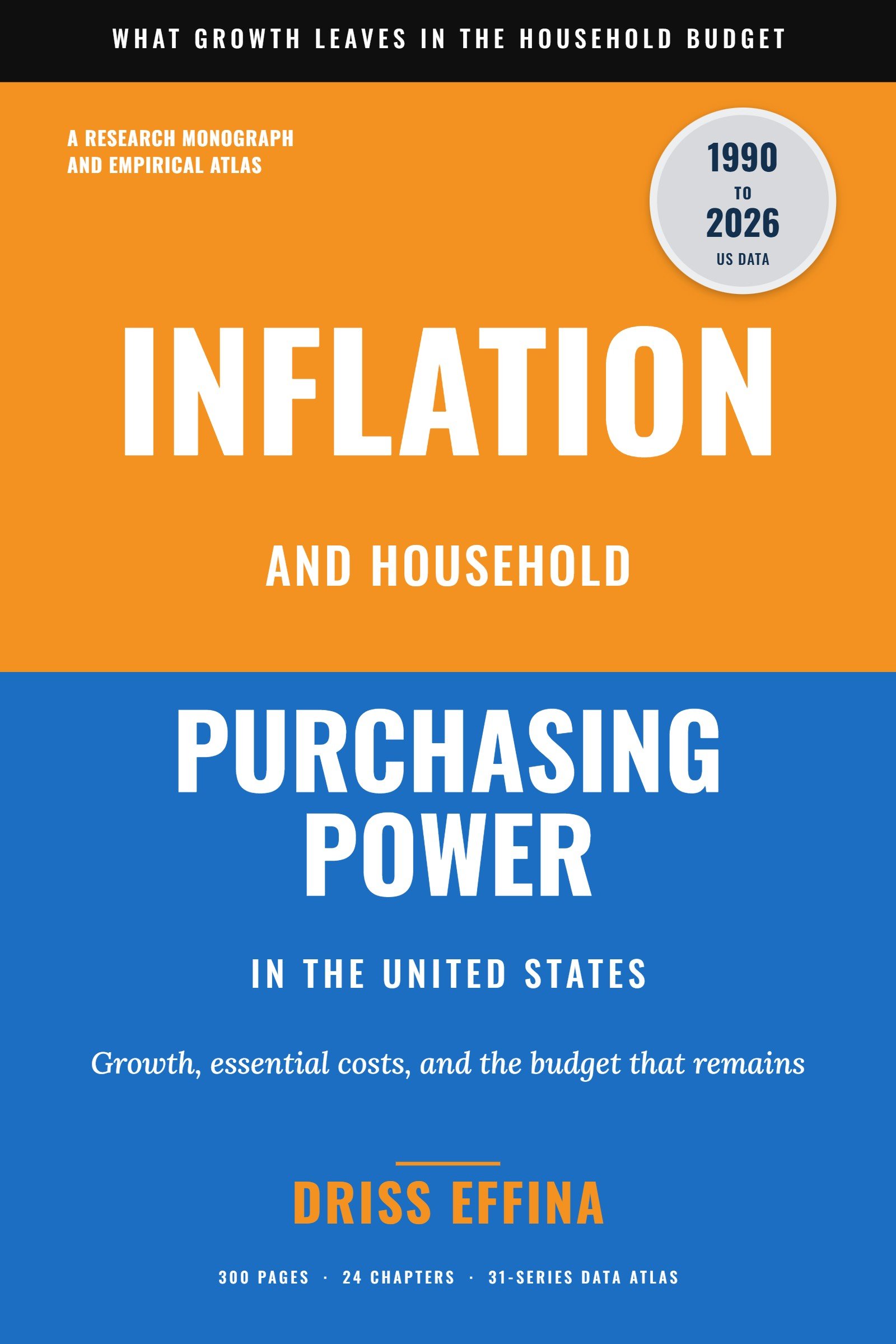
Real gross domestic product records production across the economy. A household pays its bills from a narrower stream of resources. In Inflation and Household Purchasing Power in the United States, Dr. Driss Effina asks how much command over goods and services remains once a household has met its commitments, and answers with verified public time series, reproducible econometric estimates and explicit household-budget scenarios.
The main monthly calendar runs from January 1990 to September 2026. The book keeps the economy, the resident, the employee and the consumer unit separate, and it distinguishes observed values, exact accounting identities, illustrative scenarios, conditional associations and forecast tests.
Selected Findings
- From December 2019 to September 2026, seasonally adjusted consumer prices rose 30.03 percent, while the selected gross weekly earnings proxy rose 37.50 percent. Real weekly earnings increased 5.75 percent.
- Real disposable income per capita increased 13.09 percent over the same period.
- An illustrative fixed essential basket rose 35.75 percent.
- At an 80 percent initial committed share, the scenario remainder fell 13.05 percent below baseline in June 2022, then recovered to 11.13 percent above baseline by September 2026. These are conditional scenarios, not population estimates.
- A one-factor pressure summary correlates weakly with consumer sentiment, and ridge forecasts do not outperform a zero-change benchmark.
Key Questions
- Why can national growth coexist with household financial pressure?
- How do the unit of analysis and the choice of price index change the answer?
- How do housing, food, energy and credit combine into one household budget?
- What remains of the budget after essential commitments, and when?
- What can national time series establish, and what requires linked household data?
Inside the Book
24 chapters, each with four analytical sections, a chart with interpretation and a numerical evidence table. The technical appendices hold a 31-series atlas, 37 annual evidence records, 25 local-projection horizons, technical methods, references and a glossary, so that readers can check the numerical claims without extracting values from charts.
Written for economists, policymakers, researchers, students and readers who want a careful, evidence-based account of inflation and household purchasing power.
Author: Dr. Driss Effina
Format: PDF eBook
Language: English
Length: 300 pages
Period covered: January 1990 to September 2026
Edition: First edition, November 2026
Read the front matter and Chapter 1 free (PDF, 16 pages)
This is a digital download. No physical book is shipped.






Reviews
There are no reviews yet.