More Income, Harder Choices?
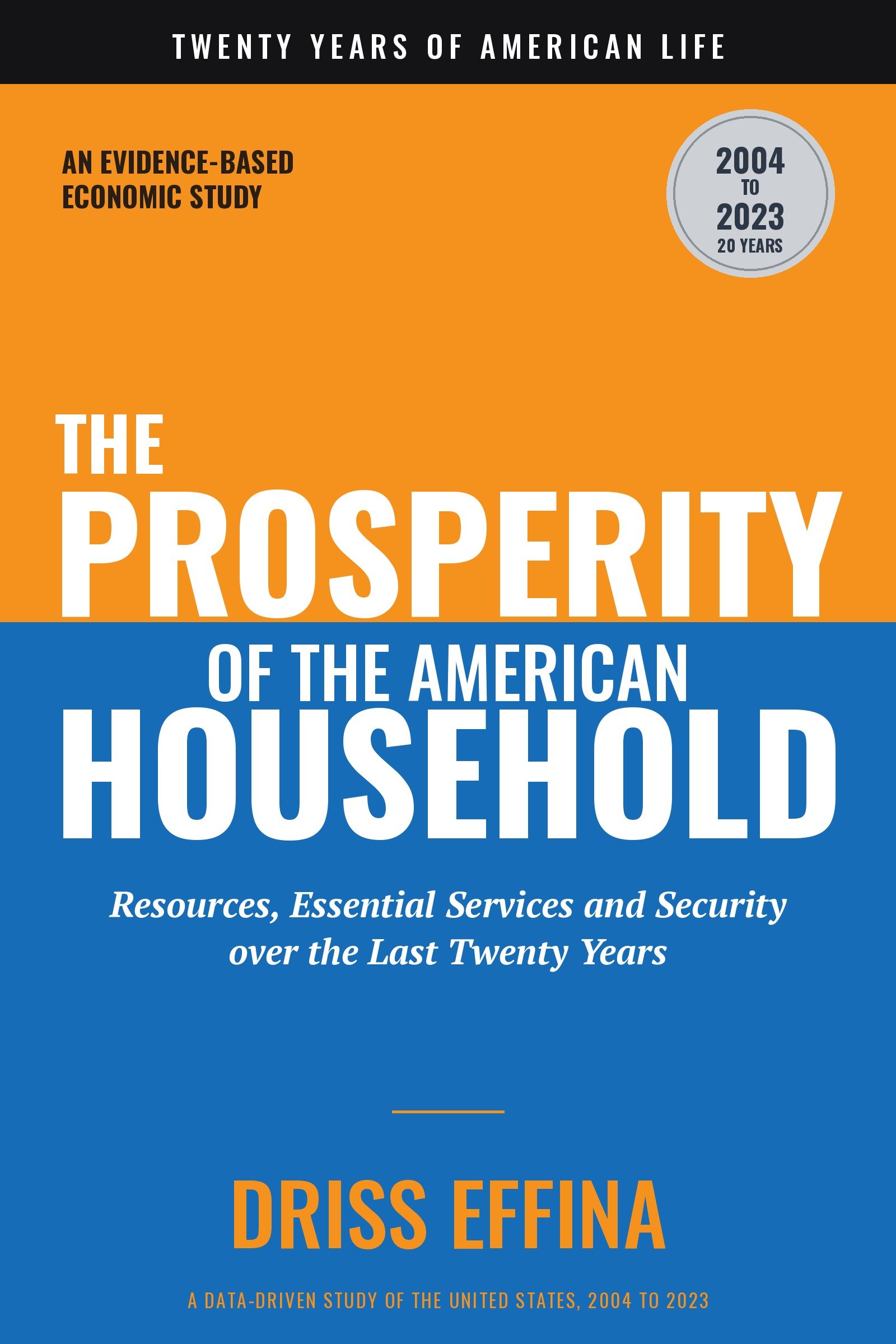
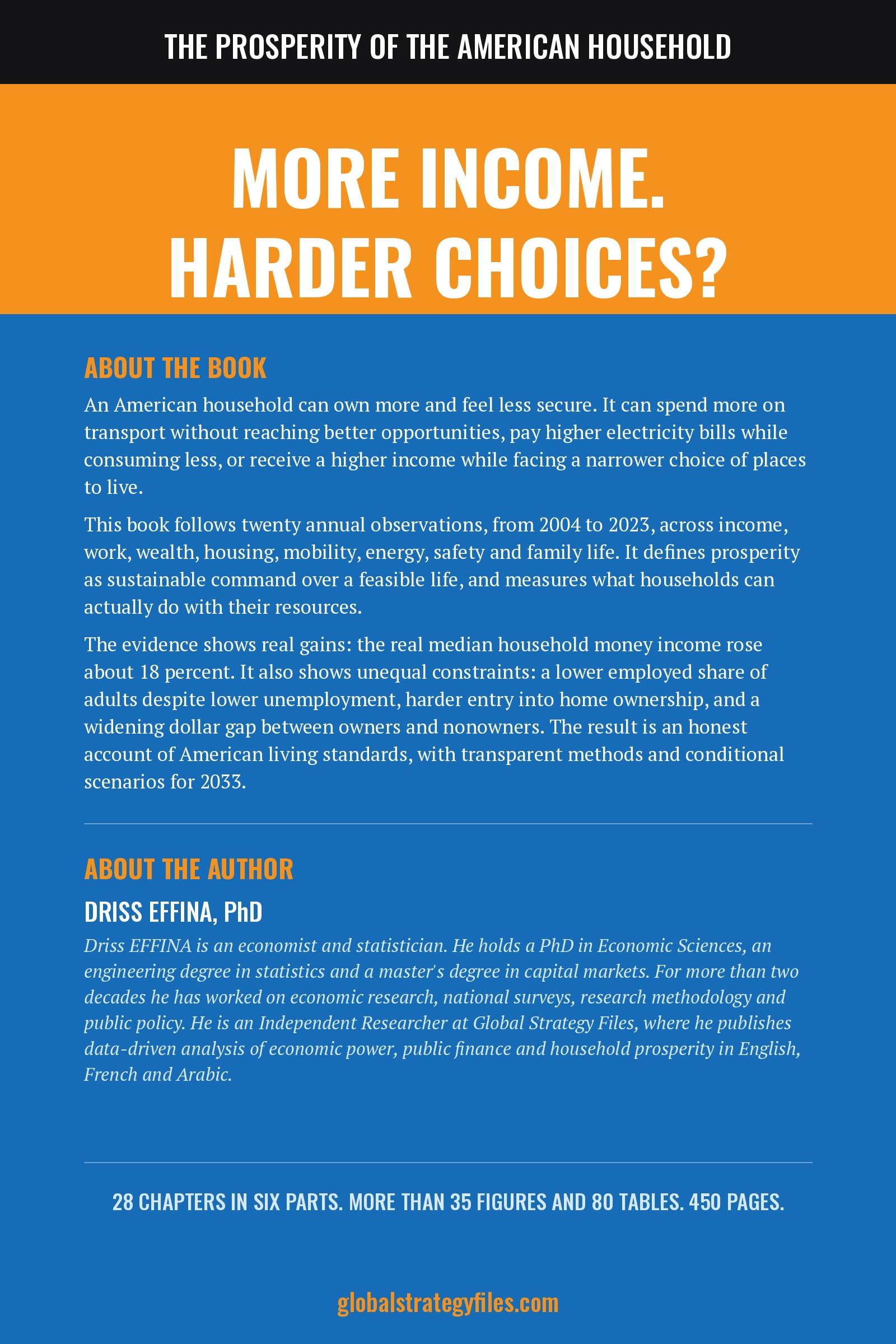
An American household can own more and feel less secure. It can spend more on transport without reaching better opportunities, consume less electricity while paying higher bills, or receive a higher income while facing a narrower choice of places to live. In The Prosperity of the American Household over the Last Twenty Years, Dr. Driss Effina asks what households can do with their resources, what they must commit to preserve ordinary life, and what happens when circumstances change.
The book studies twenty annual observations, from 2004 to 2023. It defines prosperity as sustainable command over a feasible life: resources, access to essential services, security and resilience. It does not treat prosperity as a synonym for gross domestic product, spending, ownership or happiness, and it keeps safety, autonomy and time visible beside material resources.
Selected Findings
- The real median household money income rose about 18 percent over the period, and the gain remains positive, at about 15 percent, under a strong bridge sensitivity test.
- Unemployment ended lower, while labor force participation and the employed share of the adult population ended lower too.
- Lower retail electricity purchases coexisted with higher bills and unequal hardship.
- Owners and nonowners both saw higher median wealth from 2019 to 2022, but the dollar gap between them widened.
- Advanced models sharpen the answer through both results and failures: precision and complexity do not justify a single prosperity score.
Key Questions
- Why does a higher national median not mean that the same household earns more?
- How do wages, wealth and liquidity determine how long a gain survives a shock?
- How do housing, transport and energy combine into one household constraint?
- What do safety, family transitions, children and care costs reveal about prosperity?
- What could prosperity look like in 2033 under explicit assumptions about resources, costs and shocks?
Inside the Book
Six parts and 28 chapters: defining and measuring household prosperity; resources, work and financial security; housing, mobility and energy services; safety, family formation and children; distribution, identification and integrated evidence; and forecast evaluation and conditional futures. Technical appendices record definitions, accounting identities, survey designs, identification strategies, fitted models and the replication workflow, followed by references and an analytical index.
Written for economists, policymakers, researchers, students and readers who want a rigorous, evidence-based account of American living standards.
Author: Dr. Driss Effina
Format: PDF eBook
Language: English
Length: 450 pages
Period covered: 2004 to 2023
Edition: First edition, October 2026
Read the preface and Chapter 1 free (PDF, 25 pages)
This is a digital download. No physical book is shipped.




Reviews
There are no reviews yet.