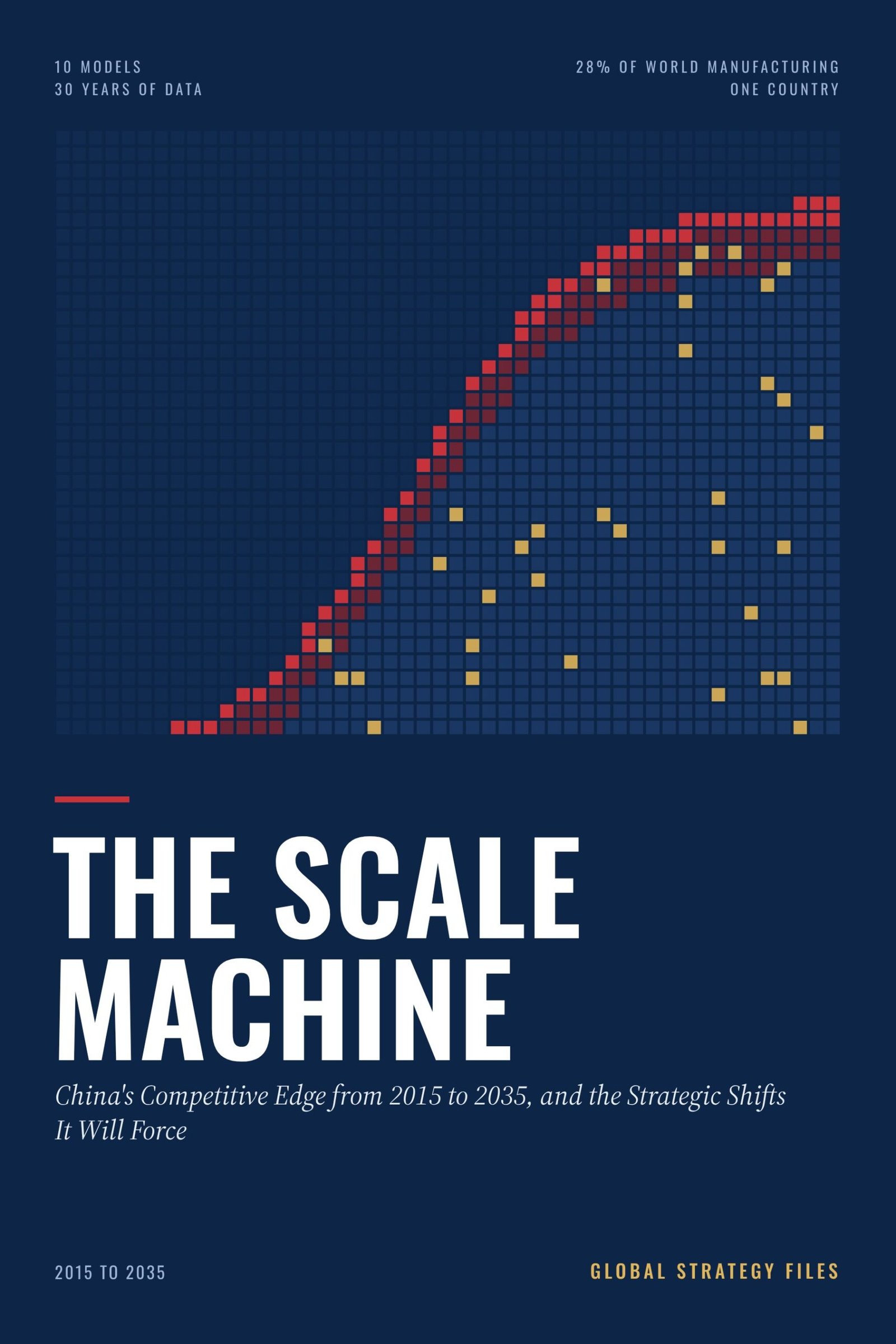
The Scale Machine: China’s Competitive Edge from 2015 to 2035, and the Strategic Shifts It Will Force
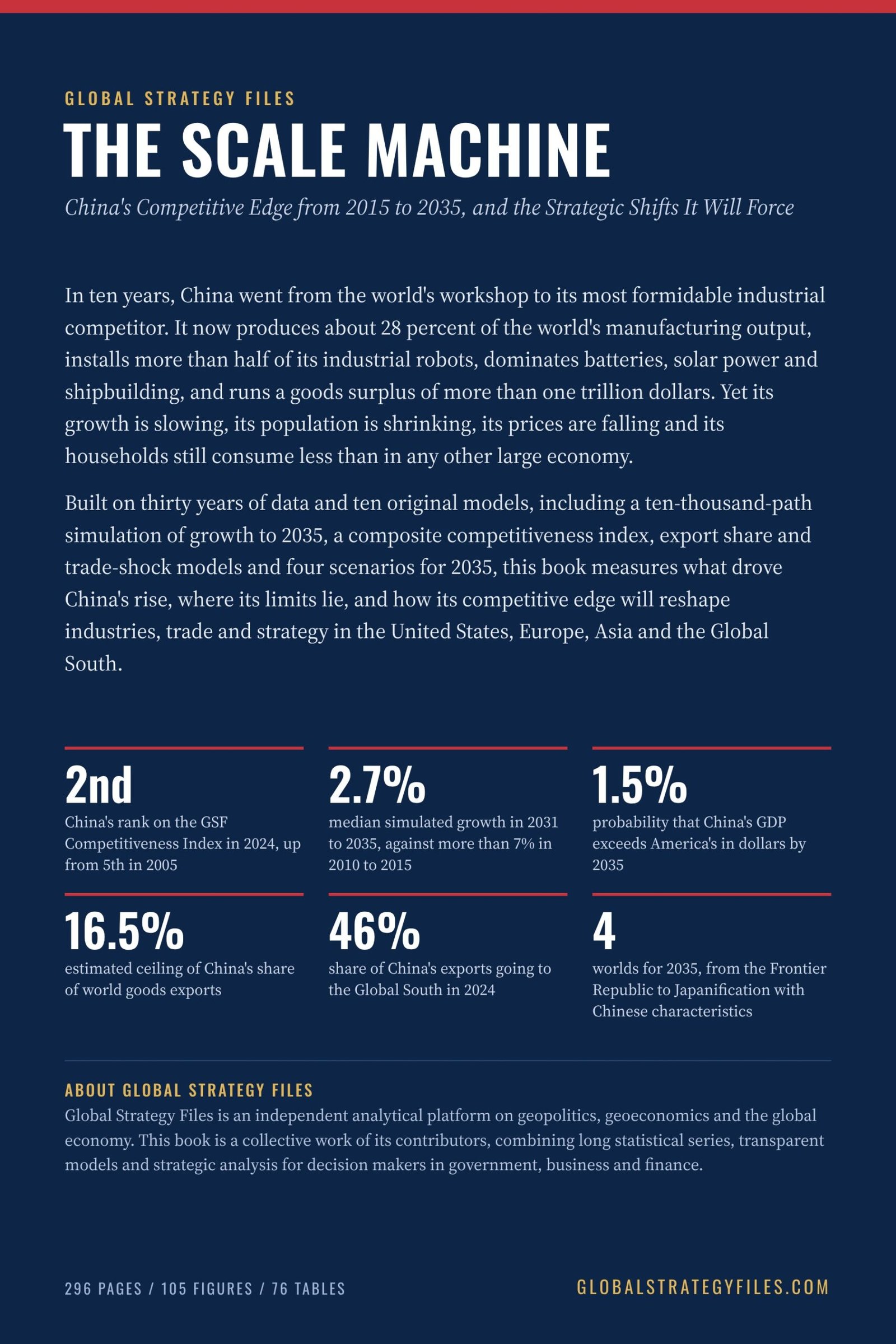
In ten years, China went from the world’s workshop to its most formidable industrial competitor. It now produces about 28 percent of the world’s manufacturing output, installs more than half of its industrial robots, dominates batteries, solar power and shipbuilding, and runs a goods surplus of more than one trillion dollars. Yet its growth is slowing, its population is shrinking, its prices are falling and its households consume less than in any other large economy. How long can the scale machine run, and what will it force the rest of the world to do?
This book answers with thirty years of data and ten original models. It measures what drove China’s rise from 2015 to 2025, identifies the fault lines that could erode its edge, and projects its competitiveness to 2035 under transparent, quantified assumptions.
What you will find inside
- The GSF Competitiveness Index: ten indicators in six pillars for eight economies, showing China rising from fifth to second place between 2005 and 2024.
- Ten thousand futures: a Monte Carlo growth model giving a median of 3.6 percent a year in 2026 to 2030 and 2.7 percent in 2031 to 2035, with full probability ranges.
- Export share and trade-shock models: a logistic ceiling near 16.5 percent of world exports, panel regressions, and tariff scenarios costing China between 0.2 and 1.1 percent of GDP.
- Four worlds in 2035: the Frontier Republic, the Fortress Factory, the Comfortable Plateau and Japanification with Chinese characteristics, with probabilities and signposts.
- Ten strategic shifts for China, the United States, the European Union, Japan, South Korea, Taiwan and the Global South.
- A sector atlas of 24 product groups, profiles of seven competing economies and ten Chinese firms, from BYD and CATL to Huawei, SMIC and Unitree.
Key facts
- 296 pages, PDF, 6 x 9 inches, first edition November 2026
- 27 chapters in five parts, an epilogue and twenty appendices
- 105 figures and 76 tables built on World Bank, IMF, Penn World Table, Atlas of Economic Complexity and United Nations data
- A collective work of the contributors of Global Strategy Files
Written for decision makers in government, business and finance who need a clear, quantified and independent view of the single most important structural force in the world economy of the 2020s.



Reviews
There are no reviews yet.