
After the Fire: Iran’s Post-War Futures

Structural Pressures, Regime Resilience, and Three Plausible Scenarios for the Islamic Republic (2026–2035)
Effina Driss, PhD
Independent Researcher in Geostrategy and Middle Eastern Affairs, Rabat, Morocco
ABSTRACT
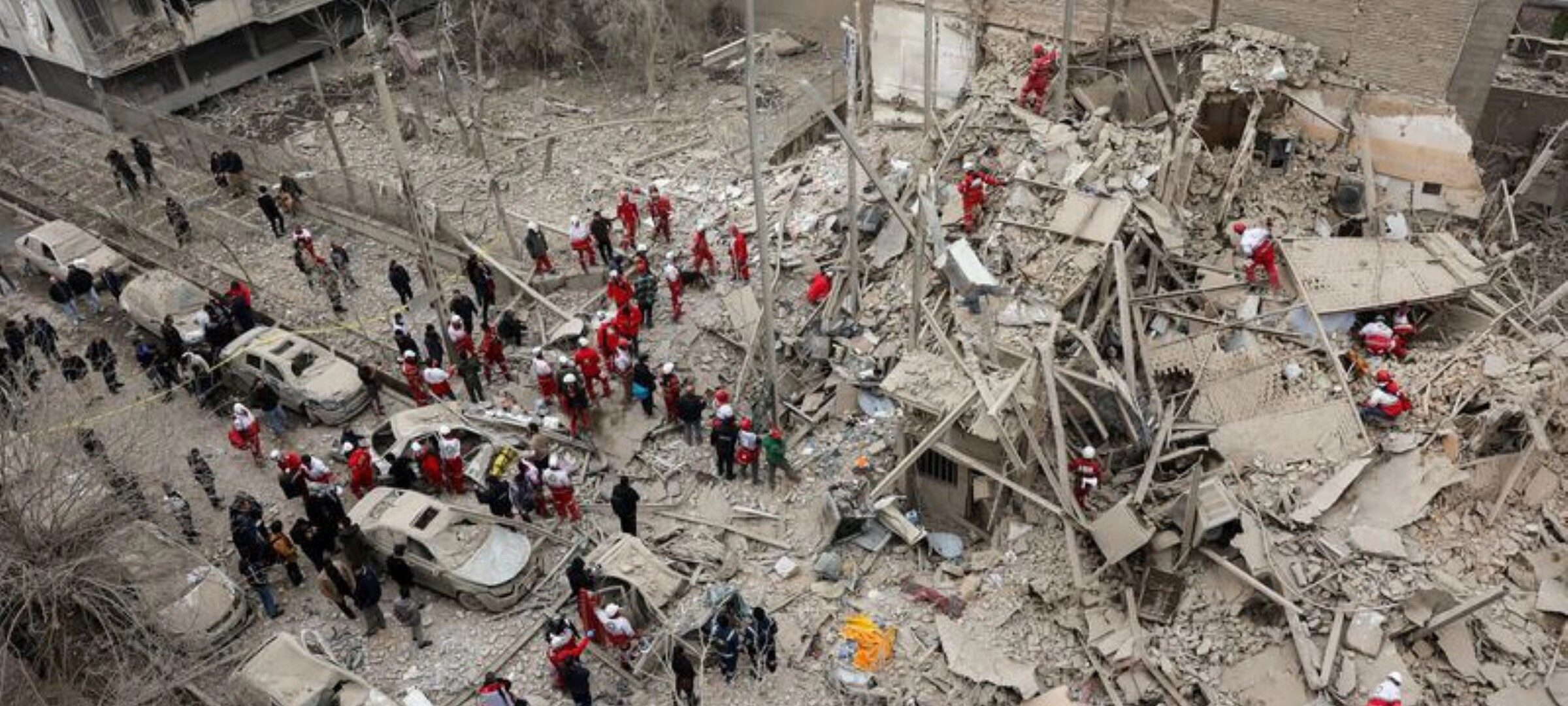
The 2026 Iran war — launched on February 28 by the United States and Israel — has inflicted unprecedented damage on the Islamic Republic: the assassination of Supreme Leader Ali Khamenei, the destruction of major military and nuclear infrastructure, the crippling of the Iranian navy, a near-total closure of the Strait of Hormuz, and the exposure of a population already exhausted by four decades of sanctions, protest, and economic collapse. As the conflict enters its third week, the question of Iran’s post-war political trajectory has become one of the most consequential open questions in contemporary international relations. This article analyzes three structurally plausible scenarios for Iran’s future: (1) regime survival and authoritarian reconsolidation under Mojtaba Khamenei and the Islamic Revolutionary Guard Corps; (2) negotiated transition toward a technocratic or semi-reformed Islamic Republic following a US-brokered deal; and (3) regime collapse and a protracted period of state fragmentation, civil conflict, and contested sovereignty. Drawing on structural indicators — institutional resilience, IRGC cohesion, opposition capacity, great-power interests, and the historical record of post-war political transitions — we assess the conditions under which each scenario becomes probable, their regional and global implications, and the policy frameworks they demand. We conclude that regime survival, though contested, remains the most structurally probable outcome in the near term, while the conditions for more transformative change will accumulate with or without external acceleration.
Keywords: Iran post-war; Islamic Republic futures; regime collapse; IRGC; political transition; Middle East 2026–2035; authoritarian resilience; nuclear deal; state fragmentation; geopolitical scenarios.
I. INTRODUCTION: THE DAY AFTER — IRAN’S OPEN HORIZON
Every major war generates, in its wake, a political vacuum whose contours are shaped by the interaction of military outcomes, institutional continuities, popular pressures, and the strategic interests of external actors. The 2026 Iran war is no different — except that it has done so in a nation of 90 million people, at the center of the world’s most energy-critical region, while a watching world debates whether what is unfolding is a liberation, a catastrophe, or both simultaneously.
The Islamic Republic of Iran was, before February 28, 2026, already a regime under profound structural stress. Decades of US-led sanctions had reduced the rial to a fraction of its former value; annual inflation was projected by the World Bank to approach 60 percent in 2026; the Woman, Life, Freedom movement of 2022–2023 had demonstrated the depth of popular alienation; and the January 2026 protest massacres — in which between 7,000 and 32,000 people were killed by security forces — had generated international condemnation of a scale not seen since the Syrian civil war.¹ The Twelve-Day War of June 2025 had already set back Iran’s nuclear program by an estimated two years, eliminated senior military commanders, and degraded the principal instruments of Iran’s regional power projection.
The 2026 campaign did not merely add to these accumulated pressures. It reorganized them. By killing Khamenei, the US-Israeli operation removed the single most important node of authority in the Islamic Republic’s institutional architecture — a figure who, unlike any president or prime minister, held both supreme religious and political authority, commanded the loyalty of the IRGC, and served as the ultimate arbiter of all inter-institutional conflicts. Whatever succeeds Khamenei will be structurally weaker, more contested, and less able to perform the functions that his authority previously discharged.
This article proceeds by first mapping the structural determinants of Iran’s political future (Section II). It then analyzes three scenarios in detail: authoritarian reconsolidation (Section III), negotiated transition (Section IV), and regime collapse and state fragmentation (Section V). Section VI assesses the comparative probability of each scenario and the conditions that would shift outcomes between them. Section VII addresses the geopolitical implications for regional and global order. Section VIII concludes.
II. STRUCTURAL DETERMINANTS OF POLITICAL FUTURES
2.1 The IRGC: The State Within the State
No analysis of Iran’s political future can avoid beginning with the Islamic Revolutionary Guard Corps. The IRGC is not merely the Islamic Republic’s most powerful military institution; it is the regime’s economic backbone, internal security apparatus, and ideological vanguard simultaneously. Through its Khatam al-Anbiya Construction Headquarters alone, the IRGC controls an estimated 30 to 40 percent of Iran’s formal economy — from telecommunications and energy to construction and pharmaceuticals. The Basij, the IRGC’s paramilitary auxiliary, provides the street-level coercive capacity through which the regime manages popular dissent.²
The critical variable for all three scenarios analyzed in this article is the internal coherence of the IRGC under sustained military pressure. The 2026 campaign has killed significant portions of the IRGC’s senior leadership — including former commander-in-chief Mohammad Pakpour and IRGC Aerospace Force commander Amir Ali Hajizadeh, eliminated during the Twelve-Day War. But the IRGC’s institutional design is explicitly engineered to survive leadership attrition: it is geographically distributed, ideologically homogenized, and economically self-sufficient in ways that make it far more resilient than the conventional military forces of comparable states. As Time Magazine noted, the IRGC ‘has been subjected to intense ideological vetting and institutional consolidation, expressly designed to produce the most committed defenders of the Islamic Republic.’³
2.2 The Succession Problem
The installation of Mojtaba Khamenei as supreme leader on March 8, 2026, resolved the immediate constitutional crisis while creating long-term legitimacy challenges. Mojtaba Khamenei lacks his father’s clerical credentials — he is not a Grand Ayatollah — which renders his religious authority within the Shia tradition structurally inferior to that of the institution he now heads. The concept of Velayat-e Faqih (Guardianship of the Jurist) requires that the supreme leader be a qualified jurist of the highest religious rank; Mojtaba’s elevation represents a significant departure from this foundational principle.⁴ This creates an opening for clerical opposition — particularly from Quietist scholars in Qom who have long questioned the political theology of the Islamic Republic — to challenge not merely the leader but the legitimacy of the system itself.
US Secretary of Defense Hegseth’s statement that the new supreme leader is ‘wounded and likely disfigured’ adds a further dimension of physical vulnerability and symbolic fragility. Whether accurate or not, the image of a wounded, unproven successor in a regime whose authority has rested heavily on the personal charisma and institutional presence of his father will shape both domestic perceptions and the IRGC’s calculations about whether to sustain or recalibrate its loyalty.
2.3 Society, Economy, and the Limits of Repression
Iran’s population in 2026 is younger, better educated, more globally connected through diaspora networks and social media, and more systematically alienated from the Islamic Republic than at any point since the Revolution. The January 2026 massacres represented not the quelling of a protest but its martyrdom — a transformation of grievance into permanent structural opposition. Even within the security forces, evidence of demoralization had emerged before the war: viral videos of police officers describing wages of $171 per month and contemplating selling organs captured a moment of institutional corrosion that no ideological training can easily reverse.⁵
The economic baseline from which Iran must recover is dire. The World Bank projected 60 percent annual inflation before the war began. The rial had already collapsed to historic lows. The war itself — with the Strait of Hormuz effectively closed, sanctions maintained at maximum pressure, and major energy infrastructure damaged or destroyed — adds multiple compounding shocks to an economy that had no fiscal buffer. Any post-war political settlement must contend with the reality that the material conditions of ordinary Iranian life will deteriorate further before they improve, regardless of which political trajectory obtains.
SCENARIO 1 Authoritarian Reconsolidation
3.1 The Logic of Regime Survival
The first and, in structural terms, most probable near-term scenario is the survival and reconsolidation of the Islamic Republic under a modified authoritarian arrangement. This scenario rests on a set of institutional realities that have proven remarkably durable across four decades and multiple existential challenges. The IRGC and Basij remain organizationally intact; no significant defection from the security apparatus has been documented at the unit level; and the new supreme leader, however weak his legitimacy credentials, has already received formal pledges of allegiance from the IRGC, the regular army, President Pezeshkian, and major state institutions.
The historical record of similar regimes under comparable external pressure is instructive. Neither Hamas nor Hezbollah collapsed following devastating military campaigns that killed their senior leadership and destroyed their infrastructure. The Ba’athist state in Syria survived eight years of civil war, foreign intervention, and chemical weapons use before the Assad regime’s fall in December 2025 — and its fall came not from external military pressure but from internal fragmentation of elite support. The Islamic Republic’s power structure is, if anything, more deeply institutionalized than Assad’s, with a broader economic base and a more sophisticated ideological apparatus.
As Brookings analysts observed: ‘Inside Iran, while the killing of Khamenei and other top officials has decapitated the regime, the incentives of each element of the regime have not meaningfully shifted.’⁶ The IRGC commands approximately 150,000 elite troops, extensive intelligence networks, and the economic resources to sustain its operations independently of the Iranian state budget. Its primary institutional interest is regime preservation — because regime collapse means not merely the loss of power but the risk of accountability for decades of internal repression and external operations.
3.2 The Path to Reconsolidation
Under this scenario, the Islamic Republic pursues a three-pronged strategy: (a) acceptance of a negotiated ceasefire on terms that can be framed domestically as strategic resilience rather than defeat; (b) accelerated internal repression of protest activity under the cover of wartime emergency powers; and (c) a long-term program of military and nuclear reconstitution, drawing lessons from the June 2025 and February 2026 campaigns about the vulnerabilities that enabled the attacks.
The ceasefire dimension is already visible. Iran’s foreign minister has signaled openness to negotiations while simultaneously insisting on Iran’s right to defend itself and maintaining the Hormuz closure as a coercive instrument. Trump has acknowledged that Iran ‘wants to make a deal.’ The Brookings analysis identifies what it terms a ‘Venezuela scenario’: a deal struck with whoever comes to replace Khamenei, ‘likely a modified nuclear deal plus some oil concessions.’⁷ For this scenario to obtain, the modified nuclear deal would need to be constructed in ways that allow the IRGC to maintain its fundamental coercive and economic power, which argues against the zero-enrichment demands that Trump’s envoys had articulated before hostilities.
On the nuclear dimension, the reconsolidation scenario implies a long-term covert program to restore breakout capacity, almost certainly relocated to hardened facilities not known to US and Israeli intelligence. The Defense Intelligence Agency’s preliminary (if contested) assessment that the June 2025 strikes set back Iran’s nuclear program by ‘only a matter of months’ — disputed by CIA Director John Ratcliffe but consistent with Iran’s demonstrated pattern of nuclear program resilience — suggests that the regime retains the institutional knowledge and political will to rebuild.
3.3 Implications of Scenario 1
An Iran that survives the 2026 war as an authoritarian reconsolidated state would be more dangerous, not less, than the pre-war Islamic Republic. It would have absorbed the lesson that external military pressure is survivable; it would have renewed motivation to develop a genuine nuclear deterrent as the ultimate guarantee against future decapitation strikes; it would have eliminated or reduced the moderating institutional voices — including whatever remained of the reformist current within the system — in favor of IRGC-dominated hardline governance; and it would have accumulated a generation of grievances against the United States, Israel, and the Gulf states that would drive strategic behavior for decades.
Regionally, a reconsolidated Iran would seek to rebuild its proxy network — likely with greater emphasis on decentralized, autonomous cells less vulnerable to the kind of leadership targeting that devastated Hezbollah and Hamas — while pursuing strategic partnerships with China and Russia as structural hedges against renewed US-Israeli pressure. The Hormuz card would remain permanently in play as an asymmetric coercive instrument, making any future escalation carry immediate global economic costs.
SCENARIO 2 Negotiated Transition and the ‘New Iran’
4.1 The Architecture of a Deal
The second scenario envisions a negotiated settlement between the United States, Israel, and a modified Iranian leadership that produces a qualitative transformation of the Islamic Republic — not through regime collapse but through institutionalized concessions that fundamentally alter the regime’s external behavior while preserving its domestic political architecture. This is what Axios analysts have termed the ‘Venezuela blueprint’: a functional model in which a modified regime, having accepted key US demands, is rewarded with sanctions relief and a degree of international rehabilitation.⁸
The structural conditions for this scenario are present, though precarious. Both the United States and Iran have signaled interest in negotiations: Trump acknowledged on March 11 that Iran ‘wants to make a deal’; Iranian Foreign Minister Araghchi had stated publicly in the days before the war began that a ‘historic agreement’ was ‘within reach.’ The Oman diplomatic channel — the most effective bilateral communication mechanism since the Obama-era back-channel — remains operational. The February 26 Geneva talks demonstrated that technical progress on nuclear issues was achievable.
The scenario’s core bargain would involve Iran accepting: (a) permanent limits on uranium enrichment, with robust IAEA verification; (b) constraints on the range and payload capacity of its ballistic missile program; (c) a significant reduction in financial and material support for proxy organizations; and (d) the release of US and dual-national detainees. In exchange, the United States would offer: phased sanctions relief restoring Iran’s access to frozen assets (estimated at over $100 billion); removal from the State Sponsors of Terrorism list; and implicit security guarantees against further decapitation strikes targeting the supreme leader.
4.2 The Obstacles: Domestic and Structural
The negotiated transition scenario faces formidable obstacles on both sides. Within Iran, the IRGC’s institutional interests are structurally incompatible with the kind of concessions the US demands. The IRGC’s economic empire is sustained by the sanctions environment that creates rent-seeking opportunities inaccessible under normal market conditions; its political power rests on the external threat framing that any genuine rapprochement would undermine; and its organizational identity is defined by resistance to US pressure. A leadership willing to accept the necessary concessions would face the risk of a coup or internal coup from IRGC factions whose interests are threatened by the deal.
On the US-Israeli side, the structural incompatibility of objectives creates its own obstacles. Israel’s strategic objective appears to be regime collapse rather than a modified deal; Israeli officials told CNN they are planning strikes on ‘thousands of targets over the next three weeks,’ a timeline and target set inconsistent with a near-term negotiated resolution. If the United States and Israel are not genuinely aligned on acceptable end-states — as Trump himself acknowledged when he said ‘our objectives may not be identical’ — then any negotiated framework faces the risk of Israeli sabotage through the continuation of strikes that undermine whatever diplomatic process is underway.
4.3 Conditions for and Implications of Scenario 2
For the negotiated transition scenario to obtain, several conditions must align: US domestic political pressure (driven by rising gasoline prices, military casualties, and economic disruption) must generate sufficient political costs to motivate a genuine search for a deal; Iran must produce a negotiating partner with sufficient authority to commit the IRGC to the terms of any agreement; and Israel must be persuaded or compelled to accept a diplomatic resolution rather than prosecuting the campaign to its maximalist conclusion.
An Iran that has accepted the negotiated transition bargain would be substantially less threatening to regional and global order in the near term. Sanctions relief would permit gradual economic recovery; nuclear restraint under verification would reduce the proliferation risk; and the reduction of proxy support would diminish Iran’s capacity to destabilize neighboring states. However, the scenario’s durability depends entirely on whether the deal’s terms are perceived by the Iranian security establishment as compatible with long-term survival — a calculation that will be revisited at every future crisis point. The nuclear knowledge cannot be unlearned; the missile production capacity can be reconstituted; and the regional ambitions that drove Iran’s proxy strategy will persist regardless of the deal’s terms.
SCENARIO 3 Regime Collapse and State Fragmentation
5.1 The Collapse Pathway
The third scenario — regime collapse and state fragmentation — is the most dramatic, the most historically consequential, and, in the near to medium term, the least structurally probable. It requires a conjunction of developments that, while individually possible, are unlikely to occur simultaneously: the internal fragmentation of the IRGC under sustained military pressure; the emergence of a sufficiently organized and nationally coordinated opposition movement capable of filling the political vacuum; and the absence of the kind of elite rallying that has historically enabled authoritarian regimes to survive existential crises.
The collapse scenario could unfold through two primary pathways. The first is internal military fragmentation: if IRGC units — particularly in ethnically distinct regions such as Kurdistan, Khuzestan, Baluchistan, and Azerbaijan — begin to prioritize local and ethnic loyalties over institutional loyalty to Tehran, central authority could dissolve rapidly. The precedents of Iraq in 2003 and Libya in 2011 are relevant: in both cases, the removal of a dominant authoritarian leader produced not democratic transition but competitive state collapse, characterized by the fragmentation of former regime structures into competing armed factions. The second pathway is a popular uprising that reaches the tipping point at which security forces begin to defect in significant numbers — the dynamic that ultimately ended the Iranian Shah’s regime in 1979 and drove the rapid collapse of authoritarian governments across the Arab world in 2011.
5.2 Against Rapid Collapse: Structural Counterarguments
The structural case against rapid collapse is compelling. As Time Magazine assessed: ‘The Iranian government is unlikely to collapse. It is a vast and deeply institutionalized network sustained by oil revenues and extensive economic and political relationships built up over decades.’⁹ The IRGC represents not merely a military force but a social institution — a network of families, dependencies, and ideological commitments that extends into every Iranian province. Its economic interests, which include vast real estate holdings, manufacturing concerns, and financial institutions, create a class of stakeholders whose material survival depends on regime continuity.
Moreover, the opposition faces the structural challenge that has defeated every previous Iranian reform and revolution movement since 1979: fragmentation. There is no unified opposition leadership, no agreed political program, no single charismatic figure capable of commanding cross-ethnic and cross-ideological loyalty. The diaspora opposition — whose energy and resources could theoretically support an internal uprising — is divided between monarchists, reformists, secular democrats, Marxists, and Islamists in ways that preclude effective coordination. Trump’s explicit dismissal of the idea of arming Kurdish militias — his statement that he had ‘ruled out sending the Kurds to Iran’ — removes one potential external catalyst for regime destabilization in the north and northwest.
5.3 Conditions for Collapse and Its Consequences
The collapse scenario becomes structurally more probable under the following conditions: a prolonged campaign (beyond three months) that degrades IRGC coercive capacity below the threshold required for internal security; simultaneous popular uprising in multiple provinces with sufficient organizational coherence to deny the regime the space for selective repression; and the emergence of a credible alternative political authority — whether a transitional council, a military figure willing to defect, or an internationally recognized exile government — capable of offering security force members an exit from the regime that does not entail accountability for past crimes.
The consequences of Iranian state fragmentation would be catastrophic in scale and duration. Iran’s ethnic geography — with significant Kurdish, Azeri, Arab, and Baluch minorities concentrated in border regions contiguous with neighboring states — creates conditions for proxy interventions by Turkey, Azerbaijan, Iraq, Saudi Arabia, Pakistan, and Russia that would replicate the Syrian model of sustained multi-actor conflict. The nuclear dimension adds a further layer of existential risk: the fragmentation of state authority over Iran’s enriched uranium stockpile — whose location is partially known to the US but may be partially unknown following pre-strike relocation — would create proliferation risks of the highest order, potentially involving transfers to non-state actors or third-party states.
The humanitarian consequences would be commensurately severe. A population of 90 million, already stressed by years of sanctions and economic crisis, confronting simultaneous military destruction, institutional collapse, and competing armed factions, would generate a refugee and displacement crisis dwarfing anything the Middle East has previously experienced. UN and humanitarian agencies — already strained by simultaneous crises in Gaza, Sudan, and Ukraine — would lack the resources to respond at scale.
VI. COMPARATIVE PROBABILITY ASSESSMENT
Scenario analysis requires not merely the identification of plausible trajectories but an honest assessment of their relative probability under current conditions. Table 1 summarizes the key determinants of each scenario’s likelihood across a 2026–2030 time horizon.
Scenario 1 (Authoritarian Reconsolidation): Near-term probability MODERATE TO HIGH (60–70%). The structural resilience of the IRGC, the rapid institutional response to Khamenei’s death, and the historical record of comparable regimes under external pressure all favor regime survival. The primary risks to this scenario are IRGC internal fragmentation — for which there is currently no documented evidence — and a sustained military campaign of sufficient duration to degrade institutional coercive capacity below operational thresholds. The Trump administration’s stated preference for a short war and its evident reluctance to commit ground forces creates a military ceiling that is likely insufficient to produce regime collapse.
Scenario 2 (Negotiated Transition): Near-term probability MODERATE (25–35%). The conditions for a negotiated deal are present but fragile: both parties have signaled interest, but the structural incompatibility of Israeli and US objectives, the IRGC’s institutional resistance to the necessary concessions, and the domestic political constraints on both the US and Iranian sides create significant obstacles. This scenario becomes more probable as the economic costs of the Hormuz closure accumulate, generating political pressure on Trump from domestic audiences and allied governments.
Scenario 3 (Regime Collapse/State Fragmentation): Near-term probability LOW (5–15%), rising to MODERATE (25–35%) over a 5–10 year horizon if Scenario 1 obtains and fails to address the underlying structural pressures. The structural barriers to rapid collapse are substantial; however, the combination of accumulated economic crisis, military damage, legitimacy deficit, and population exhaustion creates conditions in which a triggering event — a dramatic military defeat, an IRGC massacre of unacceptable scale, or the emergence of a credible opposition leadership figure — could produce a non-linear transition that structural analysis systematically underestimates.
VII. REGIONAL AND GLOBAL IMPLICATIONS
7.1 The Gulf After Iran
All three scenarios carry profound implications for the Gulf states, whose security architecture has been organized since 1979 around the management of Iranian power. Under the reconsolidation scenario, Gulf states face a more militarized and nuclear-motivated Iran, necessitating both continued US security guarantees and the development of independent deterrence capabilities that will drive proliferation pressures across the region. Saudi Arabia’s own nuclear ambitions — which its leadership has explicitly linked to Iranian capabilities — would gain new urgency.
Under the negotiated transition scenario, Gulf states would need to reckon with an Iran partially rehabilitated into the international system — a development that some, particularly the UAE and potentially Oman, might welcome as enabling a return to the détente approach that characterized UAE-Iran relations in the early 2020s, but that Saudi Arabia and Israel would view with deep suspicion. The ‘new detente’ question — whether Gulf states choose to confront, contain, or accommodate a post-war Iran — is identified by Atlantic Council experts as one of the central uncertain variables in the regional order.¹⁰
7.2 The China-Russia Dimension
The 2026 war has accelerated a structural shift in Iran’s great-power alignments that will shape all three scenarios. China’s preferential access to Iranian oil — with Iranian authorities reportedly permitting Chinese-flagged vessels to transit the Strait even as it is closed to all other shipping — and the possibility of yuan-denominated energy transactions represent a strategic deepening of the Sino-Iranian relationship with consequences for both the regional order and the dollar’s role in global energy markets. Russia, while rhetorically condemning the US-Israeli strikes, has shown ‘little interest in intervening on Iran’s behalf’ — a stance that reflects Moscow’s complex interests in a weakened but surviving Iran that continues to absorb US strategic attention.
Under the reconsolidation scenario, Iran would deepen its strategic alignment with both China and Russia, creating a more formally institutionalized axis of anti-Western powers that would challenge US regional leadership far more systematically than the pre-war Islamic Republic did. Under the collapse scenario, China and Russia would compete with the United States, Turkey, and Gulf states for influence over successor entities in a fragmented Iran — a competition whose geopolitical stakes would dwarf those of comparable proxy competitions in Syria, Libya, or Iraq.
7.3 The Nuclear Proliferation Horizon
Perhaps the most consequential long-term implication of all three scenarios is their impact on the global nuclear non-proliferation architecture. The 2026 war has demonstrated — irrespective of its outcome — that states that had advanced toward the nuclear threshold and accepted diplomatic constraints remained vulnerable to preemptive military action that diplomatic progress could not prevent. The lesson drawn by potential nuclear aspirants in Pyongyang, Riyadh, Ankara, Cairo, and beyond is that the US security guarantee is conditional, that diplomatic engagement is instrumentally manipulated rather than strategically sincere, and that the ultimate guarantee of regime survival against US military action is a credible nuclear deterrent.
This demonstration effect — regardless of whether Iran itself reconstitutes its nuclear program — may prove to be the 2026 war’s most durable and most dangerous legacy.
VIII. CONCLUSION: LIVING WITH UNCERTAINTY
The Islamic Republic of Iran stands, in March 2026, at the most consequential juncture in its history since the Islamic Revolution of 1979. The physical damage of the US-Israeli campaign is severe; the political damage is potentially irreversible; the economic damage will compound for years regardless of when the shooting stops. And yet the Islamic Republic has not fallen. Its institutions, however battered, continue to function; its security forces, however demoralized, continue to repress; and its new supreme leader, however weak his legitimacy credentials, has received the formal oaths of allegiance that the constitutional system requires.
The three scenarios analyzed in this article are not mutually exclusive across time. Iran could experience a period of authoritarian reconsolidation that, having failed to address underlying structural pressures, gives way to a negotiated transition a decade hence; or that reconsolidation could produce the accumulated grievances that eventually trigger the popular uprising the January 2026 massacres nearly achieved but did not. The trajectories are not predetermined. They are shaped by the decisions of actors — Iranian, American, Israeli, Gulf Arab, Russian, Chinese — whose calculations are themselves shaped by incomplete information, domestic political pressures, and the irreducible uncertainty of war.
What can be said with confidence is this: the fire that began on February 28, 2026 will not be fully extinguished by any ceasefire. The questions it has placed before the Iranian people — about sovereignty, about theocracy, about the relationship between a regime and its nation — are questions that 90 million people will continue to answer, in their daily lives, their political choices, and their willingness or refusal to continue sustaining a system that has failed them in almost every material dimension. The war may end. The Iranian question will not.
NOTES
1 HRANA, ‘Crimson Winter Report: Fifty Days of Protest Killings in Iran,’ February 23, 2026; UN Special Rapporteur on Human Rights in Iran, Statement, January 22, 2026; The Sunday Times, January 17, 2026.
2 Clingendael Institute, ‘The IRGC’s Political Economy,’ March 2025; Saeid Golkar, Captive Society: The Basij Militia and Social Control in Iran (New York: Columbia University Press, 2015).
3 Time Magazine, ‘Why the War with Iran Could Be a Long One,’ March 13, 2026.
4 For the theological dimensions of Velayat-e Faqih and its contested application, see Hamid Dabashi, Theology of Discontent: The Ideological Foundation of the Islamic Revolution in Iran (New York: New York University Press, 1993); Ervand Abrahamian, Iran Between Two Revolutions (Princeton: Princeton University Press, 1982).
5 Iran International, ‘Bruised but Undeterred: Iran Braces for More Risks in 2026,’ January 5, 2026; video reports of Iranian police officers circulated on social media, January 2026.
6 Brookings Institution, ‘After the Strike: The Danger of War in Iran,’ February 28, 2026.
7 Brookings Institution, ‘After the Strike,’ February 28, 2026; Axios, ‘5 Scenarios for Ending the Iran War,’ March 11, 2026.
8 Axios, ‘5 Scenarios for Ending the Iran War,’ March 11, 2026; for the Venezuela precedent, see Reuters, ‘US Forces Arrest Maduro, Install Rodríguez as Interim Leader,’ January 2026.
9 Time Magazine, ‘Why the War with Iran Could Be a Long One,’ March 13, 2026.
10 Atlantic Council, ‘Twenty Questions (and Expert Answers) About the Iran War,’ March 11, 2026.
11 Dr. Mohamed Chtatou, ‘Iran and Probable Collapse of Mullah Regime: Structural Pressures, Regime Resilience, and Future Scenarios (2026–2030),’ Eurasia Review, January 20, 2026.
REFERENCES
Abrahamian, Ervand. Iran Between Two Revolutions. Princeton: Princeton University Press, 1982.
Atlantic Council. ‘Twenty Questions (and Expert Answers) About the Iran War.’ March 11, 2026.
Axios. ‘5 Scenarios for Ending the Iran War.’ Athens Times (citing Axios), March 11, 2026.
Brookings Institution. ‘After the Strike: The Danger of War in Iran.’ February 28, 2026.
Chtatou, Mohamed. ‘Iran and Probable Collapse of Mullah Regime: Structural Pressures, Regime Resilience, and Future Scenarios (2026–2030).’ Eurasia Review, January 20, 2026.
Clingendael Institute. ‘The IRGC’s Political Economy and the Islamic Republic’s Resilience.’ The Hague, March 2025.
CNN. ‘What We Know on the 17th Day of the US and Israel’s War with Iran.’ March 16, 2026.
Dabashi, Hamid. Theology of Discontent: The Ideological Foundation of the Islamic Revolution in Iran. New York: New York University Press, 1993.
Golkar, Saeid. Captive Society: The Basij Militia and Social Control in Iran. New York: Columbia University Press, 2015.
House of Commons Library. ‘Iran: What Challenges Face the Country in 2026?’ Research Briefing CBP-10456. London, 2026.
Human Rights Activists in Iran (HRANA). ‘Crimson Winter: Fifty Days of Protest Killings in Iran.’ February 23, 2026.
Iran International. ‘Bruised but Undeterred: Iran Braces for More Risks in 2026.’ January 5, 2026.
Al Jazeera Centre for Studies. ‘On the Brink of War: US and Iranian Calculations in the New Negotiations.’ February 2026.
Middle East Institute. ‘Iran’s Axis of Resistance After the 12-Day War: Adaptation, Restructuring, and Reconstitution.’ December 2025.
Middle East Institute. ‘Iran’s Political Deadlock — and a Way Out the Regime Is Unlikely to Take.’ January 2026.
NPR. ‘Iran War: Costs and Casualties Two Weeks In.’ March 14, 2026.
Time Magazine. ‘Why the War with Iran Could Be a Long One.’ March 13, 2026.
UN Special Rapporteur on the Situation of Human Rights in the Islamic Republic of Iran. Statement on protest killings. January 22, 2026.
Wikipedia. ‘2026 Iran War.’ Last modified March 17, 2026.
Wikipedia. ‘2026 Iran Massacres.’ Last modified March 16, 2026.
Wikipedia. ‘Twelve-Day War.’ Last modified March 17, 2026.
World Bank. ‘Iran Economic Monitor.’ October 2025.
