
Russia’s Pyrrhic War

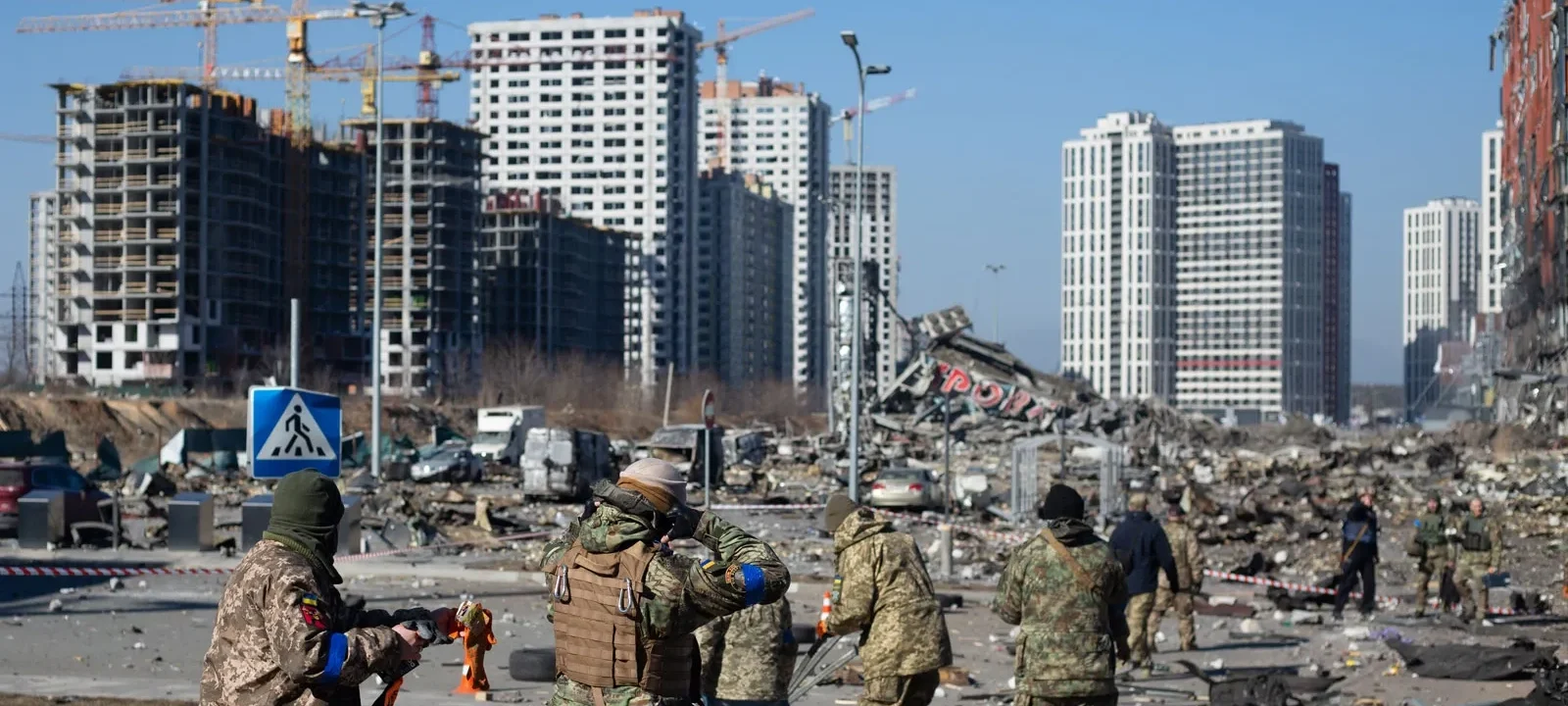
How Putin’s Ukraine Gamble Is Destroying the Country It Was Meant to Save
Driss EFFINA, PhD
Reading time: 12 minutes
Introduction: The War That Broke the Strategy
When Vladimir Putin ordered the full-scale invasion of Ukraine in February 2022, the Kremlin expected a swift operational victory: three days to Kyiv, a compliant government installed, NATO humiliated, and the post-Cold War order rewritten on Russian terms. Four years later, the war has produced the precise opposite of every stated objective.
NATO has expanded, not contracted. Ukraine has not been subjugated — it has been hardened into one of the most combat-experienced military forces in Europe. Russia’s international isolation has deepened. Its economy has been restructured around a war footing that is consuming resources at an unsustainable rate. And the demographic, technological, and industrial trends all point toward a Russia that emerges from this war structurally weaker than it entered.
The central strategic question of 2026 is not whether Russia will win in Ukraine. It is what Russia will look like when the war ends — and whether that Russia will be more or less dangerous than the one that started it.
I. The Military Reality: Attrition Without Decision
1.1 The human cost
Western intelligence assessments in early 2026 suggest Russian casualties — killed and seriously wounded — approaching 600,000. This figure, if accurate, represents a generational catastrophe. Russia’s professional military has been largely consumed and replaced by mobilized reservists with minimal training. The quality degradation is significant: the force that invaded Ukraine in 2022 was incomparably more capable than the force fighting today.
The territorial gains of 2024-2025 have been real but costly — measured in kilometers per thousands of casualties. The correlation between Russian sacrifice and Russian territorial gain is the worst in modern military history for a major power. Putin has traded a generation of men for strips of eastern Ukrainian steppe.
1.2 The technological gap
Perhaps more consequential than the human cost is the technological trajectory. Russia entered the war with a legacy of Soviet-era military-industrial capacity that, while aging, was substantial. Four years of attrition, Western sanctions on semiconductor and precision manufacturing imports, and the extraordinary pace of Ukrainian drone warfare have exposed the limits of that inheritance.
Russia is now fighting a 1980s military against a 2025 adversary. Ukraine’s drone campaigns — targeting Russian logistics, command nodes, and energy infrastructure deep inside Russian territory — have demonstrated that modern warfare has fundamentally changed in ways that Russian doctrine has not adapted to. The gap will not close quickly, because the sanctions cutting Russia off from Western technology are not going away.
II. The Economic War: Resilience and Its Limits
2.1 Sanction-proofing — and its costs
Russia’s economic performance since 2022 has surprised many Western analysts. GDP has not collapsed. The ruble has stabilized. Unemployment remains low. The Kremlin has successfully redirected trade from Europe to China, India, and the Gulf — maintaining export revenues and import capacity through alternative channels.
But this resilience has come at enormous cost. The Russian economy is now running a permanent wartime budget that is crowding out civilian investment. Interest rates at 16-21% are destroying the private sector. Inflation is eroding living standards in ways that official statistics do not fully capture. The long-term structural damage — to human capital through emigration, to industrial capacity through sanctions, to institutional quality through the militarization of the state — is severe and cumulative.
2.2 The dependency trap
Russia’s economic survival has come through a bargain with China that is becoming increasingly asymmetric. Chinese companies have replaced Western ones in Russian markets — but on Chinese terms, at Chinese prices, with Chinese leverage. Russian energy is sold to China at discounts that benefit Beijing far more than Moscow. Russian technology is increasingly sourced from China, creating dependencies that reduce Russian strategic autonomy precisely when Russia claims to be asserting it.
The post-war Russia that emerges from this war will be economically dependent on China in ways that fundamentally constrain its foreign policy options. This is not the outcome Putin sought. It is the outcome his war produced.
III. The Post-War Russia: Three Scenarios
3.1 Frozen conflict, frozen Russia
The most likely near-term scenario is a negotiated ceasefire that freezes the conflict along current lines of control — leaving Russia in control of approximately 18% of Ukrainian territory, with no formal recognition from Ukraine or the West, but with de facto possession. In this scenario, Russia claims a partial victory domestically, avoids further military humiliation, and begins a slow economic reconstruction.
The problem with this scenario for Russia is that the underlying dynamics do not change. NATO remains expanded. Ukraine remains independent and Western-oriented. Sanctions remain in place. The demographic and technological deficits compound. Russia has exchanged a failed war of conquest for a permanent geopolitical quarantine.
3.2 Escalation and the nuclear question
The most dangerous scenario is a Russian decision that conventional defeat is unacceptable — and that nuclear signaling, or even limited tactical nuclear use, is a preferable alternative to acknowledging failure. Putin has made repeated nuclear threats throughout the conflict. Western governments have modulated their Ukraine support partly in response to this signaling.
The risk is not zero. But it is probably lower than Western media coverage suggests. Nuclear use would produce Chinese condemnation, global economic catastrophe, and a NATO response whose scale and nature are deliberately ambiguous — all outcomes that the Russian leadership understands would be far worse than any conceivable outcome in Ukraine.
3.3 Internal fracture
The least discussed but potentially most transformative scenario is internal Russian instability. The Prigozhin mutiny of June 2023 — a Wagner Group march on Moscow that came closer to the Kremlin than any public analysis acknowledged — demonstrated that Putin’s control is not as absolute as it appears. Four more years of war casualties, economic deterioration, and elite dissatisfaction creates conditions in which the stability of the Putinist system is genuinely uncertain.
A post-Putin Russia is not necessarily a democratic Russia, or a peaceful Russia, or a Russia that abandons its territorial ambitions. But it is a Russia whose trajectory is genuinely open — and whose relationship with the West could, in certain scenarios, be reset in ways that the current impasse makes unimaginable.
Conclusion
Russia in 2026 is a country that has sacrificed its future on the altar of imperial nostalgia. The war in Ukraine has not restored Russian greatness — it has consumed it. The question for the international community is how to manage the consequences of a diminished, embittered, and nuclear-armed Russia that has lost a war it cannot acknowledge losing.
For the deepest analysis of how the Ukraine war fits into the broader collapse of the post-Cold War order, the books
The Biden Doctrine and
The Trump Prophecy — available at globalstrategyfiles.com — provide the essential strategic context.
