
The Price of Rearmament: Can Five Economies Afford 5 Percent of GDP for Defence by 2035?

The Price of Rearmament: Can Five Economies Afford 5 Percent of GDP for Defence by 2035?
Driss EFFINA, PhD Independent Researcher, Global Strategy Files Foresight, prospective note No. 2, 20 October 2026. Reading time: about 50 minutes
Key takeaways
- Reaching 3.5 percent of GDP on core defence by 2035 on a linear path costs the US, UK, France, Germany and Canada 2.04 trillion dollars over 2026 to 2035; the 1.5 percent resilience heading is largely already counted.
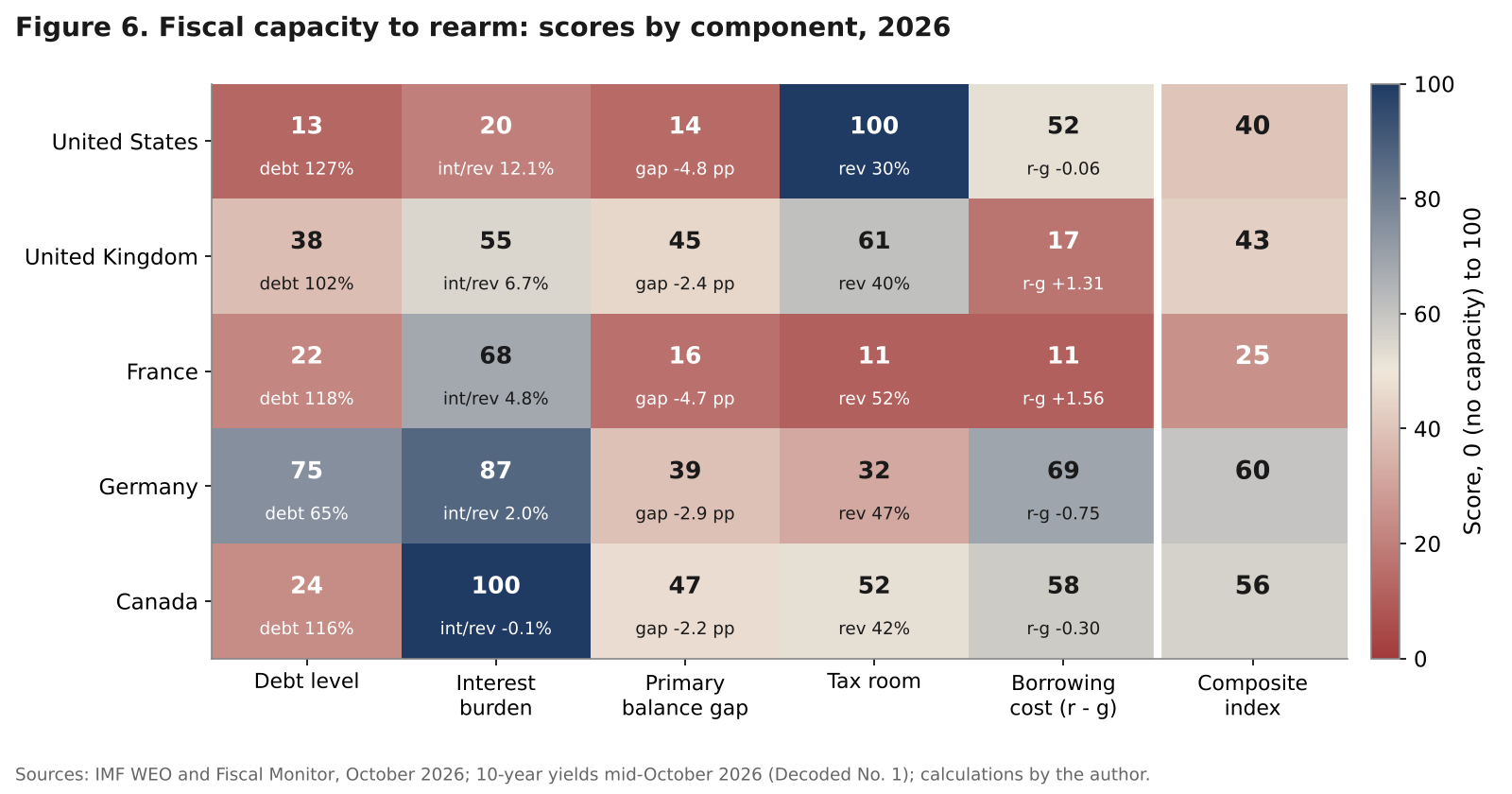
- Germany has the most fiscal room (60 out of 100 on the author’s index) and funded plans to 3.5 percent by 2029; France (25) and Canada, with unfunded plans and a historically unprecedented required pace, are most likely to miss.
- Rearmament explains 40 percent of Germany’s projected rise in debt to 2035 and absorbs 43 to 47 percent of the debt reduction otherwise projected in the UK and Canada, but only 1.6 points of GDP in the US.
- The binding constraint is industrial: if capacity grows 5 percent a year, defence inflation could cut the purchasing power of 2035 equipment budgets by 31 percent in France and 48 percent in Canada, while allies’ purchases from US suppliers reach about 234 billion dollars.
Abstract
At The Hague in June 2025, NATO allies committed to spend 5 percent of GDP a year by 2035: at least 3.5 percent on core defence and up to 1.5 percent on resilience. Sixteen months later, with Brent at 127 dollars a barrel and long-term yields at multi-decade highs, the question is whether the target is affordable. This note answers it for the United States, the United Kingdom, France, Germany and Canada with five original tools built from SIPRI, NATO and IMF October 2026 data: a year-by-year defence gap; a debt model with multipliers, import leakage and a risk premium; a fiscal capacity to rearm index; a measure of the peace dividend since 1990; and a capacity model of defence inflation. Reaching 3.5 percent on a linear path costs the five countries 2.0 trillion dollars over 2026 to 2035 compared with their 2025 effort. Germany is the only country whose funded plans cover its gap, and it has the most fiscal room. France has the least room and needs a pace of increase it achieved in only 2 of the past 35 years. Canada is furthest behind and would need to multiply its equipment spending by 2.6. The resilience half of the target is largely accounting; the binding constraint is industrial, not fiscal. All projections are the author’s.
Keywords: defence spending, NATO, public debt, fiscal multiplier, peace dividend, defence inflation, industrial capacity, fiscal space
JEL codes: H56, H62, H63, E62, F14
Key findings
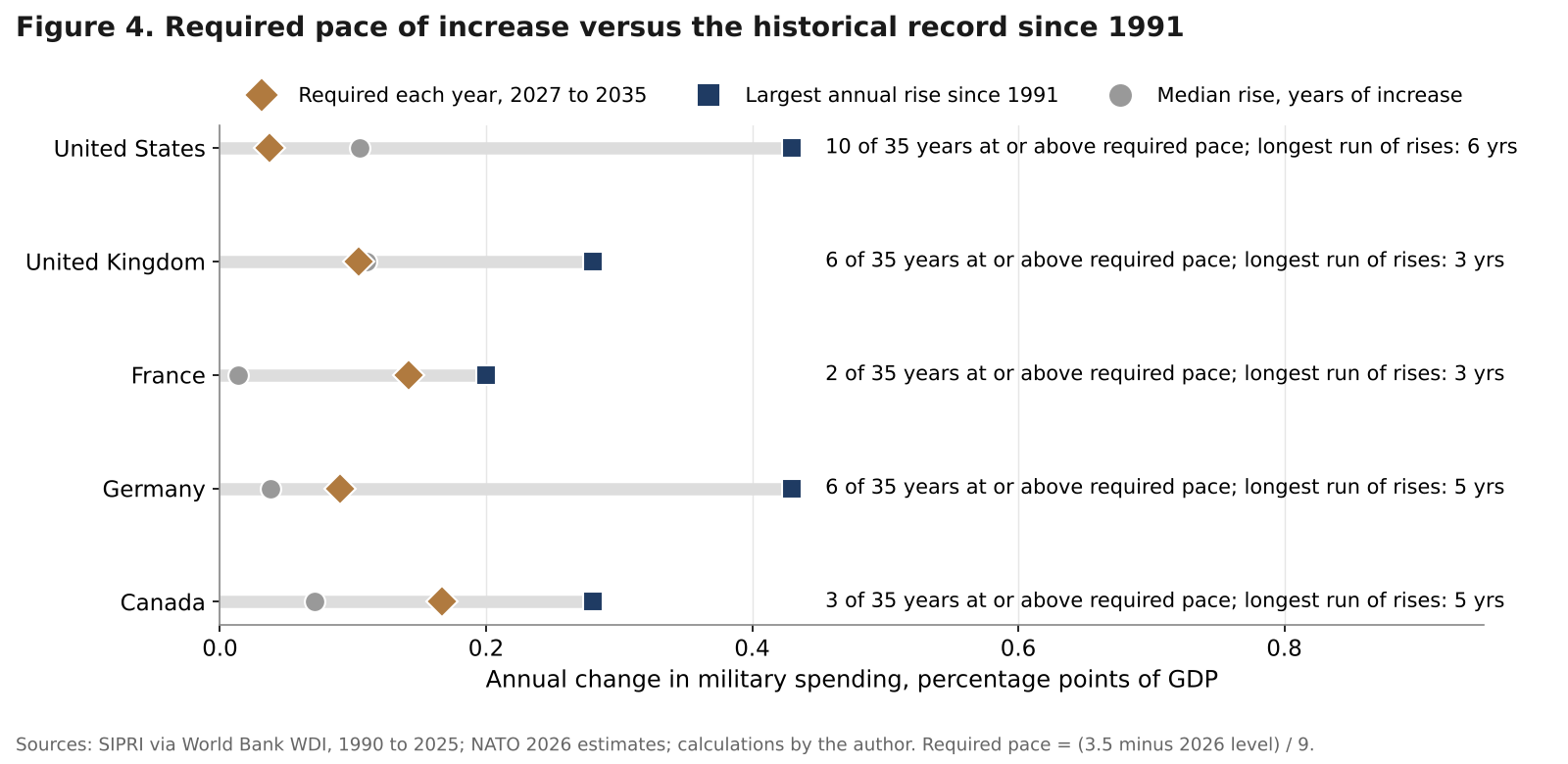
1. The real target is 3.5 percent, and its cost falls mostly on Europe and Canada. A linear path from 2025 levels to 3.5 percent of GDP costs the five countries 2.04 trillion dollars over 2026 to 2035, of which 1.41 trillion for the four allies other than the United States. The resilience heading adds little new spending: NATO already counts 1.4 percent of GDP of related spending for European allies and Canada in 2026. 2. Germany can afford it; France and Canada will probably miss it. Germany scores 60 out of 100 on the fiscal capacity index and its funded plans reach 3.5 percent by 2029. France scores 25, its plans cover 31 percent of its gap, and the required rise of 0.14 points of GDP a year has been achieved in only 2 of 35 years. Canada is already 0.16 points behind its path and its funded plans cover none of the gap. 3. Rearmament is a European debt story, not an American one. Under full compliance, rearmament adds 9.0 points of GDP to German debt by 2035, 40 percent of the projected rise. In the United Kingdom and Canada it absorbs 43 to 47 percent of the debt reduction otherwise projected. In the United States it adds only 1.6 points to a debt ratio heading to 164 percent of GDP for other reasons. 4. The peace dividend was large, and the target exceeds the Cold War in three countries. Spending less than in 1990 saved 62 percent of one year’s GDP in the United States, 52 percent in the United Kingdom and 40 percent in Germany over 1991 to 2025. Yet 3.5 percent is above 1990 levels in France, Germany and Canada. 5. Factories, not bond markets, are the binding constraint. Canada and France must raise real equipment purchases by 12.0 and 8.9 percent a year. If capacity grows by 5 percent a year, excess defence inflation of 6.7 and 3.7 percent a year would cut the purchasing power of their 2035 equipment budgets by 48 and 31 percent. Buying abroad instead would send about 234 billion dollars to US suppliers over ten years, almost half of the United States’ own extra core spending.
1. Introduction
For three decades, Western democracies financed part of their welfare states, tax cuts and deficits by spending less on defence. The 5 percent commitment made at The Hague on 25 June 2025 ends that era. It arrives when public debt exceeds 100 percent of GDP in four of the five economies studied here, when bond yields have risen sharply after the outbreak of war with Iran in early 2026, and when ageing is pushing up pension and health spending.
Commentary has followed two lines. One treats the target as a political number, unlikely to be met and therefore of little economic relevance. The other multiplies 5 percent by GDP and declares a fiscal shock of historic size. Both miss what matters. The target is a path, not a level; it starts from very different points; it is partly covered by plans already in official projections; it can be financed in ways with very different effects; and it runs into physical limits on how fast shells, missiles and armoured vehicles can be produced.
This note builds five tools. The first measures the defence gap, year by year from 2026 to 2035, in percent of GDP and in dollars, and the part not covered by funded plans. The second is a debt model that converts the gap into 2035 debt ratios under different financing choices, multipliers and import shares. The third is an index of fiscal capacity to rearm. The fourth compares the target with 1990 and measures the peace dividend. The fifth measures the industrial constraint: how fast equipment purchases must grow, how much would turn into higher prices, and how much would leak to US suppliers.
The answer to the question in the title is a qualified yes on money and a qualified no on capability. The sums are smaller than headlines suggest, but only Germany is on a funded path, and the main risk is not the bond market but the factory floor.
2. The commitment and where each country stands
2.1 What was agreed in The Hague
The Hague Summit Declaration commits allies to invest 5 percent of GDP annually on core defence requirements and defence- and security-related spending by 2035. At least 3.5 percent must go to core defence as defined by NATO. Up to 1.5 percent may be spent to protect critical infrastructure, defend networks and ensure civil preparedness and resilience. Allies submit annual plans showing “a credible, incremental path”, and the trajectory and balance of spending will be reviewed in 2029. Contributions to Ukraine’s defence and defence industry are included.
Three features matter for the economics. The target applies to 2035, not to the years before it. The resilience heading is loosely defined, so existing spending can be counted under it. And the 2029 review gives every government a chance to revise the path just before most of the increase would have to happen.
2.2 The 2026 situation and national plans
NATO estimates published on 7 July 2026, ahead of the Ankara summit, put core defence spending in 2026 at 3.17 percent of GDP in the United States, 2.69 percent in Germany, 2.56 percent in the United Kingdom and 2.22 percent in France. European allies and Canada together spend 2.53 percent on core defence and 1.40 percent on related items. Five allies (Lithuania, Estonia, Latvia, Poland and Greece) already exceed 3.5 percent. Canada reached 2.0 percent in fiscal year 2025-26 after more than 9 billion Canadian dollars of extra spending announced in June 2025; no separate NATO figure for Canada in 2026 was found, and this note assumes 2.0 percent.
| Country | NATO 2025 (% GDP) | NATO 2026 (% GDP) | Official plan | Financing approach |
|---|---|---|---|---|
| United States | 3.22 | 3.17 | FY2027 request of 1.5 trillion dollars (1.15 trillion base plus 350 billion via reconciliation), not enacted | No offsets; about 73 billion dollars of non-defence cuts proposed |
| United Kingdom | 2.40 | 2.56 | 2.6% by 2027; Defence Investment Plan 2.7% to 2029-30; 3% an ambition; 3.5% by 2035 | About half from other departments’ capital budgets, a third unfunded |
| France | 2.05 | 2.22 | Programming law updated 1 July 2026: 436 billion euros over 2024 to 2030, about 2.5% in 2030 | EU fiscal rules; 15.09 billion euros of SAFE loans |
| Germany | 2.22 | 2.69 | 3.5% by 2029 | Defence above 1% of GDP exempt from the debt brake |
| Canada | 2.01 | 2.00 (assumed) | 2.5% core by 2030 and 3.5% by 2035 committed | Debt in PBO analysis; no published fiscal path |
Table 1. Defence spending in 2025 and 2026 and official plans. Sources: NATO (June 2025 report; estimates of 7 July 2026 as reported by Reuters); CSIS; IFS; Assemblee nationale; Ifri; Noerr; OSW; Parliamentary Budget Officer of Canada; IRIS.
The plans differ sharply in how much is financed. The US request would raise defence outlays to 3.6 percent of GDP in 2027 and 3.7 percent in 2028, according to CSIS, putting the United States above the core target within a year. But the House defence appropriations bill carries about 1.07 trillion dollars, both budget resolutions allow only 60 billion dollars for defence through reconciliation, and the government is funded by a continuing resolution to 11 December 2026. A supplemental request of 87.6 billion dollars, mostly for operations against Iran, has not been enacted. The UK Defence Investment Plan of June 2026 adds an average of 3.8 billion pounds a year over four years; the Institute for Fiscal Studies estimates that 3.5 percent by 2035 would need about 25 billion pounds a year more. The French law brings spending to about 2.5 percent of GDP in 2030; as Ifri notes, doubling the budget in euros since 2017 is far from doubling the effort, which would mean about 3.6 percent of GDP. Germany is the outlier: the constitutional amendment of March 2025 exempts defence spending above 1 percent of GDP from the debt brake, and the budget framework reaches 3.5 percent by 2029.
2.3 Two yardsticks, one awkward gap
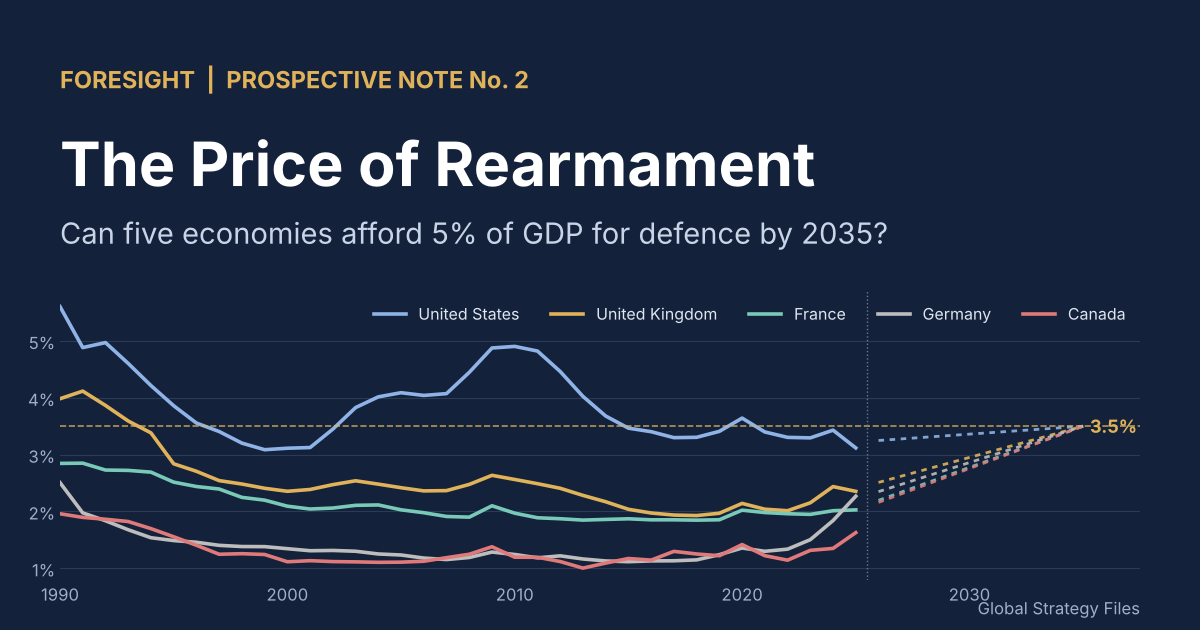
Targets and plans in this note use NATO’s definition; history uses SIPRI data, available consistently from 1990. The two are close for four countries: in 2025, NATO’s figure exceeds SIPRI’s by 0.10 points of GDP for the United States, 0.05 for the United Kingdom and 0.02 for France, and is 0.05 points lower for Germany. For Canada, the difference is 0.38 points: SIPRI puts Canadian spending at 1.63 percent of GDP in 2025, NATO at 2.01 percent. Close to a fifth of Canada’s NATO figure depends on what is counted rather than on what is bought.
Figure 1 shows the long run. The United States has never fallen below 3 percent of GDP since 1990; its low was 3.09 percent in 1999. The others hit their lows in the 2010s: 1.93 percent in the United Kingdom and 1.85 percent in France in 2018, 1.11 percent in Germany in 2015 and 1.00 percent in Canada in 2013. Outside Germany the recovery is modest: in 2025 the United Kingdom was 0.42 points above its low and France only 0.18 points.
A first look at the results
The full note goes much further, with original models, scenarios and a dashboard of leading indicators. Two of its 14 charts and diagrams are shown below.
Continue reading
Get the full note: 25 pages, 14 charts and diagrams, 7 tables
This page shows the first part of the note. The full PDF adds: the Cold War benchmark and the peace dividend; the defence gap; how defence spending reaches the economy; fiscal capacity to rearm; financing choices; the debt bill to 2035; industrial bottlenecks, defence inflation and leakage; scenarios to 2035; the triple squeeze: defence, ageing, climate and interest.
29 USD, instant PDF download, secure card payment.
Buy the full noteNeed this analysis for your organisation?
We prepare confidential briefings, executive talks and studies on countries, markets and policies, built on the same method as this article.
Request a briefingSupport independent analysis
Our studies are free to read and carry no advertising. If this one was useful, a small contribution helps us publish the next.
Support our workGo further: books by Global Strategy Files

Frequently asked questions
What did NATO agree at The Hague summit in 2025?
At The Hague on 25 June 2025, NATO allies committed to invest 5 percent of GDP a year by 2035 in defence and security. At least 3.5 percent must go to core defence as defined by NATO, and up to 1.5 percent to protecting critical infrastructure, networks, civil preparedness and resilience. Allies submit annual plans showing a credible, incremental path, and the trajectory will be reviewed in 2029.
How much would the 3.5 percent core defence target cost?
On a linear path from 2025 levels to 3.5 percent of GDP in 2035, the United States, the United Kingdom, France, Germany and Canada would spend a cumulative 2.04 trillion dollars more over 2026 to 2035, and 411 billion dollars a year more by 2035. About 1.41 trillion of the cumulative total falls on the four allies other than the United States, according to calculations by the author.
Which countries can afford NATO’s 5 percent target?
Germany has the most fiscal room, with low debt and borrowing costs below growth, and its funded plans already reach 3.5 percent of GDP by 2029. The United States can afford its small gap despite weak public finances. France has the weakest fiscal capacity of the five, and Canada has the largest gap with no funded path, so both are the most likely to miss the target.
Why could rearmament cause defence inflation?
Defence production cannot expand quickly. To reach 3.5 percent of GDP, real equipment purchases must grow by 8.9 percent a year in France and 12 percent in Canada. If production capacity grows by about 5 percent a year, the excess demand shows up as higher prices for defence goods, which could cut the purchasing power of 2035 equipment budgets by 31 percent in France and 48 percent in Canada.
Sources
- NATO, The Hague Summit Declaration, 25 June 2025.
- NATO, Defence Expenditure of NATO Countries (2014-2025), June 2025 (Tables 2, 3 and 8a).
- Reuters, “Five NATO members seen to spend over 3.5% of GDP on core defence this year, alliance estimates show”, 7 July 2026; “NATO sees sharp increase in Europe’s and Canada’s defence spending”, 26 March 2026; Qatar Tribune (Reuters), NATO 2026 estimates, July 2026.
- SIPRI Military Expenditure Database via World Bank WDI: MS.MIL.XPND.GD.ZS, MS.MIL.XPND.CD, 1990 to 2025 (retrieved 20 October 2026).
- SIPRI, “Are European NATO states moving towards self-reliance in arms procurement?”, Q&A with Katarina Djokic, 19 March 2025.
- World Bank, Population Estimates and Projections: SP.POP.DPND.OL (retrieved 20 October 2026).
- IMF, World Economic Outlook and Fiscal Monitor database, October 2026: NGDPD, GGXWDG_NGDP, GGXCNL_NGDP, GGXONLB_G01_GDP_PT, GGR_G01_GDP_PT, G_X_G01_GDP_PT, NGDP_RPCH, PCPIPCH (retrieved 20 October 2026).
- FRED: DCOILBRENTEU, ECBDFR; Bank of Canada Valet: BD.CDN.5YR.DQ.YLD (retrieved 20 October 2026).
- Global Strategy Files, Decoded No. 1, “Five Bond Markets, One Shock: Who Really Pays for the 2026 Yield Surge”, 19 October 2026.
- CSIS, S. P. Daniels, “Unpacking the $1.5 Trillion FY 2027 Defense Budget Topline”, 10 April 2026; “Tracking FY 2027 Defense Appropriations, Reconciliation, and the Supplemental Request”, 18 August 2026.
- Akin Gump, “Defense Funding Update: FY 2026 vs. FY 2027 Toplines”, 22 June 2026.
- Institute for Fiscal Studies, M. Warner, “Initial response to the Defence Investment Plan”, 30 June 2026.
- UK Defence Journal, “UK sets date on 3% defence spending boost”, 30 June 2025.
- CIPP, “The date of the Autumn Budget announced”, 31 July 2026.
- LCP, “Programmation militaire: l’Assemblee adopte definitivement l’effort budgetaire”, 1 July 2026.
- Ifri, Audrand and Tenenbaum, “Actualisation de la LPM 2026”, 16 April 2026.
- Noerr, “Bundestag approves exemption from the debt brake for defence spending and special funds”, March 2025.
- Reuters (via Free Malaysia Today), “Germany to raise defence spending to 3.5% of GDP by 2029”, 23 June 2025.
- OSW, “Germany: 2026 budget and rising debt”, 5 December 2025.
- Parliamentary Budget Officer of Canada, “Fiscal Implications of Meeting NATO’s 5% Commitment”, 5 February 2026; “Canada’s Defence Spending Commitments: A Primer”, 6 October 2026.
- Procurement Magazine, “Canada pivots: the new 70% domestic procurement mandate”, 13 April 2026.
- Office of the Chief Actuary, Highlights of the 18th Actuarial Report on the Old Age Security Program.
- IRIS, J.-P. Maulny, ReArm Europe consequences note, September 2026.
- Bruegel, Mejino-Lopez and Wolff, “What role do imports play in European defence?”, 4 July 2024; Wolff, Burilkov, Bushnell and Kharitonov, “Fit for war in decades”, 16 September 2024.
- Kiel Institute, Burilkov, Bushnell, Mejino-Lopez, Morgan and Wolff, “Fit for war by 2030?”, Kiel Report No. 3, June 2025; “Guns and Growth” (summary by ASD Europe).
- The Register, “UK Ministry of Defence is spending less with US biz, and more with Europeans”, 10 May 2025 (Tussell data).
- National Defense magazine (via NTSA), “Defense sector inflation threatens to eat away at budget plus-ups”, 9 February 2026.
- European Central Bank, “Fiscal aspects of European defence spending”, Economic Bulletin 5/2025, 7 August 2025.
- Czech National Bank, Boermans, Hodula and Simpartl, “Economic and Financial Effects of Rising Defense Spending”, Research Brief 3/2026, 27 July 2026.
- Barro, R. J. and Redlick, C. J. (2011), “Macroeconomic Effects from Government Purchases and Taxes”, Quarterly Journal of Economics 126(1).
- Ramey, V. A. and Zubairy, S. (2018), “Government Spending Multipliers in Good Times and in Bad”, Journal of Political Economy 126(2).
- Congressional Budget Office, Gamber and Seliski, “The Effect of Government Debt on Interest Rates”, Working Paper 2019-01.
- France Strategie, “The economic implications of climate action” (Pisani-Ferry and Mahfouz), executive summary, November 2023.
- OECD public pension expenditure, 2019 (as reported by Apollo Academy, 30 January 2025); Office for Budget Responsibility on the state pension (as reported by the Press Association).
- Reuters, “France sets presidential election dates”, 1 July 2026; ECB meeting calendar 2026 (Admiral Markets); 2027 NATO summit in Albania (retrieved 20 October 2026).
