
Stablecoins and Monetary Sovereignty: The Digital Dollar’s Reach, Scenarios to 2030

Driss EFFINA, PhD Independent Researcher, Global Strategy Files Foresight, prospective note No. 18, 24 October 2026. Reading time: about 55 minutes
Key takeaways
- Stablecoin supply was 304.2 billion dollars at the end of September 2026, 99.4 percent in dollars; issuers hold about 185 billion dollars of bills, 2.6 percent of the market, and the largest issuer’s buffer fell to 2.24 percent of its tokens.
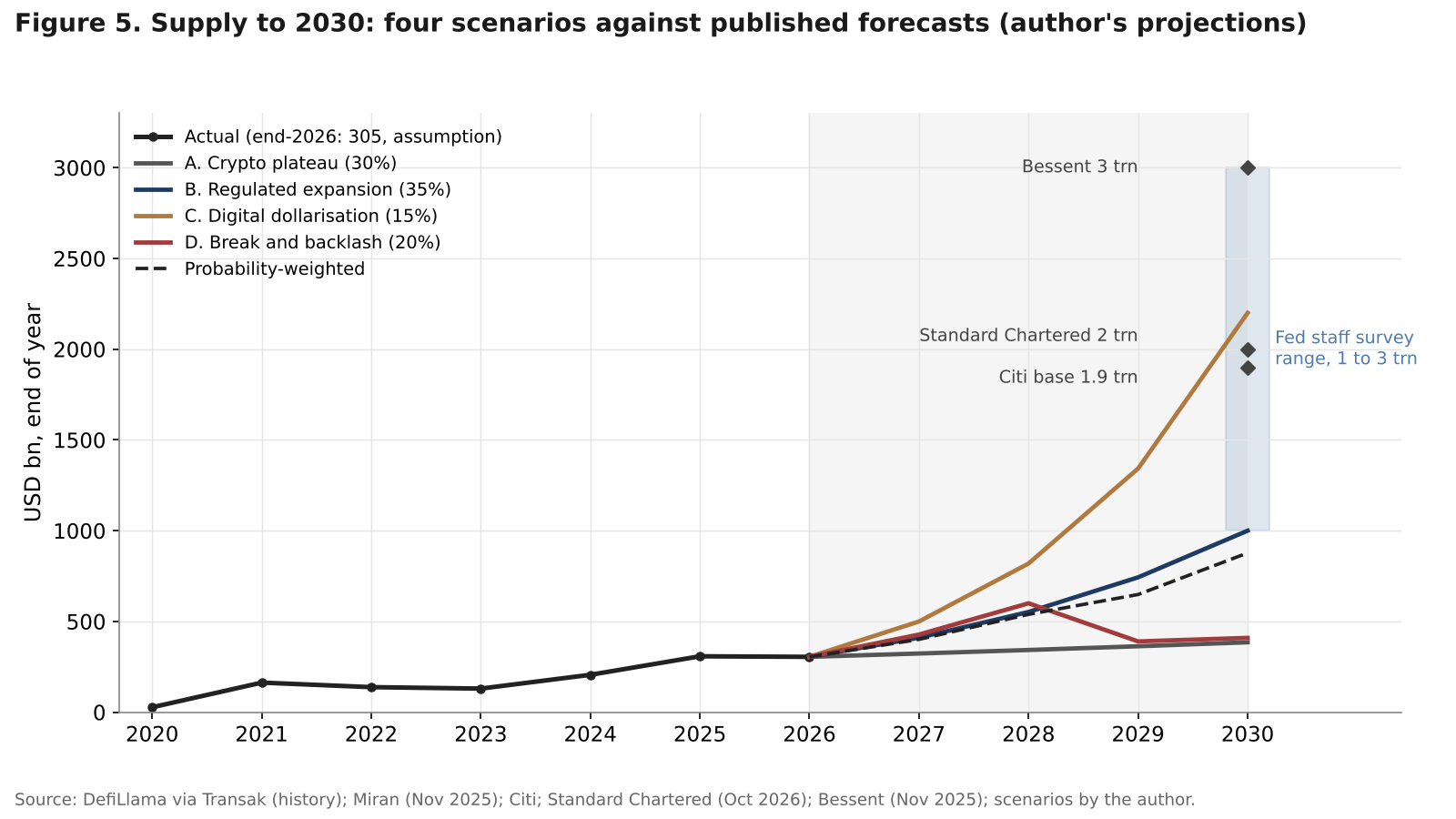
- In the author’s scenarios supply reaches 877 billion dollars in 2030 on a probability-weighted basis; stablecoins could absorb a quarter to two thirds of new bill issuance in the growth scenarios but lower bill yields by only 4 to 10 basis points.
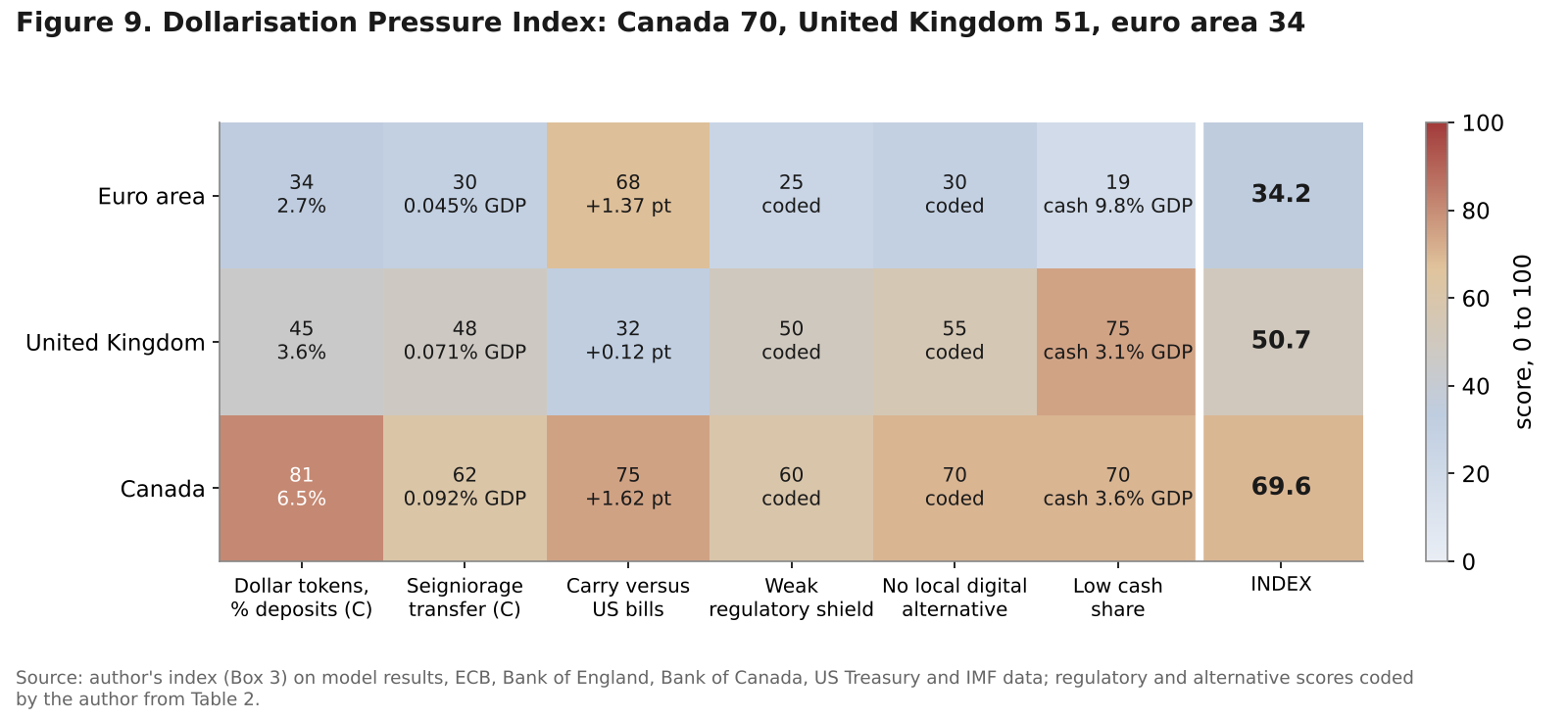
- Dollarisation pressure is highest in Canada (index 69.6), then the United Kingdom (50.7) and the euro area (34.2); in the strongest scenario dollar tokens reach 6.5 percent of Canadian transactional deposits.
- Run risk is the weak link: a five-day run of 40 percent on a 1 trillion dollar market would force about 111 billion dollars of bill sales, while the Bank of England’s 30 percent central bank deposit rule meets a one-day run without asset sales.
Abstract
Dollar stablecoins are tokens that promise to pay one US dollar on demand and hold short-term Treasury bills to back the promise. They have grown from 27 billion dollars at the end of 2020 to 304.2 billion dollars at the end of September 2026, and in 2025 and 2026 they acquired a legal framework: the GENIUS Act in the United States, MiCA in the European Union, a systemic regime at the Bank of England and a Stablecoin Act in Canada. Two claims now circulate. One says stablecoins will finance the US Treasury and export the dollar to every phone in the world; the other says they will drain bank deposits and erode the monetary sovereignty of every other currency. Both are usually made without numbers.
This note puts numbers on them for the United States, the United Kingdom, the euro area (with France and Germany) and Canada. It builds four growth scenarios to 2030 with probabilities; a model of the demand for Treasury bills and its effect on bill yields, calibrated on published supply elasticities; a “dollarisation pressure” model and index for the euro area, the United Kingdom and Canada covering deposits, payments and seigniorage; estimates of bank deposit outflows and lending; and a run model that links redemptions to forced sales in the bill market. It closes with a dashboard of twelve indicators, implications for central banks, banks, investors and governments, and a dated calendar. All projections and probabilities are the author’s.
Keywords: stablecoins, monetary sovereignty, dollarisation, Treasury bills, GENIUS Act, MiCA, digital euro, bank deposits, seigniorage, run risk, United States, United Kingdom, euro area, Canada
JEL codes: E42, E44, E58, F33, G21, G23
Key findings
1. The market is small, stalled and dollar-only. Supply was 304.2 billion dollars on 30 September 2026, 5.1 percent below the May peak; 99.4 percent is denominated in dollars and two tokens hold 84.9 percent. Issuers hold about 185 billion dollars of bills, bill repo and fund shares, 2.6 percent of the 7.12 trillion dollars of bills outstanding and a third of the Federal Reserve’s bill portfolio. The largest issuer’s buffer halved to 2.24 percent of its tokens in the second quarter, against 38.1 billion dollars of gold, bitcoin and secured loans, 9.3 times the buffer. 2. Stablecoins can absorb a large share of new bill issuance but move bill yields only a little. On probability-weighted supply of 877 billion dollars in 2030 (and a 50 percent probability of reaching 1 trillion), issuers would hold 669 billion dollars of bills, 7.2 percent of the market. In the regulated-expansion scenario they absorb 26.6 percent of the growth in bills between 2026 and 2030, in the digital-dollarisation scenario 68.5 percent. Yet the fall in bill yields is 4.0 basis points (1.5 to 6.6) and 10.4 basis points (3.8 to 16.9) respectively: a cheaper source of short-term funding, not a fiscal solution. 3. Dollarisation pressure is highest in Canada and lowest in the euro area. On the author’s six-component index (0 to 100), Canada scores 69.6, the United Kingdom 50.7 and the euro area 34.2. In the digital-dollarisation scenario, residents would hold dollar tokens worth 6.5 percent of transactional deposits in Canada (99 billion Canadian dollars), 3.6 percent in the United Kingdom (72 billion pounds) and 2.7 percent in the euro area (216 billion euros). The direct seigniorage cost is small, 0.05 to 0.09 percent of GDP a year; the cost to sovereignty lies in payments and in monetary policy transmission. 4. The bank channel is real but second-order outside the extreme case. After recycling of reserves into deposits, US bank lending would be 71 to 150 billion dollars lower in 2030 in the regulated-expansion scenario (at most 1.06 percent of loans) and 194 to 408 billion dollars lower in the digital-dollarisation scenario (at most 2.89 percent). In that case the high-end loss reaches 1.87 percent of GDP in Canada, 1.50 percent in the United Kingdom and 0.99 percent in the euro area. 5. Run risk is the most underpriced link to the Treasury market. With 80 percent of reserves in bills, a five-day run of 40 percent on a 1 trillion dollar market would force about 111 billion dollars of bill sales, 32 times the daily flow studied by the BIS and a fifth of the Fed’s bill holdings; at 2.2 trillion dollars, 244 billion. The Bank of England’s design, with 30 percent in central bank deposits, meets a one-day run of 30 percent without selling a single gilt; the American rules do not impose an equivalent buffer. The author assigns 30 percent to a crypto plateau, 35 percent to regulated expansion, 15 percent to digital dollarisation and 20 percent to a break-and-backlash path.
1. Introduction
Monetary sovereignty is the ability of a state to choose the unit in which its residents save, pay and borrow, and to influence the price of credit in that unit. It rests on three things: a currency that residents want to use, banks that create most of the money supply in that currency, and a central bank that sets the rate on the settlement asset and stands behind the system in a crisis. Stablecoins touch all three. They are a new form of private money in a foreign currency, held outside domestic banks, backed by the debt of another government.
The issue moved from the margins to policy in 2025 and 2026. The GENIUS Act, signed on 18 July 2025, gave the United States its first federal law for payment stablecoins; the Office of the Comptroller of the Currency published its final implementing rule on 23 October 2026, and the Act takes effect on 18 January 2027 at the latest. The US Treasury Secretary said in November 2025 that the market could grow tenfold to about 3 trillion dollars by the end of the decade. A member of the Federal Reserve Board, Stephen Miran, said that stablecoins “may become a multitrillion dollar elephant in the room for central bankers”. In Europe the response has been defensive: MiCA restricts non-euro tokens, the European Systemic Risk Board and the ECB have warned about multi-issuance schemes, and the digital euro is in trilogue negotiations. The Bank of England has finalised a regime for systemic sterling stablecoins; Canada’s Stablecoin Act received royal assent in March 2026 and draft regulations were published on 24 October.
Yet the market has stalled. Supply peaked at 320.6 billion dollars in May 2026, fell by 7.7 billion dollars in June, the largest monthly decline since the Terra collapse of May 2022, and stood at 304.2 billion dollars at the end of September. On 14 October Standard Chartered pushed its 2 trillion dollar forecast from 2028 to 2030, noting that supply had stayed in a 300 to 320 billion dollar range for twelve months. The question is therefore not whether stablecoins are already a threat, but under which conditions they become one, through which channel, and for whom.
Figure 1 sets out four channels. The Treasury channel runs through the reserves: every dollar token creates demand for about 75 to 80 cents of bills, bill repo or government money market fund shares. The bank channel runs through deposits: residents who buy tokens move money out of banks, part of which comes back as issuers’ deposits. The sovereignty channel runs through residents of other currency areas who hold dollar tokens instead of local deposits or cash. The run channel runs through redemptions that force issuers to sell bills in stress. The note quantifies each channel under four scenarios to 2030. It does not repeat the analysis of the dollar’s role in the 2026 war economy (Decoded No. 15, “The Dollar as a War Asset”) or of the risk that debt steers central banks (Foresight No. 15, “Fiscal Dominance Watch”); it uses their conclusions where relevant.
Section 2 describes the market in 2026, Section 3 the four rulebooks, Section 4 the place of stablecoins in the bill market. Section 5 sets out the growth scenarios. Sections 6 to 9 quantify the four channels. Section 10 brings the scenarios together, Section 11 presents the dashboard, Sections 12 and 13 draw implications and a calendar.
2. The market in 2026: concentrated, dollar-only, thinly buffered
2.1 Size and growth
Stablecoin supply grew from 27 billion dollars at the end of 2020 to 163 billion at the end of 2021, fell to 130 billion by the end of 2023 after the Terra collapse and the 2022 crypto bear market, then rose to 206 billion at the end of 2024 and 308 billion at the end of 2025 (Figure 2a). The compound growth rate was 62.7 percent a year over 2020 to 2025 and 53.9 percent over 2023 to 2025. In 2026 growth stopped. The cycle explains most of this: about 69 percent of economic stablecoin activity between January and August 2026 was trading, 13 percent store of value and at most 13 percent payments, according to Allium data compiled by Stablecoin Insider. When crypto prices fall, traders redeem.
Activity has nevertheless kept rising inside a flat stock. Adjusted transaction volume reached 1.79 trillion dollars in June 2026, up 125 percent on a year earlier, and 8.82 trillion dollars in the first half of 2026 against 10.8 trillion in the whole of 2025. Identified payments, such as business-to-business settlement, payroll and supplier payments, reached at least 401 billion dollars from January to August 2026, up 42 percent. Visa’s stablecoin settlement run rate rose from 7 billion dollars a year in March to above 20 billion in September. The money stock is not growing; its velocity is.
2.2 Concentration and currency
Two tokens dominate (Table 1). Tether’s USDT had 183.8 billion dollars in circulation on 30 September 2026, 60.4 percent of the total; Circle’s USDC 74.6 billion, 24.5 percent. The next six tokens together amount to 26.4 billion dollars. Dollar tokens are 99.4 percent of supply. Euro tokens grew 22.6 percent between January and early September 2026, to 848 million dollars, about 0.3 percent of the market; Circle’s EURC accounts for 62.6 percent of them and Société Générale’s EURCV for 19.6 percent. No sterling or Canadian-dollar token has reached significant size.
Table 1. The stablecoin market, 30 September 2026
| Token | Issuer and home regime | Supply, USD bn | Share of total | Reserve model |
|---|---|---|---|---|
| USDT | Tether; separate US token USAT issued through Anchorage Digital Bank | 183.8 | 60.4% | Bills and repo (about 74% of assets), gold, bitcoin, secured loans |
| USDC | Circle (United States) | 74.6 | 24.5% | Circle Reserve Fund (Treasuries and Treasury repo) plus bank cash |
| USDS and DAI | Sky (decentralised) | 11.5 | 3.8% | Mixed crypto and real-world assets |
| USDe | Ethena | 4.9 | 1.6% | Crypto collateral and derivatives hedges |
| USD1, USDG, RLUSD | Various | 10.0 | 3.3% | Mostly bills, repo and cash |
| All other | 19.4 | 6.4% | Mixed | |
| Total | 304.2 | 100% | 99.4% dollar-denominated |
Sources: DefiLlama via Stablecoin Insider, Q3 2026 report; Tether Q1 2026 attestation; The Block; calculations by the author.
2.3 How thin is the buffer?
A stablecoin is a narrow bank without deposit insurance. Its safety depends on the liquidity of its reserves and on the capital that absorbs losses on them. Tether’s attestations, prepared by BDO, show total assets of 191.8 billion dollars against liabilities of 183.5 billion at the end of March 2026, an excess of 8.23 billion (4.48 percent of liabilities), and about 141 billion dollars of direct and indirect exposure to Treasury bills, 73.5 percent of assets. By the end of June the excess had fallen to 4.11 billion dollars, 2.24 percent of liabilities, as gold and bitcoin prices fell (Figure 2d). Against that buffer the issuer held 18.8 billion dollars of gold, 5.8 billion of bitcoin and 13.5 billion of secured loans: 38.1 billion dollars of assets that can lose value quickly, 20.7 percent of its liabilities and 9.3 times its buffer. A fall of a quarter in the value of these assets would leave the token undercollateralised. This is the main reason why the American rules matter: from 2027 a token offered in the United States must hold only cash, deposits, short bills, bill repo, government money market funds and similar assets.
A first look at the results
The full note goes much further, with original models, scenarios and a dashboard of leading indicators. Two of its 14 charts and diagrams are shown below.
Continue reading
Get the full note: 27 pages, 14 charts and diagrams, 16 tables
This page shows the first part of the note. The full PDF adds: four rulebooks; stablecoins in the bill market today; four growth paths to 2030; the Treasury channel: bill demand and bill yields; the sovereignty channel: dollarisation pressure; the bank channel: deposits and lending; the run channel and the Treasury market; four scenarios to 2030; leading indicators dashboard.
29 USD, instant PDF download, secure card payment.
Buy the full noteNeed this analysis for your organisation?
We prepare confidential briefings, executive talks and studies on countries, markets and policies, built on the same method as this article.
Request a briefingSupport independent analysis
Our studies are free to read and carry no advertising. If this one was useful, a small contribution helps us publish the next.
Support our workGo further: books by Global Strategy Files

Frequently asked questions
How much US government debt do stablecoins hold?
In 2026 stablecoin issuers hold about 185 billion dollars of Treasury bills, bill repo and government money market fund shares, mostly at Tether and Circle. That is about 2.6 percent of the 7.12 trillion dollars of bills outstanding at the end of September 2026 and roughly a third of the Federal Reserve’s bill holdings. Money market funds remain far larger, with about 2.5 trillion dollars of bills.
Will stablecoins lower US Treasury yields?
Only slightly. The author’s model, calibrated on published supply elasticities, finds that a 1 trillion dollar stablecoin market in 2030 would lower bill yields by about 4 basis points, and a 2.2 trillion dollar market by about 10 basis points. Stablecoins could absorb a quarter to two thirds of new bill issuance in those scenarios, but the effect on long-term yields is negligible and the saving for the budget is small.
Do dollar stablecoins threaten the monetary sovereignty of Europe, the UK and Canada?
Not in the central case. In the author’s scenarios residents’ dollar tokens stay below 2 percent of transactional deposits in 2030 unless dollar tokens become the default for payments and saving. In that tail scenario they reach 6.5 percent of deposits in Canada, 3.6 percent in the UK and 2.7 percent in the euro area. Canada is most exposed; the euro area is best protected by MiCA and the digital euro project.
Can a stablecoin run destabilise the Treasury market?
A large one could strain the bill market. If stablecoins reach 1 trillion dollars with 80 percent of reserves in bills, a five-day run of 40 percent would force about 111 billion dollars of bill sales, a fifth of the Fed’s bill holdings. The Bank of England requires systemic issuers to keep 30 percent of reserves at the central bank, which covers a one-day run of 30 percent without selling assets; US rules contain no such buffer.
Sources
- Ahmed, R. and Aldasoro, I., “Stablecoins and safe asset prices”, BIS Working Paper No. 1270 (data to March 2026); earlier version presented at the Federal Reserve Bank of Cleveland Financial Stability Conference 2025 (via Crane Data).
- American Banker, “Crypto market structure bill fails in Senate vote 49-50” (15 September 2026).
- Bank for International Settlements, Annual Economic Report 2025, chapter III, “The next-generation monetary and financial system” (June 2025; via The Block).
- Bank of Canada, Selected monetary aggregates and their components (August 2026).
- Bank of England, “Sterling-denominated systemic stablecoins: policy statement and draft Code of Practice” (22 June 2026); consultation of 10 November 2025; Financial Stability Paper, “The role of holding limits for sterling-denominated systemic stablecoins and a potential digital pound” (2025); Weekly Report, 31 December 2025.
- Canada Gazette, Part I, Vol. 160, No. 43, “Stablecoin Regulations” (24 October 2026).
- Cipollone, P., “Money in the digital age: digital euro, tokenisation and the role of central banks”, ECB (6 October 2026); remarks reported by Eunews (14 September 2026).
- Congressional Research Service, “Stablecoin Legislation: An Overview of the GENIUS Act of 2025 (P.L. 119-27)” (August 2026).
- Council of Economic Advisers, “Effects of Stablecoin Yield Prohibition on Bank Lending” (April 2026).
- CoinTurk News, euro stablecoin supply from Token Terminal (9 September 2026).
- Crowdfund Insider, Treasury Secretary Bessent at the Treasury Market Conference (13 November 2025).
- Decrypt, “Tether supply plummeted 7.4 billion dollars amid depegging concerns, Terra collapse: Glassnode” (May 2022).
- ECB, Euro area bank interest rate statistics, July 2026 (2 September 2026); Monetary developments in the euro area, August 2026 (25 September 2026); euro reference exchange rates (23 October 2026); Working Paper No. 3199, “Stablecoins and monetary policy transmission” (May 2026, via Lovguiden).
- ESCB, response to the European Commission’s targeted consultation on the review of MiCAR (September 2026).
- ESMA statement on non-MiCA-compliant stablecoins (17 January 2025; via Unlock).
- FCA, “Crypto firms get guidance on how the new regime applies” (16 September 2026).
- Federal Register: OCC final rule implementing the GENIUS Act, 91 FR 67000 (23 October 2026); Federal Reserve Board proposed rule, 91 FR 61580 (29 September 2026); FDIC proposed rule (10 April 2026).
- Federal Reserve Board, H.4.1 (15 October 2026) and H.8 (9 October 2026); FEDS Notes: Wang, J. J., “Banks in the age of stablecoins” (17 December 2025); “In the shadow of bank run: lessons from the Silicon Valley Bank failure and its impact on stablecoins” (17 December 2025).
- Federal Reserve Bank of Kansas City, Jacewitz, S., “Stablecoins could increase Treasury demand, but only by reducing demand for other assets”, Economic Bulletin (August 2025, updated September 2026).
- Federal Reserve Bank of San Francisco, Leduc, S., Oliveira, L. E. and Sawyer, A., “Stablecoin issuers’ growing appetite for Treasury securities”, Economic Letter 2026-26 (28 September 2026).
- Fricke, D., “Stablecoins and the U.S. treasury market: a new but still small investor group”, SUERF Policy Brief No. 1431 (30 April 2026).
- FRED: FEDFUNDS, ECBDFR, T5YIE, DCOILBRENTEU (retrieved 20 October 2026).
- International Monetary Fund, World Economic Outlook database, October 2026 (NGDPD, GGXWDG_NGDP); Reuter, M., “Decrypting Crypto: How to Estimate International Stablecoin Flows”, IMF Working Paper 25/141 (July 2025); Adrian, T., Miccoli, M. and Sugimoto, N., “How stablecoins can improve payments and global finance”, IMF blog (4 December 2025), and “Understanding Stablecoins” (December 2025).
- Krishnamurthy, A. and Vissing-Jorgensen, A. (2012), “The Aggregate Demand for Treasury Debt”, Journal of Political Economy 120(2) (presentation via US Treasury).
- Miran, S., “Stablecoins and monetary policy”, speech at the BCVC Summit, New York (7 November 2025; BIS central bankers’ speeches).
- Payment Expert, Breeden on the digital pound (14 October 2026); Positive Money, European Parliament vote on the digital euro (9 July 2026).
- Primerates, “Treasury bills reach 22.4% of marketable debt” (12 October 2026, from US Treasury data).
- Stablecoin Insider, “Q3 2026 stablecoin report: main insights” and “What backs USDC” (2026).
- Standard Chartered via The Block, “Standard Chartered pushes 2 trillion dollar stablecoin market forecast to 2030” (14 October 2026).
- Tether, Q1 2026 attestation (1 May 2026); Q2 2026 attestation (31 July 2026, via Spotted Crypto).
- The Block, Qivalis consortium (20 May 2026); USAT on Celo (29 July 2026).
- Transak, “Stablecoin market cap in 2026” (June 2026, from DefiLlama).
- Treasury Borrowing Advisory Committee, charges for Q2 2025 and Q1 2026 (US Treasury).
- VBCE, daily foreign exchange update (27 August 2026).
- Global Strategy Files: Decoded No. 15, “The Dollar as a War Asset”; Foresight No. 15, “Fiscal Dominance Watch”.
- All data retrieved 20 to 24 October 2026.
Books from Global Strategy Files
Go further on this topic
 Future-Proofing AmericaEconomic challenges and the road to reform.20 USD, see the bookThe Tariff GambleHow America’s trade war is reshaping power, prices and prosperity.24.99 USD, see the book
 Kill KennedyWhat the 2025 declassified files reveal about the machinery of American power.20 USD, see the book
