
Fiscal Rules Meet Reality: London, Paris, Berlin, Ottawa and Washington’s Missing Rule in 2026


Driss EFFINA, PhD Independent Researcher, Global Strategy Files Decoded, analysis note No. 17, 24 October 2026. Reading time: about 55 minutes
Key takeaways
- Since 2010 the United Kingdom has introduced eight sets of fiscal rules, France has reset its deficit path eight times and Canada has used seven anchors, while Washington passed 12 debt-limit measures. In the IMF’s data France’s deficit was at or below 3 percent of GDP in only 2 of 16 years.
- Turning headroom into probabilities gives 55 percent for the UK stability rule, 33 percent for Germany within the EU defence flexibility, 26 percent for France and Canada and 9 percent for a stable US debt ratio. About 11 billion pounds of UK headroom would vanish with a 0.9-point rise in yields.
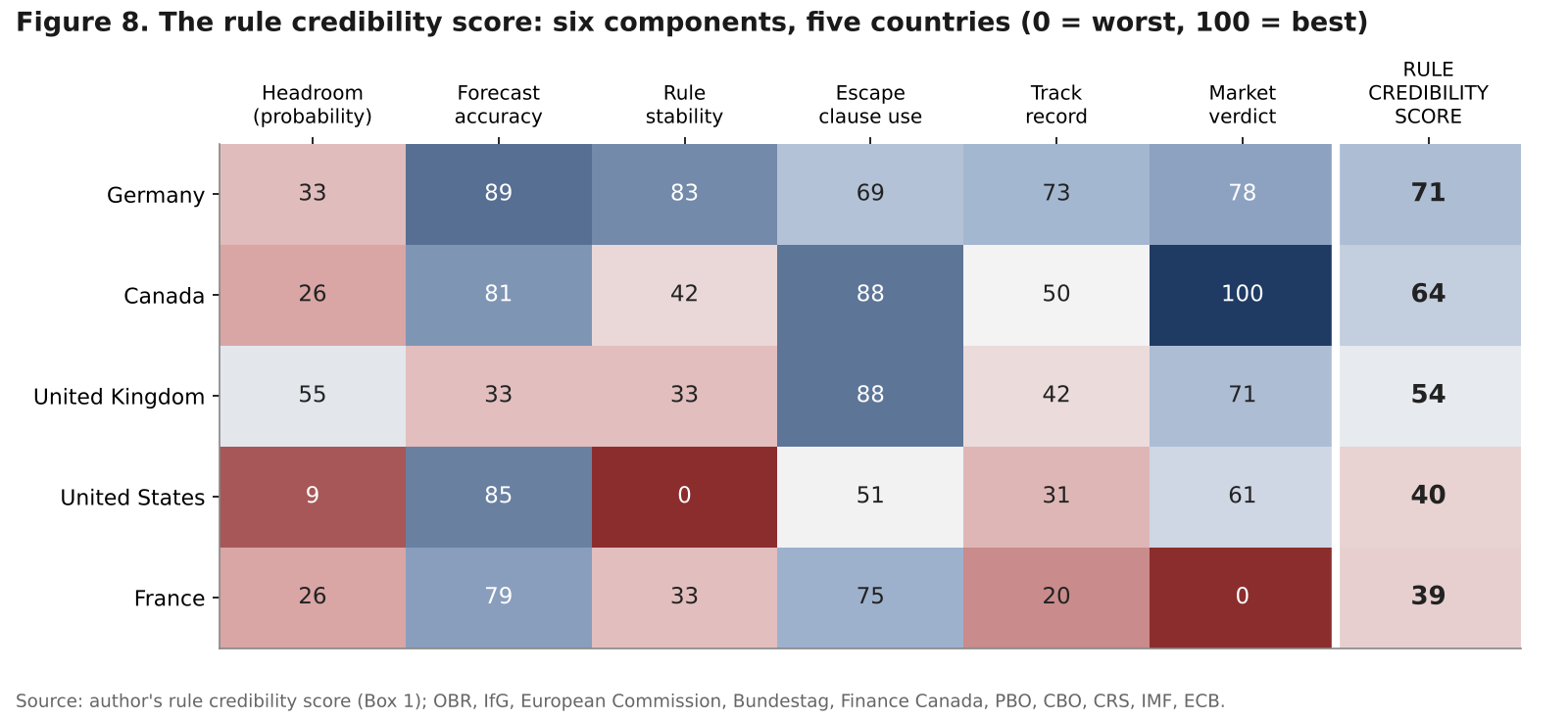
- The author’s rule credibility score ranks Germany 71, Canada 64, the United Kingdom 54, the United States 40 and France 39. Germany ranks first in 75 percent of 20,000 random weightings; the United States or France ranks last in 92 percent.
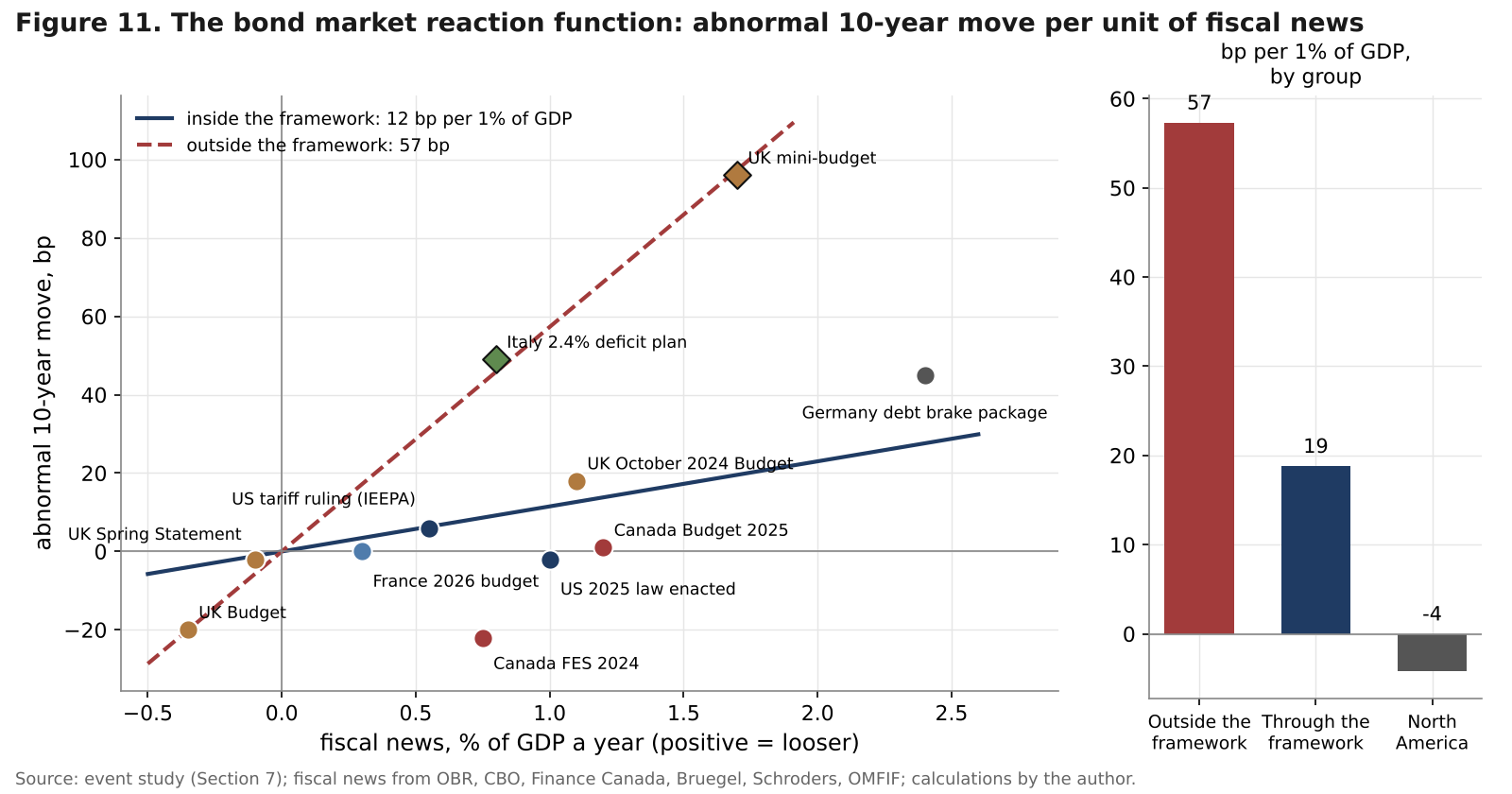
- Bond markets charge about 12 basis points per 1 percent of GDP of fiscal news delivered through the framework and about 57 when it is bypassed. In 2026 France alone paid a country-specific premium, 39 to 50 basis points between February and September.
Abstract
Four of the five largest Western economies run on a fiscal rule; the fifth, the United States, runs on a debt limit that is not a rule. In 2026 all five were hit by the same shock: a war involving Iran, oil above 100 dollars a barrel and 10-year yields 59 to 113 basis points higher between February and September. This note asks which rules survive contact with that reality. It builds a track record of every rule set and target since 2010, compares official plans with independent projections, converts headroom into a probability of compliance, and combines six measures into a rule credibility score. An event study of 26 fiscal and political events estimates how bond markets price fiscal news, inside and outside a credible framework. The answer is uneven. Germany’s rewritten rule and Canada’s new anchors score best; the United Kingdom sits in the middle with headroom worth a coin toss; France and the United States score lowest, for different reasons. Markets charge about 12 basis points per 1 percent of GDP of fiscal news delivered through the framework and about 57 basis points when the framework is bypassed. Four scenarios to 2028, with probabilities, show that rewriting rules is more likely than breaking them, and that France is the country where markets are already doing the enforcing.
Key findings
1. Rules are rewritten far more often than they are met. Since 2010 the United Kingdom has introduced eight sets of fiscal rules, France has reset its deficit path at least eight times, Canada has used seven anchors or target dates and Washington has passed 12 debt-limit measures, with extraordinary measures in use in 11 of the 16 years. Germany changed its rule twice. In the IMF’s data France’s deficit was at or below 3 percent of GDP in only 2 of the 16 years from 2010 to 2025. 2. Headroom is thin everywhere. On the author’s uncertainty profile, the probability of meeting the binding target is 55 percent for the United Kingdom (61 percent in March), 33 percent for Germany within the EU defence flexibility, 26 percent for France and for Canada, and 9 percent for the United States measured against the implicit goal of a stable debt ratio. The United Kingdom’s estimated October headroom of about 11 billion pounds would be erased by a 0.9-point rise in gilt yields and Bank Rate. 3. The planning gap is small in London and large elsewhere. The OBR’s March path and the IMF’s October projections for the United Kingdom differ by at most 0.2 point of GDP. France’s 2029 target of 3 percent sits 1.5 points below the IMF’s projection and its 2027 target has slipped 0.9 point in 18 months; Germany’s debt is projected 4.6 points above its own medium-term plan by 2029; the PBO puts Canada’s 2027-28 deficit 6.7 billion dollars above the budget and the deficit ratio rising. 4. The rule credibility score ranks Germany (71) ahead of Canada (64), the United Kingdom (54), the United States (40) and France (39). Germany ranks first in 75 percent of 20,000 random weightings of the six components; the United States or France ranks last in 92 percent. 5. Markets punish the bypass more than the borrowing. Across 11 events with quantified fiscal news, the abnormal 10-year move is about 12 basis points per 1 percent of GDP inside the framework (19 for the euro area and the United Kingdom, close to zero for North America) and about 57 basis points when the news bypasses the framework, as in the United Kingdom in 2022 and Italy in 2018. Between the February and September 2026 monthly averages France paid a country-specific premium of 39 to 50 basis points; no other country paid more than 5. 6. The author’s scenarios to 2028 give Grind 45 percent, Rewrite 25 percent, Market enforcement 20 percent and Benign reset 10 percent. Weighted across them, the probability of meeting the binding target is 51 percent for the United Kingdom, 41 percent for Germany, 22 percent for France and Canada and 6 percent for the United States; French debt reaches 122.9 percent of GDP in 2028 and US debt 133.6 percent.
1. Introduction: four rules and an absence
A fiscal rule is a promise made in advance about a number. It is useful only if the promise binds when it is inconvenient, and 2026 has been very inconvenient. Since the war involving Iran began at the end of February, Brent has averaged about 127 dollars a barrel in October, central banks have stopped cutting and in some cases started hiking, and long-term yields have risen across the board. Between the February and September monthly averages, the 10-year yield rose by 86 basis points in the United States, 81 in the United Kingdom, 113 in France, 72 in Germany and 59 in Canada.
Higher rates hit fiscal rules through three doors: they raise interest spending, they lower growth, and they make the market itself an enforcer, charging a premium to a government that appears to slip. This note is about that third door, and about whether the rules governments chose are credible enough to keep it shut.
The five countries cover the full range of designs: a British current-budget rule policed by an independent forecaster, the EU’s net expenditure path for France, a German constitutional brake rewritten in 2025, a Canadian split between operating and capital budgets, and an American debt limit that is not a rule at all.
Sections 2 to 5 set out the rulebook, the track record since 2010, planning errors and the probability of compliance; Section 6 combines them into a rule credibility score; Section 7 estimates the bond market reaction function; Section 8 looks at Washington; Sections 9 to 12 present scenarios, a dashboard, implications and a calendar. Figure 1 summarises the framework. The note does not revisit Germany’s investment pipeline under the reformed debt brake, covered in Decoded No. 9, or the British growth and stagflation outlook, covered in Foresight No. 10.
2. The rulebook in October 2026
2.1 United Kingdom: a rule about to roll, a Budget on 28 October
The United Kingdom’s fiscal mandate, known as the stability rule, requires the current budget, revenue minus day-to-day spending, to be in surplus in 2029-30 until that year becomes the third year of the forecast, after which the current budget must be in balance or surplus in the third year of each rolling forecast. A supplementary target, the investment rule, requires public sector net financial liabilities to fall as a share of GDP by 2029-30. The Charter for Budget Responsibility allows the Chancellor to suspend both in an emergency or after a significant negative economic shock. Since the November 2025 Budget, the OBR assesses performance against the rules formally only once a year, at the Budget.
The numbers are tight. In November 2025 the OBR found the stability rule met with headroom of 21.7 billion pounds. The Spring Forecast of 3 March 2026, prepared with market data from before the war, put the margin at 23.6 billion pounds, about 1.6 percent of current receipts, but did not count as a formal assessment. Since then the ground has moved. Borrowing in the first half of 2026-27 was 97.8 billion pounds, 6.0 billion above the OBR’s March forecast, and the EY ITEM Club estimated on 5 October that headroom had fallen to about 11 billion pounds, mainly because of higher yields and weaker activity. The 10-year gilt yield stood at 5.34 percent in mid-October, 186 basis points above the Bund.
Politics changed too. Andy Burnham became Prime Minister and John Healey Chancellor on 20 July 2026. Mr Healey has said that he and the Prime Minister are “in lockstep” on meeting the fiscal rules and that he wants to leave the Budget with a “solid buffer against uncertainty”. The Budget on 28 October will be the first formal test of the rules in eleven months, and the first after the OBR’s March path, which showed borrowing falling from 115.5 billion pounds (3.6 percent of GDP) in 2026-27 to 63.4 billion (1.8 percent) in 2029-30, with net debt peaking at 96.3 percent of GDP in 2028-29.
2.2 France: an EU path, a missed national target and an election in 2027
France has been in the excessive deficit procedure since July 2024. The Council’s recommendation of 21 January 2025 set a corrective path in terms of net expenditure, spending net of interest, cyclical unemployment outlays and discretionary revenue measures. The ceilings are 0.8 percent growth in 2025, 1.2 percent in 2026, 2027 and 2028 and 1.1 percent in 2029, a cumulative 9.5 percent over 2023. They underpin France’s medium-term fiscal-structural plan, which brings the deficit below 3 percent of GDP in 2029.
In its assessment of 3 June 2026 the Commission found that France had complied with its commitments and held the procedure in abeyance. Net expenditure grew by 0.7 percent in 2025, below the ceiling, but is projected to grow by 1.4 percent in 2026, a deviation of 0.1 percent of GDP, still within the cumulative limit (5.4 against 5.8 percent). The Commission projected the deficit at 5.1 percent of GDP in 2026 and 5.7 percent in 2027 at unchanged policy, and noted that the 2023 pension reform had been suspended in December 2025 until January 2028.
The national targets have moved faster than the EU path. The 2026 budget, adopted on 2 February 2026 after a third use of Article 49.3, targeted 5.0 percent of GDP, against 4.7 percent in the original bill. The 2027 budget bill presented on 1 October 2026 now expects 5.4 percent for 2026 and targets 5.0 percent for 2027, with debt at 119.3 percent of GDP in 2026 and 121.7 percent in 2027, the highest since at least 1995. It relies on about 54 billion euros of effort and plans net primary expenditure growth of 0.7 percent in 2027. Eighteen months earlier, in April 2025, the government’s path had 4.6 percent for 2026 and 4.1 percent for 2027. In the week of 19 October, the French 10-year yield touched 5 percent for the first time since 2002, according to market reports; on 23 October Moody’s left France at Aa3 with a negative outlook. The presidential election is due on 18 April and 2 May 2027.
2.3 Germany: a rule rewritten, an escape clause activated
Germany’s debt brake, written into the Basic Law in 2009 and binding on the federal government from 2016, limits structural federal borrowing to 0.35 percent of GDP. It was suspended under its emergency clause from 2020 to 2023. The reform of March 2025, adopted by the Bundestag on 18 March, exempts defence and related security spending above 1 percent of GDP, creates a 500 billion euro infrastructure fund outside the brake and gives the Länder a joint structural allowance of 0.35 percent of GDP.
The EU side followed. Germany submitted its medium-term plan in July 2025; the Commission endorsed it on 16 September 2025, together with activation of the national escape clause, which allows defence spending to exceed the net expenditure path by up to 1.5 percent of GDP a year for four years. The plan sets net expenditure growth of 4.4 percent in 2025 and 4.5 percent in 2026, against 2.2 and 2.0 percent in the Commission’s reference path, and a debt ratio rising from 62.5 percent of GDP in 2025 to 66.9 percent in 2029. Bruegel judged the plan’s assumptions optimistic, with potential growth of 0.9 percent against 0.1 to 0.5 percent from other forecasters.
The government’s expert commission on modernising the brake reported in July 2026 without a compromise, offering three models: a near-return to the existing rule, a general borrowing allowance of up to 1.5 percent of GDP for investment, and alignment with the EU rules. A new constitutional amendment, which needs two-thirds majorities in both chambers, is therefore unlikely soon. Meanwhile the 2027 draft budget plans 118.7 billion euros of core net borrowing, of which 85.4 billion under the defence exemption, with a final vote due on 27 November 2026. The IMF projects a general government deficit of 4.3 percent of GDP in 2026 and 4.6 percent in 2027.
2.4 Canada: an operating budget, a capital budget and two anchors
Budget 2025, tabled on 4 November 2025, replaced the declining debt-to-GDP anchor with two new ones: balancing the operating budget, day-to-day spending against revenue, by 2028-29, and keeping the overall deficit-to-GDP ratio declining. Capital spending, defined broadly, is financed by borrowing. The budget projected a deficit of 78.3 billion dollars (2.5 percent of GDP) in 2025-26, falling to 65.4 billion in 2026-27, 63.5 billion in 2027-28 and 56.6 billion (1.5 percent) in 2029-30, with federal debt near 43 percent of GDP.
The anchors were tested quickly. In June 2026 the Parliamentary Budget Officer estimated that the probability of the deficit ratio falling in every year from 2026-27 to 2030-31 was below 1 percent. On 20 October it projected a deficit of 63.3 billion dollars in 2026-27 and a peak of 70.2 billion in 2027-28, with the deficit ratio rising in 2027-28 and 2029-30, and the operating budget balanced in 2028-29, a year later than the government now promises after the Prime Minister moved the target forward to 2027-28 in September. The PBO also estimates that the government’s definition of capital inflates capital spending by nearly 100 billion dollars over six years. Budget 2026 will be tabled on 5 November.
2.5 United States: a debt limit, not a rule
The United States has no numerical fiscal target. The binding statutory constraint is the debt limit, a cap on gross federal debt that does not constrain the spending and tax laws that create the borrowing. The reconciliation law of July 2025, Public Law 119-21, raised the limit by 5 trillion dollars to 41.1 trillion; CBO estimated that it raises primary deficits by 3.4 trillion dollars over 2025 to 2034 and debt-service costs by 718 billion. In fiscal year 2026 the federal deficit was 1,993 billion dollars, about 6.2 percent of GDP, 140 billion more than CBO projected in February, and net interest (1,052 billion) exceeded defence spending (965 billion). The Bipartisan Policy Center expects the new limit to be reached between late winter and mid-summer 2027, with extraordinary measures lasting six to nine months beyond that.
Table 1 summarises the rulebook. Figure 2 shows the fiscal positions behind it.
Table 1. The rulebook in October 2026
| Country | Binding rule or anchor | Target year | Escape clause | Watchdog | Status, October 2026 |
|---|---|---|---|---|---|
| United Kingdom | Current budget surplus (stability rule); PSNFL falling (investment rule) | 2029-30, then rolling third year | Emergency or significant negative shock | OBR (one formal assessment a year) | Met in March by GBP 23.6 bn; about GBP 11 bn in October (EY) |
| France | EU net expenditure path (EDP); deficit below 3% | 2029 | EU general and national clauses | HCFP, European Commission | EDP in abeyance; 2026 net spending 1.4% vs 1.2% ceiling |
| Germany | Structural federal borrowing 0.35% of GDP; defence above 1% exempt; EU path with NEC | annual; NEC 2025 to 2028 | Emergency clause; NEC up to 1.5% of GDP | Stability Council, Commission | 2027 draft: EUR 85.4 bn under the defence exemption |
| Canada | Operating balance; declining deficit-to-GDP | 2028-29 (government now says 2027-28) | None formal | PBO | PBO: operating balance 2028-29, deficit ratio rises in 2027-28 |
| United States | Debt limit (USD 41.1 tn); no numerical fiscal rule | none | Suspension or increase by Congress | CBO | Limit expected to bind in 2027 (BPC) |
Sources: Charter for Budget Responsibility (Autumn 2025); OBR; EY ITEM Club; Council of the EU (document 11122/26); Bruegel; Bundestag; Department of Finance Canada; PBO; CRS; Bipartisan Policy Center.
The contrast in Figure 2 is the starting point. On the IMF’s October projections the US deficit stays above 7.5 percent of GDP every year to 2031 and its debt rises by 20.6 points between 2025 and 2031. French debt rises by 8.1 points, German debt by 12.9 points from a much lower level, while British and Canadian general government debt ratios edge down. Net interest, measured as the overall balance minus the primary balance, rises from 3.6 to 5.0 percent of GDP in the United States, and to 3.7 percent in France, but stays below 1 percent in Canada, whose net interest is low because of large financial assets.
A first look at the results
The full note goes much further, with original models, scenarios and a dashboard of leading indicators. Two of its 14 charts and diagrams are shown below.
Continue reading
Get the full note: 26 pages, 14 charts and diagrams, 10 tables
This page shows the first part of the note. The full PDF adds: sixteen years of rules: the track record; plans and reality; headroom: how likely is each rule to be met?; a rule credibility score; the bond market reaction function; washington: life without a rule; scenarios to 2028; leading-indicators dashboard; implications for policy and for investors.
29 USD, instant PDF download, secure card payment.
Buy the full noteNeed this analysis for your organisation?
We prepare confidential briefings, executive talks and studies on countries, markets and policies, built on the same method as this article.
Request a briefingSupport independent analysis
Our studies are free to read and carry no advertising. If this one was useful, a small contribution helps us publish the next.
Support our workGo further: books by Global Strategy Files

Frequently asked questions
Will the UK meet its fiscal rules at the 28 October 2026 Budget?
The OBR put headroom against the stability rule at 23.6 billion pounds in March 2026, but the EY ITEM Club estimated about 11 billion in October after yields rose. On this note’s uncertainty profile, 11 billion pounds, 0.32 percent of 2029-30 GDP, gives a 55 percent probability of meeting the rule. A 0.9-point rise in gilt yields and Bank Rate would erase it; 32 billion pounds of headroom would raise the probability to 65 percent.
Is France complying with the EU fiscal rules in 2026?
Formally yes. In June 2026 the Commission held France’s excessive deficit procedure in abeyance, but net expenditure is projected to grow 1.4 percent in 2026 against a 1.2 percent ceiling. The 2027 budget bill targets a 5.0 percent deficit and 3 percent in 2029, while the IMF projects 4.5 percent in 2029. France’s 10-year spread over the Bund rose from 66 to 97 basis points between February and September 2026.
How do bond markets react to fiscal news?
In an event study of 26 events since 2018, abnormal 10-year moves were about 12 basis points per 1 percent of GDP of fiscal news when the news came through the fiscal framework, and about 57 basis points when the framework was bypassed, as with the UK mini-budget of 2022 and Italy’s 2018 budget. Germany’s 2025 debt brake reform, the largest loosening in the sample, cost 19 basis points per point of GDP.
Does the United States have a fiscal rule?
No. The United States has a statutory debt limit, raised by 5 trillion dollars to 41.1 trillion in July 2025, which caps borrowing but not the laws that require it. Since 2010 Congress has passed 12 debt-limit measures and the Treasury used extraordinary measures in 11 episodes. The Bipartisan Policy Center expects the limit to bind again in 2027. Markets barely react to standoffs; the cost shows in a rising term premium.
Sources
- Bank of Canada (Valet) and Bank of England Database: 10-year benchmark and par yields, weekly; retrieved 20 October 2026.
- Bipartisan Policy Center, debt limit projections, as reported by Bloomberg Government, “US Set to Hit Debt Ceiling by Mid-2027”, 4 June 2026.
- Bruegel, “What Germany’s medium-term fiscal plan means for Europe”, policy brief, October 2025.
- Bundesbank, zero-coupon yield estimates for federal securities, weekly; retrieved 20 October 2026.
- Business Day (Reuters), “UK bonds suffer biggest sell-off since October 2022”, 2 July 2025.
- City AM, “Spring Statement 2025: very small headroom risks getting erased again, OBR warns”, March 2025.
- Congressional Budget Office, “An Evaluation of CBO’s Projections of Deficits and Debt From 1984 to 2023”, December 2024.
- Congressional Budget Office, estimates of Public Law 119-21 (August 2025) and of the IEEPA tariff ruling (5 March 2026); Monthly Budget Review, September 2026.
- Congressional Research Service, “The Debt Limit Since 2011” and Insight IN11829, updated 11 September 2025.
- Council of the European Union, document 11122/26, draft Council Recommendation on the economic, social, employment, structural and budgetary policies of France, 3 July 2026.
- Department of Finance Canada, Budget 2025 (4 November 2025) and Annual Financial Report of the Government of Canada, Fiscal Year 2024-2025.
- Desjardins Economic Studies, “Canada: Budget 2025”, 4 November 2025.
- European Central Bank, Data Portal, IRS dataflow: long-term interest rates for convergence purposes (10-year government bond yields, monthly); retrieved 21 October 2026.
- PA Media via Express and Star: OBR spring forecast at a glance (3 March 2026); Chancellor’s Budget warning (5 September 2026).
- EY ITEM Club, “UK pre-Budget fiscal outlook”, 5 October 2026.
- FRED: DGS10, THREEFYTP10, IRLTLT01 series for the US, UK, Canada, France and Germany; retrieved 20 October 2026.
- Federal Reserve Board, H.10 foreign exchange rates (via FRED/datahub); retrieved 24 October 2026.
- French Ministry of the Economy, annual progress report on the medium-term plan (22 April 2026); AFP report on the April 2025 progress report (16 April 2025); 2027 budget bill (1 October 2026), as reported by MoneyVox, 19 September 2026.
- HM Treasury, Charter for Budget Responsibility, Autumn 2025 version (presented February 2026).
- ifo Institut, “Die deutsche Schuldenbremse: Stabilitaetsanker oder Investitionsblocker?”, 8 December 2023.
- IMF, World Economic Outlook and Fiscal Monitor, October 2026, DataMapper API (GGXCNL_NGDP, GGXONLB_G01_GDP_PT, GGXWDG_NGDP, NGDP_RPCH, PCPIPCH, NGDPD); retrieved 20 and 21 October 2026.
- Institute for Government, “Fiscal rules in the UK since 1997” and “Current fiscal rules”, explainers.
- LCP, “Budget 2026: ce que contient le texte sur le point d’etre definitivement adopte”, February 2026.
- OBR, Economic and fiscal outlook, November 2025 and Spring Forecast, March 2026; Forecast evaluation report, June 2026; Public finances commentary, March 2026.
- OMFIF, “Gilts under pressure after budget pushes up borrowing expectations”, November 2024.
- ONS, Public sector finances, UK: September 2026 (21 October 2026).
- Parliamentary Budget Officer, Economic and Fiscal Outlook, June 2026, and update of 20 October 2026, as reported by Better Dwelling, CFJC Today and The Hub (21 October 2026).
- Public Senat, “La prochaine election presidentielle aura lieu les 18 avril et 2 mai 2027”.
- Schroders, “Markets react negatively to Italy’s planned fiscal overshoot”, 28 September 2018.
- StratPost, “EU Council clears Germany’s defence spending plans”, 14 October 2025.
- taz, “Regierungskommission zur Schuldenbremse”, 9 July 2026.
- ABC Bourse, “Moody’s pourrait degrader la note de la France vendredi”, 21 October 2026.
- New Statesman and Investing.com reports on the UK mini-budget of 23 September 2022 (45 billion pounds of tax cuts).
- UK Tax Drag, “Autumn Budget 2026 tracker” (Budget date, ministerial appointments, OBR assessment frequency), 2 October 2026.
- CTV News, “Feds deliver fall economic statement with $61.9B deficit for 2023-24, amid political turmoil”, 16 December 2024.
- Global Strategy Files, Decoded No. 9 and Foresight No. 7 and No. 10 (context only).
Books from Global Strategy Files
Go further on this topic
The Tariff GambleHow America’s trade war is reshaping power, prices and prosperity.24.99 USD, see the book Future-Proofing AmericaEconomic challenges and the road to reform.20 USD, see the book
 Kill KennedyWhat the 2025 declassified files reveal about the machinery of American power.20 USD, see the book
