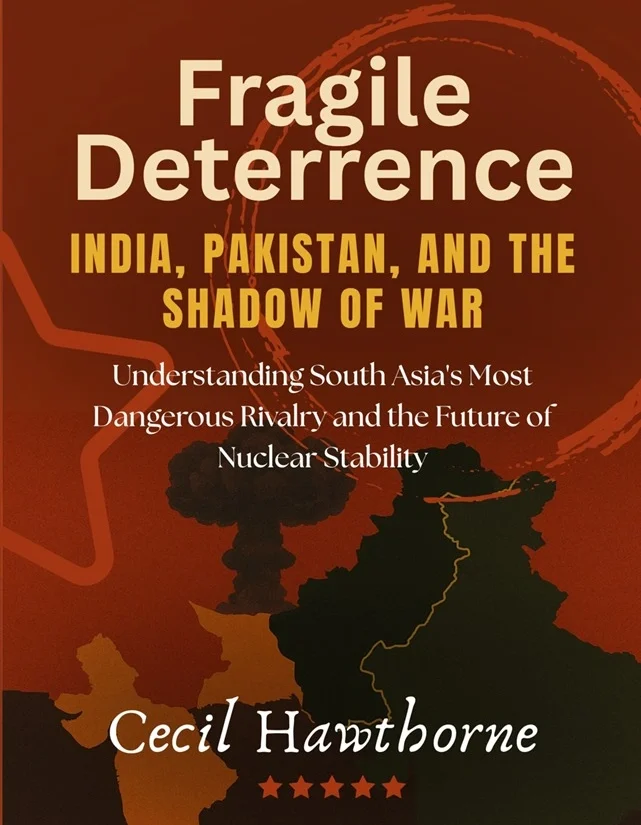
Fragile Deterrence: India, Pakistan, and the Shadow of War is the most urgent and comprehensive analysis yet written of the world’s most dangerous nuclear standoff — a rivalry that in 2025 is more volatile, more unpredictable, and more capable of catastrophic escalation than at any point in its 78-year history.
Two nuclear-armed nations. Over 300 nuclear warheads between them. A disputed border that has sparked four wars. A peace built not on trust — but on fear of mutual annihilation.
Along the Line of Control in Kashmir, soldiers peer at each other through cracked binoculars. A single gunshot, a misplaced patrol, a wrongly attributed terror attack — any one of these could unleash a catastrophe that would kill millions within hours and poison the planet for generations. Yet somehow, for nearly eight decades, the unthinkable has been avoided. But for how much longer?
In 2025, the India-Pakistan rivalry has entered its most dangerous phase. Prime Minister Modi’s third term has brought unprecedented nationalist assertiveness to India’s foreign policy. Pakistan remains politically unstable, its fragile civilian government dependent on a military establishment with its own strategic agenda. Both nations have expanded and modernized their nuclear arsenals. Cyberwarfare, AI-guided surveillance, and space-based intelligence have added explosive new variables to an already volatile equation.
Drawing on rigorous geopolitical analysis and military strategy, Cecil Hawthorne traces the full arc of this deadly rivalry — from the traumatic partition of 1947, through four wars and the nuclear tests of 1998, to the Pulwama-Balakot crisis of 2019 and the new flashpoints of 2024-2025.
The work investigates several key questions:
– How does a peace built entirely on fear remain stable — and when does it shatter?
– Could a single terrorist attack, cyber incident, or military miscalculation trigger a nuclear exchange?
– What would it take for India and Pakistan to step back from the brink — and is anyone capable of stopping them?
Structured across four devastating parts — the birth of the rivalry, the logic of deterrence, the 2025 powder keg, and three crisis scenarios — Fragile Deterrence delivers the clearest, most analytically rigorous account available of why South Asia remains the most dangerous place on Earth.
Perfect for readers interested in nuclear strategy, South Asia, geopolitics, military history, and the future of global security.
Key Themes
• The India-Pakistan rivalry: from partition to nuclear deterrence
• The stability-instability paradox: how nuclear weapons enable small wars
• 2025 flashpoints: Kashmir, terrorism, cyberwarfare, and nationalist politics
• Three crisis scenarios: managed rivalry, accidental escalation, deliberate showdown
• The role of the US, China, and Russia — and why their leverage is failing
















Reviews
There are no reviews yet.