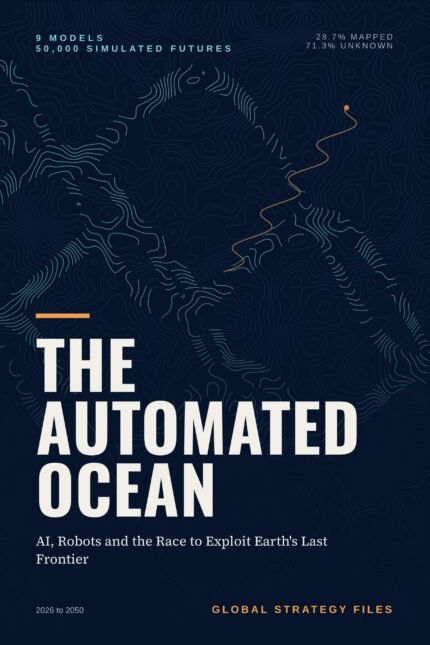
The last frontier on Earth is being opened by machines
Seven tenths of the planet lies under water, and most of it has never been seen in detail. That is changing fast. Uncrewed survey vessels, autonomous underwater robots, AI that reads sonar and satellite images, digital twins of entire seas and robotic systems for wind farms, fish farms, cables and the deep seabed are turning the ocean into the next great arena of economic and strategic competition.
The Automated Ocean measures that transition with an original model. The GSF Ocean Frontier Model links nine modules (mapping, access costs, fisheries, blue food, offshore wind, deep sea minerals, subsea cables, national power and scenarios) and runs them year by year from 2026 to 2050. Each chapter states what the data show, what the model finds and what it means for governments, investors and the ocean itself.
What the model finds
- The mapping clock: only 28.7 percent of the seafloor is mapped at modern resolution. At the current pace the world reaches 80 percent around 2085. A fleet of about 250 uncrewed survey vessels could reach 95 percent by 2040, for 0.8 to 1.6 billion dollars against 3.3 billion by conventional ships.
- The 92 percent rule: AI makes fishing fleets far more efficient, but efficiency without enforcement is a trap. In the model, smarter fleets alone leave stocks at 13 percent of their optimum by 2050. The same technology used for monitoring and control reverses the outcome.
- Blue food: automated offshore aquaculture could add about 50 million tonnes and lift supply to nearly 30 kilograms of fish per person by 2050.
- Offshore wind: robotic inspection and maintenance cut the cost of energy by 7.6 percent for fixed turbines and 11 percent for floating ones, worth about 10 billion dollars a year.
- Deep sea minerals: despite about 12 trillion dollars of gross metal value in the Clarion Clipperton Zone, a Monte Carlo test gives a typical nodule project only a 47 percent chance of positive net present value.
- Subsea cables: a coordinated attack cutting 40 cables would take about 51 days to repair with today’s fleet, and 29 days with robotic repair capacity.
- The ocean economy: from about 3.5 trillion dollars today to about 7 trillion by 2050, with scenario probabilities of 34, 48 and 18 percent.
- The Blue Power Index: an original ranking of 30 countries on ocean technology, data, industry, naval reach and governance.
Inside the book
- 307 pages, 27 chapters in eight parts: the last frontier, seeing the ocean, feeding ten billion, powering and watering the planet, the deep, living on and under the sea, power and conflict at sea, and limits and futures.
- An atlas of nine plates: a world map of untapped riches, how little has been touched, the metal endowment of a single abyssal plain, the energy of the sea, three trajectories for the ocean economy, the timeline of a frontier not yet opened and the shape of ocean power.
- More than 40 original figures and dozens of tables, with sensitivity tests for every key result.
- Nine annexes: the model methodology, data sources, Blue Power Index inputs and country profiles, a glossary, a bibliography, year by year model results, a chronology of the automated ocean and questions for further research.
Written for policy makers, investors, naval and maritime professionals, researchers and anyone who wants numbers rather than slogans about the future of the sea.






Reviews
There are no reviews yet.