

Shrinking and Slack: The Beveridge Curve Paradox of a Contracting Workforce

Germany combines rising unemployment of about 3 million with persistent skill shortages and a workforce that has started to shrink. A quarterly Beveridge curve, a matching function and a stock-flow model show an outward shift of the curve, an 8 to 15 percent loss of matching efficiency since 2019 and a structural unemployment rate of about 5.9 percent. Projections to 2030 show unemployment stalling at that floor while labour demand goes unmet.

China Shock 2.0: A Regional Map of Germany’s Automotive Exposure
Germany is living its own China shock. Our Monte Carlo decomposition attributes about half of the 82,500 motor vehicle jobs lost since 2022 to China, mainly through the collapse of exports, and a shift-share index shows exposure up to 2.8 times the national average in some Laender and 8 times in the most dependent districts, with fiscal losses in auto towns running four to ten times faster than job losses.

The End of Bund Scarcity: Term Premium, ECB Hikes and Germany’s Policy-Mix Collision
The debt-brake reform and the special funds have turned the Bund from Europe's scarcest safe asset into a growing supply, just as the ECB hikes into the Iran energy shock. Decomposing ten-year yields, we find the term premium explains about three-quarters of the rise since 2024, while the 2026 move is mostly policy. On today's curve federal interest more than doubles to about EUR 71 billion by 2030.

The Point of No Return: Estimating the Irreversibility Threshold of German Chemicals
German base chemicals have run below the profitability threshold for eighteen consecutive quarters, and closures no longer restore the utilisation of the survivors. This paper estimates the closure threshold at about 81 percent utilisation, maps an irreversibility frontier and projects that Germany is likely to become a net importer of core chemicals around 2029.
Survivor Elasticity: Why Germany’s Second Energy Shock Hits a Different Industry Than 2022
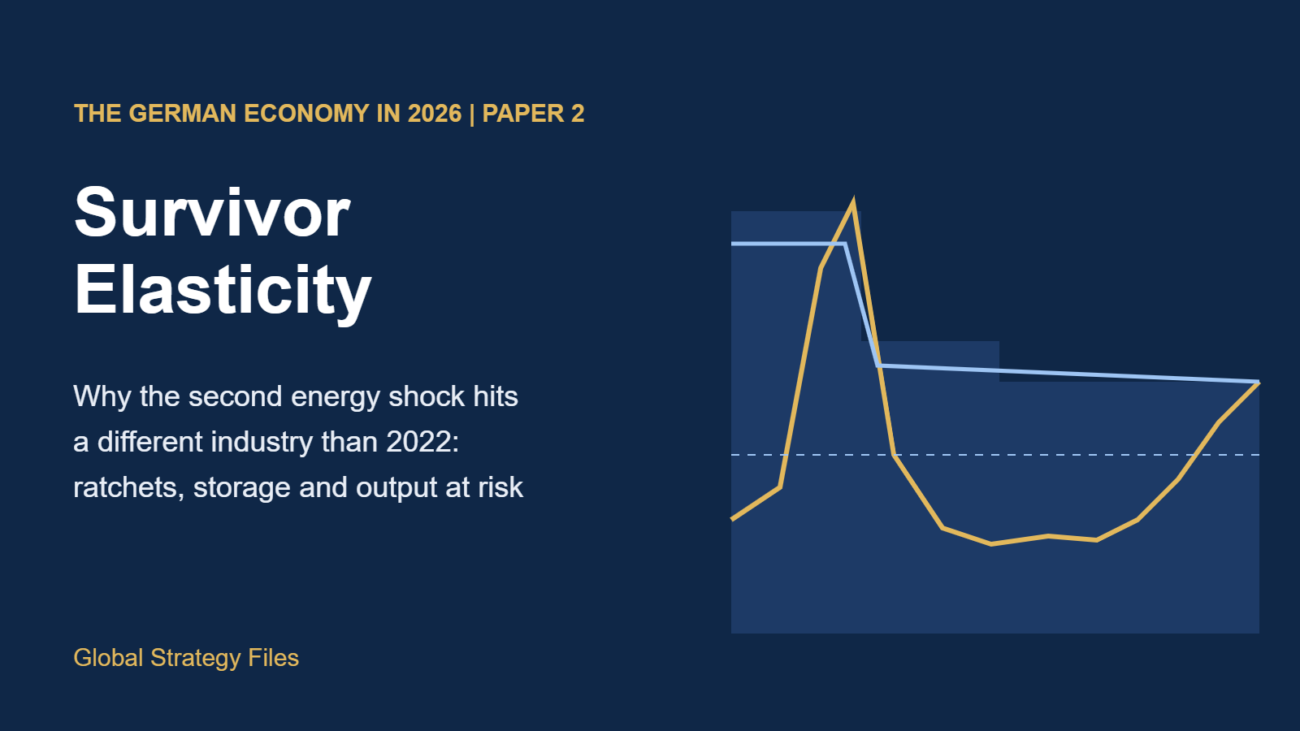
The 2022 gas shock permanently removed the most gas-sensitive part of German energy-intensive industry, and the survivors now respond four to five times less to gas prices. A hysteresis model, a storage Monte Carlo and an output-at-risk simulation show that the real danger of winter 2026/27 lies in low storage and a long tail of irreversible closures, not in the price level itself.

The Vertical Offset: Municipal Insolvency as the Hidden Brake on Germany’s Federal Investment Push
German municipalities ran a record EUR 31.9 billion deficit in 2025 and their current balance has all but vanished. This paper shows that the municipal squeeze cancels roughly one euro of own investment for every euro of special-fund money reaching the municipalities, offsetting a fifth to almost a third of the federal investment push, and quantifies what relief would be needed to stop the real decline.

Rentenangst: Quantifying How Pension Reform Uncertainty Freezes German Consumption
Germany's 2026 consumption freeze is above all a saving freeze driven by monetary policy and the energy shock. A pension-debate component of about 0.10 points of income is measurable, less than half of what the commission's proposals rationally imply, and could cost up to 0.24 percent of GDP in 2027 if the reform is legislated in disorder.

Cleansing or Destruction? Decomposing Germany’s 21-Year Insolvency High
Germany's 2026 insolvency wave is mostly a return to normal after the zero-rate era: an insolvency equation estimated on pre-2020 data attributes about 70 percent of the 2026 excess to interest-rate normalisation and pandemic catch-up. The Iran war added about 1,500 cases, half of the pandemic insolvency deficit is still unreleased, and 2027 is likely to bring about 26,700 corporate insolvencies.

Can Tanks Replace Cars? Import Leakage and Labour Reallocation in Germany’s Rearmament
Germany is raising defence spending towards 3.5 percent of GDP by 2029, but only 57 cents of each additional defence euro become German real value added and the effective multiplier is about 0.48. Our labour reallocation model finds that defence can absorb only about one in seven car industry job losses by 2029, with the jobs concentrated in the wrong regions.
The Absorption Trap: How Much of Germany’s EUR 500 Billion Infrastructure Fund Becomes Construction Inflation Rather Than Capital
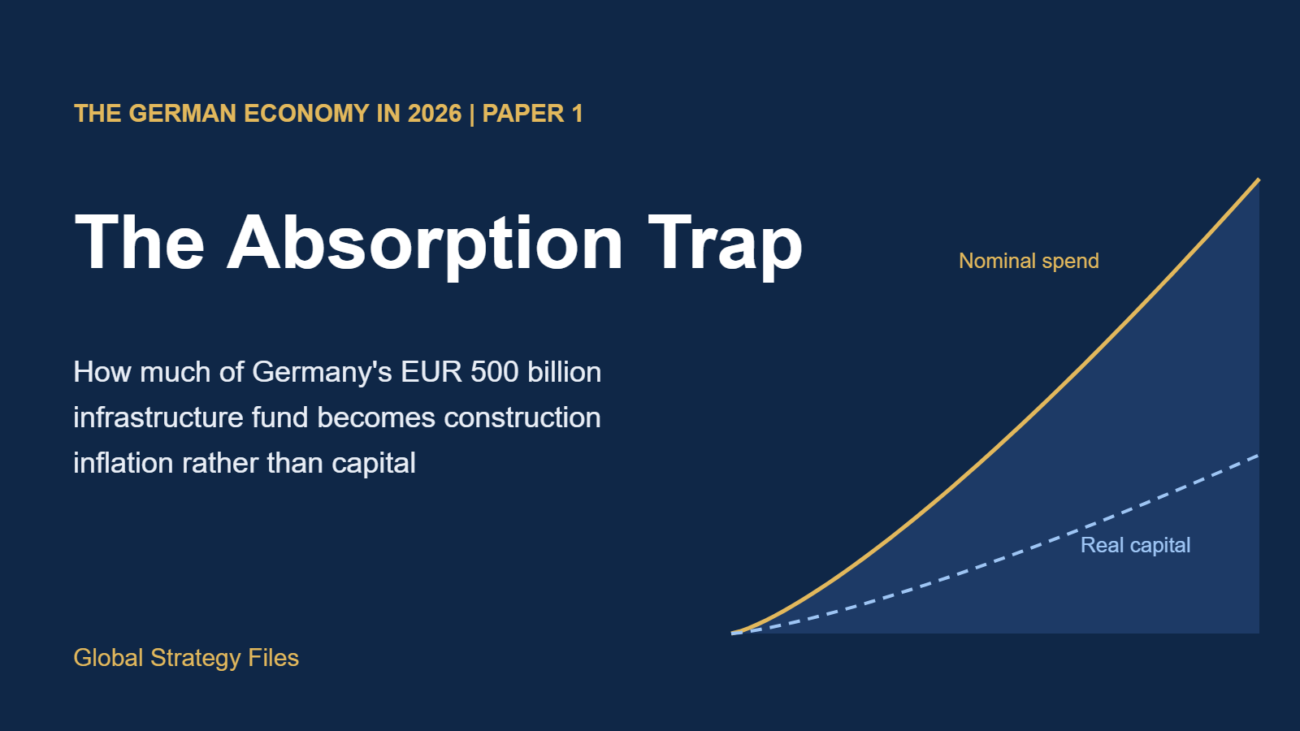
Germany's EUR 500 billion infrastructure fund is now paying out faster than the construction sector can build. Using monthly turnover, price and disbursement data, this paper shows that the share of new spending lost to excess construction inflation tripled in four months, and that each borrowed euro adds only about 38 cents of genuinely new real capital.