
The Ageing Bill: Growth, Pensions and Debt in Five Economies to 2050

The Ageing Bill: Growth, Pensions and Debt in Five Economies to 2050
Driss EFFINA, PhD Independent Researcher, Global Strategy Files Foresight, prospective note No. 1, 20 October 2026. Reading time: about 55 minutes
Key takeaways
- Ageing is a problem of the next decade: Canada’s old-age dependency ratio overtook the United Kingdom’s in 2025, and slower working-age population growth cuts potential growth by 0.23 to 0.76 points a year in 2026 to 2035 relative to 2000 to 2019.
- Under a no-reform rule, age-related spending rises by 2.8 to 7.1 points of GDP by 2050; official French and German projections are far lower because they assume pensions keep falling behind wages, a reform credit worth 65 and 42 points of GDP of debt.
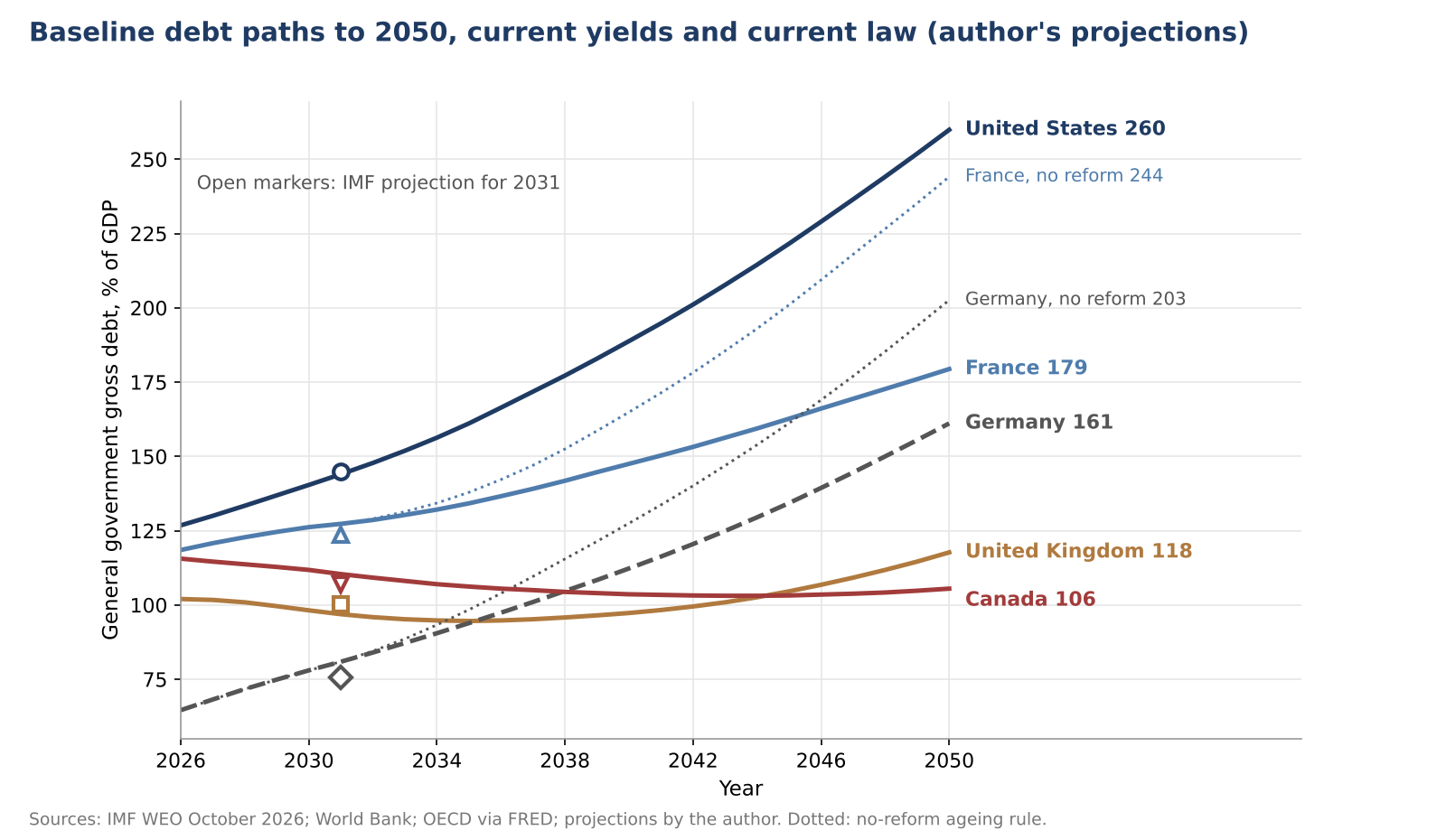
- At September 2026 yields and under current law, only Canada stabilises its debt; the permanent adjustment needed to return to 2026 debt levels by 2050 is 5.0 percent of GDP in the United States, 3.5 in Germany, 2.1 in France and 0.5 in the United Kingdom.
- Germany has the lowest debt but the second-largest fiscal ageing gap, and an AI productivity boost is worth less to German public finances than raising the pension age by two years; in France, the United States and Canada, productivity is the strongest domestic lever.
Abstract
Population ageing is usually treated as a slow problem for the 2040s. This note argues that for the United States, the United Kingdom, France, Germany and Canada it is a problem of the next ten years, now amplified by the rise in bond yields since February 2026. Using World Bank population projections to 2050 and the IMF World Economic Outlook of October 2026, it builds four original tools: a demographic growth-accounting decomposition, an estimate of age-related spending under a uniform “no-reform” rule compared with official projections, a debt model to 2050 at current market yields, and a “fiscal ageing gap”, the permanent adjustment needed to bring debt in 2050 back to its 2026 level. It then quantifies five policy levers and four scenarios.
The results overturn several common assumptions. The countries usually described as demographically young are ageing fastest now: Canada’s old-age dependency ratio overtook the United Kingdom’s in 2025 and rises by 0.88 points a year between 2025 and 2030, a pace exceeded only by Germany. Over 2026 to 2035, the slowdown of the working-age population subtracts between 0.23 and 0.76 percentage points a year from potential growth relative to 2000 to 2019; Canada suffers the largest swing relative to its own recent past (0.89 points a year). Under a rule in which spending per older person keeps pace with incomes, age-related spending rises by 2.8 to 7.1 percentage points of GDP by 2050; official projections for France and Germany are far lower because legislated indexation and pension-age rules are assumed to hold, a “reform credit” worth 65 and 42 points of GDP of debt by 2050. At current yields and under current law, only Canada stabilises its debt. Germany, with the lowest debt ratio of the five, has the second-largest fiscal ageing gap (3.5 percent of GDP), and an artificial intelligence productivity boost is worth less to Germany’s public finances than raising the pension age by two years.
Keywords: population ageing, demographic drag, potential growth, pensions, health spending, public debt, fiscal sustainability, interest-growth differential, migration, retirement age, United States, United Kingdom, France, Germany, Canada
JEL codes: H55, H63, H68, J11, E62, O47
Key findings
1. The “young” economies are ageing fastest now. Canada’s old-age dependency ratio (people aged 65 and over per 100 aged 15 to 64) passed the United Kingdom’s in 2025 and rises by 6.8 points by 2035, as much as France’s. The United States adds 12.8 points between 2015 and 2035, against 8.2 for the United Kingdom. 2. Demography cuts potential growth by up to three quarters of a point a year. Relative to 2000 to 2019, the slower growth of the working-age population subtracts 0.64 points a year from US potential growth in 2026 to 2035, 0.23 in the United Kingdom, 0.51 in France, 0.76 in Germany and 0.74 in Canada. Germany’s potential growth turns slightly negative (minus 0.2 percent a year) on the World Bank population path, and the IMF’s medium-term growth forecasts for Germany, Canada and France require labour productivity growth 0.7 to 1.1 points a year faster than in 2015 to 2025. 3. The ageing bill is 3 to 7 points of GDP, and official numbers already bank most of the savings in Europe. Under a no-reform rule, age-related spending rises by 2.8 points of GDP by 2050 in the United States, 3.2 in the United Kingdom and Canada, 6.9 in France and 7.1 in Germany. Current-law projections imply 0.0 for France and 1.4 for Germany. The difference is a reform credit that is worth 65 points of GDP of French debt and 42 points of German debt by 2050, and that depends on pensions continuing to fall behind wages. 4. Only Canada can stabilise its debt without new measures. At September 2026 yields and current-law ageing costs, the author’s projections put general government debt in 2050 at 260 percent of GDP in the United States, 179 percent in France, 161 percent in Germany, 118 percent in the United Kingdom and 106 percent in Canada. The permanent primary adjustment needed to return to 2026 debt levels by 2050 is 5.0 percent of GDP in the United States, 3.5 in Germany, 2.1 in France, 0.5 in the United Kingdom and minus 0.4 in Canada. 5. Germany’s fiscal space shrinks much faster than its debt ratio suggests, and the best lever differs by country. Per 10 points of current debt, Germany’s adjustment need is three times France’s. Excluding migration, the strongest domestic lever is the pension age in Germany and productivity in France, the United States and Canada, where pensions in payment are price-indexed; in the United Kingdom, the triple lock makes the two equal.
1. Introduction
Every advanced economy knows it is ageing. Almost none has priced the cost of ageing at the interest rates of October 2026. Since the end of February, when the war involving Iran disrupted the Strait of Hormuz, ten-year government bond yields have risen by 70 to 140 basis points across the five economies studied here. The first note of this series, Decoded No. 1, showed who pays for that shock in the short run. This note asks a longer question: what happens when a permanent shift in demography meets a world in which the interest rate on public debt is no longer below the growth rate of the economy?
Ageing affects public finances through three channels at once. It slows the growth of the working-age population and of potential output, which raises the debt ratio through a smaller denominator. It raises spending on pensions, health and long-term care, which worsens the primary balance. And by lowering growth while market yields are set globally, it widens the gap between the interest rate and the growth rate (the “r minus g” differential) that decides whether a deficit is sustainable. Official projections usually treat these channels separately, country by country, and almost none is made at today’s yields.
This note builds a single, transparent framework and applies it consistently to five economies. It uses two primary datasets, the World Bank population projections to 2050 and the IMF World Economic Outlook database of October 2026, plus a few structural facts from official sources: OECD employment rates by age and sex, current age-related spending from the US Congressional Budget Office (CBO), the UK Office for Budget Responsibility (OBR), the European Commission’s 2024 Ageing Report and the Canadian Parliamentary Budget Officer (PBO), and the average maturity of government debt.
Four questions organise the note. How large is the demographic drag on growth? How much will age-related spending rise if nothing changes, compared with official projections? Which countries can stabilise public debt at current yields? And which lever, among later retirement, higher employment, more immigration and faster productivity, buys the most fiscal room in each country? The answers are more uneven than the familiar contrast between “old Europe” and “young North America” suggests. Section 2 sets out the demographic arithmetic. Section 3 measures the demographic drag on growth. Section 4 estimates the ageing bill. Section 5 projects debt to 2050. Section 6 presents scenarios. Section 7 ranks the five countries by their fiscal ageing gap. Section 8 quantifies the policy levers. Section 9 proposes a dashboard of leading indicators, Section 10 draws implications for policy and investors, and Section 11 lists what to watch until mid-2027. All projections in this note are the author’s own and are labelled as such.
2. The demographic arithmetic, 2025 to 2050
2.1 Who ages fastest
The old-age dependency ratio measures the number of people aged 65 and over for every 100 people of working age (15 to 64). It is the simplest summary of the pressure that ageing puts on pension systems, since most pensions are paid by the contributions and taxes of the working-age population.
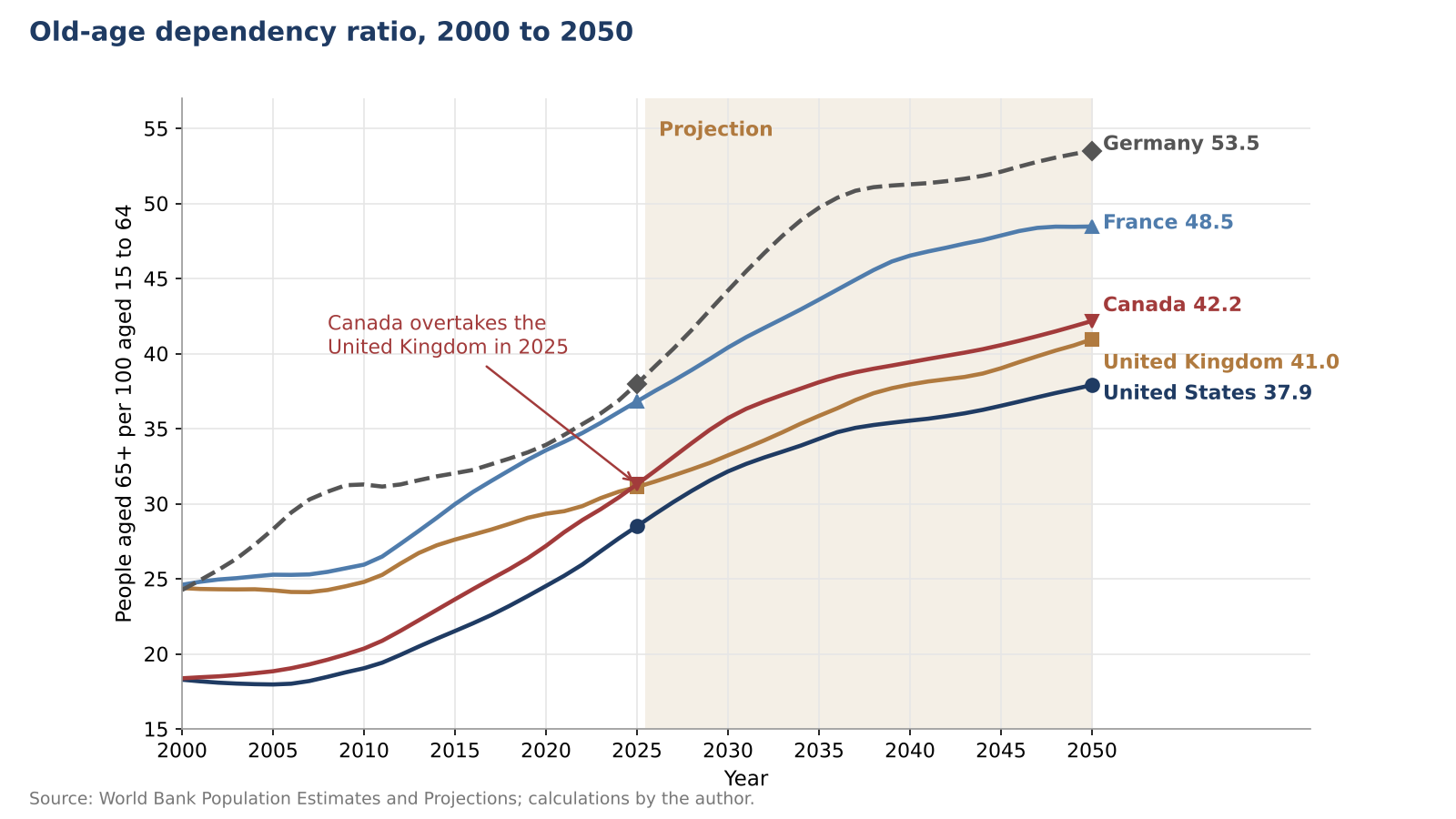
Figure 1 shows the ratio from 2000 to 2050. In 2025, Germany (38.0) and France (36.8) are the oldest of the five, Canada (31.3) and the United Kingdom (31.1) are close behind, and the United States (28.5) is the youngest. By 2050, the ranking at the top is unchanged: Germany reaches 53.5 and France 48.5. But the middle of the ranking moves. Canada passed the United Kingdom in 2025 and stays ahead, at 42.2 against 40.9 in 2050. The United States remains the youngest, at 37.9, but it is not ageing slowly: its ratio rose by 7.0 points between 2015 and 2025, more than any other country in this sample except Canada (7.7); France added 6.8 points, Germany 6.0 and the United Kingdom 3.5.
| Indicator | United States | United Kingdom | France | Germany | Canada |
|---|---|---|---|---|---|
| Old-age dependency ratio, 2025 | 28.5 | 31.1 | 36.8 | 38.0 | 31.3 |
| Old-age dependency ratio, 2035 | 34.3 | 35.8 | 43.6 | 49.7 | 38.1 |
| Old-age dependency ratio, 2050 | 37.9 | 40.9 | 48.5 | 53.5 | 42.2 |
| Change 2015 to 2035, points | 12.8 | 8.2 | 13.6 | 17.7 | 14.5 |
| People aged 15 to 64 per person 65+, 2025 to 2050 | 3.51 to 2.64 | 3.21 to 2.44 | 2.72 to 2.06 | 2.63 to 1.87 | 3.20 to 2.37 |
| Working-age population, change 2025 to 2050 | +7.0 m (+3.2%) | +1.2 m (+2.6%) | -2.5 m (-5.8%) | -8.3 m (-15.9%) | +1.4 m (+5.2%) |
| Population aged 65+, change 2025 to 2050 | +37.2% | +35.0% | +24.0% | +18.6% | +41.8% |
| Total fertility rate, 2008 and 2024 | 2.07 and 1.63 | 1.91 and 1.55 | 2.01 and 1.61 | 1.38 and 1.36 | 1.70 and 1.25 |
Table 1. The demographic starting point and projections. Source: World Bank Population Estimates and Projections (series SP.POP.DPND.OL, SP.POP.1564.TO, SP.POP.65UP.TO.ZS, SP.POP.TOTL, SP.DYN.TFRT.IN); calculations by the author.
Three features of Table 1 stand out. First, the working-age population still rises in the United States, the United Kingdom and Canada, but very slowly, while Germany loses 8.3 million people of working age (15.9 percent) and France 2.5 million. Second, the older population grows fastest where the population is youngest today: by 41.8 percent in Canada and 37.2 percent in the United States, against 18.6 percent in Germany, where the baby boom is already largely retired. Third, fertility has fallen everywhere since 2008 except in Germany, where it was already low; Canada’s rate of 1.25 in 2024 is now the lowest of the five. By 2050, Germany will have 1.87 people of working age for each person aged 65 and over, and even the United States only 2.64.
2.2 The fiscal clock
Demographic change is gradual, but the fiscal decisions it forces arrive on specific dates. Figure 2 places the main milestones on a single timeline.
In the United States, the youngest baby boomers, born in 1964, turn 65 in 2029. The 2026 Social Security Trustees Report, published on 9 June 2026, projects that the Old-Age and Survivors Insurance trust fund will be depleted in the fourth quarter of 2032, at which point 78 percent of scheduled benefits would be payable, and that the combined retirement and disability funds will be depleted in 2034. The CBO’s long-term outlook of 2026 projects the Medicare Hospital Insurance trust fund to be exhausted in 2040. In the United Kingdom, the State Pension age started rising from 66 to 67 in April 2026 and will reach 67 by April 2028; the rise to 68 is legislated for 2044 to 2046, and a review launched in 2025 may change the later timetable.
In France, the social security financing law for 2026, adopted on 16 December 2025, suspended the acceleration of the 2023 pension reform for people born from 1964 to 1968, from 1 September 2026 through 2028; the presidential election follows on 18 April and 2 May 2027. In Germany, the retirement age reaches 67 in 2031, and the pension package adopted on 5 December 2025 holds the pension level at 48 percent until 2031, alongside the “Aktivrente”, a tax incentive to work beyond the statutory age from January 2026. In Canada, the 2026 to 2028 Immigration Levels Plan sets permanent admissions at 380,000 a year and aims to bring temporary residents below 5 percent of the population by the end of 2027, while the PBO projects federal elderly benefits to peak at 2.9 percent of GDP in 2032.
2.3 The speed of ageing
The level of the dependency ratio is less informative than its speed, because the speed determines how quickly spending must adjust. Figure 3 offers four complementary views, and Figure 4 maps the speed of ageing by five-year period.
The working-age population (top left panel of Figure 3) tells the clearest story. In Germany it falls by about one percent a year until the mid-2030s; in France it declines steadily; in Canada, the surge of 2022 to 2024, driven by temporary immigration, gives way to a near-flat path. The support ratio (bottom left), the share of the population aged 15 to 64, falls everywhere, to about 61 percent in 2050 in the United States, the United Kingdom and Canada and about 57 percent in France and Germany.
Figure 4 identifies the peak of the ageing wave. For France and the United Kingdom, the fastest increase in the dependency ratio came in 2010 to 2015, when the first baby boomers turned 65. For the United States, it was 2020 to 2025 (0.80 points a year). For Germany and Canada, the peak is now: 2025 to 2030, at 1.24 points a year in Germany and 0.88 in Canada. Canada’s dependency ratio is rising faster in the second half of the 2020s than France’s (0.72) or the United Kingdom’s (0.42). This is the first non-obvious finding of this note: the country usually presented as the demographic success story of the G7 is in the steepest phase of its ageing wave, and has just cut immigration, its main counterweight.
A first look at the results
The full note goes much further, with original models, scenarios and a dashboard of leading indicators. Two of its 13 charts and diagrams are shown below.
Continue reading
Get the full note: 25 pages, 13 charts and diagrams, 7 tables
This page shows the first part of the note. The full PDF adds: growth: measuring the demographic drag; the ageing bill: age-related spending to 2050; debt dynamics to 2050; scenarios to 2050; the fiscal ageing gap: who can still stabilise debt?; policy levers: what buys the most fiscal room?; a leading-indicators dashboard; implications for policy and for investors; what to watch.
29 USD, instant PDF download, secure card payment.
Buy the full noteNeed this analysis for your organisation?
We prepare confidential briefings, executive talks and studies on countries, markets and policies, built on the same method as this article.
Request a briefingSupport independent analysis
Our studies are free to read and carry no advertising. If this one was useful, a small contribution helps us publish the next.
Support our workGo further: books by Global Strategy Files

Frequently asked questions
How much will population ageing cost the United States, United Kingdom, France, Germany and Canada?
Under a rule in which spending per older person keeps pace with incomes, public spending on pensions, health and long-term care rises between 2025 and 2050 by about 2.8 percent of GDP in the United States, 3.2 percent in the United Kingdom and Canada, 6.9 percent in France and 7.1 percent in Germany. Official projections are lower in France and Germany because current law lets pensions grow more slowly than wages.
How much does demographic change reduce economic growth?
Slower growth of the population aged 15 to 64 subtracts, relative to 2000 to 2019, about 0.64 percentage points a year from US potential growth in 2026 to 2035, 0.23 in the United Kingdom, 0.51 in France, 0.76 in Germany and 0.74 in Canada. On the World Bank population path, Germany’s potential growth turns slightly negative, at about minus 0.2 percent a year over the next decade.
Which of these countries can stabilise public debt by 2050?
At September 2026 bond yields and with current-law ageing costs, only Canada keeps its debt ratio below its 2026 level by 2050, at about 106 percent of GDP. The author’s projections put debt at about 260 percent of GDP in the United States, 179 percent in France, 161 percent in Germany and 118 percent in the United Kingdom, unless budgets are tightened permanently.
Which policy lever does most to offset the fiscal cost of ageing?
At the sizes tested, higher net migration is the strongest lever everywhere. Among domestic levers, raising the pension age by two years matters most in Germany, where pensions follow wages, while faster productivity growth matters most in France, the United States and Canada, where pensions in payment are indexed to prices. In the United Kingdom the triple lock makes both levers equally valuable.
Sources
- World Bank, Population Estimates and Projections (data source 40) and World Development Indicators: SP.POP.DPND.OL, SP.POP.1564.TO, SP.POP.65UP.TO.ZS, SP.POP.TOTL, SP.DYN.TFRT.IN; retrieved 20 October 2026.
- International Monetary Fund, World Economic Outlook database, October 2026, and Fiscal Monitor indicators, via DataMapper API: GGXWDG_NGDP, GGXCNL_NGDP, GGXONLB_G01_GDP_PT, GGR_G01_GDP_PT, G_X_G01_GDP_PT, NGDP_RPCH; retrieved 20 October 2026.
- International Monetary Fund, Public Finances in Modern History database: interest expense (ie) and primary balance (pb); retrieved 20 October 2026.
- OECD, Infra-Annual Labour Statistics, via Federal Reserve Bank of St. Louis (FRED): LREM64TTUSA156N, LREM64TTGBA156S, LREM64TTFRA156N, LREM64TTDEA156S, LREM64TTCAA156S, LREM55TTUSA156S, LREM55TTGBA156S, LREM55TTFRA156S, LREM55TTDEA156S, LREM55TTCAA156S, LREM64FEUSA156S, LREM64FEGBA156S, LREM64FEFRA156S, LREM64FEDEA156S, LREM64FECAA156S; retrieved 20 October 2026.
- OECD, long-term interest rates (10-year government bond yields), monthly, via FRED; Bank of Canada Valet API, BD.CDN.5YR.DQ.YLD; US EIA via FRED, DCOILBRENTEU; retrieved 20 October 2026.
- Congressional Budget Office, The Long-Term Budget Outlook: 2026 to 2056 (2026), as summarised by the Peter G. Peterson Foundation and the National Fiscal Commission, March 2026.
- Social Security Administration, 2026 Annual Report of the Board of Trustees of the OASI and DI Trust Funds, press release of 9 June 2026.
- Office for Budget Responsibility, Fiscal risks and sustainability, July 2026 (published 7 July 2026).
- Intergenerational Foundation, “Unsustainable, unpredictable, and unfair: the OBR highlights why the triple lock on the State Pension must go”, 15 July 2025.
- European Commission, 2024 Ageing Report: Economic and Budgetary Projections for the EU Member States (2022 to 2070), Institutional Paper 279, and France country fiche.
- Conseil d’orientation des retraites, document on the 2024 Ageing Report, November 2024.
- Parliamentary Budget Officer (Canada), Fiscal Sustainability Report 2024 (28 August 2024) and Fiscal Sustainability Report 2023 (27 July 2023).
- Canadian Institute for Health Information, National health expenditure trends, 2024: snapshot.
- Immigration, Refugees and Citizenship Canada, Immigration Levels Plan briefing to the Standing Committee on Citizenship and Immigration, March 2026.
- Loi de financement de la securite sociale pour 2026 (France), adopted 16 December 2025, as described by CMS Francis Lefebvre and quelles-aides.fr.
- Bundesregierung, statement on the adoption of the Rentenpaket 2025 by the Bundestag, 5 December 2025; PwC Germany, “Bundesrat stimmt Rentenpaket 2025 zu”, 19 December 2025.
- Deutsche Rentenversicherung, statement on the final report of the Alterssicherungskommission, 23 June 2026.
- Noerr, “Bundestag approves exemption from the debt brake for defence spending and special funds for investments in infrastructure and climate protection”, March 2025.
- Royal London, “State Pension age increase: what you need to know”.
- Coutts, “Autumn Budget 2026: the key dates to look out for”.
- 2027 French presidential election dates, as reported by Reuters (1 July 2026).
- Global Strategy Files, Decoded No. 1, “Five Bond Markets, One Shock: Who Really Pays for the 2026 Yield Surge”, October 2026.
