
Germany’s Debt Brake Holiday: Crowding In or Crowding Out?

Driss EFFINA, PhD Independent Researcher, Global Strategy Files Decoded, analysis note No. 9, 24 October 2026. Reading time: about 55 minutes
Key takeaways
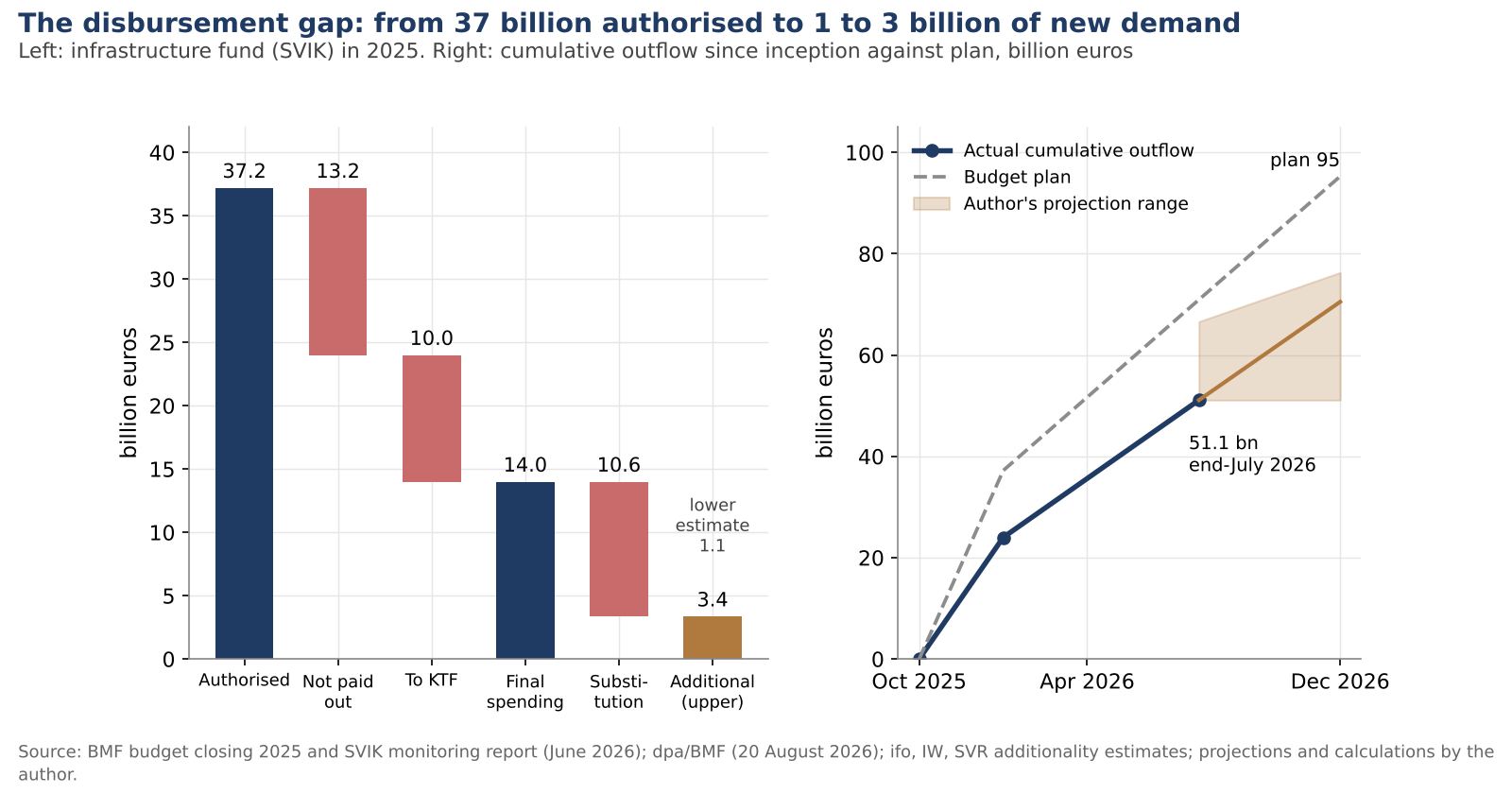
- In 2025 the infrastructure fund was authorised to spend 37.2 billion euros, paid out 24.0 billion, spent 14.0 billion after a transfer to the climate fund, and added only 1.1 to 3.4 billion of new demand: 3 to 9 percent of the authorisation.
- The fiscal impulse reaches about 2 percent of GDP by 2028, 61 percent of it defence; the author’s central output effect is 1.26 percent of GDP, an implied multiplier of 0.64, close to the Bundesbank’s estimate.
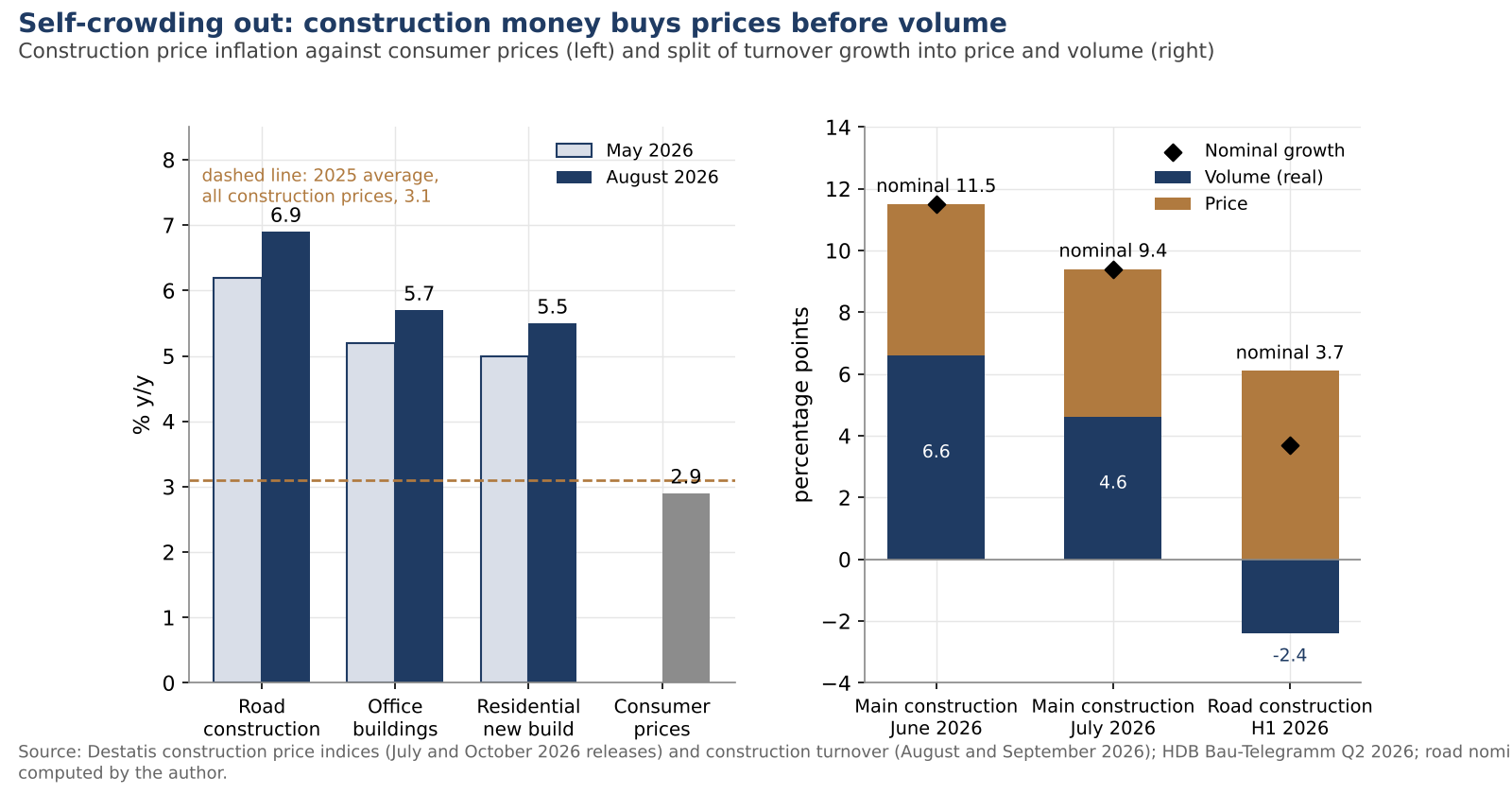
- Construction money buys prices before volume: road construction prices rose 6.9 percent against consumer prices of 2.9 percent while real road output fell; the author’s absorption indicator is 39 out of 100 for civil engineering and 40 for defence.
- Interest rate crowding out is small: German supply has cost Bunds about 14 basis points of scarcity premium, 13 percent of their rise since February 2025, and mechanically narrowed every euro area spread over Bunds by the same amount.
Abstract
In March 2025 Germany amended its constitution to exempt defence spending above 1 percent of GDP from the debt brake, to create a 500 billion euro fund for infrastructure and climate neutrality over twelve years and to give the Länder a structural deficit allowance of 0.35 percent of GDP. Eighteen months later the federal government plans net borrowing of 181.5 billion euros in 2026 including special funds, the ten-year Bund yield stands at 3.42 percent, close to its highest level since 2011, and the economy is expected to grow 1.3 percent this year after three years of contraction or near-stagnation. Is the new borrowing pulling in private investment, or bidding up prices and interest rates? This note follows the money from borrowing authority to output. It measures the disbursement gap between what was authorised, paid out and genuinely added; estimates the impulse and its output effect by spending type; weighs crowding-in channels against crowding-out channels; builds an original absorption capacity indicator for construction and the defence industry; and splits the movement in euro area spreads since 2025 into a German supply component and a country component. The answer is neither textbook crowding in nor textbook crowding out. The infrastructure money has so far mostly replaced spending the core budget would have made, the impulse is led by defence, and where new demand does reach construction it buys prices before volume. Interest rate crowding out is real but small. Scenarios to 2028 with probabilities, a dashboard of twelve indicators and a calendar to mid-2027 complete the analysis.
Keywords: Germany, debt brake, Schuldenbremse, special fund, Sondervermögen Infrastruktur und Klimaneutralität, defence spending, fiscal multiplier, crowding out, crowding in, Bund yields, construction prices, euro area spreads, France, Italy
JEL codes: E62, H54, H56, H63, E43, F42
Key findings
1. A large disbursement gap in 2025. Of the 37.2 billion euros authorised from the infrastructure fund (SVIK) in 2025, 24.0 billion flowed out, 10.0 billion of which was a transfer to the Climate and Transformation Fund (KTF), leaving 14.0 billion of final spending. Only 1.1 to 3.4 billion was additional to what the core budget would have financed: 3 to 9 percent of the authorisation, 0.03 to 0.08 percent of GDP. Net borrowing including special funds was about 103 billion euros against 142 billion planned. 2. Pace is not the binding problem in 2026; additionality is. Cumulative SVIK outflows reached 51.1 billion euros by end-July 2026, 10.2 percent of the fund after 6.9 percent of its life. The author projects 43 to 52 billion euros of outflows in 2026 (73 to 90 percent of plan). But the best estimates put the additional share at only 40 to 45 percent. 3. A defence-led impulse with a modest multiplier. The author estimates the fiscal impulse at about 2.0 percent of GDP by 2028 relative to 2025, 61 percent of it defence and 13 percent additional infrastructure. The central GDP level effect is 1.26 percent in 2028 (range 0.62 to 2.43), an implied multiplier of 0.64. Infrastructure accounts for 21 percent of the output effect; if the planned infrastructure outlays were fully additional, they alone would add about 0.9 percent of GDP. 4. Self-crowding out in construction. Road construction prices rose 6.9 percent in the year to August 2026 against consumer price inflation of 2.9 percent, although machinery utilisation in civil engineering (73.2 percent) is below its ten-year average (76.1 percent). Prices accounted for 43 to 51 percent of nominal construction turnover growth in mid-2026, and all of it in road building. The author’s absorption capacity indicator stands at 39 out of 100 for civil engineering (50 in 2025) and 40 for the defence industry. Planned additional infrastructure demand in 2027 equals about 17 percent of public construction turnover, four times the spare machinery capacity. 5. Interest rate crowding out is real but small. The German-specific component of the Bund yield, measured by the Netherlands minus Germany spread, fell from 23 to 9 basis points between February 2025 and September 2026: 14 basis points, or 13 percent of the 107 basis point rise in the ten-year Bund yield over the period. A debt-based cross-check gives 19 to 25 basis points; at full repricing the cost is 0.10 to 0.17 percent of GDP a year. Most of the rise is imported. 6. For the euro area, German supply compresses spreads mechanically. Losing 14 basis points of scarcity premium narrows every spread over Bunds by the same amount. Half of Italy’s 29 basis point spread compression since February 2025 is this German effect; France’s spread widened by 22 basis points, and by 36 once the German component is removed. In the author’s scenarios the probability-weighted GDP effect is 1.3 percent by 2028 and the Bund yield averages 3.7 percent in 2028; the main risk is price absorption (25 percent), in which more money buys less volume.
1. Introduction
Germany’s debt brake was the most binding fiscal rule in the euro area. Written into the Basic Law in 2009, it limited the federal government’s structural deficit to 0.35 percent of GDP and the Länder to structural balance. In March 2025, in the last days of the outgoing Bundestag, the CDU, CSU, SPD and Greens changed it. Defence spending above 1 percent of GDP no longer counts against the limit, a 500 billion euro special fund for infrastructure and climate neutrality was created outside it, and the Länder received their own structural allowance. On 5 March 2025, the day after the coalition partners announced the plan, the ten-year Bund yield rose by about 30 basis points, the largest one-day increase since 1990.
The phrase debt brake holiday captures the politics but not the economics: a holiday from a rule is not spending, and spending is not additional demand. Between the constitutional amendment and extra GDP lie at least four stages: appropriation, outflow, final spending and additional demand. At each stage money can leak: into planning delays, into transfers between public funds, into the replacement of spending that would have happened anyway, and, once it does reach the economy, into higher prices rather than higher volume. Figure 1 sets out the chain and the numbers for 2025.
The crowding-in versus crowding-out question is therefore not one question but several. Does the new borrowing reach the economy? Does it add to what the core budget would have spent? When it is spent, does it raise output and private investment, or does it raise construction prices, wages and interest rates that displace private activity at home and in the rest of the euro area? Each answer can be measured, at least approximately, with data available in October 2026.
Sections 2 to 5 cover the reform, the disbursement gap, additionality and the impulse. Sections 6 to 8 weigh crowding in against crowding out and introduce an absorption capacity indicator. Section 9 turns to the euro area, Sections 10 to 13 to scenarios, a dashboard, implications and a calendar. The note does not repeat the analysis of French debt crisis triggers in Foresight No. 4; it uses euro area data only to isolate the German supply effect.
2. What changed in March 2025, and what the budgets say
2.1 The constitutional reform
The reform amended three articles of the Basic Law. It was adopted by the Bundestag on 18 March 2025 by 512 votes to 206 and by the Bundesrat on 21 March 2025 with 53 votes, the two-thirds majority needed. Table 1 summarises the architecture.
Table 1. The March 2025 reform of the debt brake. Sources: Basic Law as amended (Articles 109, 115, 143h); Noerr and DLA Piper legal summaries (March 2025); Bundestag resolution on the investment quota; StruKomLäG of 20 October 2025 as reported in Wirtschaftsdienst (2026).
| Element | Article | Content | Numbers |
|---|---|---|---|
| Defence and security exemption | 115(2) | Spending on defence, civil protection, intelligence services, IT security and aid to states attacked in violation of international law is exempt above a threshold | Threshold: 1 percent of GDP; about 40 billion euros of defence stays inside the regular rule |
| Infrastructure and climate fund (SVIK) | 143h(1) | Credit-financed special fund outside the debt brake for additional investment | 500 billion euros over 12 years; 100 billion to the KTF; 300 billion federal |
| Länder share of the fund | 143h(2) | Infrastructure investment by Länder and municipalities | 100 billion euros, about 8.3 billion a year |
| Additionality condition | 143h(1) | Fund money only if the core budget keeps an appropriate investment ratio | Investment above 10 percent of core spending, excluding the fund and financial transactions |
| Länder structural allowance | 109(3) | Länder may jointly run a structural deficit | 0.35 percent of GDP, 15.15 billion euros in 2025 and 2026, distributed by the Königstein key |
Two design features matter for what follows. The additionality condition applies to planned, not actual, investment, and the planned core investment ratio for 2025 was just 10.0 percent. And the defence exemption has no upper limit: every euro above about 1 percent of GDP can be borrowed.
2.2 The 2025, 2026 and 2027 budgets
The 2025 federal budget was adopted by the Bundestag on 18 September 2025, more than eight months into the year, after the early election. Until then the government operated under provisional budget management, and the fund could only be used from October 2025. The 2026 budget followed quickly: the Bundestag adopted it on 28 November 2025 by 322 votes to 252, and the Bundesrat on 19 December 2025. The 2027 draft, with the financial plan to 2030, was presented in August 2026 and is due for its final vote on 27 November 2026.
Table 2. Federal budgets 2025 to 2027, billion euros. Sources: Bundestag (hib 641/2026 on the Finanzplan 2026 to 2030; hib 71/2026 on the 2025 closing); NWB, ZDF and Boersen-Zeitung reports on the 2025 and 2026 budgets; Bundestag text archive on the 2027 timetable.
| Item | 2025 plan | 2025 outturn | 2026 budget | 2027 draft |
|---|---|---|---|---|
| Core budget spending | 502.6 | about 496 | 524.5 | 555.4 |
| Core net borrowing | 81.8 | 66.9 | 98.0 | 118.7 |
| of which under the defence exemption | n.a. | n.a. | 57.6 | 85.4 |
| Net borrowing incl. special funds | 142 | about 103 | 181.5 | n.a. |
| Defence, Einzelplan 14 | 62.3 | n.a. | 82.7 | 109.8 |
| Bundeswehr special fund outflows | 24.1 | 19.5 | 25.5 | about 30 |
| SVIK outflows (incl. 10 bn to the KTF) | 37.2 | 24.0 | 58.1 | 54.9 (credit) |
| Investment: core, KTF and SVIK | about 117 | just under 87 | 128.7 | 124.0 |
In the financial plan, defence spending in Einzelplan 14 rises to 153.9 billion euros in 2028, once the Bundeswehr special fund is exhausted, and to 183.7 billion in 2030; borrowing under the defence exemption reaches 151.8 billion and core interest spending 80.7 billion in 2030, double the 2027 level. Unresolved gaps of 22 billion euros in 2028, 39 billion in 2029 and 48 billion in 2030 are booked as global spending cuts (Figure 2).
The shift is clear. In 2025 the core budget borrowed under the regular rule only. By 2027 the regular component, about 33 billion euros, is less than a fifth of planned federal borrowing; the defence exemption and the special funds carry the rest. Investment, by contrast, is planned to peak in 2026 at 128.7 billion euros and to fall to 120.0 billion by 2028 and 112.6 billion by 2030. The holiday is increasingly a defence holiday.
A first look at the results
The full note goes much further, with original models, scenarios and a dashboard of leading indicators. Two of its 14 charts and diagrams are shown below.
Continue reading
Get the full note: 27 pages, 14 charts and diagrams, 9 tables
This page shows the first part of the note. The full PDF adds: the disbursement gap; additionality: how much is new money?; the fiscal impulse and its multipliers; crowding in: what the evidence shows so far; crowding out at home: prices, labour and Bunds; an absorption capacity indicator; the euro area: German supply and French and Italian spreads; scenarios to 2028; leading-indicators dashboard.
29 USD, instant PDF download, secure card payment.
Buy the full noteNeed this analysis for your organisation?
We prepare confidential briefings, executive talks and studies on countries, markets and policies, built on the same method as this article.
Request a briefingSupport independent analysis
Our studies are free to read and carry no advertising. If this one was useful, a small contribution helps us publish the next.
Support our workGo further: books by Global Strategy Files

Frequently asked questions
What did Germany change in its debt brake in March 2025?
In March 2025 the Bundestag and Bundesrat amended the Basic Law so that defence and security spending above 1 percent of GDP is exempt from the debt brake, created a 500 billion euro special fund for infrastructure and climate neutrality over twelve years, with 100 billion for the Länder and 100 billion for the climate fund, and allowed the Länder a joint structural deficit of 0.35 percent of GDP.
How much of Germany’s infrastructure fund has actually been spent?
In 2025 the fund paid out 24.0 billion euros of 37.2 billion planned, including a 10 billion euro transfer to the climate fund; the Länder share did not flow. By end-July 2026 cumulative outflows reached 51.1 billion euros, about 10 percent of the fund. Estimates of the additional share range from 5 to 14 percent in 2025 to about 40 to 45 percent from 2026.
Does German fiscal expansion crowd out private investment?
Through interest rates, only slightly. The German-specific premium in Bund yields fell by about 14 basis points between February 2025 and September 2026, 13 percent of the rise in ten-year yields, which mostly reflected global rates, oil and the ECB. The stronger crowding out is in construction, where prices rise faster than volume, and in defence, where orders far outrun production capacity.
How does German borrowing affect French and Italian spreads?
Because spreads are measured against Bunds, the loss of German scarcity premium narrows every spread mechanically. About half of Italy’s 29 basis point spread compression since February 2025 reflects this German effect. France’s spread widened by 22 basis points, and by 36 once the German component is removed, so German supply masked part of the deterioration in French credit.
Sources
- Basic Law for the Federal Republic of Germany, Articles 109, 115 and 143h as amended in March 2025; Noerr, “Bundestag approves exemption from the debt brake for defence spending and special funds for investments in infrastructure and climate protection” (March 2025); DLA Piper, “Germany’s turning point for infrastructure and defense funding” (21 March 2025); Wikipedia, “German balanced budget amendment” (vote counts).
- Deutscher Bundestag, heute im bundestag: hib 71/2026 (28 January 2026, preliminary 2025 closing); hib 641/2026 (14 August 2026, Finanzplan 2026 to 2030); hib 811/2026 (12 October 2026, hearing on the 2027 budget accompanying act); hib 839/2026 (16 October 2026); text archive “Haushalt 2027: Ablauf der Beratungen”.
- Bundesministerium der Finanzen, preliminary closing of the federal budget 2025 (23 January 2026), as reported by Boersen-Zeitung (“Öffentliche Investitionen blieben 2025 deutlich unter den Planungen”, 23 January 2026); first SVIK monitoring report and dashboard (1 June 2026), as reported by Boerse Express (2 June 2026), VerkehrsRundschau and Berliner Zeitung (1 June 2026), experten.de (1 June 2026); dpa citing the BMF, “Sondervermögen Infrastruktur: Zehn Prozent ausgezahlt”, VerkehrsRundschau (20 August 2026).
- NWB Experten-Blog, “Bundeshaushalt 2026 passiert den Bundesrat”; ZDFheute, “Bundestag beschließt Haushalt 2026” (28 November 2025) and “Bundeshaushalt 2025” (18 September 2025); ms-aktuell (24 August 2026) on 2026 federal investment plans.
- Institut der deutschen Wirtschaft (IW), Tobias Hentze, “86 Prozent des Sondervermögens im Jahr 2025 zweckentfremdet” (17 March 2026).
- ifo Institut, study on the 2025 use of the special fund (March 2026), as reported by ZDFheute, “Sondervermögen nach einem Jahr: Das Geld kommt kaum an” (17 March 2026), and Rheinpfalz.
- Sachverständigenrat zur Begutachtung der gesamtwirtschaftlichen Entwicklung (SVR), Jahresgutachten 2025/26, chapter 2; Frühjahrsgutachten 2026 (short version); Frühjahrsgutachten 2025 as reported by Boersen-Zeitung (21 May 2025).
- Deutsche Bundesbank, Monatsbericht December 2025 (“Deutschland-Prognose: Wirtschaft geht allmählich wieder auf Erholungskurs”) and June 2026 (“Deutschland-Prognose: Energiepreisschock treibt Teuerung an und bremst die Konjunkturerholung”); press reports of 12 June 2026 (Tagesspiegel, Boersen-Zeitung); Bundesbank daily yields of federal securities, 20 October 2026.
- Projektgruppe Gemeinschaftsdiagnose, “Aufschwung mit Strukturproblemen, Finanzpolitik auf Abwegen”, Herbst 2026 (24 September 2026); Bundesministerium für Wirtschaft und Energie, Herbstprojektion 2026 (8 October 2026).
- Statistisches Bundesamt (Destatis): government gross investment 2025 (June 2026); GDP releases of 22 May and 25 August 2026; construction orders in the main construction industry, June and July 2026 (August and September 2026 releases); construction price indices, May 2026 (corrected release of 10 July 2026) and August 2026 (as reported by fundresearch, 9 October 2026); general government deficit 2025 (as reported by vergabeblog, 6 March 2026).
- Hauptverband der Deutschen Bauindustrie (HDB), Bau-Telegramm Konjunktur, Q4 2025 (3 March 2026), Q1 2026 (29 May 2026) and Q2 2026 (31 August 2026); ifo skilled-labour survey (July 2026) as reported by baulinks (21 August 2026); Boersen-Zeitung, “Tiefbau-Unternehmen haben wieder mehr zu tun” (14 April 2025).
- Wirtschaftsdienst (2026), issue 7, “Schuldenbremse der Bundesländer: Auswirkungen der Strukturkomponente”.
- Rheinmetall AG, half-year financial report press release (6 August 2026); Euronews, F126 frigate cancellation (24 June 2026); BMVg, “Beschaffung: 25-Millionen-Euro-Vorlagen”; ES&T (December 2025); Kiel Institute, Wolff, Binder and Morgan, “Leading in spending, lagging in innovation: German defence procurement compared to the UK and Poland”, Kiel Report 8 (2026); KfW Research, Industriekonjunktur (11 February 2026); Euronews (28 September 2025) citing SIPRI.
- Ilzetzki, E. (2025), “Guns and Growth: The Economic Consequences of Defense Buildups”, Kiel Report No. 2; Conigrave, B. and Shin, Y.-H. (2026), “Defence spending: no free lunch”, VoxEU (19 April 2026); Ramey, V. (2019), “Ten Years after the Financial Crisis: What Have We Learned from the Renaissance in Fiscal Research?”, Journal of Economic Perspectives 33(2).
- Abiad, A., Furceri, D. and Topalova, P. (2016), “The macroeconomic effects of public investment: Evidence from advanced economies”, Journal of Macroeconomics 50, 224 to 240.
- Laubach, T. (2009), “New Evidence on the Interest Rate Effects of Budget Deficits and Debt”, Journal of the European Economic Association 7(4), 858 to 885.
- European Central Bank, Data Portal: long-term interest rates for convergence purposes (IRS dataflow, ten-year yields for 11 countries, retrieved 21 October 2026); MFI interest rate statistics (composite cost of borrowing for house purchase, Germany); Eurostat HICP (prc_hicp_minr); labour cost index (lc_lci_r2_q); ECB, schedule of Governing Council meetings (press release of 30 June 2026); Biallo, ECB decision of 10 September 2026.
- BNP Paribas Economic Research, “Eurozone bond market spillovers from the jump in Bund yields” (FXStreet, 16 April 2025), citing an ECB occasional paper; MNI, “Historic increase in 10-year Bund yields today” (5 March 2025); IFR, “New era for German debt as swap spread turns negative” (November 2024).
- Deutsche Finanzagentur, Emissionsplanung des Bundes 2026 (press release of 18 December 2025) and quarterly updates; Boersen-Zeitung, “Bund muss 2027 mehr Anleihen begeben” (24 September 2026); stock3/Deutsche Börse (24 July 2026) and Biallo (19 August 2026) on Bund yield highs.
- quifinanza, “Spread a 116 punti base, Btp al 4,61%” (6 October 2026); babypips, “Explainer: why the OAT-Bund spread matters for the euro” (12 October 2026).
- International Monetary Fund, World Economic Outlook and Fiscal Monitor databases, October 2026: GGXWDG_NGDP, GGXCNL_NGDP, GGXONLB_G01_GDP_PT, NGDP_RPCH, BCA_NGDPD, G_X_G01_GDP_PT, GGR_G01_GDP_PT for Germany, France, Italy and eight other euro area countries (retrieved 20 and 21 October 2026).
- World Bank, World Development Indicators: NE.GDI.FTOT.ZS (gross fixed capital formation, percent of GDP), retrieved 23 October 2026.
- wahlrecht.de, “Wahltermine in Deutschland”; finanzen.net economic calendar (Destatis GDP release of 30 October 2026).
Books from Global Strategy Files
Go further on this topic
The Tariff GambleHow America’s trade war is reshaping power, prices and prosperity.24.99 USD, see the book Future-Proofing AmericaEconomic challenges and the road to reform.20 USD, see the book
 Kill KennedyWhat the 2025 declassified files reveal about the machinery of American power.20 USD, see the book
