
Defence Boom, Factory Bottlenecks: Can Europe and North America Deliver the Weapons They Are Paying For?

Driss EFFINA, PhD Independent Researcher, Global Strategy Files Decoded, analysis note No. 21, 24 October 2026. Reading time: about 60 minutes
Key takeaways
- Nine major defence groups hold a median 3.1 years of 2026 sales in backlog; KNDS, Rheinmetall and MBDA hold 5.5 to 6.5 years, and Lockheed Martin’s missiles segment 7.9 years after its backlog tripled in nine months.
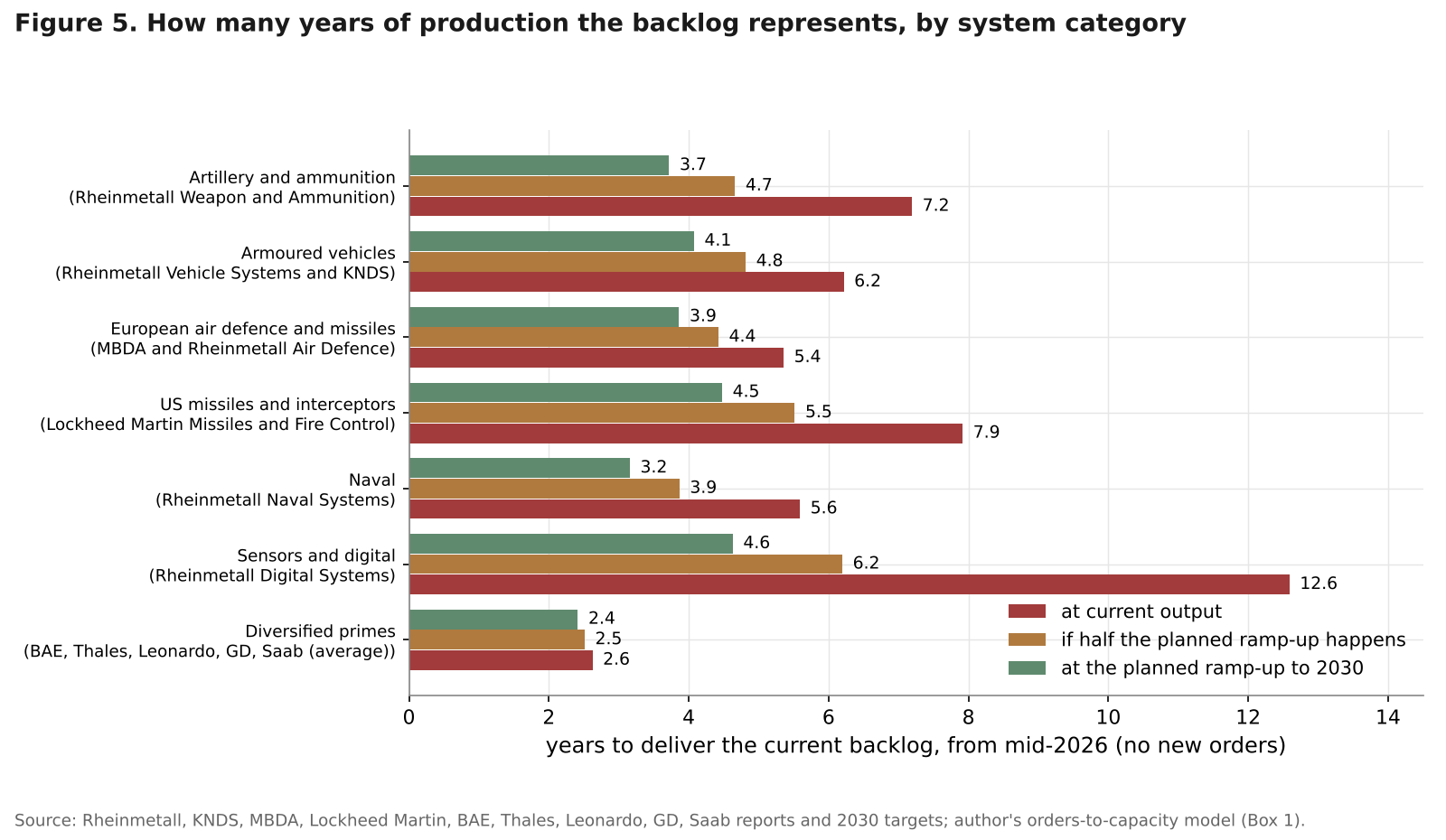
- At current output, backlogs equal 5.4 to 7.9 years of production for ammunition, armoured vehicles, air defence and US missiles; even if every 2030 capacity target is met, they take 3.7 to 4.5 years to clear.
- US defence equipment prices rose 7.5 percent in the year to mid-2026 while real equipment investment fell 3.7 percent; on the author’s model only 6 to 40 of each 100 of extra spending becomes new domestic output in 2026 to 2027.
- Sub-tier components, skilled labour and energetics are the binding bottlenecks; in the author’s scenarios there is a 65 percent probability that order queues are no shorter in 2030 than today.
Abstract
Western defence money is arriving faster than Western defence factories can absorb it. In 2026 Germany is budgeting 47.9 billion euros for military procurement and plans 55.8 billion for 2027; France has 126.5 billion euros of commitments it has signed but not yet paid; the United Kingdom’s capital budget for defence rises by 30 percent over four years; the United States has asked Congress for 70.5 billion dollars for munitions in fiscal year 2027, almost three times the 2026 amount; and Canada wants 70 percent of its purchases to go to domestic firms whose revenues would have to grow by 13 percent a year for a decade. This note asks whether the money can be turned into equipment, and at what price. It builds five original tools for France, Germany, the United Kingdom, the United States and Canada: an order book panel of nine major groups; an orders-to-capacity gap model by system category, which converts backlogs into years of production at current and planned output; an absorption estimate of how much extra spending becomes new output rather than higher prices, imports or longer queues, checked against US national accounts; a bottleneck heatmap across eight system categories and five constraints; and an estimate of the contribution of defence output to GDP growth. Scenarios to 2030 carry explicit probabilities. The answer is that the industry is expanding quickly, but from a base so small that the queue lengthens before it shortens. Most of the extra money buys time and prices in 2026 and 2027, not equipment. All projections and scenarios are the author’s.
Keywords: defence industry, procurement, order backlog, book-to-bill, production capacity, defence inflation, artillery shells, interceptors, energetics, nitrocellulose, SAFE, EDIP, rearmament, supply chain
Key findings
1. The order books hold three to eight years of work. Across nine groups (Rheinmetall, KNDS, MBDA, Saab, Lockheed Martin, Leonardo, BAE Systems, General Dynamics and Thales), the median backlog equals 3.1 years of 2026 sales and the median book-to-bill ratio in the latest reported period is 2.3. The land and missile specialists are the most stretched: KNDS holds 6.5 years of work, Rheinmetall 5.8 and MBDA 5.5. Lockheed Martin’s backlog rose 51 percent in nine months, to 292.0 billion dollars, and its missiles segment now holds 7.9 years of current sales.
2. Even the planned ramp-up leaves a queue past 2030. On the author’s orders-to-capacity model, today’s backlogs represent 5.4 to 7.9 years of production at current output in artillery and ammunition, armoured vehicles, European air defence and US missiles. If every 2030 capacity target is met, the same backlogs still take 3.7 to 4.5 years to clear; if only half the ramp-up happens, 4.4 to 5.5 years, before any new order. Replacing the Patriot interceptors used in the first 39 days of the Iran war takes 2.3 years of 2025 production, and the US Army produced 36,000 artillery shells a month in March 2026 against a target of 100,000.
3. Extra money is buying prices and time more than equipment. In the US national accounts, the price of defence equipment rose 7.5 percent in the year to the second quarter of 2026, faster than any annual increase since at least 2000 and twice consumer price inflation (3.8 percent), while real equipment investment fell 3.7 percent. On the author’s absorption model, of each 100 of extra procurement spending in 2026 to 2027 only 6 (Canada) to 40 (Germany) becomes new domestic output within the period; 7 to 22 goes into excess defence inflation and as much again waits in the queue.
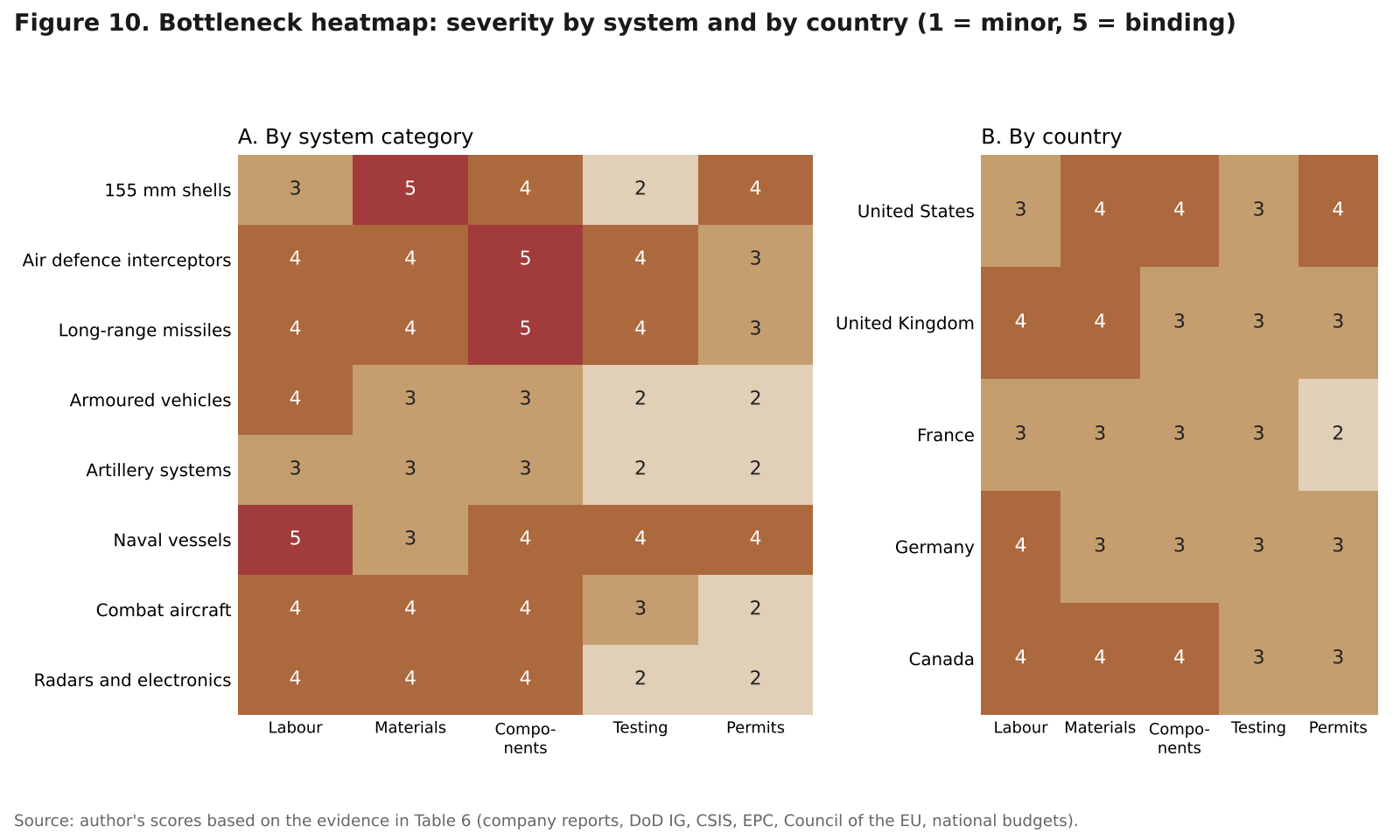
4. Sub-tier components, skilled labour and energetics bind first. On the author’s heatmap (1 to 5), sub-tier components such as rocket motors, seekers and forgings score 4.0 on average, labour 3.9 and energetics and raw materials 3.8, against 2.9 for testing and 2.8 for permits. Interceptors, long-range missiles and naval vessels are the most constrained categories. Europe’s nitrocellulose output of 4,500 to 10,000 tonnes a year falls 10,000 to 15,500 tonnes short of need, and the United States has made no TNT since 1986.
5. The growth dividend is small, and the probability of a longer queue is high. Defence equipment output adds 0.083 percentage points a year to German GDP growth in 2026 to 2027, 7.6 percent of the IMF’s growth forecast for 2027, and 0.013 to 0.032 points elsewhere. Bottlenecks cost 0.01 to 0.05 points a year. In the author’s scenarios, a slow grind is the most likely path (45 percent); there is a 65 percent probability that order queues are no shorter in 2030 than today and that excess defence inflation averages more than 2 percent a year.
1. Introduction: when the money moves faster than the factory
For three decades, Western defence industries were sized for peacetime: low and steady orders, long production runs of a few units a year, and supply chains that could rely on a global market for chemicals, metals and electronics. Rearmament has changed demand almost overnight. The war in Ukraine since 2022, the NATO commitment of June 2025 to spend 3.5 percent of GDP on core defence by 2035, and the war involving Iran that began at the end of February 2026 have together produced the largest wave of Western defence orders since the 1980s. The supply side cannot follow at the same speed. A budget can double in two years; a propellant plant needs permits, a qualified workforce and a reliable source of cotton linters, and a missile needs a rocket motor and a seeker from suppliers that may each have one production line.
The question of this note is simple to state: can Europe and North America actually deliver the weapons they are paying for, and if not, where does the money go? It complements two earlier notes in this series without repeating them. Foresight No. 2 (“The Price of Rearmament”) asked whether five economies can afford the NATO 5 percent target and used an aggregate capacity assumption to estimate defence inflation to 2035. Decoded No. 9 examined Germany’s debt brake exemption. This note works at the level below: firms, system categories, units and inputs, using company reports, national budgets and official audits published up to October 2026.
Figure 1 sets out the framework. Money passes through five stages before it becomes capability: budgets, orders, a backlog, production and deliveries. The first two can move within months. The last three move at the speed of the slowest of five bottlenecks: skilled labour, energetics and raw materials, sub-tier components, testing and qualification, and permits and contracting rules. Wherever orders outrun capacity, money leaks in three directions: into higher prices, into imports, and into time, the queue of orders waiting to be built.
The note proceeds in ten steps. Section 2 measures the money. Section 3 reads the order books of nine groups. Section 4 builds the orders-to-capacity gap model and applies it to units such as interceptors and shells. Section 5 estimates how much of the extra spending is absorbed into output. Section 6 maps the bottlenecks. Section 7 reviews lead times and the policy instruments meant to shorten them. Section 8 measures the growth contribution. Section 9 sets out scenarios to 2030, and Sections 10 to 12 give a dashboard, implications and a calendar.
2. The money: budgets, approvals and commitments
2.1 Five budgets on the rise
NATO estimates published in July 2026 put defence spending in 2026 at 3.17 percent of GDP in the United States, 2.69 percent in Germany, 2.56 percent in the United Kingdom and 2.22 percent in France; Canada reached 2.0 percent in fiscal year 2025-26 (Figure 2, panel A). The increase is concentrated in equipment. Table 1 summarises what each government has budgeted and what it has committed.
Table 1. Defence money in 2026 and 2027: budgets, procurement and commitments. Sources: NATO; BMVg and Bundestag; Defense News; French Senate report on the 2026 budget; Breaking Defense (8 April 2026); Reuters via Arab News (16 July 2026); UK Ministry of Defence via Janes (3 July 2026); CSIS (18 August 2026); GovConWire (3 September 2026); Department of National Defence; Canadian Naval Review (17 February 2026).
| Country | NATO % of GDP, 2025 / 2026 | 2026 budget and procurement | 2027 and beyond | Commitments and constraints |
|---|---|---|---|---|
| United States | 3.22 / 3.17 | Munitions and missiles 24.4 bn USD (FY2026) | FY2027 request 1.5 trillion USD, of which 350 bn via reconciliation; munitions 70.5 bn; House bill 1.072 trillion | Continuing resolution to 11 December 2026 bars production rate increases and new multiyear buys |
| United Kingdom | 2.40 / 2.56 | Capital budget 26.6 bn GBP in 2026-27 | Defence Investment Plan (30 June 2026): 297.7 bn GBP over four years; capital 34.5 bn GBP in 2029-30 | 11 bn GBP for munitions; at least six energetics factories by 2030 |
| France | 2.05 / 2.22 | 57.15 bn EUR (+6.67 bn); equipment programme +22.4% | 63.3 bn EUR in 2027; 76.3 bn EUR by 2030 | 126.5 bn EUR of commitments not yet paid at end-2025; 15.09 bn EUR SAFE loan |
| Germany | 2.22 / 2.69 | 108.2 bn EUR incl. special fund; procurement 47.88 bn EUR | Core budget 109.7 bn EUR in 2027; procurement 55.8 bn EUR | 103 projects worth 83 bn EUR approved in 2025 |
| Canada | 2.01 / 2.00 | 2.0% reached in 2025-26 after a 9 bn CAD top-up | Budget 2025: 81.8 bn CAD over five years, of which 17.9 bn for equipment and ammunition | 70% domestic procurement goal; 1.4 bn CAD for ammunition plants (March 2026) |
2.2 Approvals and unpaid commitments: the leading edge of demand
Budgets measure what governments intend to pay in a year; approvals and commitments measure what they have already ordered. Both have moved faster than budgets. In Germany, the budget committee of the Bundestag approved 103 procurement projects above 25 million euros in 2025, worth about 83 billion euros, a record, after 97 in 2024 and 55 in 2023 (Figure 2, panel B). Over 2023 to 2025 it approved 255 projects worth 188.4 billion euros, against 215 projects worth 109 billion over the eight years 2015 to 2022. Measured per year, approvals have risen 4.6 times.
France shows the same pattern from the payer’s side. Its “restes a payer”, contracts signed and not yet paid, rose from 64 billion euros at the end of 2020 to 99 billion at the end of 2024 and about 126.5 billion at the end of 2025, according to the Senate’s report on the 2026 budget (Figure 2, panel C). The last figure equals 2.2 years of the 2026 defence budget. The same report shows payment arrears (reports de charges) more than doubling from 3.88 billion euros at the end of 2022 to 8.02 billion at the end of 2024, with 8.6 billion expected at the end of 2026. When a ministry signs faster than it pays, and industry delivers slower than the ministry signs, the queue is visible on both sides of the contract.
In the United States the signal is the munitions request (Figure 2, panel D). Funding for munitions and missiles was just under 20 billion dollars in fiscal 2025 and 24.4 billion in 2026; the 2027 request is about 70.5 billion, an increase of 188 percent, with about 40 billion sought through a reconciliation bill. The request includes 3,203 PAC-3 MSE interceptors against 357 in 2026, 857 THAAD interceptors against 55, and 785 Tomahawks against 55. Whether Congress funds it is uncertain: as of August 2026 the House defence bill carried about 1.072 trillion dollars, both budget resolutions allowed only 60 billion for defence through reconciliation, and the supplemental request of 87.6 billion dollars had not been enacted. The government runs on a continuing resolution to 11 December 2026 which, according to GovConWire, prohibits raising production rates above what fiscal 2026 funds can sustain.
2.3 European instruments: large on paper, slow in cash
The European Union’s Security Action for Europe (SAFE) offers up to 150 billion euros of loans for joint procurement. Nineteen member states take part; Poland has the largest allocation (43.7 billion euros) and France 15.09 billion; Germany opted out. Canada became the first non-European participant when the Council concluded its agreement on 15 June 2026. By 28 August 2026, about 11.9 billion euros had been disbursed as pre-financing to nine states, 7.9 percent of the envelope, and about 20 billion euros remained unallocated, according to a tracker compiled by Grosswald. The European Defence Industry Programme (EDIP), adopted on 8 December 2025, has a work programme of 1.5 billion euros for 2026 to 2027, of which more than 700 million euros to raise production of components, missiles, ammunition and counter-drone systems. The money that targets capacity directly is thus 1 percent of the SAFE envelope; the rest finances demand.
A first look at the results
The full note goes much further, with original models, scenarios and a dashboard of leading indicators. Two of its 14 charts and diagrams are shown below.
Continue reading
Get the full note: 27 pages, 14 charts and diagrams, 8 tables
This page shows the first part of the note. The full PDF adds: the order books: nine groups, one queue; how long is the queue? An orders-to-capacity gap model; absorption: how much of the extra money becomes output?; the bottleneck heatmap; lead times and the instruments meant to shorten them; the growth contribution of defence output; scenarios to 2030; a dashboard of leading indicators; implications for policy, investors and suppliers.
29 USD, instant PDF download, secure card payment.
Buy the full noteNeed this analysis for your organisation?
We prepare confidential briefings, executive talks and studies on countries, markets and policies, built on the same method as this article.
Request a briefingSupport independent analysis
Our studies are free to read and carry no advertising. If this one was useful, a small contribution helps us publish the next.
Support our workGo further: books by Global Strategy Files

Frequently asked questions
How large are defence industry order backlogs in 2026?
Very large relative to output. Across nine groups (Rheinmetall, KNDS, MBDA, Saab, Lockheed Martin, Leonardo, BAE Systems, General Dynamics and Thales) the median backlog equals 3.1 years of 2026 sales. KNDS holds 33.1 billion euros, about 6.5 years of sales, Rheinmetall 80.5 billion euros and Lockheed Martin a record 292 billion dollars, up 51 percent in nine months, mostly from interceptor orders.
Can Europe produce enough artillery shells?
Capacity is rising but output lags the claims. The EU says Europe can make more than two million shells a year, yet Rheinmetall, the largest producer, has moved its target of 1.5 million 155 mm rounds a year from 2027 to 2030. In the United States, output was about 36,000 shells a month in March 2026 against a target of 100,000, held back by a metal-parts plant that produced no compliant projectiles.
Is defence spending causing defence inflation?
Yes, in part. US national accounts show defence equipment prices up 7.5 percent in the year to the second quarter of 2026, against consumer inflation of 3.8 percent, while real equipment investment fell 3.7 percent. The author’s absorption model estimates that 7 to 22 of each 100 of extra procurement spending in 2026 to 2027 goes into excess defence inflation, and a similar amount waits in order queues.
What are the main bottlenecks in defence production?
Upstream inputs bind first. Sub-tier components such as solid rocket motors, seekers and forgings, skilled labour, and energetics such as nitrocellulose and TNT score highest on the author’s heatmap. Europe produces 4,500 to 10,000 tonnes of nitrocellulose a year against a need near 20,000, and the United States has made no TNT since 1986. Interceptors, long-range missiles and warships are the most constrained systems.
Sources
- Rheinmetall AG: “Rheinmetall presents annual report for 2025” (11 March 2026); “Half-Yearly Financial Report H1 2026” (6 August 2026); “Rheinmetall opens modern medium calibre production facility in Albacete” (16 October 2026); Capital Markets Day presentation (18 November 2025), as reported by Invezz; Unterluess plant opening (27 August 2025), as reported by Harici.
- KNDS N.V., “KNDS achieves strong revenue growth and record order intake in 2025” (26 May 2026).
- MBDA 2025 results, as reported by Defense News, R. Ruitenberg, “MBDA to double Aster air defense missile output in 2026” (26 March 2026), and Breaking Defense (March 2026).
- Saab AB, Q2 2026 results press release and webcast presentation (July 2026); Janes on Saab’s Q2 2026 results.
- Lockheed Martin Corporation, third quarter 2026 results, Form 8-K exhibit 99.1 (22 October 2026); “Lockheed Martin and Department of War advance landmark acquisition transformation to accelerate PAC-3 MSE production” (6 January 2026), as reported by The Aviationist; Army Technology on the PAC-3 MSE award (30 July 2026).
- General Dynamics Corporation, “General Dynamics Reports Second Quarter 2026 Financial Results” (29 July 2026).
- BAE Systems plc, 2026 Half Year Results (30 July 2026).
- Thales, 2026 half-year results (23 July 2026), as reported by RTT News and Devdiscourse.
- Leonardo S.p.A., H1 and Q2 2026 financial results (30 July 2026).
- CSIS: M. F. Cancian and C. H. Park, “Last Rounds? Status of Key Munitions at the Iran War Ceasefire” (21 April 2026); S. P. Daniels, “Tracking FY 2027 Defense Appropriations, Reconciliation, and the Supplemental Request” (18 August 2026); CSIS estimates as reported by Defense News (30 July 2026) and the Libertarian Institute (21 April 2026).
- Breaking Defense: A. Roque and V. Insinna, “The Pentagon wants a 188 percent bump for missile procurement. Can industry deliver?” (13 April 2026); “Army official not happy with GD’s handling of 155mm contract as production lags” (25 February 2026); A. Roque, “Army well short of 155mm ammo production goal” (14 July 2026).
- US Department of Defense Inspector General, evaluation of DoD’s capability and capacity to produce 155 mm artillery rounds (July 2026), as reported by Military Times (14 July 2026).
- GovConWire, “New CR blocks new defense production starts” (3 September 2026).
- US Government Accountability Office, Weapon Systems Annual Assessment, GAO-26-108457 (July 2026).
- Bureau of Economic Analysis national accounts via FRED: Y050RG3A086NBEA, Y050RX1A020NBEA, Y050RG3Q086SBEA, Y050RX1Q020SBEA, Y050RC1Q027SBEA, B788RG3Q086SBEA, A824RY2Q224SBEA; CPIAUCSL (retrieved 20 to 24 October 2026).
- NATO, Defence Expenditure of NATO Countries (2014-2025), June 2025; NATO estimates of July 2026 as reported in Foresight No. 2.
- German Federal Ministry of Defence (BMVg), “Beschaffung: 25-Millionen-Euro-Vorlagen” and “Investitionen in Sicherheit: Verteidigungshaushalt 2026” (14 November 2025); Vergabeblog on the 2026 budget (27 August 2025); Defense News, “Germany to spend almost 60 billion in latest military funding package” (18 December 2025); ESUT on 2025 approvals (13 December 2025); Grosswald on the 2027 federal budget (September 2026); Destatis press release on government gross investment in 2025 (June 2026); Heuking on the BwPBBG (18 February 2026); Wissenschaftliche Dienste des Bundestages, WD 5-3000-089/26 on defence spending (15 September 2026).
- Naval News, “Germany is cancelling the F126 frigate project and procuring eight MEKO frigates” (24 June 2026).
- Senat (France), report on the 2026 finance bill, mission Defense; Breaking Defense, “France to increase defense spending by 42 billion” (April 2026); Reuters via Arab News on 2027 spending ceilings (16 July 2026); Public Senat (24 October 2025).
- UK Ministry of Defence, Defence Investment Plan (30 June 2026), as analysed by Janes (3 July 2026); Defence Industry Europe on UK energetics factories (16 September 2026).
- Government of Canada, Department of National Defence: “Minister McGuinty announces investment of 1.4 billion into domestic ammunition production” (18 March 2026); Question Period Note on lapsed funding; Gowling WLG on the Defence Industrial Strategy (5 June 2026); D. Perry, Canadian Naval Review, “Dollars and Sense: Budget 2025” (17 February 2026).
- European Commission, EDIP work programme (30 March 2026); Council of the EU, Omnibus V note 10406/26 (15 June 2026); Eunews on Canada’s participation in SAFE (15 June 2026); Grosswald SAFE loans tracker (19 October 2026); White and Case on the Defence Readiness Omnibus (14 July 2025).
- Interfax-Ukraine and Censor.net on EU shell production (26 February 2026); Polskie Radio on European 155 mm output (10 November 2025); Grosswald European ammunition and energetics tracker (October 2026).
- European Policy Centre, C. Kremidas-Courtney, “Running on empty: the chemical shortage undermining European defence” (18 June 2025); Hurriyet Daily News on cotton linters (19 August 2026); ABC17 News on the Kentucky TNT plant (8 November 2024); Mining Weekly on aerospace material constraints (11 September 2026); Manufacturing Dive on L3Harris rocket motors (16 April 2026); Militarnyi on IRIS-T production (24 January 2026); Army Recognition on CAESAR production (9 April 2025); The Defense Post on Leopard 2A8 orders (1 December 2025); Swiss DDPS on Patriot deliveries (17 July 2025).
- ASD Europe facts and figures 2025, as reported by Euronews (2 December 2025); SIPRI Top 100 press release (1 December 2025); WisdomTree, “European defence: strong fundamentals behind a soft market” (8 June 2026); Bloomberg on Estonian defence prices (May 2026).
- IMF, World Economic Outlook database, October 2026: NGDPD, NGDP_RPCH, PCPIPCH (retrieved 20 October 2026).
- Global Strategy Files: Foresight No. 2, “The Price of Rearmament” (import shares, NATO 2026 estimates, shell prices); Foresight No. 13, “Critical Minerals 2030” (export controls calendar); Decoded No. 9, “Germany’s Debt Brake Holiday”.
Books from Global Strategy Files
Go further on this topic