
The Creditor That Cannot Collect: Student Loan Defaults, the Atrophy of Federal Collections and the 2027 Cash-Flow Shock

Borrowers in default rose from 5.2 million to 9.3 million in nine months while the recovery yield of federal collections fell elevenfold. A stock-flow model puts defaults at 8.2 to 11 million by end 2028 and shows that the 2027 cash-flow shock on borrowers will come mostly from the new repayment plan, not from garnishment.
The Vanishing Corporate Tax: Expensing, the AI Investment Boom and the Permanence of a Temporary Loss
Corporate tax receipts fell about 16 percent in fiscal 2026 during a profit boom. Half of the shortfall will reverse in 2027; the other half is permanent as long as investment keeps growing. Twenty years of data and a simple model show why full expensing has turned the corporate tax into a tax on the end of investment cycles.

The End of Bund Scarcity: Term Premium, ECB Hikes and Germany’s Policy-Mix Collision

The debt-brake reform and the special funds have turned the Bund from Europe's scarcest safe asset into a growing supply, just as the ECB hikes into the Iran energy shock. Decomposing ten-year yields, we find the term premium explains about three-quarters of the rise since 2024, while the 2026 move is mostly policy. On today's curve federal interest more than doubles to about EUR 71 billion by 2030.

The Last Budget Before the Vote: Italy’s Escape Clause and the Electoral Fiscal Cycle
Italy's 2027 budget takes the deficit back to 3.4 per cent of GDP, using the European escape clause for defence and energy. This paper shows that the loosening matches, almost to the decimal, what Italian governments have typically done around elections for thirty years, that Italy has the strongest electoral fiscal cycle of thirteen EU countries, and that the escape-clause money buys very little growth: about 26 cents of GDP for every euro of extra deficit.
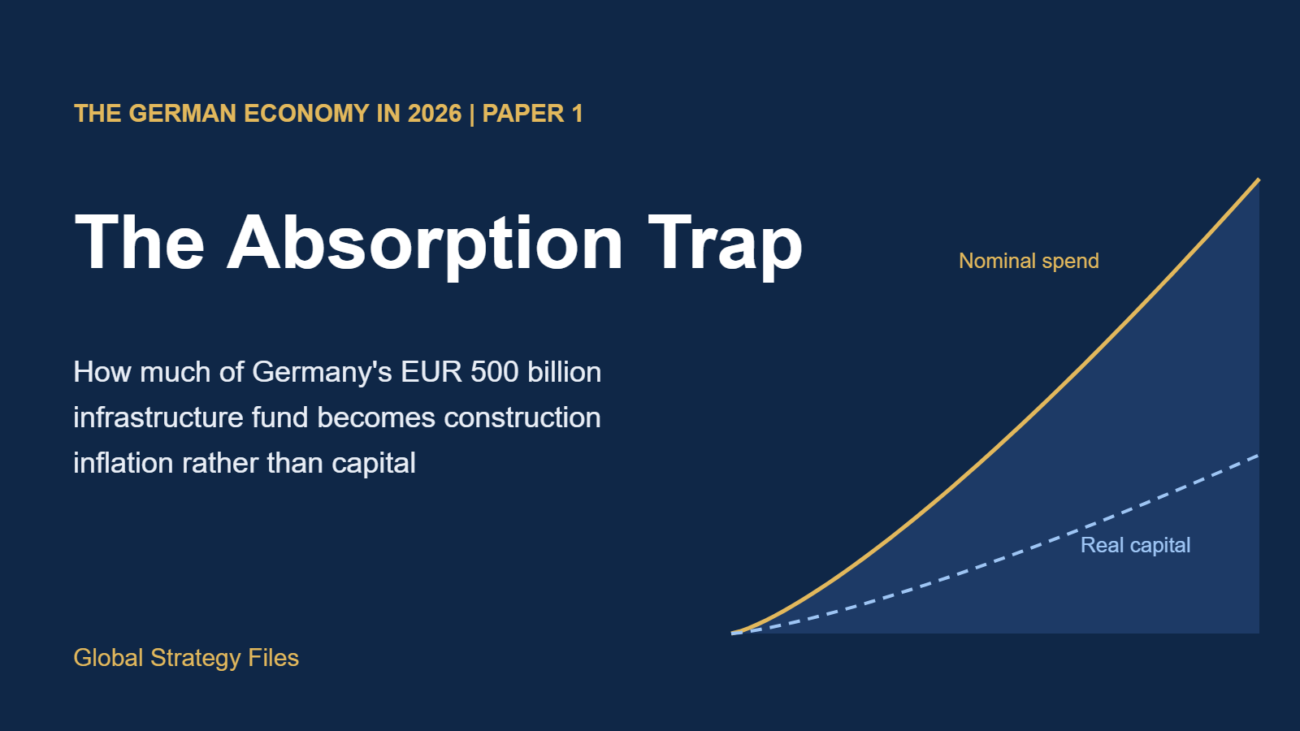
The Absorption Trap: How Much of Germany’s EUR 500 Billion Infrastructure Fund Becomes Construction Inflation Rather Than Capital
Germany's EUR 500 billion infrastructure fund is now paying out faster than the construction sector can build. Using monthly turnover, price and disbursement data, this paper shows that the share of new spending lost to excess construction inflation tripled in four months, and that each borrowed euro adds only about 38 cents of genuinely new real capital.

The Thin Margin: Italian Debt Dynamics Under a Hiking ECB
For four years inflation did the work of fiscal consolidation for Italy. That era ended in 2025. With the ECB raising rates, nominal growth slowing and the spread back above 110 basis points, this paper maps the fragility frontier: the highest spread at which Italian debt stops rising. In 2027, the election year, the country will be on the wrong side of it.

Guns, Gilts and Growth: The Domestic Multiplier of Britain’s Rearmament
Britain plans to raise defence spending to 3.5 per cent of GDP by 2035 and presents rearmament as an engine of growth. One hundred and fifty years of British data put the defence multiplier at only 0.2 to 0.3: rearmament may be necessary for security, but if financed by borrowing it will not pay for itself.