
The Tipping Zone: Three Ways a French Debt Crisis Could Start, and What It Would Cost Europe

Driss EFFINA, PhD Independent Researcher, Global Strategy Files Foresight, prospective note No. 4, 20 October 2026. Reading time: about 65 minutes
Key takeaways
- France’s 10-year spread over Bunds reached about 159 basis points on 21 October 2026; a Markov-switching model puts France in a stress regime (probability 0.80 in September, 1.00 with October data) while Italy and Belgium stay calm.
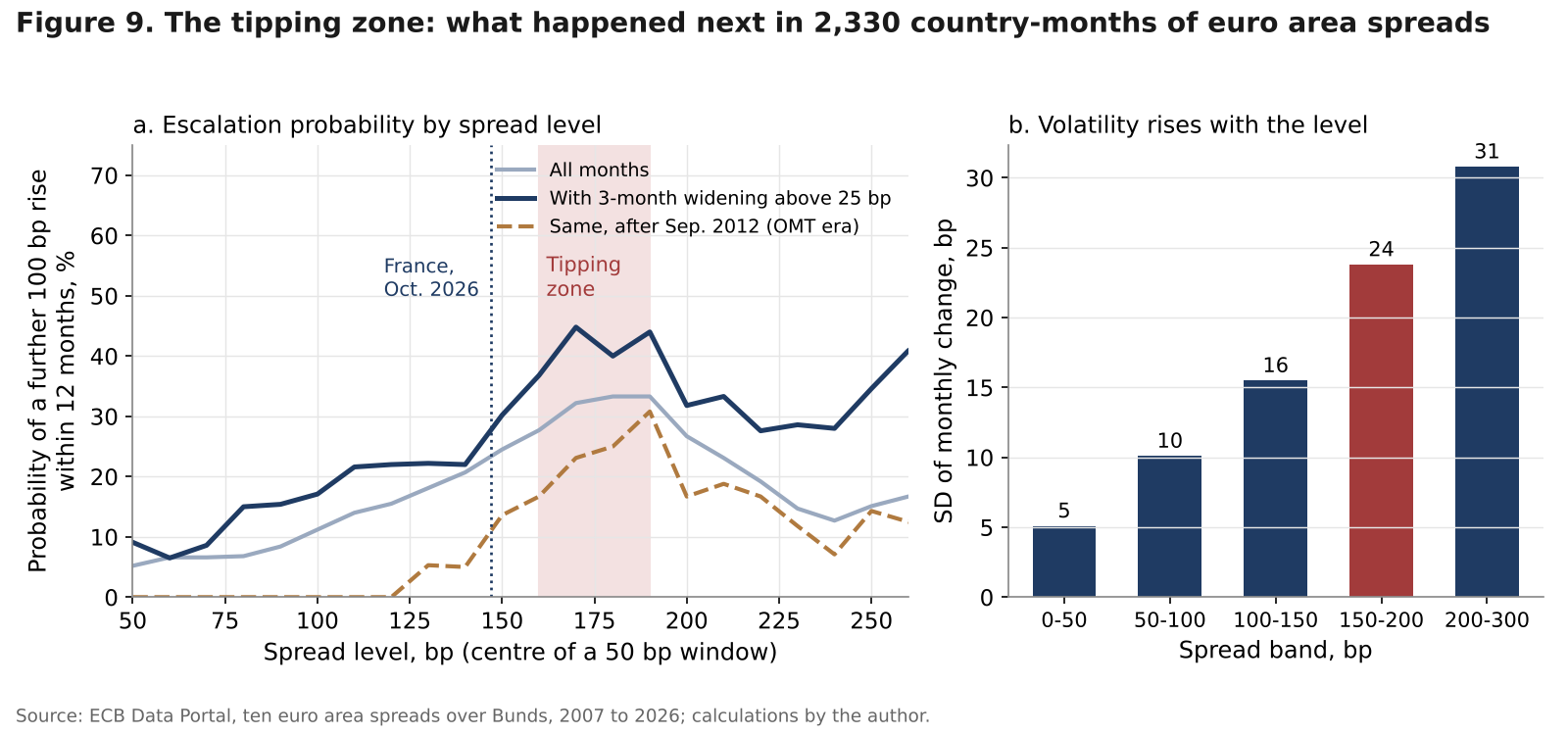
- Across 2,330 country-months of euro area spreads, escalation risk peaks between 160 and 190 basis points: with recent momentum, 37 to 45 percent of spreads in that zone rose by another 100 basis points within a year.
- France has lost a core discount of about 60 basis points and now trades 51 basis points above its fundamentals; French debt stops rising by 2031 in only 49 percent of 10,000 simulated paths, even with the planned consolidation.
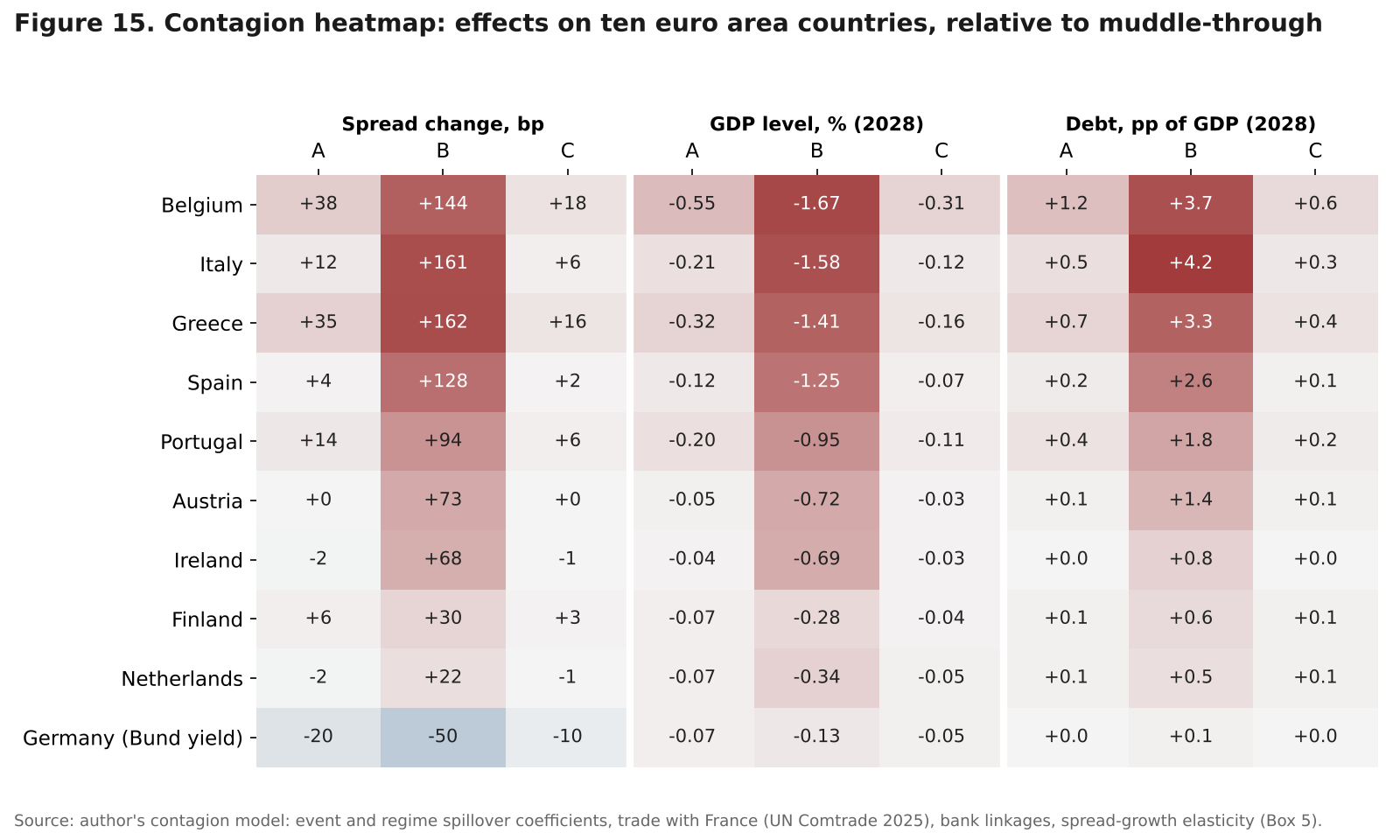
- Author’s probabilities: muddle-through 50 percent, political-fiscal trigger 22 percent, market-liquidity trigger with no ECB backstop 10 percent, slow-burn squeeze 18 percent. Belgium is the most exposed economy outside France; Germany roughly breaks even.
Abstract
On 21 October 2026 the French 10-year government bond yield crossed 5 percent for the first time since 2002 and its spread over German Bunds reached about 159 basis points, the widest since 2011. France now borrows at a higher rate than Italy. Public debt stood at 119.0 percent of GDP at the end of June, the 2026 deficit is expected at 5.4 percent of GDP, the 2027 budget has not been voted, and a presidential election is set for 18 April and 2 May 2027. The public debate oscillates between two slogans: France is “the new Italy”, or France “is not Greece”. This note replaces slogans with measurement. It builds five econometric tools from monthly ECB yield data for eleven euro area countries (2007 to 2026) and IMF October 2026 projections: a Diebold-Yilmaz connectedness network of sovereign spreads; a narrative identification of French-specific shocks; a two-regime Markov-switching model and an empirical “tipping zone” estimated on 2,330 country-months; a panel model of fundamentals-implied spreads; and a stochastic debt sustainability analysis with 10,000 paths that uses the maturity structure of French debt. Three crisis triggers are then quantified: a political-fiscal trigger, a market-liquidity trigger in which the ECB’s Transmission Protection Instrument cannot be used, and a slow-burn squeeze in which the interest rate on debt overtakes growth before the 2027 election. Each is transmitted to ten other euro area countries. The central result is that France is in a stress regime but not yet a systemic transmitter, and that its crisis risk is concentrated in a narrow band of spreads, 160 to 190 basis points, which it is now entering. Belgium, not Italy, is the most exposed economy; Germany neither gains nor loses much. The author assigns probabilities of 50 percent to a muddle-through baseline, 22 percent to the political-fiscal trigger, 10 percent to the market-liquidity trigger and 18 percent to the slow-burn squeeze. All projections and probabilities are the author’s.
Keywords: France, sovereign debt, bond spreads, contagion, connectedness, Markov switching, debt sustainability, euro area, ECB, Transmission Protection Instrument, scenarios
JEL codes: E44, E62, F36, G01, G15, H63
Key findings
1. France is in a stress regime, but it is an isolated one. A two-regime model of the French spread puts the probability of the high-volatility regime at 0.80 in September 2026 and at 1.00 with October data, against 0.01 for Italy and Belgium. France’s net contribution to the variance of other spreads has fallen from 11.3 points in 2008 to 2012 (and 29.4 at its 2016 peak) to 2.7 points over the last five years, and the share of its own shocks in its spread has risen from 16 to 24 percent since May 2024. French political shocks since 2024 passed 0.45 basis points to Belgium and 0.41 to Greece for each basis point of French widening, but only 0.14 to Italy and 0.05 to Spain. On this evidence France is not “the new Italy”: Italy in 2011 was a central transmitter; France in 2026 is a large, weakly connected risk. 2. There is a tipping zone, and France is at its edge. Across 2,330 country-months of euro area spreads since 2007, the probability of a further 100 basis point widening within a year rises from 17 percent at 100 basis points to a peak of 45 percent at 170 basis points when spreads have widened by more than 25 basis points in three months, before falling as policy responses arrive. In the ECB backstop era after September 2012 the same probability peaks at 31 percent. The zone runs from 160 to 190 basis points. France averaged 147 basis points in reported closes in October and touched 159 on 21 October. 3. France has lost a “core discount” worth 60 basis points, and crisis pricing would more than double its spread. A panel model of fundamentals puts France’s warranted spread at 96 basis points in 2026. From 2013 to 2025 France traded on average 61.5 basis points below its fundamentals; in October 2026 it trades 51 basis points above. Priced as markets priced debt in 2010 to 2012, France’s fundamentals would justify 361 basis points. This makes an economic case that part of the spread is “unwarranted”, but the binding constraint on the ECB is legal eligibility, not evidence. 4. Debt stabilisation is a coin toss even with the planned consolidation, and the slow burn is the most expensive path. In 10,000 simulated paths, French debt stops rising by 2031 in only 49 percent of cases even if the primary balance improves as the IMF projects; with the primary deficit frozen at its 2026 level, median debt reaches 144 percent of GDP in 2035. The IMF’s 2031 primary balance stabilises debt only if France could borrow 35 basis points below Germany. Among the scenarios, the slow-burn squeeze, which never makes headlines, ends with the highest debt: 133 percent in 2031 and 144 percent in 2035, against 127 and 129 percent after a market crisis that forces adjustment. 5. Belgium is Europe’s most exposed economy; Germany roughly breaks even. In every scenario Belgium suffers the largest output loss outside France, up to 1.7 percent of GDP by 2028 in the market-liquidity trigger, through trade (French imports equal 7.1 percent of Belgian GDP), spread co-movement and banking ties. Italy is the most exposed on debt only in the systemic case (+4.2 points of GDP). Germany’s safe-haven interest savings (about 5.6 billion euros over two years) roughly offset its lost tax revenue (about 4.2 billion euros). In the market-liquidity trigger, 61 percent of the output loss of the eleven countries falls outside France.
1. Introduction
The French bond market has been under pressure since the dissolution of the National Assembly in June 2024, but the autumn of 2026 changed the nature of that pressure. The spread between French and German 10-year yields averaged 66 basis points in February 2026, before the war involving Iran disrupted the Strait of Hormuz and sent bond yields up across the developed world. It averaged 97 basis points in September, and press reports put it at 152 basis points on 2 October, 153 on 20 October and 159 on 21 October, when the 10-year yield rose to 5.002 percent. On ECB monthly data, France has paid more than Italy to borrow at ten years in five of the last ten months.
Commentary has reached for two analogies: France is becoming Italy, or France is not Greece. Both are probably true and neither is useful. The relevant questions for investors and policymakers are narrower. Is France transmitting risk to the rest of the euro area, and to whom? At what level of spreads do dynamics become self-reinforcing? How much of the current premium is justified by fundamentals? What would each type of trigger do to French growth, debt and deficits, and how much of the damage would land elsewhere?
This note answers these questions with a sequence of reproducible models. After the facts (Section 2) and a map of channels (Section 3), it measures connectedness (Section 4), identifies where French shocks land (Section 5), estimates regimes and a tipping zone (Section 6), compares actual and warranted spreads (Section 7), runs a stochastic debt analysis (Section 8), builds three crisis scenarios and a baseline (Section 9) and transmits them to ten euro area countries (Section 10). The interest-rate pass-through parameters reuse the debt structure documented in Decoded No. 1 of this series; its analysis is not repeated here.
The note does not predict a crisis; its baseline is a muddle-through. But the distance to a crisis is shorter, and the route more specific, than either slogan suggests. Figure 1 maps the triggers and channels; Section 3 explains it.
2. France in October 2026: the facts
2.1 The numbers
Table 1 summarises the fiscal and market position. INSEE reported general government debt of 3,595.5 billion euros at the end of the second quarter of 2026, or 119.0 percent of GDP, up from 117.5 percent in the first quarter. Net debt was 111.4 percent of GDP. The State accounted for 2,942.1 billion euros of the total; negotiable securities amounted to 3,229.0 billion euros, of which 291.7 billion were short-term. The deficit was 5.8 percent of GDP in 2024 and 5.1 percent in 2025, and the government now expects 5.4 percent for 2026 against an initial target of 5.0 percent.
| Indicator | 2024 | 2025 | 2026 | 2027 |
|---|---|---|---|---|
| Real GDP growth, % (IMF) | 1.4 | 0.9 | 0.4 | 0.7 |
| Overall balance, % GDP (IMF) | -5.8 | -5.1 | -5.4 | -5.2 |
| Primary balance, % GDP (IMF) | -3.9 | -3.0 | -2.9 | -2.5 |
| Gross debt, % GDP (IMF) | 112.6 | 115.5 | 118.5 | 120.4 |
| Government target, deficit % GDP | 5.4 (revised) | 5.0 | ||
| 10-year yield, %, annual average (ECB) | 2.97 | 3.37 | 4.06 (est.) | |
| Spread over Bunds, bp, annual average | 65 | 76 | 104 (est.) | |
| Household saving rate, % of disposable income | 17.2 (Q2) | |||
| Non-financial corporate debt, % GDP | 75.2 (Q1) |
Table 1. France: key numbers. Sources: IMF WEO October 2026; ECB Data Portal; INSEE (saving rate, second quarter 2026); Banque de France (corporate debt, first quarter 2026); government targets from the 2027 draft budget. 2026 yield and spread are the author’s estimates using January to September averages and about 4.9 percent for October to December.
Activity is weak: GDP fell 0.2 percent in the first quarter of 2026 and was flat in the second, according to INSEE. The household saving rate was 17.2 percent of disposable income in the second quarter, down from 17.9 percent, as purchasing power per consumption unit fell. The private sector is not a source of strength: non-financial corporate debt was 75.2 percent of GDP in the first quarter of 2026, against 53.5 percent in the euro area, although net of cash it falls to 40.0 percent. France is the only large euro area country whose private debt ratio rose over the past year, according to the Banque de France.
Monetary policy is tightening. Inflation in the euro area reached 3.3 percent in August, and the ECB raised its deposit rate in June and again on 10 September, to 2.50 percent. New mortgage rates in France rose from 3.10 percent in February to 3.20 percent in August. Over 2015 to 2026, a one-point rise in the French 10-year yield has been associated with a 0.41 point rise in new mortgage rates within a year (standard error 0.11), a slow pass-through that protects households in the short run and delays the pain.
2.2 The political sequence
The Barnier government was censured in December 2024. The Bayrou government fell in September 2025 after losing a confidence vote it had called. Sebastien Lecornu was appointed Prime Minister on 9 September 2025, resigned less than a month later and was reappointed on 10 October 2025. The 2026 budget became law only in February 2026, after the government used Article 49.3 of the Constitution. No party has held a stable majority in the National Assembly since the June 2024 elections.
The 2027 draft budget, presented on 1 October 2026, contains about 54 billion euros of savings and new revenue and targets a deficit of 5.0 percent of GDP in 2027. The government’s projections put debt at 119.3 percent of GDP in 2026 and 121.7 percent in 2027. The High Council of Public Finances judged the government’s 2026 growth forecast of 0.5 percent plausible but its 1.0 percent forecast for 2027 optimistic, against 0.7 to 0.9 percent for other forecasters; at consensus growth the 2027 deficit would be 5.2 to 5.3 percent. It counted a structural effort of about 40 billion euros, 17 billion of revenue and 23 billion of spending. On 13 October a motion to reject the budget before debate failed by 236 votes to 149. A vote on the revenue part of the budget is expected on 3 November, according to press reports, and the Prime Minister has not said whether he will again use Article 49.3.
2.3 Ratings and the European framework
France’s ratings have been lowered by one notch at four agencies since September 2025, and the fifth has a negative outlook. Fitch lowered France from AA- to A+ on 12 September 2025 and kept A+ with a stable outlook in March and on 28 August 2026. Morningstar DBRS lowered France from AA (high) to AA on 19 September 2025. S&P Global lowered France to A+ on 17 October 2025 and affirmed it with a stable outlook on 29 May 2026; its next review is on 27 November 2026. Moody’s affirmed Aa3 with a negative outlook on 10 April 2026 and reviews France on 23 October 2026. Scope lowered France from AA- to A+ on 18 September 2026. Fitch wrote on 9 October that political fragmentation is likely to persist beyond the 2027 election.
The European framework determines whether the ECB can intervene. France has been under the excessive deficit procedure since 2024. In June 2026 the European Commission found that France had “complied with its commitments in a satisfactory manner” and that the procedure is held in abeyance, but it also projected net expenditure growth in 2026 above the recommended ceiling of 1.2 percent, a deviation of 0.1 percent of GDP, and a deficit of 5.7 percent of GDP in 2027 at unchanged policy. The ECB’s Transmission Protection Instrument, created in July 2022, can buy a country’s bonds when spreads widen in ways not warranted by fundamentals, but only if the country meets four cumulative criteria: compliance with the EU fiscal framework (in particular, not having failed to take effective action under an excessive deficit procedure), absence of severe macroeconomic imbalances, fiscal sustainability, and sound macroeconomic policies. France meets the first criterion today. It may not after the Commission’s next assessments, which will fall between the autumn of 2026 and the spring of 2027, around the presidential election. On 8 October, ECB President Lagarde said the ECB had the instruments to counter “unwarranted market dynamics”, without committing to use them.
2.4 Who holds French debt
The ownership of French debt shapes how a crisis would propagate. At the end of July 2026, negotiable State debt was 2,882 billion euros, with an average maturity of 8 years and 163 days, 313 billion euros of inflation-indexed bonds (10.9 percent) and 220 billion euros of short-term bills (7.6 percent), according to Agence France Tresor. In the first quarter of 2026, non-residents held 57.5 percent, French credit institutions 10.5 percent and French insurers 9.6 percent. The banking supervisor reported in October that French banks held about 190 billion euros of French public debt, 2 percent of their total assets. Japanese investors held about 145 billion dollars of French bonds in July 2026, according to a Bloomberg estimate. The Banque de France’s TARGET2 liabilities to the Eurosystem reached 181 billion euros at the end of August 2026, a balance that would absorb any accelerated non-resident selling. Figure 2 shows how far the French spread has moved relative to its peers, and how French yields overtook Italian yields in 2026.
2.5 Fundamentals compared
Figure 3 places France among eleven euro area countries on seven indicators from the IMF’s October 2026 projections. France combines a debt ratio of 118.5 percent of GDP, the third highest after Italy and Greece; the largest overall deficit (5.4 percent); a primary deficit of 2.9 percent; growth of 0.4 percent, the second lowest; a current account deficit; and the second largest projected rise in debt between 2025 and 2031 after Belgium (8.1 points against 14.2). Belgium appears on almost every dimension as France’s closest twin, a point that will matter for contagion.
Table 2 tests the “new Italy” analogy directly. In 2026 France has almost exactly Italy’s 2011 debt ratio (118.5 against 119.1 percent of GDP), a deficit 1.9 points larger and a primary deficit of 2.9 percent of GDP where Italy ran a surplus of 0.9 percent. Its debt gap over Germany is larger than Italy’s was (53.9 against 40.6 points), because German debt is lower today. On fiscal flow measures, France in 2026 is weaker than Italy in 2011. Yet its spread is less than a third of Italy’s peak. The difference is not in the fundamentals; it is in how markets price them, and in the existence of an ECB backstop. Sections 6 and 7 measure both.
| France 2026 | Italy 2011 | France 2011 | |
|---|---|---|---|
| Gross debt, % GDP | 118.5 | 119.1 | 88.7 |
| Debt gap over Germany, pp | 53.9 | 40.6 | 10.2 |
| Overall balance, % GDP | -5.4 | -3.5 | -5.3 |
| Primary balance, % GDP | -2.9 | 0.9 | -2.8 |
| Real growth, % | 0.4 | 0.7 | 2.5 |
| Current account, % GDP | -0.7 | -2.7 | -0.9 |
| Spread over Bunds, bp | 147 (Oct. 2026) | 519 (Nov. 2011) | 154 (Nov. 2011) |
| Net connectedness (Section 4) | +2.7 | +18.7 | +11.3 |
Table 2. Testing the “new Italy” analogy. Sources: IMF WEO October 2026; ECB Data Portal (monthly averages; France October 2026 is the average of six reported closes); connectedness from Section 4 (2021 to 2026 window for France 2026, 2008 to 2012 window for 2011).
A first look at the results
The full note goes much further, with original models, scenarios and a dashboard of leading indicators. Two of its 16 charts and diagrams are shown below.
Continue reading
Get the full note: 30 pages, 16 charts and diagrams, 13 tables
This page shows the first part of the note. The full PDF adds: a map of triggers and channels; is France a transmitter of risk?; where French shocks land; regimes and the tipping zone; warranted or not? The lost core discount; stochastic debt sustainability; three crisis triggers; contagion to Europe; a dashboard of leading indicators.
29 USD, instant PDF download, secure card payment.
Buy the full noteNeed this analysis for your organisation?
We prepare confidential briefings, executive talks and studies on countries, markets and policies, built on the same method as this article.
Request a briefingSupport independent analysis
Our studies are free to read and carry no advertising. If this one was useful, a small contribution helps us publish the next.
Support our workGo further: books by Global Strategy Files

Frequently asked questions
Is France heading for a debt crisis in 2027?
Not in the central case. The author’s baseline, with a 50 percent probability, is a muddle-through in which the 2027 budget passes and the spread drifts back towards 90 to 125 basis points. But France has entered a stress regime, its spread is at the edge of a 160 to 190 basis point tipping zone, and the author gives a combined 32 percent probability to a political-fiscal or market-liquidity trigger before mid-2027.
Is France the new Italy?
On fiscal flows France in 2026 is weaker than Italy in 2011: similar debt near 119 percent of GDP but a primary deficit of 2.9 percent of GDP against an Italian surplus. On transmission it is not: Italy in 2011 was a central net transmitter of risk, while France’s net connectedness has fallen to about 3 points and French political shocks pass mainly to Belgium and Greece, not to Italy or Spain.
Can the ECB protect France with the Transmission Protection Instrument?
Economically there is a case: about 51 basis points of France’s October spread are not explained by fundamentals in this note’s panel model. The constraint is legal eligibility. The TPI requires compliance with the EU fiscal framework, and France’s excessive deficit procedure is only held in abeyance. A Commission finding of no effective action around the 2027 election would leave only OMT, which needs an ESM programme.
Which European countries would suffer most from a French crisis?
Belgium, in every scenario. French imports equal 7.1 percent of Belgian GDP, the Belgian spread has the strongest link to French shocks and its leading retail bank is French-owned. In a market-liquidity crisis Belgian output would fall about 1.7 percent by 2028. Italy’s debt would rise most in a systemic crisis, while Germany’s safe-haven savings roughly offset its lost tax revenue.
Sources
- ECB Data Portal, IRS dataflow, long-term interest rate statistics for convergence purposes, 10-year government bond yields, monthly averages: FR, DE, IT, ES, BE, NL, PT, GR, IE, FI, AT (retrieved 21 October 2026).
- IMF, World Economic Outlook database and Fiscal Monitor, October 2026, via DataMapper: GGXWDG_NGDP, GGXCNL_NGDP, GGXONLB_G01_GDP_PT, NGDP_RPCH, NGDPD, BCA_NGDPD, PCPIPCH, LUR, G_X_G01_GDP_PT, GGR_G01_GDP_PT (retrieved 20 and 21 October 2026).
- ECB MIR statistics, composite cost of borrowing for new house purchase loans, France (retrieved 20 October 2026); Eurostat HICP (prc_hicp_minr).
- INSEE, Informations rapides No. 239, “Dette trimestrielle de Maastricht des administrations publiques, deuxieme trimestre 2026”, 29 September 2026.
- INSEE, Informations rapides No. 212, “Comptes nationaux trimestriels, resultats detailles, deuxieme trimestre 2026”, 28 August 2026.
- Banque de France, “Taux d’endettement des agents non financiers, comparaisons internationales, 2026 T1”.
- Agence France Tresor, Bulletin mensuel No. 435, August 2026.
- Haut Conseil des finances publiques, opinion on the 2027 draft budget, as reported by Public Senat, “Budget 2027 : le Haut Conseil des finances publiques pointe des previsions optimistes du gouvernement”, 7 October 2026.
- Euronews, “French government to lay out budget amid record-breaking public debt”, 1 October 2026.
- The Rio Times, “Will France’s Government Collapse Over the 2027 Budget?”, October 2026.
- Babypips, “Explainer: why the OAT-Bund spread matters for the euro”, 12 October 2026.
- The Asia Business Daily, “France’s 10-Year Bond Yield Tops 5%, Highest Since 2002 Amid Fiscal Crisis Fears”, 21 October 2026.
- OMFIF, D. Marsh, “French riots may bring ECB bond-buying closer”, 20 October 2026.
- Tech Times, “France Bond Yields Top Italy and Greece as ECB Crisis Rescue Tool Is Blocked”, 5 October 2026.
- ROIC News, “Lagarde Signals ECB Ready to Counter Unwarranted Market Dynamics”, 8 October 2026; “Fitch warns France faces potential credit rating downgrade”, 12 October 2026.
- FN News, ECB rate decision of 10 September 2026; Admiral Markets, ECB meeting calendar October and December 2026.
- European Commission, COM(2026) 210 final, Recommendation for a Council Recommendation on France, Brussels, 3 June 2026.
- Rating actions: Selectra, “Moody’s note France 23 octobre”, October 2026; Econostrum, S&P decision of 29 May 2026; dettedelafrance.fr, Scope downgrade of 18 September 2026; L’Economiste Maghrebin, DBRS downgrade of 19 September 2025; Morningstar DBRS press release, 26 May 2026; Newsquawk, S&P downgrade of 17 October 2025.
- Briefs, “French watchdog says banks’ public-debt exposure is limited”, 13 October 2026 (ACPR figures).
- Boersen-Zeitung, “Die Target-Kluft in der Eurozone reisst wieder auf”, 2026.
- Eurasia Business News, “Japanese Investors Pull Back From French Debt as Fiscal Risks Mount”, 5 October 2026.
- Public Senat, “La prochaine election presidentielle aura lieu les 18 avril et 2 mai 2027”, 1 July 2026.
- Trading Economics, France imports by country, 2025 (UN Comtrade).
- Wikipedia, “BNP Paribas Fortis”.
- SUERF Policy Brief No. 611, H. Mai, “Sovereign exposures of European banks, revisited”, June 2023.
- Diebold, F. X. and K. Yilmaz (2012), “Better to give than to receive: Predictive directional measurement of volatility spillovers”, International Journal of Forecasting 28(1).
- Hamilton, J. D. (1989), “A new approach to the economic analysis of nonstationary time series and the business cycle”, Econometrica 57(2).
- Global Strategy Files, Decoded No. 1, “Five Bond Markets, One Shock: Who Really Pays for the 2026 Yield Surge”, 19 October 2026.
Books from Global Strategy Files
Go further on this topic


