Why France Needs a President with Business Experience

Dr. Driss Effina
Strategic analysis | 25 October 2026
Economic recovery and the test of governing competence
Download the complete 30-page article as a PDF
Download the analytical supplement and reproducible calculations
Contents
- The economic inheritance
- A crisis of conversion rather than a shortage of announcements
- What the fiscal record actually establishes
- Recurring obligations constrain presidential freedom
- Which business experience would count
- How operating competence could reach the economy
- The debt equation makes promises comparable
- The primary balance required for stability
- Interest costs respond with a delay
- Three paths through a presidential term
- A successful transition initially looks expensive
- Where the simulated advantage comes from
- Why indiscriminate cuts can defeat the fiscal objective
- Delay is an economic cost
- Political durability belongs inside the calculation
- Management cannot replace institutional capacity
- What the research supports
- The Macron objection must be answered directly
- The presidency operates through constitutional institutions
- Public value requires a broader balance sheet
- The industrial test is the ability to complete
- Productivity gains must survive measurement
- Independence from private interests is an economic condition
- The uncertainty is large enough to change the verdict
- The first two years reveal the quality of leadership
- Predictions that can prove the argument wrong
- The case for a business leader is a case for demonstrated competence
- Methods and interpretation
- Sources and author
France should give serious consideration to a president who has successfully built and run a substantial enterprise. The economic case rests on the kind of work that recovery requires: choosing among competing commitments, organising delivery across institutions, and accepting responsibility for outcomes that can be independently checked. A record of operating competence would be a valuable qualification for that work. Personal wealth would be a poor substitute.
The next presidency will inherit a state whose financial commitments are difficult to reconcile with modest growth. Yet the central challenge reaches beyond the budget. A government can announce investment without creating productive capacity, reorganise an institution without improving its service, or reduce an appropriation while shifting costs to households. Recovery requires a president who understands these differences and can govern through them.
This article develops a conditional argument for business experience. It combines official French data with original debt simulations, a decomposition of the gains from delivery, and models of project delay and political durability. The calculations show why operational competence could matter economically. They do not establish that a business career causes better presidential performance. That question remains open, and no candidate is assigned an invented economic advantage.
The strongest business candidate would bring evidence of productive achievement, an ability to work with institutions beyond personal control, and a willingness to separate public authority from private interests. France needs those capabilities urgently. A business leader who possesses them could offer a more credible route to recovery than a politician whose principal achievement is surviving within the political system.
The economic inheritance
The scale of the task should be established before discussing the personality of the next president. Table 1 separates observed accounts from forecasts. Their dates matter: a quarterly debt ratio is not an annual outcome, and a central bank projection is not a promise. The article uses information available on 25 October 2026.
Table 1 The observed position and near term projections
| Indicator | Value and period | Status |
|---|---|---|
| Public expenditure / GDP | 57.3%, 2025 | Observed, provisional [1] |
| Public revenue / GDP | 52.2%, 2025 | Observed, provisional [1] |
| General government deficit | 5.1% of GDP, 2025 | Observed, provisional [1] |
| Maastricht gross debt | 119.0% of GDP, Q2 2026 | Quarterly observation [2] |
| Maastricht gross debt | EUR 3,595.5 bn, Q2 2026 | Quarterly observation [2] |
| Real GDP growth | 0.4%, 2026; 0.9%, 2027 | September projections [3] |
| Real GDP growth | 1.2%, 2028 | September projection [3] |
| Unemployment rate | 8.3%, 2026 and 2027 | Annual average projections [3] |
Sources: INSEE [1, 2] and Banque de France [3]. Forecasts are conditional. GDP ratios use the definitions and release vintages of the cited sources.
The figures describe a narrow margin for error. Modest growth limits the expansion of the tax base. A large stock of debt exposes future budgets to financing conditions even when refinancing takes several years. A deficit can decline in one year while debt continues to rise. These are connected constraints, but they are not interchangeable indicators of failure.
France retains the institutions and productive assets of an advanced economy. Fiscal pressure does not establish insolvency, and a high expenditure ratio does not establish that every programme is inefficient. The strategic question is how to increase the economic and social return on resources while bringing recurring commitments into line with durable financing. A candidate should be evaluated against that task, not against an undefined promise to restore national greatness.
A crisis of conversion rather than a shortage of announcements
The most useful diagnosis is a failure to convert resources into outcomes reliably enough. This is a hypothesis about governance, not a claim that every French institution performs badly. It directs attention to the distance between an authorised budget, a completed service, and the value that people receive. That distance is where an experienced operator may contribute something that campaign expertise does not supply.
Consider an investment programme. Parliament may authorise the money, a ministry may sign contracts, and the expenditure may appear in national accounts. None of those events guarantees that a functioning asset arrives on schedule. The missing links can include engineering design, suppliers, staffing, permissions, maintenance arrangements and integration with an existing network. A president does not personally manage these tasks. The president helps determine whether the governing system notices their dependencies and gives someone the authority to resolve them.
The same distinction applies to administrative reform. Reducing the number of offices can improve an organisation if duplicated work disappears. It can also lengthen travel, increase queues and transfer work to families. An accounting saving and a productivity improvement can therefore have opposite meanings for citizens. A leader familiar with operations should understand that cutting an input is not proof of improving a process.
This diagnosis changes the political selection problem. The relevant question becomes whether a candidate has repeatedly taken responsibility for a complete chain of delivery. Useful evidence includes a record of allocating scarce capital, maintaining quality under pressure, correcting projects that missed their targets and building teams that function without permanent intervention from the founder. Success in a favourable market is weaker evidence than durable performance across changing conditions.
The argument also creates a demanding standard for a business candidate. Public institutions have obligations that firms can sometimes avoid. A company may leave an unprofitable market; the state remains responsible for citizens who are expensive to serve. An operator becomes a plausible president only by showing that delivery competence can be adapted to universal obligations and democratic disagreement. This adaptation is central to the case, rather than an administrative detail to be discovered after the election.
What the fiscal record actually establishes
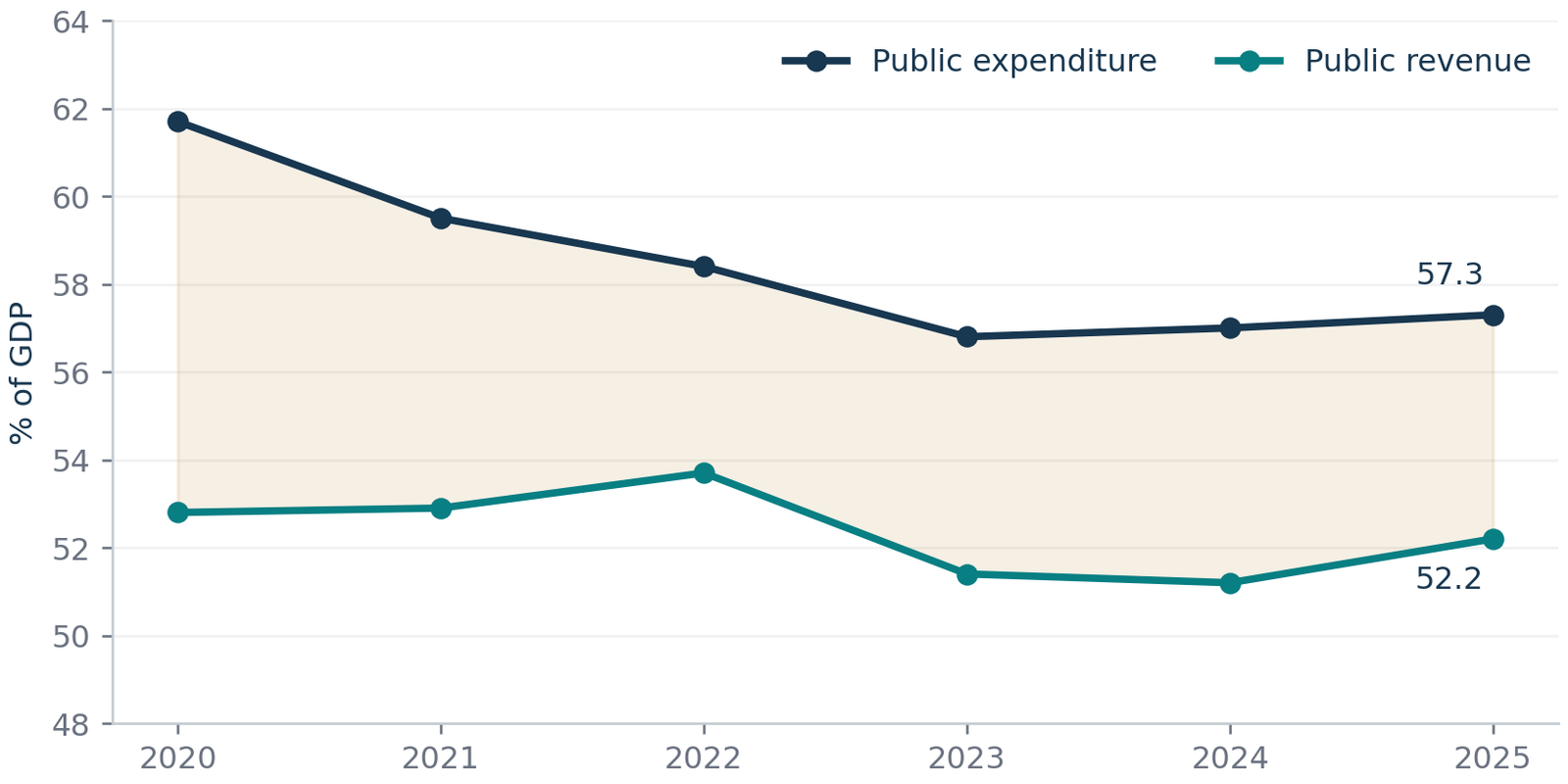
The official accounts show a persistent gap between public expenditure and revenue after the pandemic. In 2025 the two ratios were 57.3% and 52.2% of GDP. The deficit improved from 5.8% in 2024 to 5.1% in 2025, while the expenditure ratio rose by 0.3 percentage point and revenue rose by 1.0 point. This is a descriptive accounting comparison, not a causal estimate of policy effects. [1]
An improvement obtained through revenue can be legitimate, but it does not demonstrate that the state has become easier to run. Nor does a higher spending ratio prove that service quality has improved. The numerator includes transfers and many public activities, while the denominator changes with nominal GDP. Both must be examined before interpreting the ratio as an efficiency measure.
For the next president, the implication is practical. Fiscal credibility needs a bridge from each political commitment to its recurring cost and financing. A business operator may be accustomed to that discipline. The public version must add distribution, service quality and legal obligations to the calculation. A budget that balances by exporting hidden costs to citizens would fail that broader test.
Recurring obligations constrain presidential freedom
A new president can change priorities much faster than the state can change its obligations. Debt contracts, pensions, employment arrangements, procurement commitments and established service entitlements create different forms of persistence. These obligations have different legal and economic characteristics. Treating them as one flexible spending envelope makes a reform programme look easier than it is.
The Cour des comptes reported a 2025 deficit of EUR 152.5 billion and general government interest costs of EUR 65.7 billion. Its June 2026 assessment attributed much of the deficit improvement to tax increases of approximately EUR 23 billion. Those figures describe the 2025 accounts and the Court's assessment at that date; they do not measure an efficiency dividend. [4]
A useful presidential balance sheet would distinguish an obligation that expires from one that must be financed indefinitely. A temporary grant may end automatically. A new permanent entitlement accumulates beneficiaries and political expectations. A capital asset may require maintenance for decades after its inauguration. The immediate cash cost is only the first instalment of the decision.
Operating experience is relevant because businesses repeatedly confront the difference between an initial purchase and the total cost of ownership. The public analogue is more demanding. The return may take the form of health, security or access to justice rather than revenue. Nevertheless, the financing remains real. A president who understands both dimensions can resist the temptation to make commitments whose attractive first-year presentation conceals their later cost.
This is also why an exclusive focus on cutting next year's deficit is insufficient. Cancelling maintenance or delaying supplier payments can make the near-term numbers look better while increasing future costs. Selling an asset can reduce gross debt without improving the recurring balance. Guarantees may move risk outside today's cash budget while preserving the taxpayer's exposure. An operator's contribution should be to identify such substitutions and expose their consequences.
The appropriate test is the quality of the commitments the presidency leaves behind. Are future governments inheriting assets that work, obligations they can finance and information that reveals the risks? A leader who improves those conditions has created economic value even before every benefit appears in annual growth. A leader who sacrifices them for a favourable annual presentation has borrowed political success from the future.
Which business experience would count
Business experience is too broad a category to serve as a presidential qualification without further examination. A founder, a passive shareholder, a financial adviser and an executive running a large service network learn different things. Some skills transfer to public leadership; others may encourage damaging habits. Table 2 defines the relevant evidence without pretending that a résumé supplies a scientific score.
Table 2 Evidence of transferable operating competence
| Experience | Relevant evidence | Insufficient substitute |
|---|---|---|
| Capital allocation | Returns evaluated after delivery | Size of personal fortune |
| Operational leadership | Quality, cost and timing across cycles | Revenue growth alone |
| Organisational change | Results that survive departure | A restructuring announcement |
| Negotiation | Agreements with independent parties | Authority over employees alone |
| Learning from failure | Documented correction of errors | Attributing every failure to others |
Original selection framework. These are proposed evaluation criteria, not statistically validated predictors of presidential success.
The strongest record would combine responsibility for results with exposure to constraints the candidate could not simply remove. Negotiating with employees, handling regulated activities and coordinating independent suppliers can be relevant. So can admitting failure early enough to change course. A candidate who attributes every setback to subordinates provides little evidence of learning.
Commercial success must also be interpreted against its source. Returns generated by protected access, an inherited monopoly or privileged relationships do not establish an ability to increase national productivity. The public interest lies in expanding economic opportunity, including for firms that have no relationship with the president.
These distinctions strengthen the argument for a qualified business leader. They prevent the label from becoming an empty credential. The proposed advantage is demonstrated capability under scrutiny, not an occupational entitlement to govern.
How operating competence could reach the economy
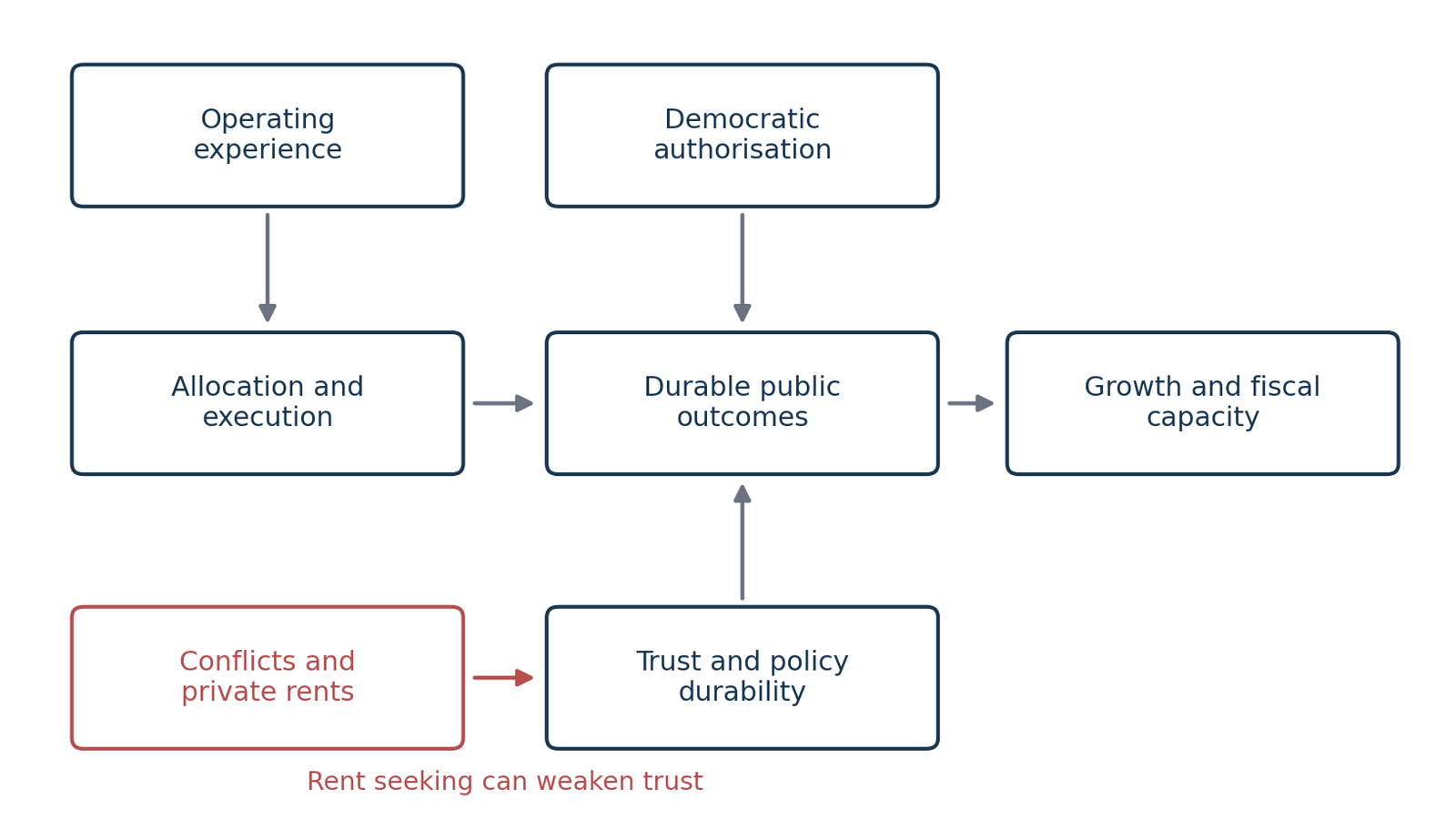
The transmission mechanism begins with choices about people, capital and responsibilities. Better decisions at that level may increase the probability that a public project is completed and its benefits survive. Economic gains then depend on what the project actually does. Faster completion of a low-value programme produces little benefit; successful delivery must be attached to a sound public purpose.
The mechanism also contains a negative channel. A leader with extensive commercial interests may create opportunities for private advantage or the perception of favouritism. Either can weaken the trust required to sustain reform. Business experience can therefore increase capability and create conflicts at the same time. The net result depends on institutional arrangements and the candidate's conduct.
Figure 2 is an analytical map, not an estimated causal diagram. It shows why the presidential choice cannot be reduced to a single trait. Operating competence must work through democratic authority, capable institutions and credible restraint. The article's subsequent models examine these links separately so that one attractive assumption cannot silently determine the entire result.
The debt equation makes promises comparable
Debt sustainability provides a disciplined way to test economic promises. Let d be general government gross debt as a percentage of GDP, i the effective nominal interest rate on the inherited stock, g nominal GDP growth, p the primary surplus as a percentage of current GDP, and a stock-flow adjustments. A positive p reduces debt; a deficit has a negative sign. The standard accounting relation is shown below.
dt = [(1 + it) / (1 + gt)] dt−1 − pt + at
The equation identifies several possible contributions from better governance. Higher productive capacity can raise real growth. Improved spending decisions or sustainable revenue measures can raise the primary balance. More credible policy may reduce the rate on new borrowing, though a president does not control market rates or euro-area monetary policy. Asset transactions and valuation changes require separate treatment through stock-flow adjustments.
These channels operate at different speeds. Growth measures often require investment before output appears. A saving must actually reduce recurring cash expenditure or increase revenue before it improves p. A lower market yield applies gradually as debt is issued or refinanced. Treating a fall in the ten-year yield as an immediate reduction in the interest cost of the entire debt stock exaggerates the dividend.
The distinction between real and nominal growth is equally important. The model combines real growth with a GDP deflator, using their multiplicative relationship. Consumer-price inflation is not substituted for the deflator. Inflation may initially reduce a debt ratio through the denominator while raising later spending and borrowing costs. It is not an administrative productivity gain.
The equation does not tell France which distribution of taxes and services is desirable. It tells a candidate whether the proposed choices are financially coherent. That is a necessary test of presidential competence. It is especially appropriate for someone asking voters to trust a business record: the candidate should be able to reconcile the economic mechanism, the financing and the time needed for delivery.
The primary balance required for stability
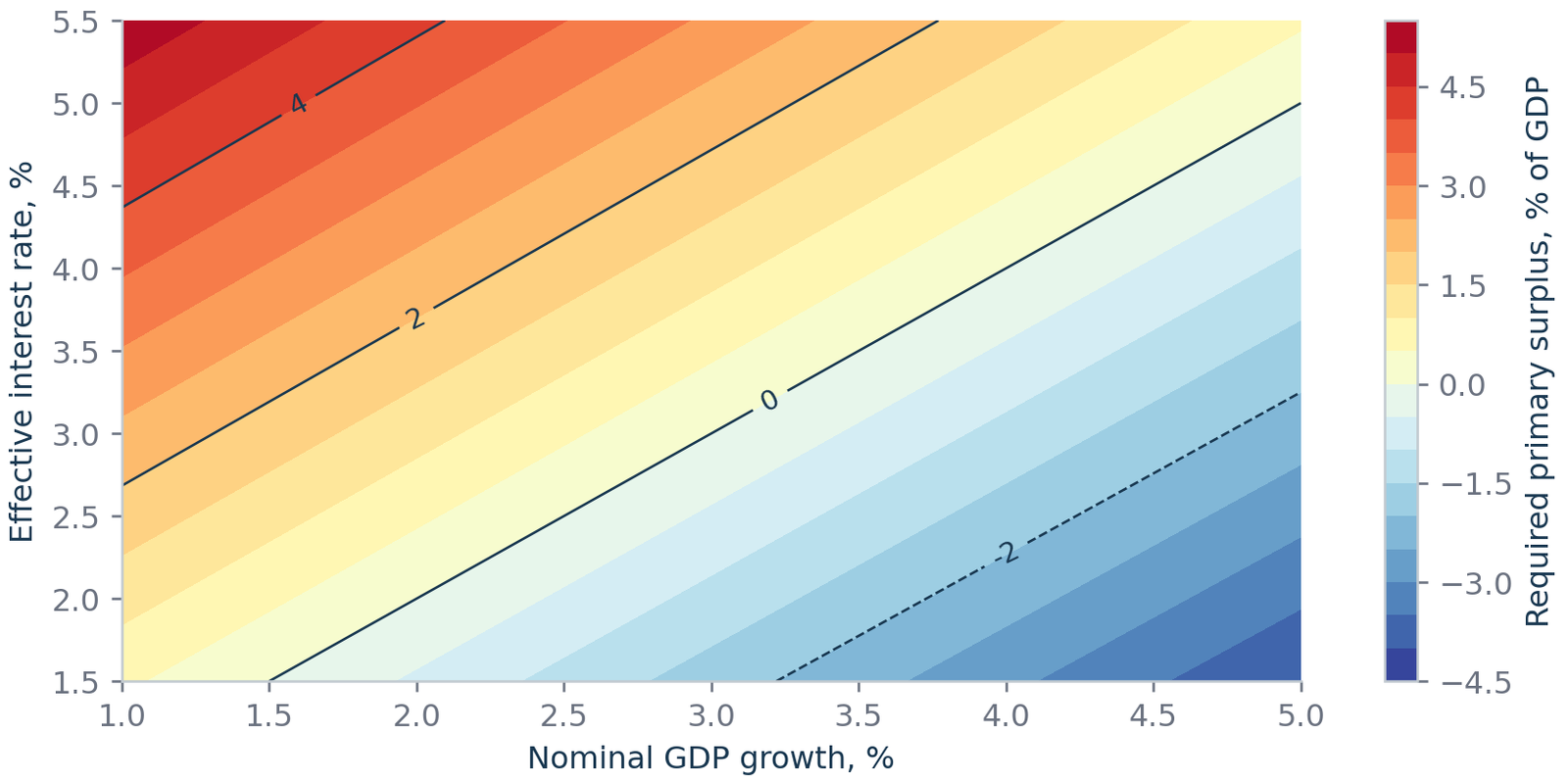
With stock-flow adjustments set to zero, stabilising the debt ratio requires a primary balance equal to the interest-growth differential multiplied by inherited debt and adjusted for nominal growth. Figure 3 evaluates this identity at an assumed debt ratio of 120% of GDP. The starting level is an illustrative end-2027 assumption, not an official forecast.
At 3% effective interest and 3% nominal growth, primary balance is sufficient for stability. If interest rises to 4% while nominal growth remains 3%, the required primary surplus becomes approximately 1.17% of GDP. If nominal growth is 4% and interest 3%, a primary deficit of about 1.15% is compatible with a stable ratio. The difference is economically material.
This is the clearest reason to connect fiscal discipline with productive performance. A government that damages durable growth can make the debt problem harder even while announcing savings. Equally, a government cannot assume that optimistic growth will finance commitments indefinitely. The relevant business skill is the ability to examine the full system of returns and obligations under less favourable conditions.
Interest costs respond with a delay
France's debt does not reprice overnight. Agence France Trésor reported an average remaining maturity of eight years and 158 days for negotiable central-government debt at 30 September 2026. This perimeter differs from total general government debt. An average maturity alone does not identify the annual refinancing share. [5]
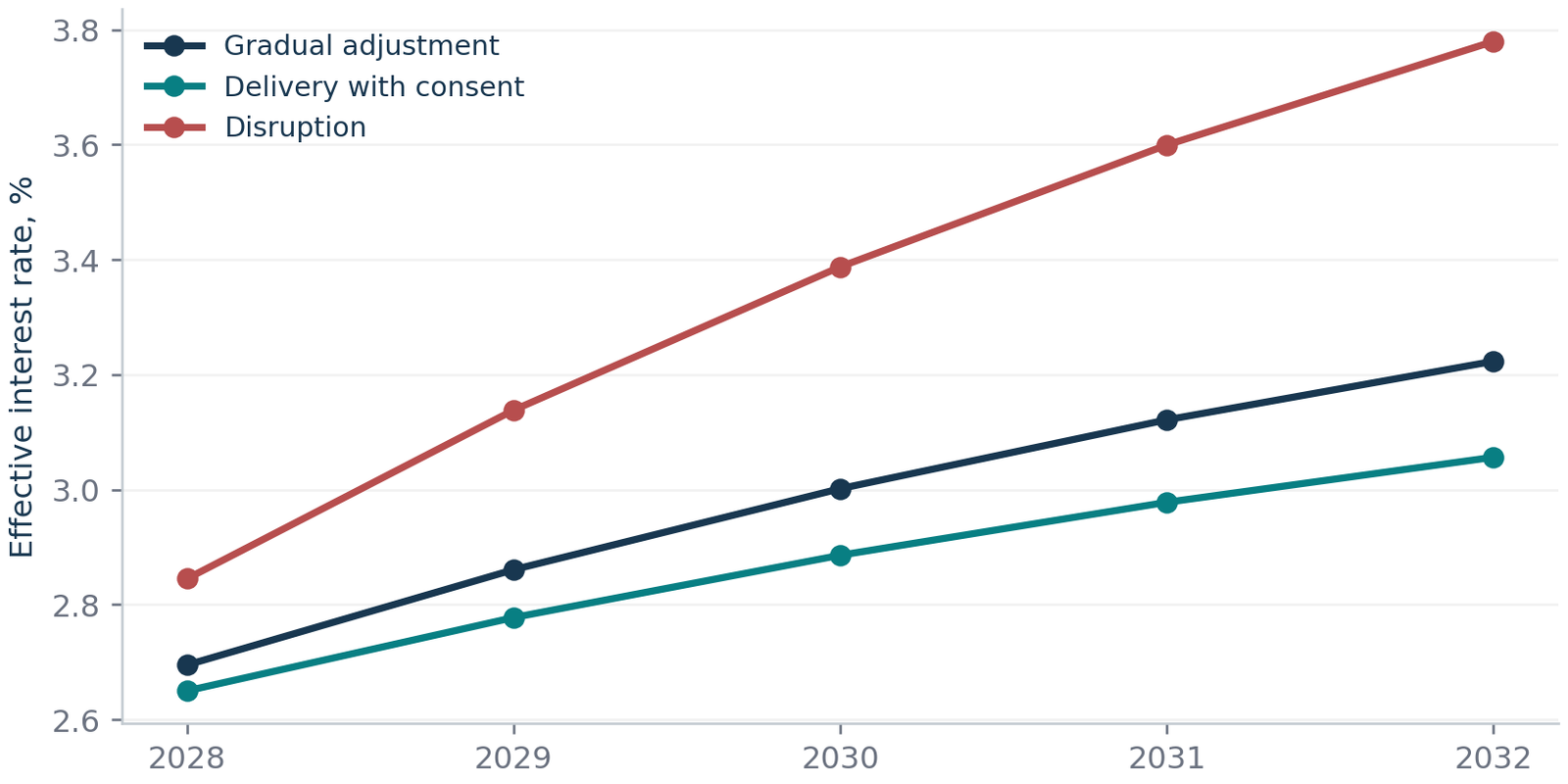
The illustrative simulations use a 15% annual repricing share and an initial effective rate of 2.5%. The effective rate moves each year towards the assumed rate on new borrowing. The three new-borrowing rates are 3.5%, 3.8% and 4.8%. These are scenario inputs, not quotations of current yields or forecasts from AFT.
The delay creates a political trap. Early in a presidency, financing costs may still reflect earlier low-rate borrowing. A programme can appear affordable before the inherited protection erodes. Conversely, improved credibility may take years to produce its full budgetary effect. Judging the leader only by immediate interest spending can reward past conditions and miss current decisions.
A capable operator should recognise this mismatch between decisions and reported results. The presidency needs an account of future exposure as well as today's expenditure. The simulation deliberately keeps refinancing simple so that its mechanism remains visible and its limits can be challenged.
Three paths through a presidential term
The simulations begin at the end of 2027 and follow five full calendar years to 2032. They do not assign economic results to any named person. The same initial debt and interest rate are used for all paths. The GDP deflator is held at an assumed 1.8%, and stock-flow adjustments are zero. This isolates the selected mechanisms while excluding several real-world risks.
Table 3 Complete variable paths for the debt simulations
| Input | Gradual adjustment | Delivery with consent | Disruption |
|---|---|---|---|
| Real growth %, 2028 to 2032 | 1.0, 1.0, 1.0, 1.0, 1.0 | 0.9, 1.3, 1.6, 1.6, 1.6 | 0.0, 0.5, 0.8, 0.8, 1.0 |
| Primary balance % GDP, 2028 to 2032 | −2.5, −2.2, −2.0, −1.8, −1.5 | −2.8, −2.1, −1.2, −0.3, +0.5 | −3.2, −3.0, −2.8, −2.5, −2.3 |
| Rate on new borrowing % | 3.8 each year | 3.5 each year | 4.8 each year |
| GDP deflator % | 1.8 each year | 1.8 each year | 1.8 each year |
| Initial debt / GDP | 120%, end-2027 | 120%, end-2027 | 120%, end-2027 |
All entries are assumptions. Initial effective interest = 2.5%; annual repricing share = 15%; stock-flow adjustments = 0. Positive primary balances are surpluses. The model is not a forecast of a candidate or an estimate of policy effects.
Gradual adjustment assumes modest growth and an improving primary deficit. Delivery with consent assumes an initial transition cost, followed by stronger productive performance and more durable fiscal adjustment. Disruption combines weaker output, persistent deficits and more expensive new borrowing. These are coherent conditional narratives, not probability-weighted forecasts.
The favourable path requires a substantial change in the primary balance. It must not be advertised as an estimate of easily removable waste. It could involve different combinations of spending efficiency, entitlement choices, revenue and growth-related receipts. A political programme would have to identify those measures and assess their distributional effects before claiming the result.
The model therefore sets a hurdle for the business-leader argument. An operating record matters only if it makes a credible difference to the paths of these variables. Substituting a successful résumé for a funded programme leaves the economic case incomplete.
A successful transition initially looks expensive
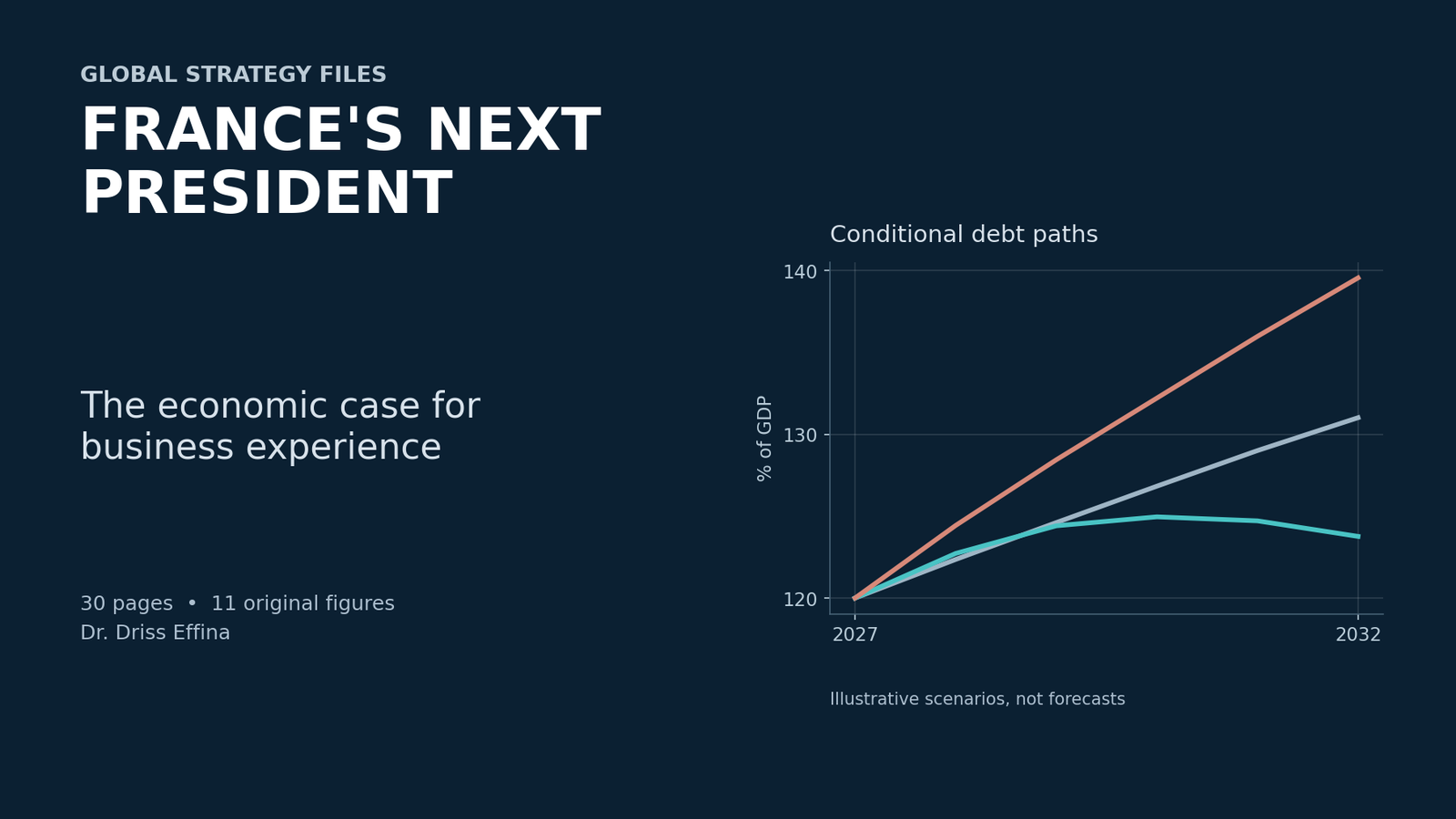
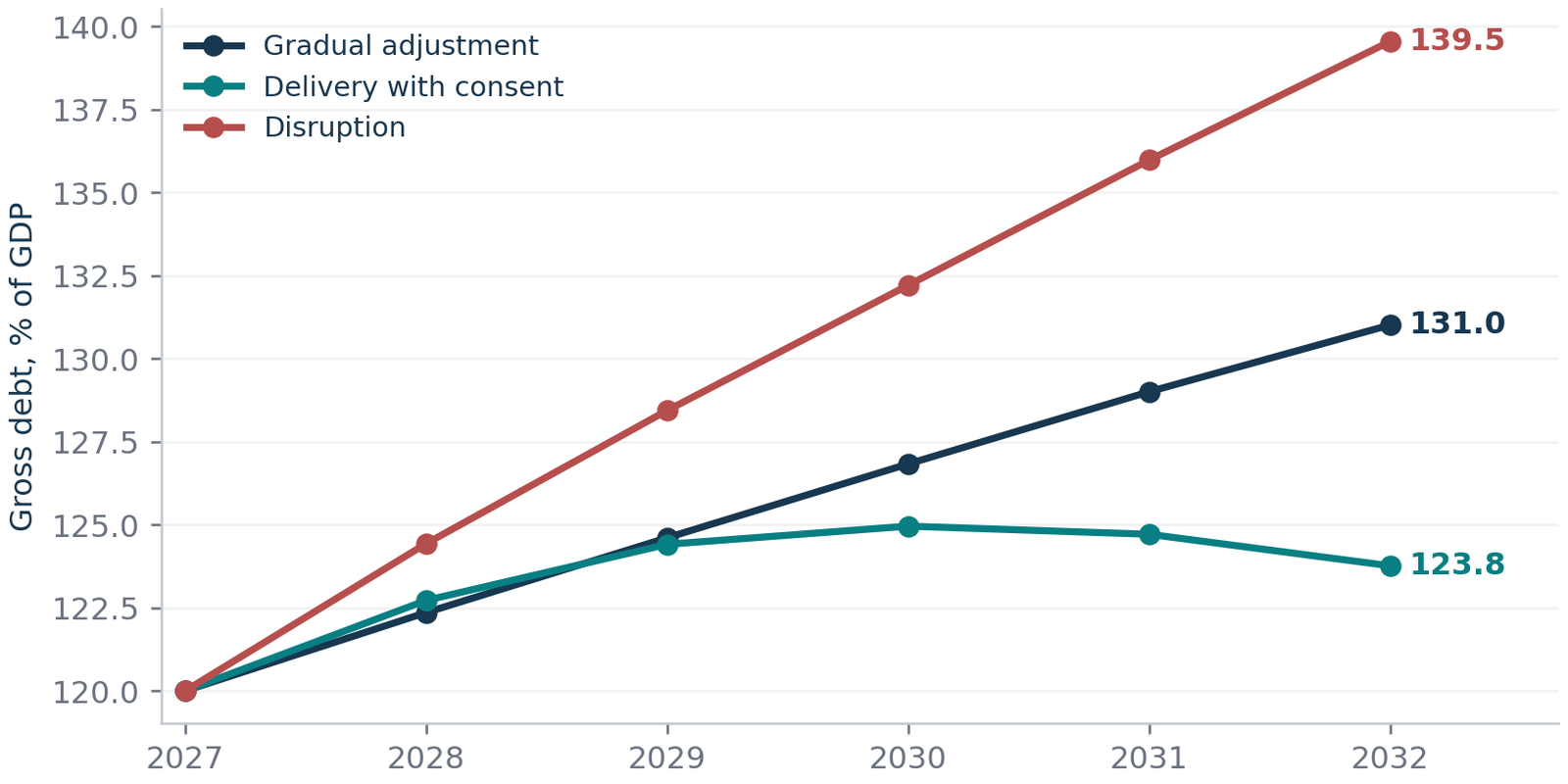
The favourable simulation does not produce an immediate debt reversal. Debt rises from the assumed 120% of GDP to 122.7% in 2028, slightly above the 122.4% gradual-adjustment result. It peaks close to 125.0% in 2030, then declines to 123.8% in 2032. Gradual adjustment reaches 131.0%; disruption reaches 139.5%. These are model outputs conditional on the assumptions on the preceding page.
The early deterioration is deliberate. Organisational change can require investment, retraining and parallel operation of old and new systems. Claiming that these costs do not exist makes the programme easier to sell and harder to deliver. A business candidate should be more willing to disclose them because commercial investment routinely separates initial cash outflows from later returns.
The eventual improvement is also bounded. Even the favourable result leaves debt above its assumed starting ratio. Its 2032 overall deficit remains about 3.2% of GDP because interest still absorbs resources. A successful presidency may establish a credible direction without completing every adjustment during its own term. Voters deserve that distinction before an election.
Where the simulated advantage comes from
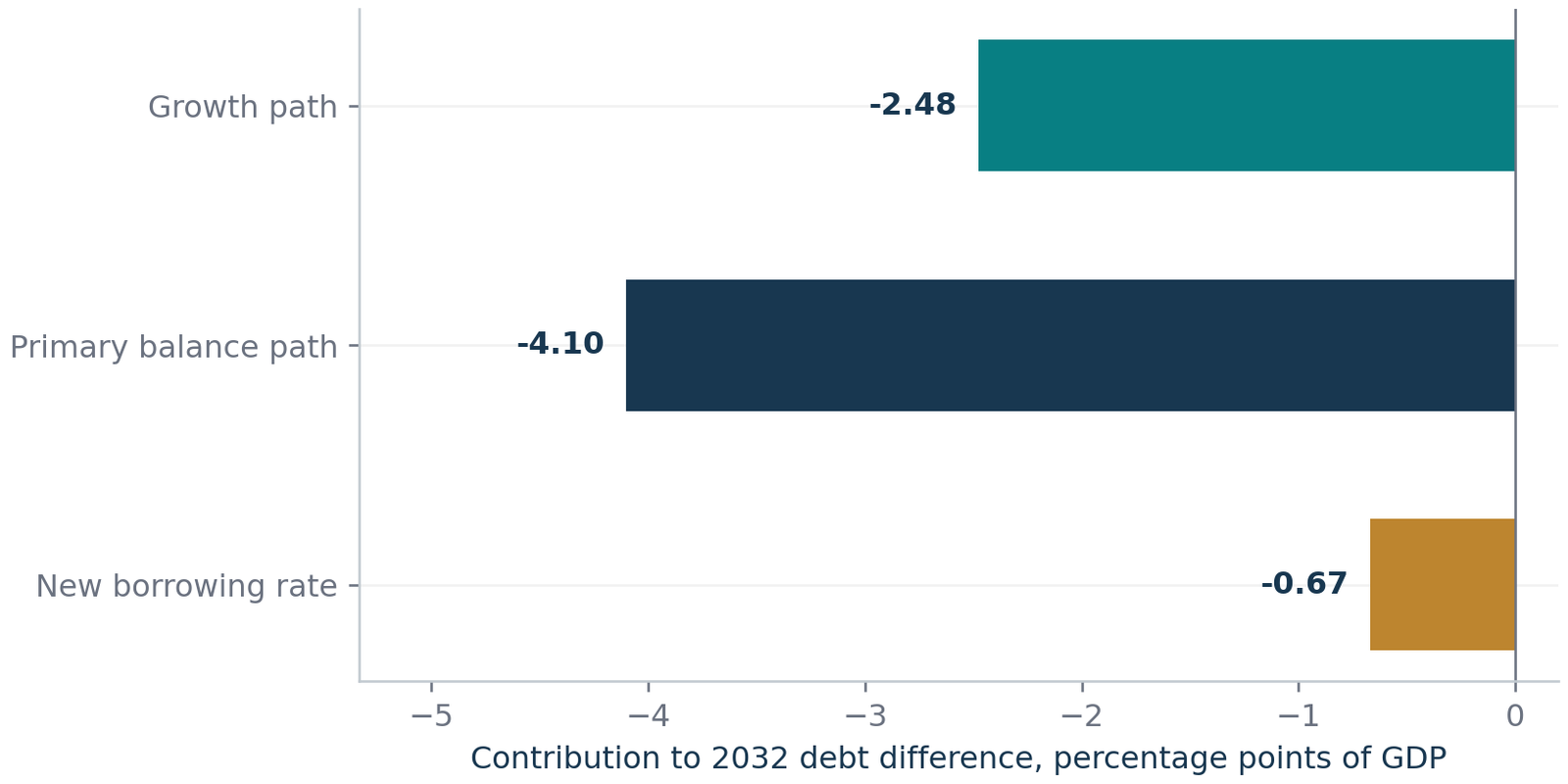
The delivery scenario ends with debt 7.25 percentage points of GDP below gradual adjustment. A Shapley decomposition attributes 4.10 points of that difference to the primary-balance path, 2.48 to the growth path and 0.67 to the lower rate on new borrowing. The calculation averages each channel's marginal contribution across all six possible orders in which the three assumptions can change.
This method avoids attributing the interactions entirely to whichever variable happens to be changed first. It remains an accounting decomposition of assumed scenarios. The shares are not empirical estimates of how much a particular president can deliver. The primary-balance contribution includes the favourable scenario's initial transition cost.
The result challenges a convenient campaign story in which confidence alone pays for recovery. Under these assumptions, the borrowing-cost channel is the smallest contribution because debt reprices gradually. Most of the difference requires actual changes in economic output and the recurring budget. A leader who can charm financial markets but cannot execute policy would have a weak claim to this simulated dividend.
For a business candidate, the implication is demanding: explain the operational foundations of the primary-balance and growth paths. A lower financing spread can reinforce successful delivery, but it cannot substitute for it.
Why indiscriminate cuts can defeat the fiscal objective
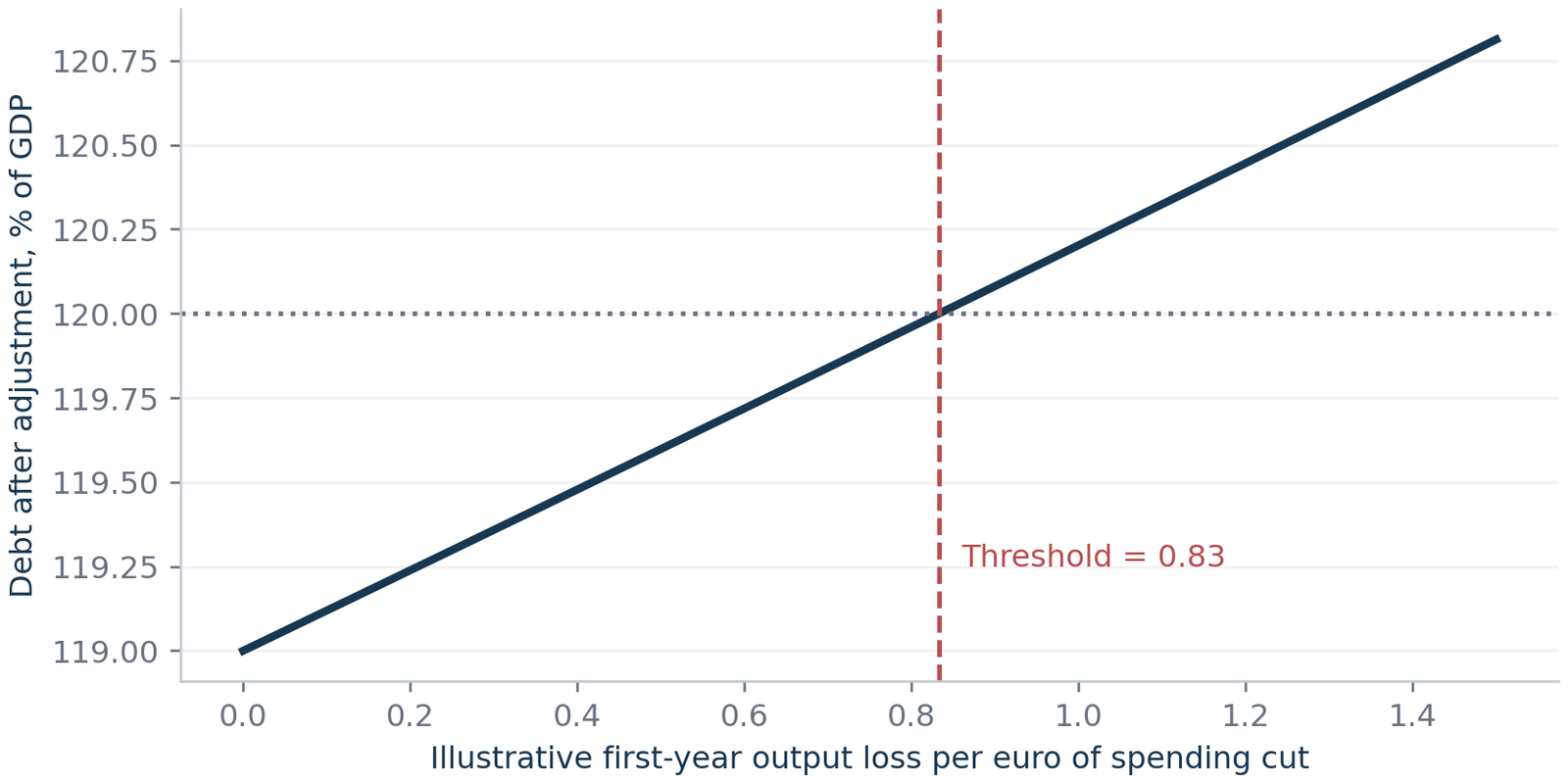
A simple one-period calculation shows why the composition of adjustment matters. Start with debt of 120 and GDP of 100. Assume a spending cut reduces debt by one unit but lowers output by m units, with no other effects. The resulting debt ratio is 119 divided by 100 minus m. It exceeds the original 120% when m is greater than approximately 0.83.
This threshold is arithmetic, not an estimate of France's fiscal multiplier. It omits tax feedback, monetary conditions, imports, expectations and subsequent years. Its purpose is to demonstrate that an immediate reduction in borrowing need not immediately reduce debt relative to GDP. The outcome depends partly on what the adjustment does to production.
An operator should distinguish the removal of duplicated administration from the cancellation of an economically valuable project. Both reduce an expenditure line. Their effects on output, future costs and service quality can be very different. A spending target without an operational account of these effects is an incomplete strategy.
This is not an argument for postponing every adjustment. It is an argument for choosing measures whose durable benefits exceed their economic and social costs. The credible business candidate would explain that choice rather than equating the largest announced cut with the strongest financial management.
Delay is an economic cost
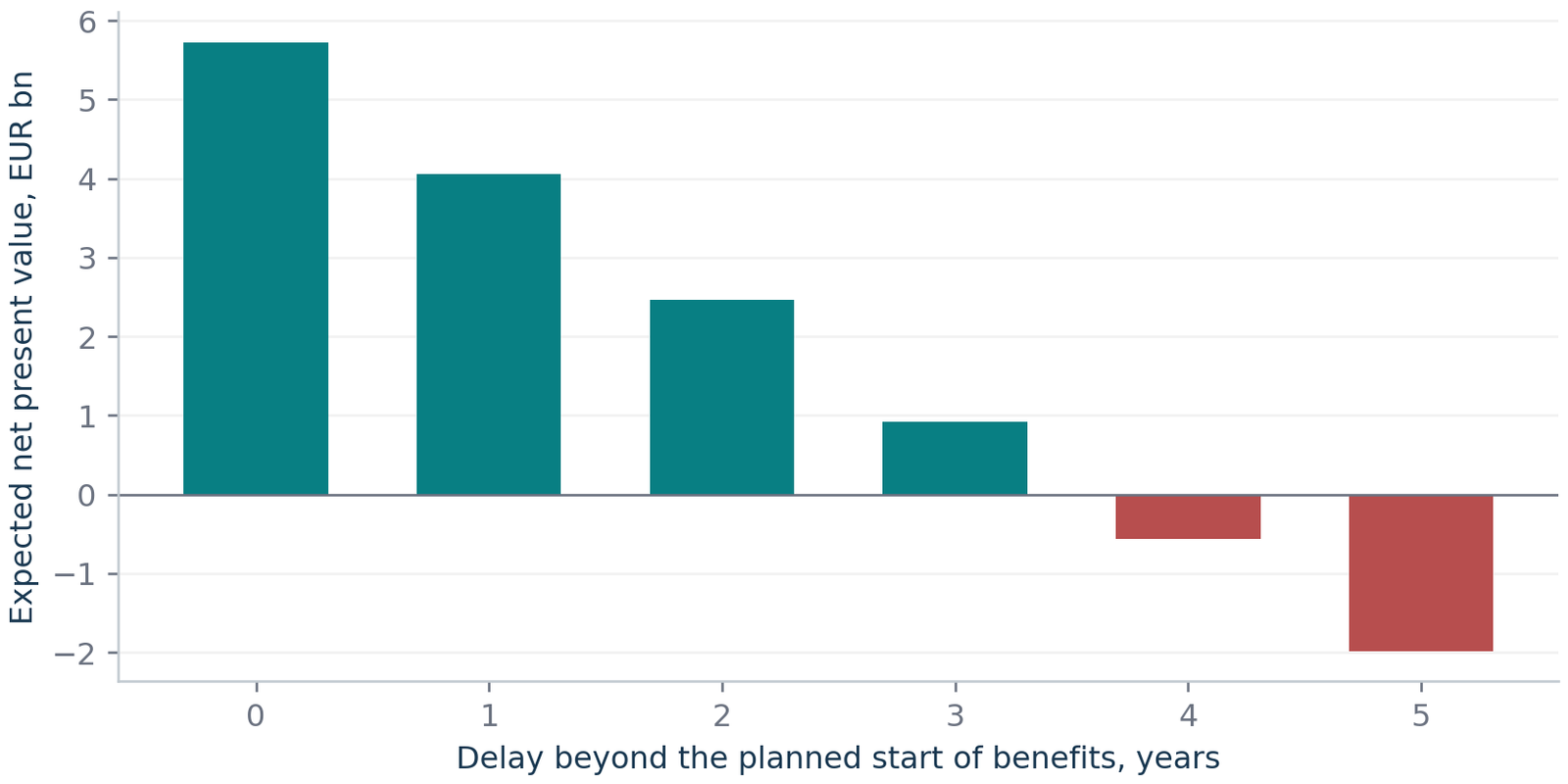
The cost of weak execution can be illustrated without inventing a national productivity estimate. Consider a programme costing EUR 5 billion at inception and expected to generate EUR 2.5 billion of annual benefits from years 2 to 10. Assume an 80% technical completion probability and 75% durability conditional on completion. Discount benefits at 4%. Each year of delay adds EUR 0.3 billion of carrying costs.
With no delay, expected net present value is EUR 5.72 billion. A two-year delay reduces it to EUR 2.46 billion, a loss of about 57%. Four years of delay make expected value negative. The calculation holds the end date of benefits fixed at year 10. Extending benefits beyond that date would reduce the measured penalty, although discounting and carrying costs would still matter.
This stylised project is not an estimate for a particular French programme. It identifies why a leader's ability to resolve dependencies can have economic value. A shorter delay may be worth more than a small saving on the original purchase price. Procurement judged only by the lowest initial bid can therefore select an expensive outcome.
Presidential attention should concentrate where unresolved coordination prevents otherwise valuable projects from functioning. The operator's contribution would be to make that coordination routine, with clear responsibilities and timely escalation, rather than requiring personal intervention in every delivery problem.
Political durability belongs inside the calculation
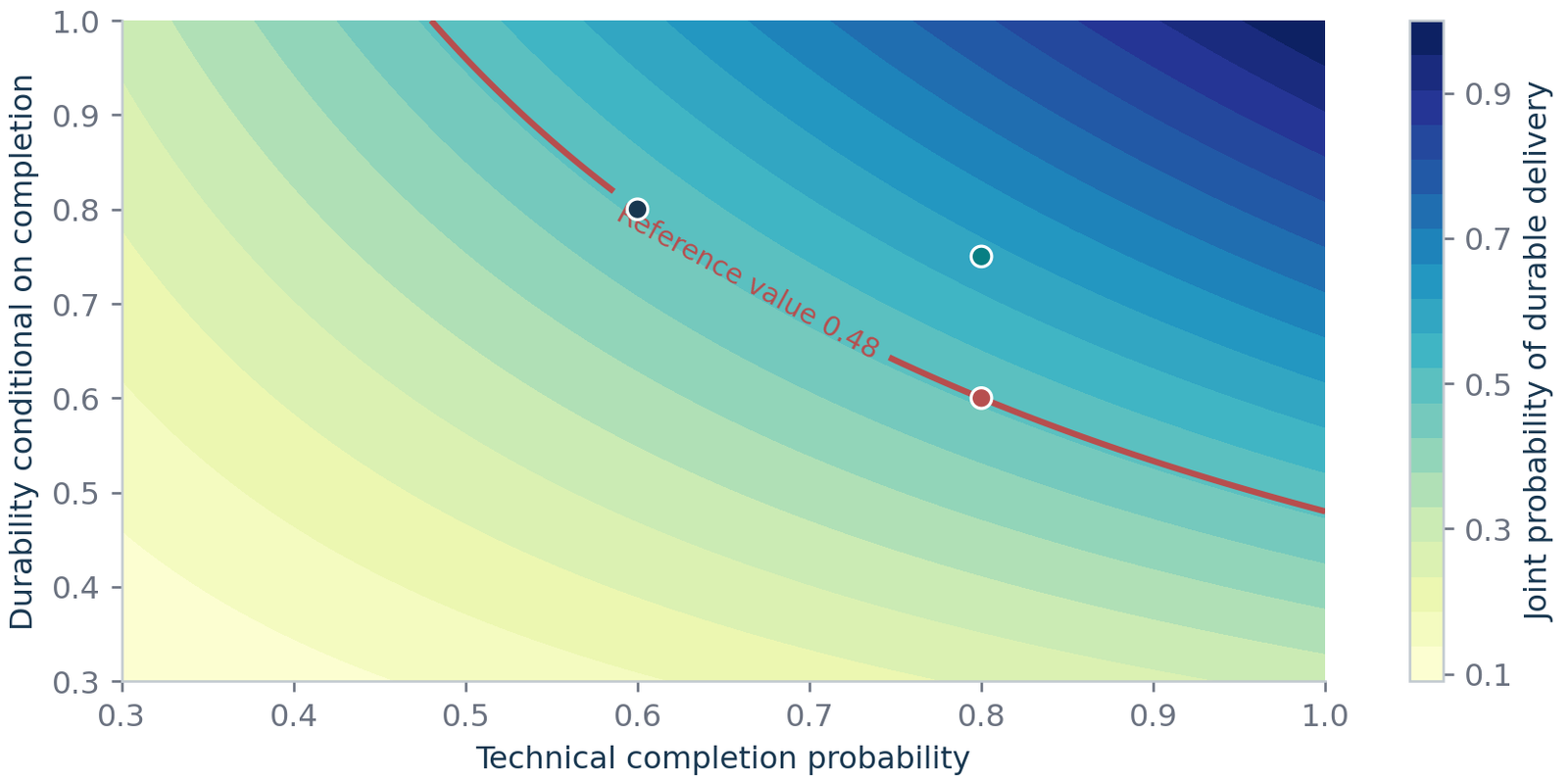
Technical competence creates value only if the resulting programme survives long enough to deliver its benefits. Let q denote the probability of technical completion and l the probability of political and legal durability conditional on completion. Their product is the joint probability of durable delivery. Defining l conditionally avoids assuming that the two events are independent.
Suppose a conventional administration has q = 0.60 and l = 0.80, giving a joint probability of 0.48. A more capable operator with q = 0.80 must maintain l above 0.60 to improve on that reference. At l = 0.75, the joint probability becomes 0.60. At l = 0.50, it falls to 0.40 despite stronger technical capability. These probabilities are illustrative.
The economic case for business experience therefore includes an ability to build agreement. A reform reversed after protest, litigation or a change of government may fail even if its administrative design was competent. Legitimate disagreement is part of the operating environment of democratic government.
The best business candidate would recognise this immediately. Negotiation, transparent distribution of costs and respect for institutional authority increase the chance that a useful programme survives. Treating consent as an obstacle outside the model would systematically overstate the candidate's expected economic contribution.
Management cannot replace institutional capacity
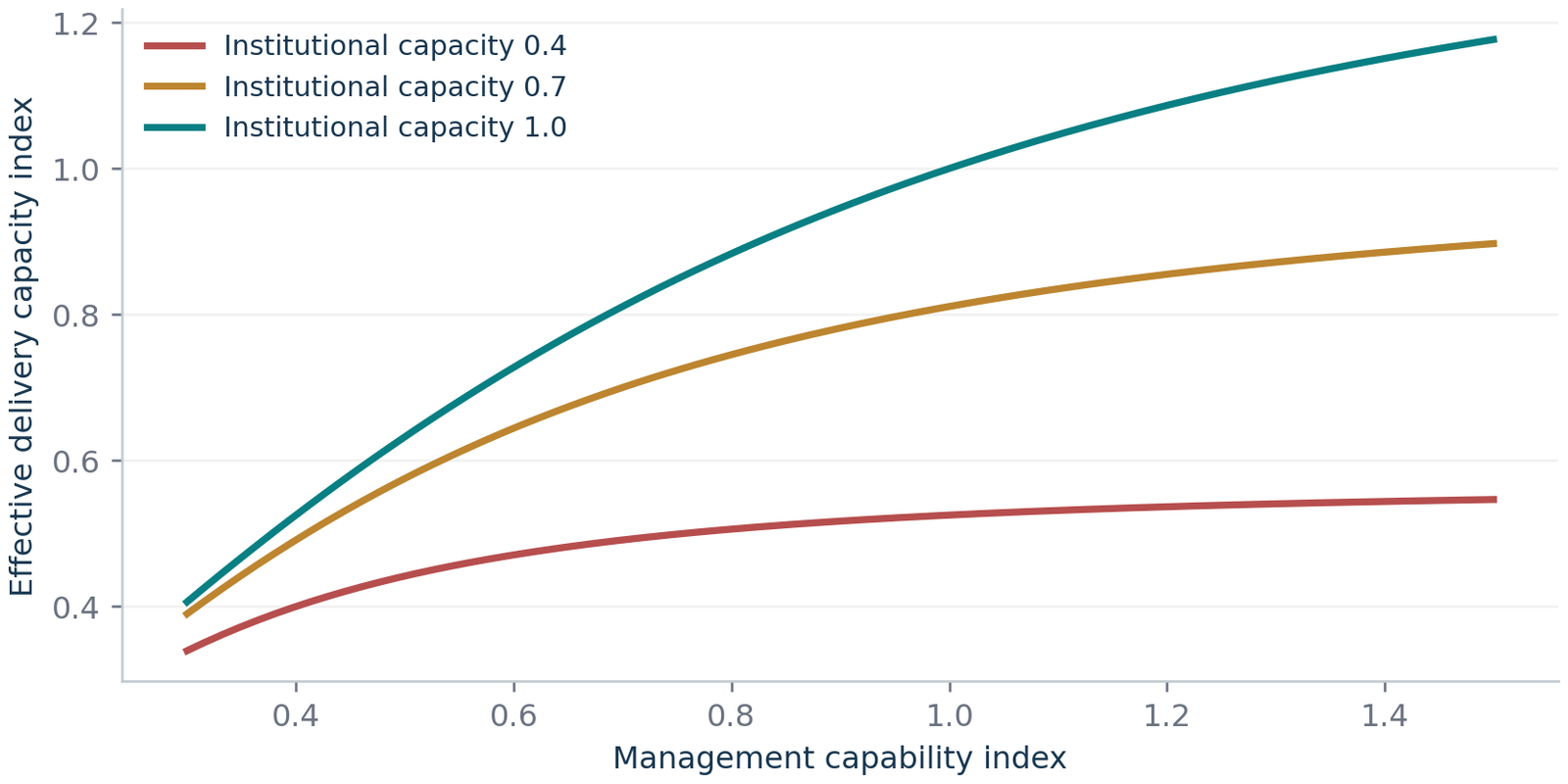
A president's competence works through an organisation. Figure 10 models management capability and institutional capacity as complements, using a constant-elasticity-of-substitution function with elasticity one-third. This deliberately represents a setting in which one input cannot easily compensate for a shortage of the other. The parameter is illustrative, not fitted to French data.
F(M,C) = [(M−2 + C−2) / 2]−1/2
With institutional capacity fixed at 0.4, raising the management index from 0.7 to 1.0 increases effective delivery capacity from 0.49 to only 0.53. If institutional capacity also rises to 0.7, effective capacity reaches 0.81. The comparison shows why replacing the person at the top may deliver little when essential skills, information or authority remain inadequate.
Business experience is most relevant when it helps a leader identify these constraints and build an organisation around them. This includes delegating to competent officials, maintaining institutional memory and giving teams a realistic sequence of tasks. Public servants become necessary partners in recovery.
The model also rejects a common fantasy of universal central control. A president who insists on deciding every detail can become a bottleneck. Successful operating leadership should make routine decisions possible at the appropriate level, while retaining accountability for the system as a whole.
What the research supports
Research offers reasons to take leadership and management seriously. It does not supply a reliable coefficient that converts a business career into French presidential growth. Table 4 separates the findings from the extrapolations that would be required to support such a claim.
Table 4 Evidence and the limits of transfer
| Research | What it establishes | Boundary for this article |
|---|---|---|
| Jones and Olken, 2005 [10] | Leader deaths identify changes in growth; effects are strongest in autocracies. | No estimate of a business-president effect in France. |
| Bloom et al., 2013 [11] | Randomised management consulting raised first-year productivity by 17% in studied Indian textile plants. | A firm-level intervention cannot be scaled into a national presidential dividend. |
| Chatterji et al., 2026 [9] | In 26 US states, active entrepreneurs selectively sponsor more pro-entry legislation, using 2009 to 2023 data. | Working-paper evidence on legislative behaviour, not national growth or welfare. |
Sources: original research [9, 10, 11]. Findings are paraphrased. Differences in population, institutions and outcomes restrict external validity.
The distinction between active entrepreneurship and other commercial ties is especially useful. Chatterji and co-authors study ownership, management and legislative behaviour separately. Their evidence concerns bills sponsored in US state legislatures. It does not measure the performance of national executives, nor does sponsorship alone establish that a policy improved welfare. [9]
Management experiments support a more limited but important proposition: organisational practices can change productive performance. The intervention, the firm and the setting matter. An effect found in textile plants cannot be inserted into a French macroeconomic model as the expected return to electing a chief executive. [11]
The argument advanced here is consequently a selection judgement informed by mechanisms and evidence. France should value demonstrated operating competence more highly when choosing its next president. It should then require evidence that the candidate can transfer that competence to public institutions. This is a stronger standard than assuming either that business experience is irrelevant or that it guarantees superior government.
The Macron objection must be answered directly
France has already elected a president with experience in banking. That fact is an important objection to any simple claim that moving someone from business into the Elysee will transform government. Emmanuel Macron's official biography records service in the Inspectorate General of Finance, a move into banking, a return to the presidency's staff in 2012, and later service as economy minister. It also records his elections in 2017 and 2022. [8]
A serious argument must therefore specify the experience it values. Financial advisory work can develop an understanding of transactions, capital and negotiation. Sustained responsibility for an operating organisation adds different evidence about production, staffing, customer service, recurring costs and execution over time. These are distinctions between forms of experience, not a claim that one biography explains every national outcome.
It would be equally misleading to infer from one presidency that a whole category of leader has been scientifically tested. Growth and public finances reflect inherited conditions, parliamentary arrangements, global shocks, policy choices and many institutions. An evaluation of a particular president requires a counterfactual, not merely the economic data observed during the term. The same standard must apply to a business candidate whom this article would favour.
The relevant lesson is that occupational proximity to finance is an insufficient selection rule. A future candidate should present a record that can be inspected in detail: what was personally controlled, which targets were achieved, how performance compared with peers, what risks were transferred to others, and whether results survived after the candidate left. Public leadership also requires evidence of working with legitimate opposition.
This makes the proposed profile narrower and more demanding than the generic label of businessman. It favours a person who has managed productive complexity and can explain how that experience would operate within the French state. It also allows a candidate from another background to demonstrate equivalent competence. The reason to prefer a business leader is an evidenced comparative advantage in the task ahead, not loyalty to a social category.
The objection thus improves the thesis. France should not repeat a selection decision based on a broad image of economic modernity. It should investigate the candidate's actual capabilities and the organisation through which those capabilities would become public results.
The presidency operates through constitutional institutions
A French president is not the chief executive of a company with an unlimited power to reorganise. Article 20 of the Constitution assigns the determination and conduct of national policy to the government, which is accountable to Parliament. Article 21 places the direction of government action with the prime minister. Article 8 gives the president the appointment of the prime minister. These provisions matter directly to any economic strategy. [7]
The practical influence of the president depends partly on the relationship between the presidency, the government and the parliamentary majority. A campaign that promises to operate above these relationships is economically incomplete. It leaves unanswered who will authorise the budget, pass necessary legislation, administer the changes and sustain them when interests conflict.
A business leader could bring useful experience in coordinating organisations without owning every participant. Large industrial projects often depend on suppliers, lenders, regulators and partners with distinct authority. That experience can encourage realistic negotiation. It can also tempt a candidate to confuse public institutions with contractual counterparties who can be replaced. Democratic legitimacy and constitutional powers cannot be acquired through a better commercial offer.
The economic programme should therefore include an institutional account of delivery. It should identify which proposals require legislation, which involve administrative action, where local responsibilities apply, and how the government will work with the relevant authorities. This is a test of preparation, rather than a request for a constitutional shortcut.
Parliamentary scrutiny can improve economic decisions by exposing assumptions that an enthusiastic executive overlooks. Independent audit can distinguish a real saving from a cost transfer. Courts can make the boundaries of action credible. The value of operating experience increases when it works with these institutions and supplies them with better information.
The next president's responsibility is consequently to assemble a governing capacity, not merely a personal mandate. A business candidate should make the intended working relationship with the prime minister and Parliament an explicit part of the case for election. Without that relationship, a plan can be technically elegant and politically undeliverable. The models in this article treat that risk as part of the economic problem because it changes whether benefits ever materialise.
Public value requires a broader balance sheet
A national economy cannot be evaluated through a single profit figure. Some public services exist precisely because their benefits are difficult to sell, their users cannot pay, or private contracts cannot capture their full value. A business leader who understands only financial returns would be poorly equipped for the presidency.
Table 5 Distinguishing financial changes from public value
| Decision | Possible financial gain | Additional outcome to examine |
|---|---|---|
| Reduce service locations | Lower premises cost | Access, travel and waiting time |
| Sell a public asset | Immediate debt reduction | Lost revenue and future control |
| Digitise a procedure | Lower processing cost | Errors, exclusion and user time |
| Defer maintenance | Lower current spending | Reliability and later replacement cost |
| Expand infrastructure | Future economic capacity | Demand, utilisation and total lifecycle cost |
Original analytical examples. Outcomes depend on design and context; the table does not assert that these effects occurred in a particular French programme.
The OECD's 2026 survey attributes around half of France's spending gap relative to the euro area to social protection, with old-age spending accounting for roughly 70% of that component. Its comparison uses the data vintage available for that survey. Such composition matters: reducing transfers changes household resources and distribution, while improving a procurement process changes how a given service is produced. [13]
The broader balance sheet should recognise assets, obligations and outcomes together. Gross debt is informative but does not value every public asset. Net debt is also incomplete because its definition covers specified financial assets. Neither measure alone captures the condition of schools, the reliability of infrastructure or the future consequences of neglected maintenance.
The transferable business skill is disciplined appraisal. The objective must be supplied democratically. A candidate should be able to explain how financial costs, public benefits and unequal effects enter the appraisal, including where a precise monetary valuation would be misleading. Table 5 gives examples of the required distinctions.
The industrial test is the ability to complete
Industrial renewal puts the operating argument under particularly demanding conditions. Factories, energy assets and transport systems require years of preparation and interdependent decisions. The political announcement usually precedes the difficult work. A president with experience of building productive capacity should understand that financing, engineering and workforce development must be credible together.
The Cour des comptes' January 2025 EPR review illustrates the issue. Its synthesis estimated the total construction cost of Flamanville 3 at about EUR 23.7 billion in 2023 euros, including financing costs during construction. It also identified unresolved concerns about costs, design maturity and financing in the subsequent programme. These are the findings of that dated review, not a claim about the latest status of every project. [12]
The analytical lesson is broader than nuclear power. In a complex programme, a saving in one contract can increase costs elsewhere. An accelerated political deadline can produce redesign or rework if engineering is incomplete. A supplier can be financially fragile even when the lead organisation has secured its budget. Public accounting often separates these exposures into different institutions, while the physical project remains one interconnected system.
An experienced operator may be better prepared to question the completeness of the delivery plan. Does the design exist at the maturity required for the next commitment? Are scarce technical skills available when several projects demand them simultaneously? Is the contingency allowance tied to identifiable risks? Who can resolve a conflict between delivery organisations before delay becomes entrenched?
These questions are compatible with a strong state. They do not imply that national infrastructure should be judged only by a private investor's required return. Security of supply, environmental effects and resilience may justify public involvement. They do require those additional benefits to be explicit, so that public purpose does not become a reason to avoid examining cost.
The business candidate's strongest claim would be the ability to insist on this discipline consistently. The test is the quality of investment decisions and completed assets, rather than the number of agreements signed in front of cameras. Industrial policy acquires economic substance when productive capacity is delivered at a cost that the country can sustain.
Productivity gains must survive measurement
A recovery strategy needs more output from available resources, but productivity statistics require care. Banque de France's July 2026 analysis estimated a 2.7% shortfall in potential market-sector productivity relative to its pre-Covid comparison, partly associated with employment composition. The same analysis found that increased labour participation offset much of the market-sector effect on potential output. These are model-based estimates, not directly observed measures of managerial failure. [6]
This distinction prevents an important mistake. Bringing less experienced workers into employment can lower average output per worker while increasing total output and inclusion. A president should not celebrate a productivity increase caused merely by excluding people with lower initial productivity. The desired result is stronger productive capability alongside sustainable employment.
Operating experience can help connect the aggregate objective to specific constraints. A firm may need better equipment, more reliable electricity, workers with particular skills or a shorter delay before an investment becomes usable. The national task is to identify where public action improves these conditions and where it simply subsidises activity that would have occurred anyway.
The effects should be measured at the appropriate level. A digitised administrative process may reduce the time firms spend completing an application. That benefit can be real even if it is initially invisible in a ministry's cash budget. Conversely, a new software system may generate expenditure and publicity without reducing processing time or errors. Expenditure is not evidence of adoption, and adoption is not evidence of value.
The presidency should therefore be assessed through a chain of indicators: the constraint addressed, the change in actual service, the response of users and the eventual economic result. These are stages in one argument, not independent achievements to be counted several times. A capable operator would be expected to notice when the chain breaks and revise the intervention.
This approach also makes uncertainty manageable. Some programmes will fail. The question is whether failure is identified early, whether the explanation is credible and whether resources are redirected. Business experience earns its relevance through that learning discipline. It loses its value if success in a previous company becomes a reason to dismiss contrary evidence in government.
Independence from private interests is an economic condition
A president with business experience must demonstrate that public authority will serve the economy as a whole. The risk is broader than unlawful conduct. Favouritism can distort competition, discourage entrants and cause citizens to interpret useful reforms as private bargains. The economic cost can arise even when a narrow transaction appears efficient.
Table 6 Proposed credibility requirements for a business candidate
| Issue | Evidence to request | Economic purpose |
|---|---|---|
| Commercial holdings | Clear, independently reviewed separation arrangements | Reduce incentives for private favour |
| Former partners | Transparent treatment of access and decisions | Maintain competition |
| Public procurement | Auditable criteria and decisions | Protect value and equal treatment |
| Policy evaluation | Publication of adverse as well as favourable findings | Preserve learning and trust |
Original normative criteria. This table is not legal advice or a description of the candidate obligations currently imposed by French law.
Disclosure alone may reveal a conflict without removing it. Delegation of private management may leave a material financial interest intact. A credible candidate should explain how holdings, former partners and foreseeable decisions would be handled, under arrangements consistent with French law and independently scrutinised. The standards in Table 6 are proposed criteria for political credibility, not a summary of existing statutory duties.
This requirement is integral to the pro-business-experience argument. A leader's former commercial network may provide knowledge, but preferential access must not become a governing method. New firms and competitors should have a reason to trust the rules even when they oppose the president politically.
The decisive distinction is between understanding business and representing selected businesses. The first can improve national policy. The second can reduce competition and damage the consent on which durable recovery depends. A business candidate who cannot make this separation credible would fail the central economic test developed in this article.
The uncertainty is large enough to change the verdict
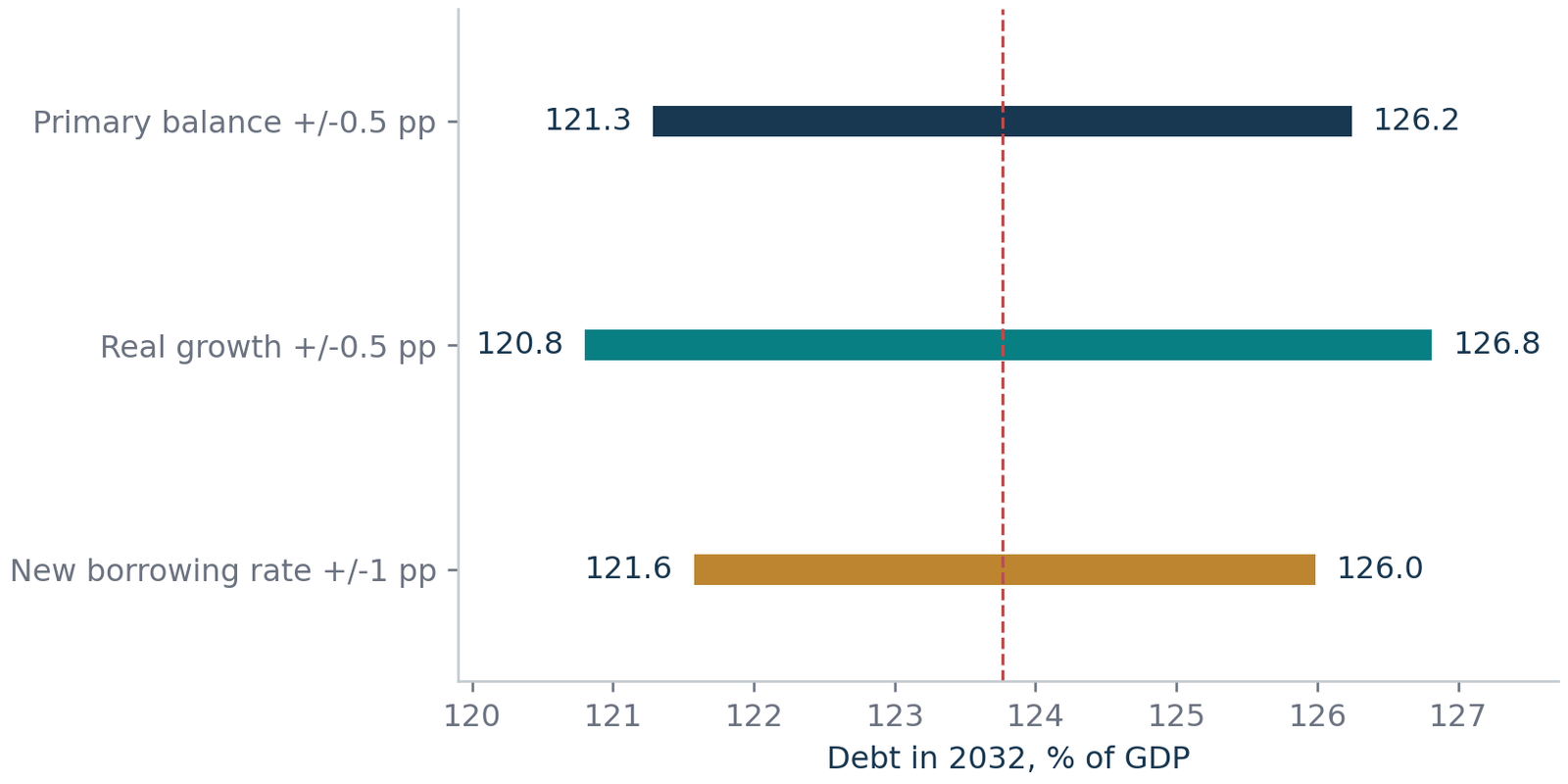
Small changes in recurring assumptions accumulate. In the delivery scenario, shifting annual primary balances by half a percentage point of GDP moves 2032 debt from the central 123.8% to between 121.3% and 126.2%. Shifting real growth by half a point each year produces a range of 120.8% to 126.8%. A one-point change in the rate on new borrowing produces 121.6% to 126.0%.
The chart varies one assumption at a time. A separate grid combines all three ranges, with 4,851 parameter combinations. Its full minimum-to-maximum range is 116.2% to 131.6%. This is an assumption stress test. It is not a confidence interval, a calibrated probability distribution or a claim that all combinations are equally likely.
The practical implication is that a plausible plan needs room for adverse surprises. A candidate who presents a single precise debt outcome without exposing its dependence on growth, financing and implementation has not demonstrated superior financial judgement.
The business-leader thesis survives this uncertainty as a claim about capabilities, not guaranteed outcomes. An experienced operator should be better equipped to identify the assumptions that matter and prepare decisions that remain defensible when those assumptions change. That expectation must itself be tested against the candidate's actual record.
The first two years reveal the quality of leadership
The early presidency should be judged by whether it establishes the conditions for later results. Growth and debt may move for reasons outside the new leader's control. In contrast, the clarity of commitments, the quality of appointments and the treatment of emerging evidence reveal governing choices much sooner.
An experienced operator would be expected to distinguish urgent continuity from deliberate transformation. Existing services must function while changes are introduced. Attempting every reform simultaneously can overload the same technical and administrative teams, creating failures that are then misdiagnosed as resistance. The relevant skill is sequencing according to dependencies and available capacity.
This does not mean that preparation becomes an excuse for indefinite delay. The programme needs observable intermediate results. A service should show whether processing times, errors or availability are changing. A capital project should show whether design, procurement and construction are proceeding against a stable scope. Fiscal claims should distinguish cash already saved from savings that depend on future implementation.
Political communication is part of this sequence. If the transition has upfront costs, those costs should be explained before they arrive. If a measure distributes costs unevenly, the distribution should be visible. Concealing these features can win a short interval of approval at the price of later reversal. The consent model shows why that trade can destroy expected value.
The presidency also needs a method for abandoning weak initiatives. A commercial leader may have experience closing unsuccessful projects, but the public decision requires additional care because access, rights and obligations remain. The standard is neither permanent continuation nor automatic cancellation. It is a reasoned account of what will replace the failing activity and how citizens will be affected.
By the end of the second year, voters should be able to distinguish a government that has established a credible system of delivery from one that has merely changed the language of politics. The distinction will appear in the evidence supporting decisions and in the willingness to correct mistakes. These are demanding expectations for any president. They are especially appropriate for a candidate who claims a comparative advantage from business.
Predictions that can prove the argument wrong
A strategic argument becomes more useful when it specifies observations that would weaken it. The predictions below concern mechanisms, not an election result. They do not presume that a business candidate wins, and they assign no numerical probability to national recovery.
Table 7 Conditional predictions and disconfirming evidence
| Mechanism | Expected observation | Evidence against the thesis |
|---|---|---|
| Operating competence | Execution reliability improves before macroeconomic results | Repeated missed milestones without correction |
| Durable consent | Implemented changes survive political pressure | Reversals erase anticipated benefits |
| Fiscal discipline | Recurring savings reconcile to actual accounts | Cost transfers and one-off gains dominate |
| Institutional learning | Failures change subsequent decisions | The same delivery errors recur |
| Commercial independence | Rules remain credible to entrants and competitors | Preferential treatment narrows competition |
Original testable propositions. No election forecast is implied. Assessment requires definitions set in advance, suitable comparisons and attention to external shocks.
The central prediction is conditional: if a president brings transferable operating competence and secures durable authority for implementation, improvement should appear first in execution measures and later in economic and fiscal outcomes. If only rhetoric changes, the expected sequence will not occur. A business background without observable improvements in delivery would provide little support for the thesis.
The assessment must preserve a comparison. Projects differ in difficulty, regions differ in inherited capacity, and economic shocks affect outcomes independently of presidential competence. Where feasible, evaluation should use comparable services or staggered implementation, publish definitions in advance and examine distributional effects alongside averages. National before-and-after comparisons alone cannot establish causality.
The argument would also weaken if the candidate's commercial ties systematically narrowed competition or damaged trust. In that case, the negative channel in Figure 2 would dominate the proposed capability advantage. A serious defence of business experience has to accept that possible verdict.
The case for a business leader is a case for demonstrated competence
France should broaden the route to its highest office and give substantially greater weight to a record of building and running productive organisations. The next president will face commitments that cannot be financed indefinitely through optimistic assumptions and institutions whose performance depends on patient coordination. Demonstrated operating competence is highly relevant to that responsibility.
The argument is strongest when it is specific. A qualified business leader would understand the total cost of a commitment, the difference between a signed contract and a functioning asset, and the consequences of allowing problems to remain hidden until they become expensive. Such experience could improve the way the presidency selects priorities and organises the government's work. It would also provide a record that voters can examine beyond campaign performance.
The simulations show the economic importance of those mechanisms. Under the assumptions used here, better delivery and stronger productive performance can create a material difference in debt over five years. Most of that difference comes from actual growth and primary-balance changes. Confidence in the financial markets contributes less. Recovery therefore depends on work that must be completed, financed and sustained after the announcement.
The qualification is equally clear. A country cannot be rescued by the personal will of a wealthy individual. Democratic authority, capable public institutions and independence from private interests determine whether operating skills become public value. These conditions identify the kind of business leader worth supporting; they do not weaken the economic reason to search for one.
France should ask every potential president for evidence of governing capability. A business candidate with a substantial operating record, credible arrangements against conflicts and a realistic parliamentary strategy could answer that demand particularly well. A candidate who offers wealth, celebrity or impatience with institutions would not meet it.
The future president's most important contribution would be to make the state more reliable in what it undertakes. That would change the economic meaning of public expenditure, improve the credibility of difficult fiscal choices and give private investment a more dependable environment. For France, the case for a business leader is strongest when it is expressed in those terms: a person who has proved an ability to turn resources into lasting results, and who is prepared to submit that ability to the obligations of the Republic.
Methods and interpretation
The empirical component is descriptive. Figure 1 transcribes six annual observations from INSEE's 28 August 2026 table. The debt snapshot comes from a separate quarterly release. Historical revisions and differences in scope are retained rather than silently reconciled. No regression, causal presidential effect, candidate ranking or estimated probability of electoral success is reported.
The debt engine applies d(t) = [(1 + i(t))/(1 + g(t))]d(t−1) − p(t), with zero stock-flow adjustments. Initial debt is 120% of GDP at end-2027 and the initial effective interest rate is 2.5%. Each year, 15% of the effective rate moves to the scenario's constant rate on new borrowing. Nominal growth is (1 + real growth) × 1.018 − 1. Primary balances are percentages of each year's GDP. These simplifying inputs are assumptions, not forecasts. Table 3 records all variable paths.
The Shapley decomposition changes growth, primary balances and borrowing rates across all six possible orders, then averages each channel's marginal contribution to terminal debt. The sensitivity grid uses 21 growth shifts from −0.5 to +0.5 percentage point, 21 borrowing-rate shifts from −1 to +1 point, and 11 primary-balance shifts from −0.5 to +0.5 point. All 4,851 combinations are evaluated; no probability weights are assigned.
For a delay D, project value is 0.8 × 0.75 × the discounted sum of EUR 2.5 billion benefits in years 2 + D through 10, less EUR 5 billion upfront and discounted EUR 0.3 billion carrying costs in years 2 through 1 + D. Discounting is 4% annually. Delays therefore shorten the benefit period. Political durability is conditional on technical completion. The CES illustration uses equal weights and exponent −2, giving substitution elasticity one-third.
The models are deliberately small enough to audit. They omit endogenous inflation, monetary responses, behavioural tax effects, migration, contingent liabilities and feedback from debt to yields. Results should be interpreted as conditional comparisons of mechanisms. The original code, input tables and calculations accompany the downloadable research files. All prose, tables and visual designs were prepared for this article; cited research and official statistics remain attributed to their sources.
Sources and author
References are numbered in order of their analytical role rather than by publication date. Official observations, external forecasts and the article's illustrative calculations are distinguished throughout. Sources were checked on 25 October 2026. Later revisions can change the historical starting point without changing the accounting identities.
Dr. Driss Effina is an economist, statistician and professor at INSEA in Morocco. His work at Global Strategy Files examines economic strategy, public policy and structural change. This article presents an argued assessment of presidential capabilities and economic recovery; it does not endorse a named candidate.
Suggested citation: Effina, Driss. 2026. Why France Needs a President with Business Experience. Global Strategy Files. 25 October. Strategic article and reproducible analytical supplement.
- INSEE. Public expenditure and revenue. Annual accounts, 28 August 2026.
- INSEE. Maastricht public debt, Q2 2026. Informations rapides 239, 29 September 2026.
- Banque de France. Interim macroeconomic projections, September 2026. Published 15 September.
- Cour des comptes. La situation et les perspectives des finances publiques. 25 June 2026.
- Agence France Trésor. Negotiable debt outstanding at 30 September 2026. Updated 1 October.
- Devulder, A. France’s potential growth following the Covid crisis. Banque de France, 8 July 2026.
- French Constitution of 4 October 1958, current text. Articles 8, 20 and 21. Légifrance.
- Presidency of the French Republic. Emmanuel Macron, official biography.
- Chatterji, A., Guzman, J., Ma, J. and McDevitt, R. C. Political Entrepreneurs. NBER Working Paper 35637, August 2026.
- Jones, B. F. and Olken, B. A. Do Leaders Matter. Quarterly Journal of Economics 120(3), 835-864, 2005.
- Bloom, N., Eifert, B., Mahajan, A., McKenzie, D. and Roberts, J. Does Management Matter. QJE 128(1), 1-51, 2013.
- Cour des comptes. La filière EPR une dynamique nouvelle des risques persistants. Synthesis, January 2025.
- OECD Economic Surveys France 2026. Chapter on sustainable public finances and long-term growth.