China Automation and Pension Geography


Driss EFFINA, PhD Independent Researcher, Global Strategy Files Decoded, China series, 23 October 2026.
Who receives contributions, who pays pensions and where a worker lives can differ. This preview joins a verified provincial cash bridge with a fully specified worker-cohort experiment and its employment and pooling counterexamples.
Jilin’s cash improvement is largely a pooling bridge
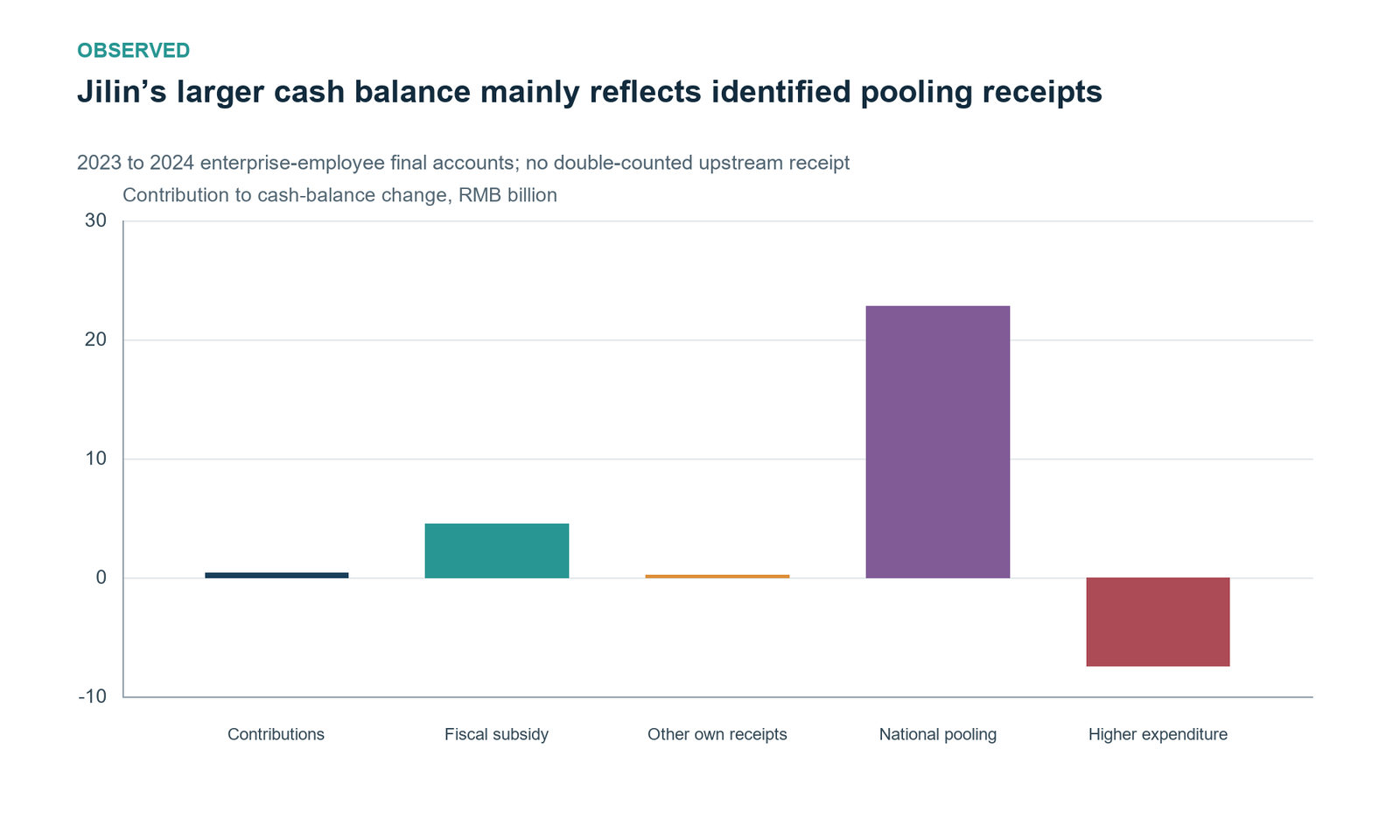
Jilin’s 2024 final-account package supplies comparable 2023 and 2024 enterprise rows. In RMB billion, own revenue rises from 99.67 to 104.76, identified national-pooling receipts from 26.69 to 49.51, and expenditure from 123.53 to 130.95. The resulting cash balance rises from 2.83 to 23.32, an improvement of 20.49. This is an exact bridge using the source’s displayed rounded values, located on printed pages 61-65, physical PDF pages 77-81. (Jilin 2024 provincial final accounts package)
The bridge consists of RMB0.40 billion additional contributions, 4.48 billion fiscal subsidies, 0.21 billion other own revenue, 22.82 billion pooling receipts, and minus 7.42 billion from higher expenditure. The components sum to 20.49. Contributions grow only 0.6652%. National pooling accounts for 32.0931% of the 2024 total revenue including that pooling, while contributions cover 46.2237% of expenditure. Increased redistribution therefore explains more than the net cash improvement, because higher spending offsets part of it.
The source presents two revenue scopes. The table’s 104.76 billion excludes the separately shown 49.51 billion pooling receipt; the narrative’s 154.27 billion already includes it. Adding pooling once to the table reconciles the narrative. Adding it again to the narrative would overstate income by RMB49.51 billion and manufacture an improved fiscal position. The same operation cannot be both a scope adjustment and an additional economic receipt. Gross portability-transfer income is another account concept and is not renamed national pooling.
Before the identified pooling receipt, 2024 own revenue minus expenditure is minus RMB26.19 billion; after it, cash is positive RMB23.32 billion. Neither quantity values remaining benefit obligations or proves an automation effect. The observed case demonstrates an actual geographic financing mechanism and the necessity of consolidation. It does not establish that robots caused Jilin’s contribution pattern, that accrued promises fell or that a larger current balance means actuarial solvency. The model’s abstract origin province is consequently not calibrated to Jilin.
A synthetic cohort makes every labor assumption visible
The prototype starts in 2025 with 10,000 men born in January 1985, each with twenty destination contribution years from 2005-2024 and an assumed RMB180,000 opening personal account. The opening balance is deliberately an input, not a reconstruction of changing historical interest and contribution rules. There are 23 future contribution years, 2025-2047, before normal retirement in 2048. All survive to retirement by construction; postretirement survival is modeled separately. Money is constant 2025 RMB and present values are dated at the start of 2025.
Baseline annual covered wages and the destination reference wage are each RMB90,000. The origin reference wage is RMB75,000. Real wage growth is zero centrally. A constructed shock at the start of 2027 displaces 20% of the original cohort. The retained 80% receive a 5% wage increase. Of those displaced, 60% find formal origin replacement jobs at 80% of the original wage; the other 40% earn the same replacement wage informally without further employee-pension payments. No parameter is fitted to robot counts.
There are therefore 8,000 retained destination workers, 1,200 formal origin returnees and 800 informal origin returnees. Formal return occurs at age 42 and re-establishes the origin-hukou insurance relationship. Informal return changes residence while retaining the destination relationship. The baseline keeps all original workers formal at the original wage in destination. An optional experiment adds new destination jobs, including the new workers’ pension accrual, rather than counting their contributions as free finance.
Both provinces are abstract. Their wages are not Jilin observations, their common reference contribution rate is not an estimated national rate, and their workers are not confidential migrant records. Year-end contribution timing, start-2027 portability, 2% real personal-account crediting, 3% real discounting, zero real pension indexation and the chosen survival curve are also assumptions. This full setup is necessary before reading the numerical results. It makes the calculation replicable and identifies which evidence would be needed to convert the experiment into an empirically calibrated study of automation and pension geography.
For the lifetime calculation, postretirement hazard starts at 0.01 at age 63 and doubles every eight years under an assumed Gompertz survival curve. The model freezes the age-63 personal-account divisor at 117 months and includes the remaining account estate on death before exhaustion, alongside survivor pensions. These are valuation choices and current-rule references held constant, rather than an estimated Chinese life table or a prediction of 2048 policy.
The current contribution loss has an exact threshold
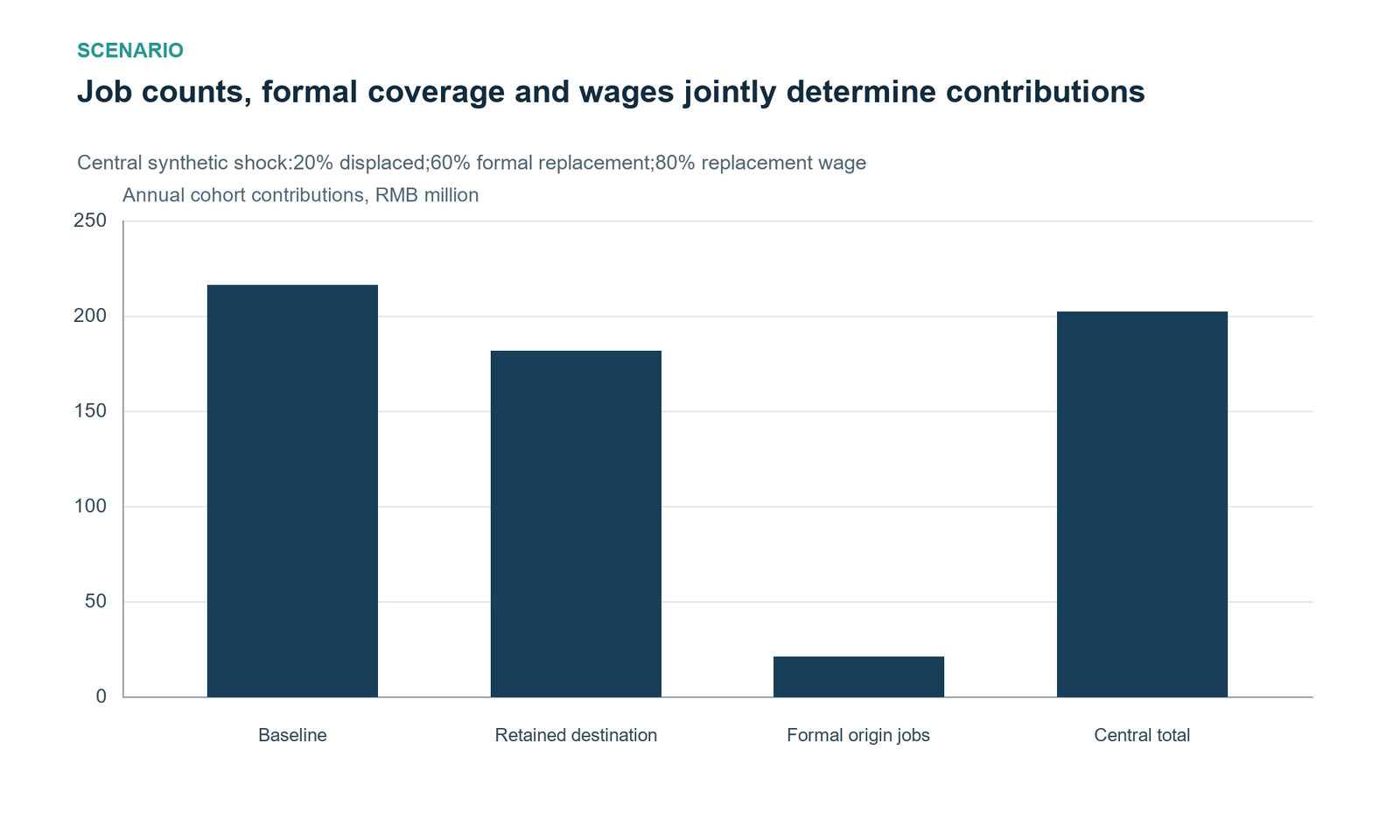
Let d be the displaced share, g retained-worker wage growth, f replacement-job formality, q replacement wages relative to the old wage, and j additional formal jobs as a share of the original cohort, paid at relative wage q_new. With common contribution rates, the post-shock contribution ratio is (1-d)(1+g) + d f q + j q_new. The central inputs give 0.8 × 1.05 + 0.2 × 0.6 × 0.8 = 0.936. The current contribution loss is therefore 6.4%.
Annual combined employer and employee payments fall from RMB216 million to RMB202.176 million. Retained workers supply RMB181.440 million and formal origin replacements RMB20.736 million. Informal workers still earn RMB72,000 each, but their scenario path contributes nothing further to the employee fund. This is a declared behavior choice, not a claim that every informal worker is legally barred from voluntary flexible-employment participation. The 2026 official reply expressly describes that possibility and preserves rights across interruptions. (Authoritative MOHRSS insurance transfer reply via government/Xinhua)
With no extra jobs, setting the contribution ratio to one gives g = d(1-fq)/(1-d). At the central displacement, formality and replacement wage, retained wages must rise 13% for current contribution neutrality. The central 5% gain is below that threshold. A lower displacement share, higher formal replacement or new jobs can also close the gap. This algebra establishes a falsifiable condition without importing an empirical robot-to-job coefficient or assuming that all technological adoption has the same labor response.
Current payroll arithmetic remains only one side of the pension question. Changes in covered years and wages also alter basic pensions, account balances and estates, and moving a formal relationship can change the payer. An analysis that holds all promises fixed while lowering contributions would predetermine an adverse lifetime result. Conversely, calling lower future benefits a policy success would confuse the fund’s receipts-minus-payments ledger with workers’ wellbeing. The next stages calculate the claims under each history before drawing any conclusion about net geographic incidence.
Receipts fall, but the included promises fall further
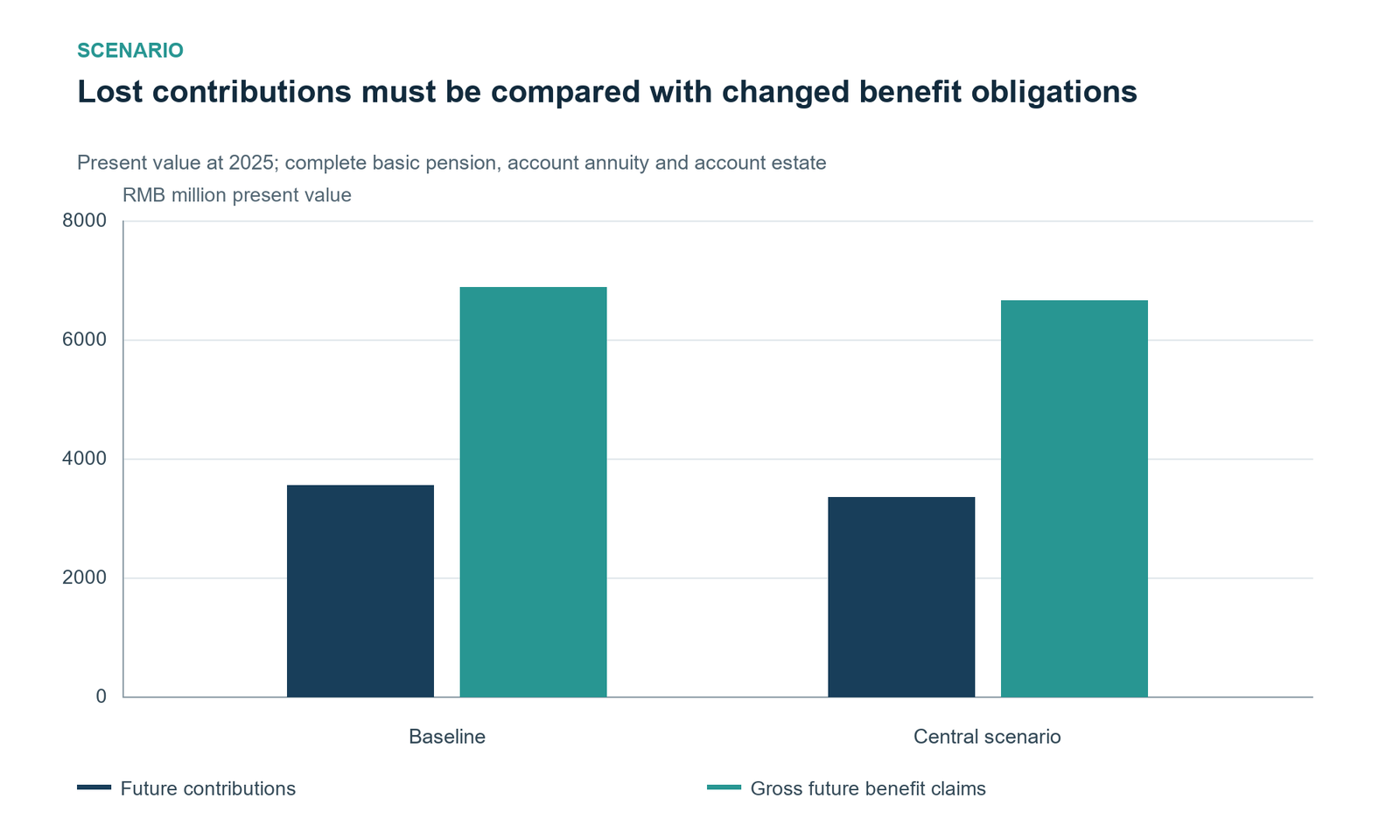
At the start-2025 valuation date, baseline future contributions total RMB3,551.819 million, against RMB3,350.955 million under the central labor paths. The difference is minus RMB200.865 million. Remaining basic pensions, account pensions and account estates total RMB6,876.312 million at baseline and RMB6,649.099 million centrally, a difference of minus RMB227.213 million. The net contribution-minus-claim change is therefore plus RMB26.348 million.
The positive net sign is a direct identity: minus 200.865 minus minus 227.213 equals plus 26.348, with displayed rounding. It does not mean lost covered employment is beneficial. Reduced future claims are resources no longer paid to workers or estates. A contribution-only analysis would report a loss and miss the claim adjustment; a fund-only celebration would report an improvement and miss whose promise has become smaller. The model supplies both quantities so neither interpretation can hide the other side.
The absolute baseline remaining-flow ledger is negative because it includes benefits earned during prior service while counting only future contributions and omitting common opening assets. It is not an estimated cohort funding deficit or a national actuarial gap. Common prior histories and assets are held equal, so the change is meaningful for the stated experiment even though the absolute ledger is not a complete historical balance sheet. Past contributions are not assumed to have vanished from an actual fund.
The present value also depends on the declared timing and valuation convention. Contributions arrive at year end, retirement starts in 2048, and the first full pension payment is at the end of the first retirement year. All survive to retirement; later pensions and estates receive survival and death weights. The central result follows those assumptions, not a fitted Chinese mortality model. The later sensitivity grid is consequently a substantive test of sign robustness. A small positive central net result should not be promoted to a national prediction merely because its inputs and arithmetic are precise.
Complete marginal pooling removes the provincial increment
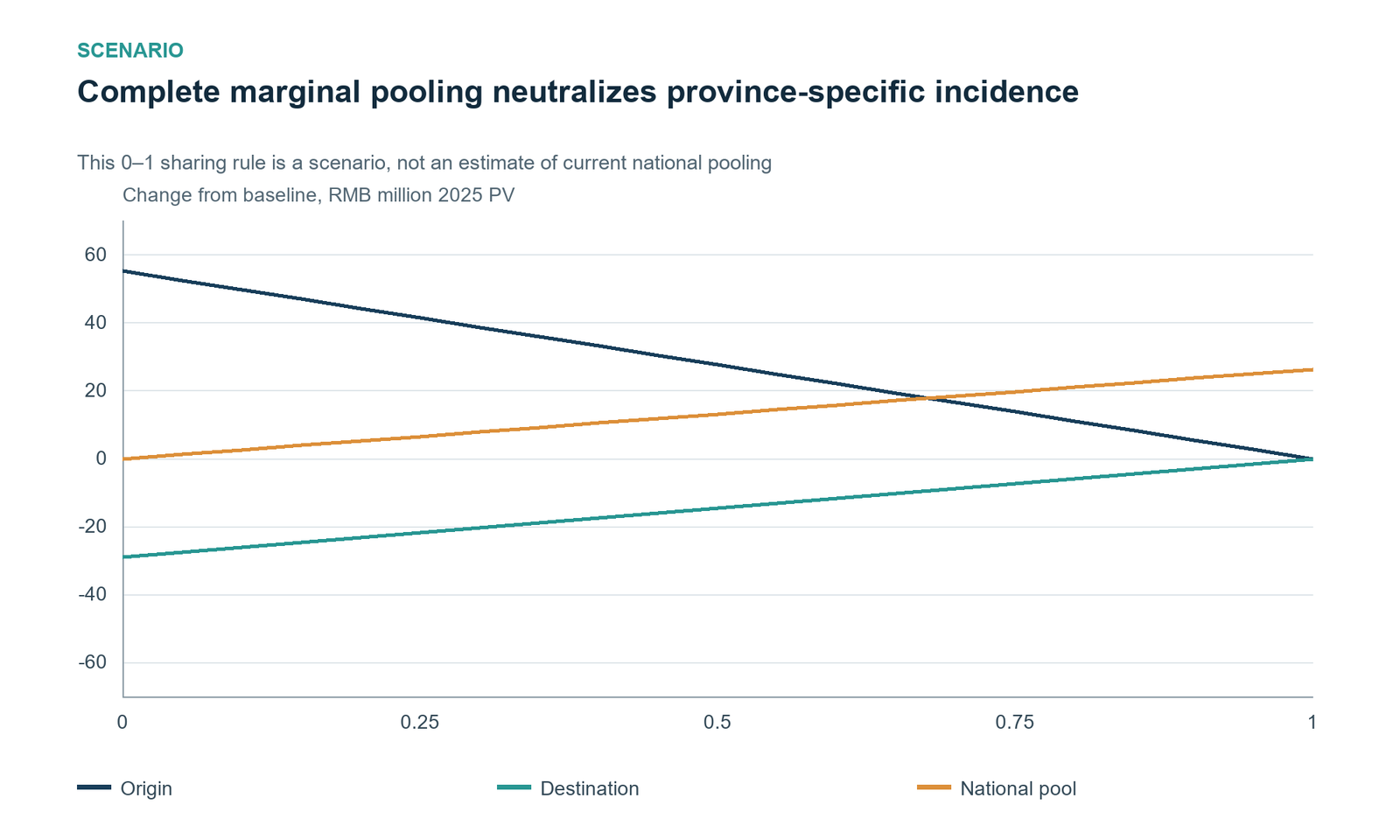
Let lambda be the fraction of the entire marginal net pension ledger cleared nationally. It applies after contributions, portability and remaining claims are all included. Provincial changes become (1-lambda) times their zero-pooling changes, and the national pool takes lambda times their sum. Total national change is invariant. Applying sharing only to selected contribution losses while leaving transfer outflows untreated would fail to represent the complete clearing rule used in this experiment.
At lambda = 0, origin gains RMB55.249 million and destination loses RMB28.900 million. At lambda = 0.5, those increments are halved and the pool carries the remaining RMB13.174 million consolidated gain. At lambda = 1, both provincial increments are zero, and the national pool holds the entire RMB26.348 million change. A claim that automation must create an unavoidable provincial pension burden is therefore rejected within this model when complete marginal clearing is assumed.
This lambda is a scenario parameter, not a measured degree of China’s existing national pooling. Published upstream and downstream cash establish actual redistribution but do not reveal the policy response to a particular worker-history shock over decades. A pool may use administrative formulas, fiscal guarantees or other mechanisms that do not equal uniform sharing of this complete marginal ledger. No inference from Jilin’s 32.09% current pooling share to lambda is made. (2024 central enterprise pension pooling final account) (2025 central executed budget report) (Jilin 2024 provincial final accounts package)
The experiment isolates allocation from behavior. Pooling does not change the stated labor paths, contribution compliance, retirement timing, benefit formula or welfare in this comparison; it reallocates one already computed total. In reality, changed incentives could affect those choices, requiring another model and evidence. The useful policy distinction is nevertheless clear. Better administrative portability and broader risk sharing can alter where a pension shock appears, while employment and benefit rules determine what total is being shared. Provincial incidence is contingent, and the explicit zero case is central evidence about that contingency.
Employment counterexamples also matter. With all replacement jobs formal at the original wage, current contributions rise 4%; with 1,000 additional formal destination jobs at 80% of the original wage, they rise 1.6%. Both alternatives include the extra pension accrual. Moving residence alone while keeping employment and insurance unchanged gives a zero pension-ledger effect.
An improved fund ledger is not a welfare gain
The central gross-earnings arithmetic is deliberately neutral: 0.8 × 1.05 + 0.2 × 0.8 = 1. Retained workers’ gains offset replacement workers’ lower earnings in the aggregate. Yet earnings distribution changes sharply, and informal workers stop employee payments. Discounted earnings net of employee contributions increase RMB66.955 million across the cohort, while the included remaining pension and estate claims decline RMB227.213 million. Neither aggregate establishes a welfare improvement.
Lower employee payments can raise current disposable earnings while reducing future retirement claims. Employer contributions are not included in this net-earnings subtraction, and their ultimate wage, profit or price incidence is not modeled. Labor effort, unemployment duration, job security, nonpension benefits, taxes, household risk and distributional preferences are also outside the calculation. Adding contribution savings to a fund improvement as if both were free social resources would ignore the promise reduction and the transfers between workers and the fund.
The model does not estimate consumption responses. A smaller expected pension can affect saving, but the magnitude requires household beliefs, wealth, credit constraints and risk preferences. It would also be wrong to deduct a pension-related loss twice if an asset or wage price already capitalized the same claim. The article therefore presents earnings and included claims as separate accounting quantities, with no synthetic consumption multiplier or national welfare total attached to them.
Policy objectives need to be stated before interpreting the signs. Preserving retirement security, stabilizing current payroll cash and limiting a province’s financing exposure can point toward different choices. A cash bridge may support a locality while leaving the national promise unchanged. Full pooling may remove a provincial increment while leaving workers’ benefits smaller. Formal replacement may increase both contributions and promises. These are reasons to report the full ledger and its distribution, not to prefer a scenario merely because one balance rises. The central experiment reveals a potential geographic incentive issue, while leaving social evaluation to a richer framework with explicit worker outcomes and preferences.
Table 8. Policy objectives are different accounting questions
| Objective | Relevant evidence or calculation |
|---|---|
| Current financing | Covered months, wages, receipts, expenditure, cash transfers |
| Province exposure | Payer assignment and marginal clearing, including portability |
| Worker security | Earnings distribution, preserved rights, replacement adequacy |
| National fund ledger | Consolidated receipts and remaining claims, common valuation |
| Social welfare | Risks, preferences, employment quality and full incidence |
The central fund improvement is not a welfare valuation. No causal consumption response is estimated.
Continue reading
Get the complete 30-page research note
The English PDF includes 16 figures, 10 tables, verified cash reconciliations, current retirement and portability rules, an exposed cohort model, personal-account estates, marginal pooling and employment/valuation counterexamples.
29 USD, instant PDF download, secure card payment.
Buy the full noteOne-time purchase. Evidence cutoff: 23 October 2026. The model is conditional; no causal automation effect or national actuarial gap is estimated.
Need this analysis for your organisation?
We prepare confidential briefings, executive talks and studies on countries, markets and policies, built on the same method as this article.
Request a briefingSupport independent analysis
Our studies are free to read and carry no advertising. If this one was useful, a small contribution helps us publish the next.
Support our workGo further: books by Global Strategy Files

Books from Global Strategy Files
Go further on this topic
The Tariff GambleHow America’s trade war is reshaping power, prices and prosperity.24.99 USD, see the book Future-Proofing AmericaEconomic challenges and the road to reform.20 USD, see the book
 Kill KennedyWhat the 2025 declassified files reveal about the machinery of American power.20 USD, see the book