
Brazil’s Consumption Tax Reform: Measuring the CBS and IBS Before the Transition Begins


Brazil’s Consumption Tax Reform: Measuring the CBS and IBS Before the Transition Begins
Driss EFFINA, PhD Independent Researcher, Global Strategy Files Reading time: about 27 minutes
Key takeaways
- Brazil's reform replaces PIS, Cofins, IPI, ICMS and ISS with a dual value added tax, the federal CBS and the subnational IBS.
- The CGIBS estimated the combined reference rate at 27.91 percent in July 2026, 1.41 points above the 26.5 percent review ceiling.
- The five taxes being replaced raised 12.22 percent of GDP in 2025, or 37.7 percent of a record 32.4 percent tax burden.
- Each extra point of the tax base exempted raises the rate paid by everyone else by about 0.28 points.
Abstract
Brazil is in the first year of the most ambitious tax reform in its recent history. Constitutional Amendment 132 of 2023 and Complementary Law 214 of 2025 replace five taxes on goods and services (the federal PIS, Cofins and IPI, the state ICMS and the municipal ISS) with a dual value added tax: the federal Contribution on Goods and Services (CBS) and the subnational Tax on Goods and Services (IBS), plus a selective excise tax. In 2026, the new taxes are collected only at symbolic test rates of 0.9 and 0.1 percent. On 31 July 2026, the Management Committee of the IBS (CGIBS) published an estimate of the combined reference rate of 27.91 percent, 1.41 points above the 26.5 percent level that the law sets as a ceiling for review. This article quantifies the reform with official data from the National Treasury and the legislation, and with the author’s own calculations. It shows that the five taxes to be replaced raised 12.22 percent of GDP in 2025, or 37.7 percent of the total tax burden, which reached a record 32.4 percent of GDP. The implied effective base of the new tax is about 43.8 percent of GDP, and the exceptions introduced by Congress have reduced it by about 5 percent relative to the initial estimate, adding 1.4 points to the standard rate. Each additional percentage point of the base that is exempted raises the rate paid by everyone else by about 0.28 points. Illustrative calculations show that the reform shifts the tax burden from manufactured goods towards services sold to final consumers. The article concludes that the reform’s economic gains depend less on its headline rate than on the discipline with which exceptions are resisted during the transition, which runs until 2033.
Keywords: Brazil, tax reform, value added tax, CBS, IBS, ICMS, consumption taxes, tax burden, fiscal federalism
JEL codes: H20, H25, H71, H77, O54
1. Introduction
Brazil’s system of taxes on consumption has long been considered one of the most complex in the world. Five different taxes, levied by three levels of government, with different bases, rates, rules for credits and accounting obligations, apply to the same transactions. The state tax on goods and services, the ICMS, alone has twenty-seven different legislations, one for each state and the Federal District. Disputes over credits and over the boundary between goods and services fill the courts. Companies spend more time on tax compliance than in almost any other country. And the system creates distortions: it taxes investment and exports, it encourages “tax wars” between states competing for factories, and it accumulates taxes along production chains.
After more than three decades of failed attempts, Congress approved Constitutional Amendment 132 in December 2023. Complementary Law 214, which regulates the new taxes, was enacted in January 2025. The reform replaces the five old taxes with a dual value added tax, a design inspired by modern VAT principles: a broad base covering goods and services, full credits for taxes paid on inputs, including investment, taxation at destination rather than origin, and exemption of exports.
The year 2026 is the first year of the transition. Companies are now issuing invoices showing the CBS at 0.9 percent and the IBS at 0.1 percent, amounts that can be offset against the old taxes. The real changes begin in 2027, when the CBS replaces PIS and Cofins, and continue until 2033, when the ICMS and ISS disappear.
This article does not repeat the general description of the reform. It aims to quantify it with official data and the author’s own calculations. It asks five questions. How much revenue is at stake? What does the estimated rate of 27.91 percent imply about the tax base? How will revenue shift from old to new taxes over the transition? How does Brazil’s rate compare internationally? And who will pay more, and who less?
Section 2 presents the context. Section 3 reviews the literature. Section 4 describes the data and methods. Section 5 presents the results. Section 6 discusses them. Section 7 presents scenarios. Section 8 concludes.
2. Context
2.1 The old system
Before the reform, five taxes applied to the consumption of goods and services:
- PIS and Cofins: federal social contributions on company revenue, with a cumulative regime (rates of 0.65 and 3 percent, without credits) and a non-cumulative regime (1.65 and 7.6 percent, with credits), depending on the company’s tax regime and sector.
- IPI: a federal tax on industrial products, with rates that vary from zero to more than 300 percent depending on the product.
- ICMS: the state tax on the circulation of goods and on interstate and intermunicipal transport and communication services, with typical internal rates of 17 to 22 percent, many reduced rates and special regimes, and a complex system of interstate rates.
- ISS: the municipal tax on services, with rates between 2 and 5 percent, levied mostly at the place where the service provider is established.
The interaction of these taxes produced a series of well-known problems: cumulative taxation of inputs (especially for services and for companies in the cumulative regime), taxation of investment because of restrictions on credits, accumulation of unrecoverable credits by exporters, a “tax war” in which states granted ICMS benefits to attract companies, and a large volume of litigation, including the dispute over the inclusion of ICMS in the base of PIS and Cofins decided by the Supreme Federal Court in 2017.
2.2 The new system
The reform creates:
- CBS: a federal contribution on goods and services, replacing PIS, Cofins and, in most cases, IPI.
- IBS: a tax on goods and services shared by states and municipalities, replacing ICMS and ISS, administered by a national Management Committee (CGIBS).
- Imposto Seletivo (IS): a selective excise on goods and services harmful to health or the environment, such as tobacco, alcoholic beverages, sugary drinks, vehicles and mineral extraction.
The CBS and IBS share the same base and rules. Each level of government sets its own rate, but a reference rate, set by the Senate, applies unless the entity decides otherwise. Several regimes depart from the standard rate: a 60 percent reduction for sectors such as education, health, some foods, medicines and cultural activities; a 30 percent reduction for some regulated professions; a zero rate for the national basic food basket; and specific regimes for fuels, financial services, real estate and cooperatives. The Simples Nacional regime for small businesses is maintained. The law also creates a “cashback” mechanism, which returns part of the tax to low-income families registered in the federal social registry (CadÚnico), with a full refund of the CBS on cooking gas, electricity, water, sewage and natural gas.
2.3 The transition calendar
The transition is long:
| Year | CBS | IBS | Old taxes |
|---|---|---|---|
| 2026 | 0.9% (test, offsettable) | 0.1% (test, offsettable) | All in force |
| 2027 | Full rate (reduced by 0.1 point) | 0.1% (test) | PIS and Cofins abolished; IPI zeroed except for the Manaus Free Zone; IS begins |
| 2028 | Full rate (reduced by 0.1 point) | 0.1% (test) | ICMS and ISS in force |
| 2029 | Full rate | 10% of reference | ICMS and ISS at 90% of their rates |
| 2030 | Full rate | 20% of reference | ICMS and ISS at 80% |
| 2031 | Full rate | 30% of reference | ICMS and ISS at 70% |
| 2032 | Full rate | 40% of reference | ICMS and ISS at 60% |
| 2033 | Full rate | Full rate | ICMS and ISS abolished |
Table 1. Transition calendar. Source: Constitutional Amendment 132/2023 and Complementary Law 214/2025.
In parallel, a separate transition of fifty years applies to the distribution of IBS revenue between states and municipalities, which will move gradually from the origin principle to the destination principle.
2.4 The rate debate
The reference rates are set to keep revenue constant as a share of GDP. In 2023 and 2024, the Ministry of Finance’s Extraordinary Secretariat for Tax Reform (SERT) estimated a combined standard rate of 26.5 percent, of which 17.7 points for the IBS and 8.8 points for the CBS. During the passage of the regulating law, Congress added further exceptions and reduced rates. To limit the effect on the standard rate, Complementary Law 214 introduced a mechanism under which, if the sum of reference rates exceeds 26.5 percent, the federal executive must propose legislation to bring it back to this level. This mechanism does not reduce the rate automatically.
In July 2026, CGIBS Resolution 14 estimated the IBS component at 18.70 percent, for budget purposes. Combined with the CBS, this implies a total of about 27.91 percent, 1.41 points above the 26.5 percent reference. The estimate is methodological and does not set the final rate, which will be determined by the Senate on the basis of actual revenue during the transition.
3. Literature review
The literature on the reform draws on international VAT research and on Brazilian studies.
Internationally, the VAT has become the main consumption tax in more than 170 countries. Ebrill, Keen, Bodin and Summers (2001), in their IMF study “The Modern VAT”, describe the principles of a well-designed VAT: a broad base, a single or limited number of rates, full input credits, destination taxation and zero rating of exports. Keen and Lockwood (2010) show that the adoption of a VAT has, on average, increased government revenue, although the effect varies with the level of development and the design of the tax. Bird and Gendron (2007) analyse the specific challenges of VAT in developing and transition countries, including in federal systems, a question directly relevant for Brazil, where states and municipalities share taxing powers.
For Brazil, Varsano (1995), at Ipea, analysed the problems of the ICMS in interstate trade and proposed solutions to reduce tax wars. Afonso, Soares and Castro (2013), in a study for the Inter-American Development Bank, documented the structure and complexity of the Brazilian tax system and its costs for growth. The design of the 2023 reform derives to a large extent from the proposal of the Centre for Fiscal Citizenship (CCiF) led by Bernard Appy, which became Constitutional Amendment Proposal 45 of 2019 and served as the basis for the final text.
Several studies estimated the economic effects of the reform. Studies prepared by Ipea and for the Ministry of Finance projected significant long-term gains in GDP, investment and exports, mainly through the end of cumulative taxation, the full deductibility of investment and the reduction of litigation and compliance costs. The IMF, in its Article IV reports on Brazil, has supported the reform and stressed the importance of limiting exceptions and of a careful transition.
A recurring theme in the VAT literature is the cost of exemptions and reduced rates. Reduced rates for “essential” goods are poorly targeted, since higher-income households consume larger absolute amounts of these goods and therefore benefit more in absolute terms. Targeted transfers, such as the Brazilian cashback, are usually a more efficient way to protect the poor. This argument is central to the analysis of the rate debate.
4. Data and methodology
4.1 Sources
The analysis uses:
- the National Treasury’s bulletin estimating the gross tax burden of the general government for 2025, published in April 2026, with the series from 2010 and the breakdown by tax;
- Constitutional Amendment 132/2023 and Complementary Law 214/2025 for the transition calendar and the rules;
- CGIBS Resolution 14/2026 and the earlier estimates of the SERT for the reference rates;
- the statutory standard VAT rates of selected countries in 2026.
4.2 Revenue at stake
The revenue to be replaced is the sum of ICMS, ISS, PIS, Cofins and IPI as a percentage of GDP in 2025, from the Treasury bulletin. This is an approximation: part of IPI will continue for products competing with the Manaus Free Zone, and the IS will replace part of IPI revenue on specific products.
4.3 Implied effective base
If the reform is revenue neutral, the reference rate r and the effective tax base B (as a percentage of GDP) satisfy: revenue = r × B. With revenue of 12.22 percent of GDP, the implied base is 12.22 / r. The comparison of the bases implied by the 26.5 percent and 27.91 percent estimates measures the effect of the exceptions added since the initial estimate.
4.4 Sensitivity of the rate to exceptions
Holding revenue constant, the author computes the rate needed for increasing shares of the base removed by exemptions or reductions, starting from the base implied by the 26.5 percent estimate.
4.5 Transition profile
The author projects the revenue of old and new taxes from 2025 to 2033 under the assumption of revenue neutrality, using the transition calendar. The test rates of 2026 to 2028 are ignored because they are offset against the old taxes or very small.
4.6 Illustrative tax burden in final prices
To illustrate the redistribution of the burden between sectors, the author compares the tax content of the final price under the old and new systems for three stylised cases: a service sold to a final consumer by a company in the cumulative regime (ISS at 5 percent and PIS and Cofins at 3.65 percent, both included in the price), the same service with a 60 percent rate reduction, and a manufactured good (ICMS at 18 percent included in the price, PIS and Cofins at 9.25 percent on a base excluding ICMS, IPI at 5 percent and an assumed 3 percent of residual cascading). The new system is assumed to apply the full rate of 27.91 percent on top of the price net of tax, with full input credits.
4.7 Limitations
The revenue-neutral approach ignores behavioural responses and changes in compliance. The illustrative calculations depend strongly on assumptions and do not represent any specific product. The CGIBS estimate is a budget parameter, not a final rate.
5. Results
5.1 A record tax burden
Figure 1 shows the gross tax burden of the general government from 2010 to 2025.
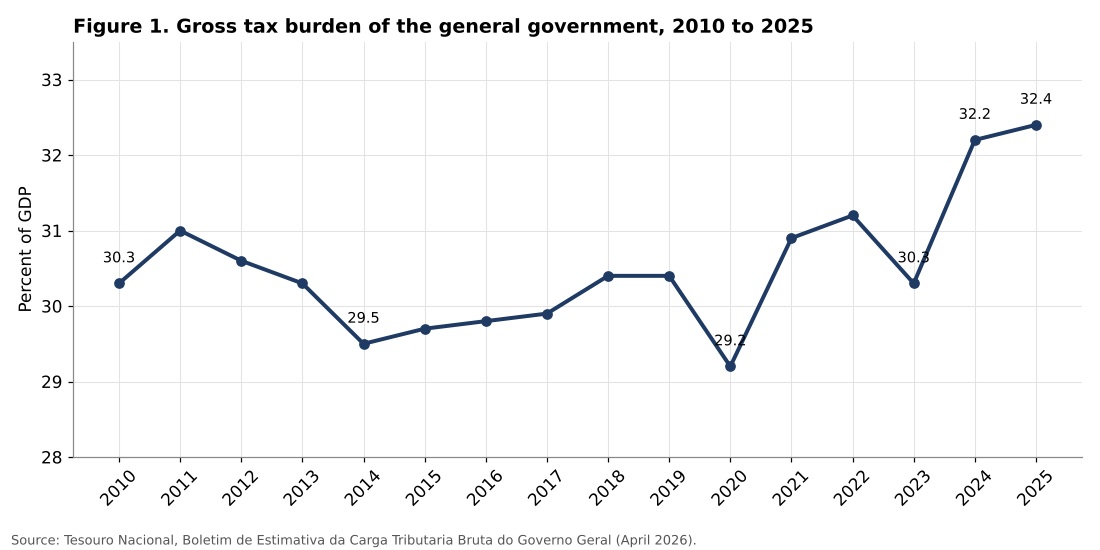
The tax burden fluctuated between about 29 and 31 percent of GDP from 2010 to 2023. It then jumped to 32.2 percent in 2024 and 32.4 percent in 2025, the highest level in the Treasury series. The increase reflects higher income tax collections, measures to recover revenue adopted by the federal government, the end of temporary fuel tax cuts, and higher social security contributions. In 2025, federal taxes accounted for 21.60 percent of GDP, state taxes for 8.38 percent and municipal taxes for 2.42 percent.
This context matters. The reform is intended to be neutral in terms of revenue, but it is introduced at a time when the overall burden is at a historical high and the public debate is particularly sensitive to any perceived increase in taxation.
5.2 How much revenue is at stake
Figure 2 shows the five taxes that the reform replaces.
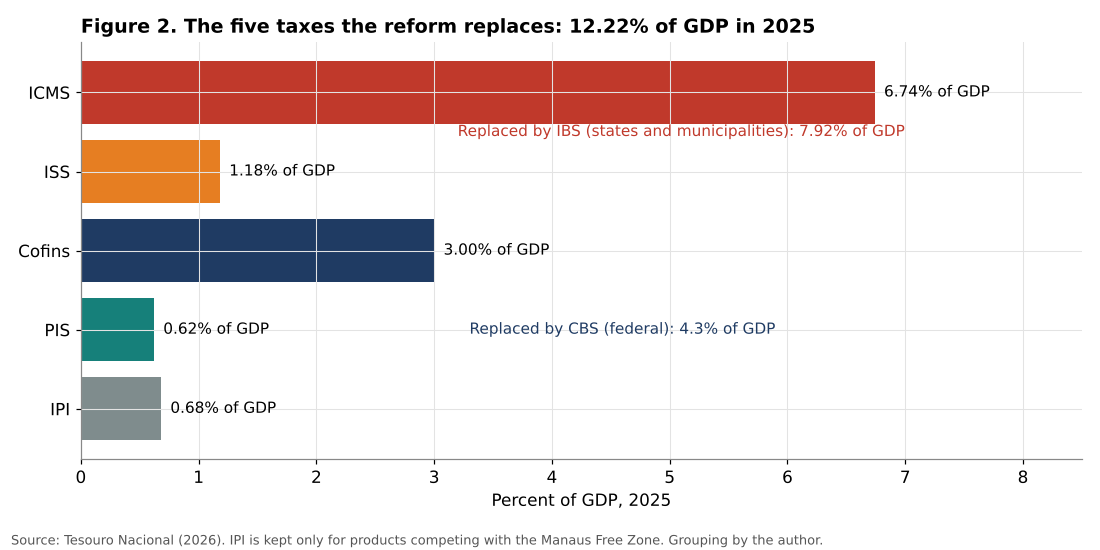
In 2025, the five taxes raised 12.22 percent of GDP: ICMS 6.74 percent, Cofins 3.00 percent, ISS 1.18 percent, IPI 0.68 percent and PIS 0.62 percent. Together, they represented 37.7 percent of the total tax burden. The IBS will replace taxes worth 7.92 percent of GDP (ICMS and ISS), and the CBS taxes worth 4.30 percent of GDP (PIS, Cofins and most of IPI).
| Tax | Level of government | 2024 (% of GDP) | 2025 (% of GDP) | Replaced by |
|---|---|---|---|---|
| ICMS | States | 6.84 | 6.74 | IBS |
| ISS | Municipalities | 1.16 | 1.18 | IBS |
| Cofins | Federal | 3.05 | 3.00 | CBS |
| PIS | Federal | 0.66 | 0.62 | CBS |
| IPI | Federal | 0.71 | 0.68 | CBS and IS (partly maintained) |
| Total | 12.42 | 12.22 |
Table 2. Taxes replaced by the reform. Source: National Treasury (2026); classification by the author.
The ICMS alone represents more than half of the revenue at stake. This explains why the transition of the IBS is longer and more complex than that of the CBS, and why the states negotiated hard over the compensation mechanisms, including a fund to compensate for the end of ICMS tax incentives and a regional development fund.
A notable detail is the slight decline of consumption taxes as a share of GDP in 2025 (13.78 percent for all taxes on goods and services, against 13.87 percent in 2024), while income taxes rose. This continues a long-term trend of erosion of the ICMS base, partly because of the reduction of ICMS on fuels, electricity and telecommunications imposed by federal law in 2022.
5.3 What the rate estimate implies
Dividing revenue by the reference rate gives the implied effective base. With the initial estimate of 26.5 percent, the effective base was about 46.1 percent of GDP. With the CGIBS estimate of 27.91 percent, it is about 43.8 percent of GDP. In other words, the exceptions and special regimes adopted since the initial estimate, together with methodological revisions, have reduced the effective base by about 5 percent.
To put these figures in context: household consumption in Brazil represents roughly 63 percent of GDP. An effective base of 43.8 percent of GDP therefore means that the new tax, at its standard rate, will effectively reach only about 70 percent of household consumption. The rest is covered by reduced rates, zero rates, special regimes, the Simples Nacional and non-compliance. This “implied efficiency” of about 70 percent is not bad by international standards, but it shows that a significant part of consumption will be taxed at less than the standard rate.
A useful rule of thumb follows from these figures. Each percentage point of the standard rate raises about 0.44 percent of GDP in revenue. Conversely, each additional percentage point of the base removed by an exception raises the standard rate by about 0.28 points for all other taxpayers.
5.4 The transition profile
Figure 3 shows the stylised evolution of revenue between old and new taxes.
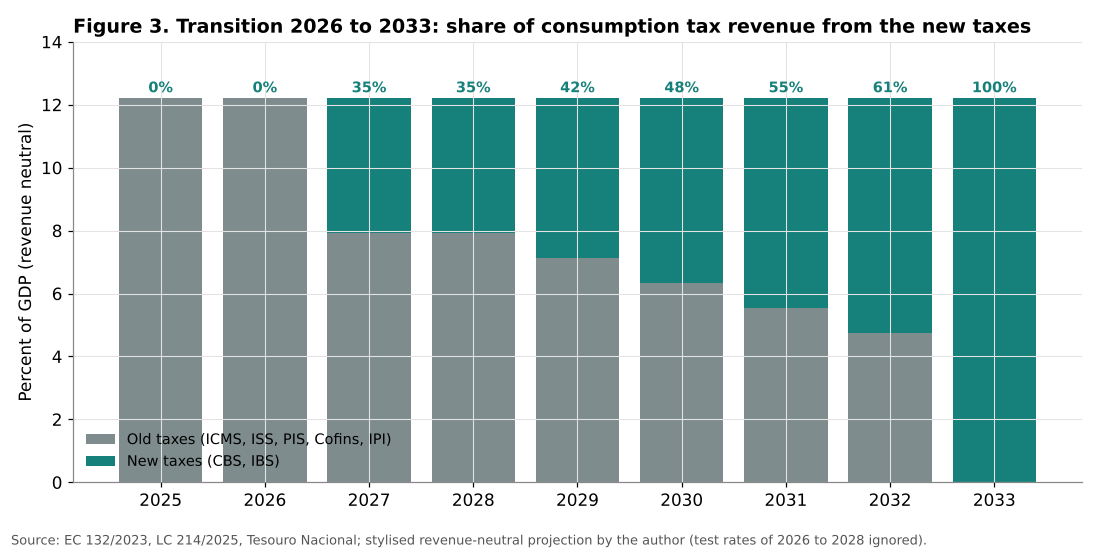
Until 2026, the old taxes still raise all the revenue. In 2027, the CBS replaces PIS and Cofins, and new taxes already account for about 35 percent of consumption tax revenue. The share rises to about 42 percent in 2029, 48 percent in 2030, 55 percent in 2031 and 61 percent in 2032, before reaching 100 percent in 2033, when the ICMS and ISS are abolished.
This profile shows that the transition is front-loaded for the federal government and back-loaded for states and municipalities. For seven years, companies will have to operate two systems in parallel: the old ICMS and ISS and the new IBS and CBS. This coexistence is the main source of compliance costs during the transition. It also creates a risk: that political pressures during the long transition lead to new exceptions or changes that undermine the final design.
5.5 An international comparison
Figure 4 compares the estimated Brazilian rate with standard VAT rates in other countries.
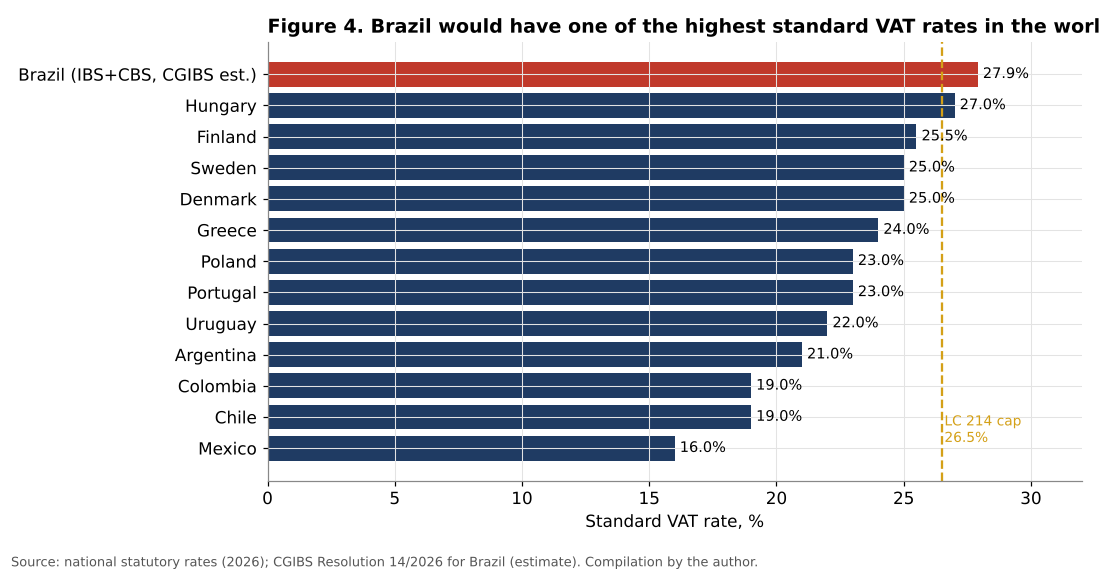
At 27.91 percent, Brazil’s combined standard rate would be the highest in the world, above Hungary (27 percent), the Nordic countries (25 to 25.5 percent) and well above the main Latin American economies: Uruguay 22 percent, Argentina 21 percent, Chile and Colombia 19 percent, Mexico 16 percent. Even at 26.5 percent, Brazil would be second only to Hungary.
This comparison must be qualified. First, the Brazilian rate is calculated “outside” the price (on the price net of tax), as in other VAT systems, while the current ICMS is calculated “inside” the price, which makes current rates look lower than they are. An ICMS rate of 18 percent calculated inside the price is equivalent to about 22 percent calculated outside. Second, Brazil’s high rate reflects the high level of revenue it must replace, about 12.2 percent of GDP, compared with an average of about 7 percent of GDP for VAT revenue in OECD countries. Third, the rate is high partly because the base is narrowed by many exceptions.
Nevertheless, a standard rate close to 28 percent creates incentives for evasion and for lobbying for reduced rates, and it makes the burden more visible to consumers.
5.6 Who pays more, who pays less
Figure 5 illustrates the tax content of the final price under the old and new systems for three stylised cases.
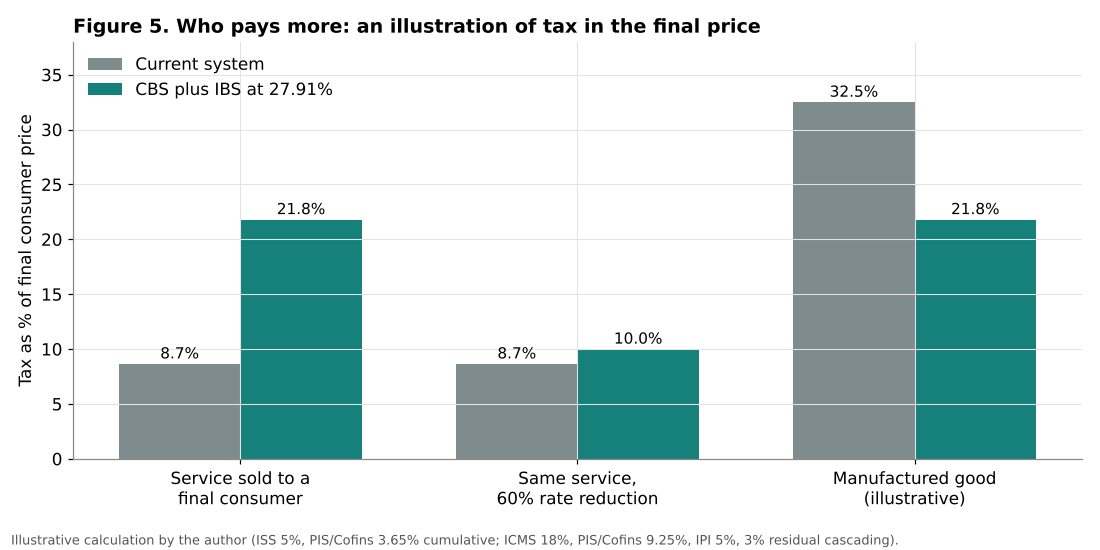
For a service sold to a final consumer by a company in the cumulative regime, the current tax content is about 8.65 percent of the price (ISS at 5 percent plus PIS and Cofins at 3.65 percent). Under the new system, with a standard rate of 27.91 percent applied outside the price, the tax represents about 21.8 percent of the final price. The tax burden on such services would therefore increase significantly. With the 60 percent reduction available to sectors such as education and health, the tax content would be about 10.0 percent, close to the current level.
For a manufactured good, the current system imposes a high burden: in the stylised example, about 32.5 percent of the final price, combining ICMS, PIS and Cofins, IPI and residual cascading. Under the new system, the burden would fall to about 21.8 percent.
These figures are illustrative and should not be applied to any specific product. But they show the direction of the change. The reform shifts the tax burden from goods, especially manufactured goods, which were overtaxed by cascading and multiple taxes, towards services sold to final consumers, which were lightly taxed. For services sold to companies, the change is less important, since the buyer can deduct the tax paid.
This redistribution has economic logic: it ends the bias against industry, which has contributed to the premature deindustrialisation of Brazil. But it also has social and political implications: services represent a growing share of household consumption, especially for the middle classes, and some service sectors will see their prices rise during the transition.
5.7 The cost of exceptions
Figure 6 shows the sensitivity of the reference rate to exceptions.
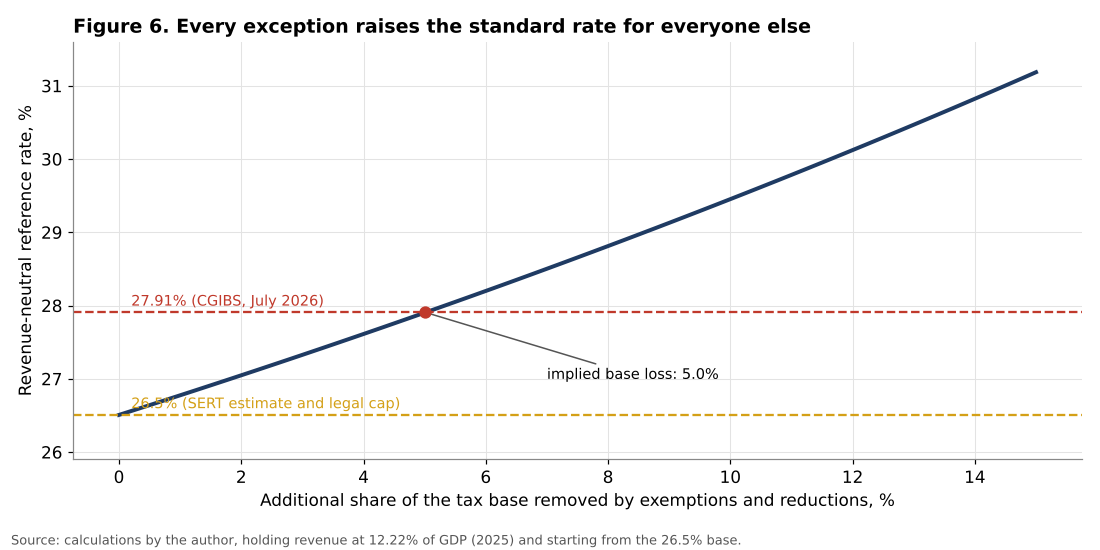
Starting from the base implied by the 26.5 percent estimate, removing an additional 5 percent of the base raises the rate to about 27.9 percent, which corresponds to the CGIBS estimate. Removing 10 percent would raise it to about 29.4 percent, and removing 15 percent to about 31.2 percent.
The relationship is not linear: each additional exception raises the rate a little more than the previous one, because the remaining base becomes smaller. This illustrates the “fiscal externality” of exceptions: each sector that obtains a reduced rate shifts its burden onto all other sectors. In a system with a single standard rate, this externality is visible and can be quantified, which is one of the advantages of the reform.
5.8 The test year in perspective
The year 2026 is a learning year rather than a revenue year. The CBS at 0.9 percent and the IBS at 0.1 percent appear on electronic invoices, but the amounts can be offset against PIS and Cofins, so that companies pay no additional tax. The purpose is to test the information systems, the calculation of credits and the reporting obligations before the real rates apply. In 2027 and 2028, the IBS will remain at a symbolic 0.1 percent, split equally between states and municipalities, while the CBS will be charged at its full rate reduced by 0.1 point.
The CGIBS budget estimate illustrates the small scale of the first IBS collections: for 2027, it projects IBS revenue of about R$5.15 billion, a tiny amount compared with ICMS and ISS revenue of several hundred billion reais. This amount will mainly finance the committee itself, which by law receives a share of collections during the initial period. The real financial stakes of the IBS begin only in 2029, when the ICMS and ISS start to fall.
This slow start is deliberate. It gives tax administrations and companies time to adapt, and it allows the reference rates to be calibrated on the basis of observed data rather than estimates. But it also means that the final rate will remain uncertain for several years, which complicates business planning and price setting.
6. Discussion
6.1 The logic of the reform
The economic logic of the reform is sound and widely supported by the literature. Replacing five taxes with a dual VAT with full credits and destination taxation should reduce distortions, end the taxation of investment and exports, reduce litigation and compliance costs, and end tax wars between states. These gains are not visible in the first years, but they can be substantial in the long run.
The results of this article show, however, that the reform operates under strong constraints. It must replace revenue of more than 12 percent of GDP, which requires a high rate. It is introduced at a time of record tax burden. And it has already been modified by exceptions that raise the standard rate.
6.2 The 26.5 percent mechanism
The mechanism introduced in Complementary Law 214 is a political compromise. It does not automatically cap the rate, but it obliges the executive to propose corrective legislation if the rate exceeds 26.5 percent. The CGIBS estimate of 27.91 percent suggests that this mechanism is likely to be triggered when the final rates are set on the basis of actual revenue, with the first review based on 2030 data.
At that point, the options will be limited: reduce exceptions, which would require Congress to reverse decisions favouring specific sectors; accept a lower level of revenue, which would worsen the fiscal situation; or broaden the base in other ways, for example by improving compliance. The sensitivity analysis shows that bringing the rate back from 27.91 to 26.5 percent would require recovering about 5 percent of the base, equivalent to about 2.3 percent of GDP of consumption currently taxed at reduced rates.
6.3 Distributional effects
The distributional effects of the reform depend on three elements: the shift of the burden from goods to services, the zero rate on the basic food basket, and the cashback. The first tends to increase the relative burden on middle- and upper-income households, which consume more services. The second benefits all households, but more in absolute terms the higher-income households. The third is targeted at the poorest.
The design of the cashback is one of the most innovative aspects of the reform. By refunding taxes to families in the social registry, it allows the government to protect the poor without reducing rates for everyone. Its effectiveness will depend on its implementation, which requires linking consumption data from electronic invoices with the social registry.
6.4 The federative dimension
The IBS is shared by 27 states and more than 5,500 municipalities, and it is administered by a single committee. This is a profound change in Brazilian fiscal federalism. States lose the power to grant ICMS incentives, which they used to attract investment. Municipalities lose control over the ISS. In exchange, they gain a broader base and an end to the disputes over the boundary between goods and services.
The long transition of revenue distribution, from origin to destination, is designed to avoid abrupt losses for producing states such as São Paulo. But it also means that the full benefits of destination taxation will only appear decades from now.
6.5 Risks during the transition
The main risks during the transition are:
- Compliance burden: for seven years, companies must operate two systems.
- Pressure for exceptions: each sector affected by a rate increase has an incentive to seek special treatment.
- Revenue uncertainty: if revenue from the new taxes is lower than expected, rates must be raised, or if higher, lowered.
- Technological risk: the system relies on electronic invoicing and on “split payment”, in which the tax is separated at the moment of payment, which requires significant investment by banks and payment systems.
- Inflation effects: price changes in sectors facing higher or lower tax burdens could affect measured inflation during the transition, especially in 2027 when the CBS is introduced.
6.6 Lessons from other countries
International experience offers useful lessons. India’s goods and services tax, introduced in 2017 to replace a multitude of federal and state taxes, shows that a dual VAT in a large federation is feasible, but also that multiple rates and frequent changes in the first years created confusion and compliance problems; India has since moved to simplify its rate structure. Canada’s harmonised sales tax shows that federal and provincial taxes can share a base and a collection system while each level keeps control over its rate, a model close to the Brazilian design. Australia’s introduction of a goods and services tax in 2000 was accompanied by compensation through income tax cuts and transfers, which helped make a visible new tax politically acceptable.
The common lesson is that the design adopted at the start tends to be eroded over time by sectoral pressures, and that the countries with the most efficient VATs, such as New Zealand, are those that resisted exceptions from the outset. For Brazil, the long transition to 2033 multiplies the occasions on which such pressures can be exercised.
7. Scenarios
7.1 Three paths for the final standard rate
On the basis of the sensitivity analysis, the author considers three scenarios for the combined standard rate in 2033:
Scenario 1: Discipline (26.5 percent). The review mechanism leads Congress to remove part of the exceptions, recovering about 5 percent of the base. The standard rate returns to 26.5 percent. This is the most favourable scenario for efficiency, but it requires difficult political decisions.
Scenario 2: Status quo (about 28 percent). No new exceptions are added, and none are removed. The rate settles around the CGIBS estimate of 27.91 percent. Brazil has the highest standard VAT rate in the world, but the system is much more efficient than the current one.
Scenario 3: Erosion (about 29.4 percent or more). During the long transition, new exceptions and special regimes are added, removing a further 5 percent of the base. The standard rate rises to about 29.4 percent. The incentives for evasion and for further exceptions increase, in a vicious circle.
7.2 Effects on prices in 2027
The introduction of the CBS in 2027 will be the first real test. The CBS replaces PIS and Cofins, which raised about 3.6 percent of GDP in 2025. If the CBS rate is set at about 8.7 to 9.2 percent, sectors that paid PIS and Cofins at 3.65 percent in the cumulative regime, mainly services, will see their federal tax burden more than double, partly offset by credits for their customers if those are companies. Sectors in the non-cumulative regime, which paid 9.25 percent with credits, will see little change. The effect on consumer inflation will depend on how much of the change in costs is passed on to prices.
7.3 Indicators to monitor
1. The CBS and IBS rates proposed for 2027 and the evolution of the reference rate estimates. 2. Revenue of the new taxes compared with the revenue of the old taxes during the transition. 3. New legislative proposals to create exceptions or special regimes. 4. The implementation of the cashback and of split payment. 5. Price changes in services sectors in 2027.
8. Conclusion
This article has quantified Brazil’s consumption tax reform using official data and the author’s own calculations. The main conclusions are:
1. The reform replaces taxes that raised 12.22 percent of GDP in 2025, or 37.7 percent of a tax burden that reached a record 32.4 percent of GDP. 2. The estimated combined reference rate of 27.91 percent implies an effective base of about 43.8 percent of GDP, about 5 percent smaller than the base implied by the initial estimate of 26.5 percent. 3. Each percentage point of the standard rate raises about 0.44 percent of GDP, and each additional percentage point of the base exempted raises the standard rate by about 0.28 points. 4. Brazil would have one of the highest standard VAT rates in the world, a consequence of the high level of revenue to be replaced and of the exceptions. 5. The reform shifts the tax burden from manufactured goods towards services sold to final consumers.
The reform is an important step towards a more efficient and transparent tax system. But its success depends on the discipline of the transition. If exceptions multiply, the standard rate will rise, the incentives for evasion will increase, and the gains of the reform will be eroded. If the transition is well managed, Brazil could, by 2033, have a modern consumption tax system that supports investment, exports and growth.
Need this analysis for your organisation?
We prepare confidential briefings, executive talks and studies on countries, markets and policies, built on the same method as this article.
Request a briefingSupport independent analysis
Our studies are free to read and carry no advertising. If this one was useful, a small contribution helps us publish the next.
Support our workGo further: books by Global Strategy Files

Frequently asked questions
What are the CBS and IBS in Brazil?
The CBS is a new federal Contribution on Goods and Services and the IBS a subnational Tax on Goods and Services. Together they form a dual value added tax replacing PIS, Cofins, IPI, ICMS and ISS, with test rates of 0.9 and 0.1 percent in 2026.
What will the VAT rate be under Brazil’s tax reform?
In July 2026 the IBS Management Committee estimated the combined CBS and IBS reference rate at 27.91 percent, 1.41 points above the 26.5 percent level that the law sets as a ceiling for review. Exceptions added by Congress raised the standard rate by about 1.4 points.
How much revenue do the taxes being replaced raise?
The five taxes on goods and services being replaced raised 12.22 percent of GDP in 2025, or 37.7 percent of Brazil’s total tax burden, which reached a record 32.4 percent of GDP. The implied effective base of the new tax is about 43.8 percent of GDP.
Why do exemptions matter in Brazil’s tax reform?
Exemptions narrow the base and raise the rate for everyone else. Each additional percentage point of the base that is exempted raises the standard rate by about 0.28 points, so the reform’s gains depend on resisting new exceptions during the transition to 2033.
Methodological note
All calculations were made by the author. Revenue data are from the National Treasury’s bulletin on the gross tax burden of the general government for 2025 (April 2026). The transition calendar is from Constitutional Amendment 132/2023 and Complementary Law 214/2025. Reference rate estimates are from the SERT (26.5 percent) and CGIBS Resolution 14/2026 (27.91 percent combined, of which 18.70 percent IBS). The implied effective base is revenue divided by the reference rate. The sensitivity analysis holds revenue constant. The illustrative tax content calculations use stated stylised assumptions and do not represent specific products. Statutory VAT rates of other countries are standard rates in force in 2026.
References
Afonso, J. R., Soares, J. M. and Castro, K. P. (2013). Avaliação da estrutura e do desempenho do sistema tributário brasileiro. Inter-American Development Bank, Discussion Paper IDB-DP-265.
Bird, R. M. and Gendron, P.-P. (2007). The VAT in Developing and Transitional Countries. Cambridge University Press.
Brasil (2023). Emenda Constitucional nº 132, de 20 de dezembro de 2023. Brasília.
Brasil (2025). Lei Complementar nº 214, de 16 de janeiro de 2025. Brasília.
Comitê Gestor do IBS (2026). Resolução CGIBS nº 14, de 29 de julho de 2026. Brasília.
Ebrill, L., Keen, M., Bodin, J.-P. and Summers, V. (2001). The Modern VAT. International Monetary Fund, Washington, DC.
International Monetary Fund (2025). Brazil: 2025 Article IV Consultation. IMF Country Report. Washington, DC.
Keen, M. and Lockwood, B. (2010). The Value Added Tax: Its Causes and Consequences. Journal of Development Economics, 92(2), 138 to 151.
Tesouro Nacional (2026). Estimativa da Carga Tributária Bruta do Governo Geral, 2025. Boletim, April 2026. Brasília.
Varsano, R. (1995). A tributação do comércio interestadual: ICMS versus ICMS partilhado. Ipea, Texto para Discussão nº 382. Brasília.
