
Russia: The Oil Windfall That Never Reached the Treasury


The Windfall That Never Reached the Treasury: Can Oil and Gas Revenues Still Secure Russia’s Budget?
Driss EFFINA, PhD
Independent Researcher, Global Strategy Files
Reading time: 27 minutes
Key takeaways
- Russia's oil and gas budget revenues fell 17.2 percent to 5.47 trillion rubles in January to September 2026 despite a 32 percent rise in Brent.
- Refunds and the damper return about 55 percent of each additional ruble of gross extraction tax generated by higher oil prices to oil companies.
- Twelve month cumulative oil and gas revenues fell to 7.34 trillion rubles, 22 percent less than a year earlier and 37 percent below the June 2022 peak.
- A 10 dollar rise in Brent adds only about 0.9 trillion rubles of annual net revenue, one eighth of the 2026 federal budget deficit.
Abstract
In the first nine months of 2026 the price of Brent crude averaged 93.3 dollars per barrel, 32 percent more than in the same period of 2025. Converted into rubles, the price of a barrel rose by 21 percent. Yet the oil and gas revenues of the Russian federal budget fell by 17.2 percent, to 5.47 trillion rubles. This paper explains that paradox and asks whether energy revenues can still secure the Russian budget. Using the monthly series published by the Russian Ministry of Finance for January 2018 to September 2026 (105 months), combined with Brent prices and the official ruble exchange rate, I decompose revenues into their fiscal components, estimate the elasticity of extraction taxes to the ruble price of oil, measure how much of every price gain is returned to oil companies through the damper mechanism and excise refunds, separate monthly rebounds from the underlying annual trend, and compute the sensitivity of the budget to prices and the exchange rate. Five findings emerge. First, gross extraction taxes respond more than proportionally to the ruble price of oil (elasticity 1.32), but since 2022 the same price yields about 25 percent less revenue than before. Second, in 2026 gross taxes have been 18 percent below what the 2018 to 2025 relationship predicts, a shortfall of about 1.4 trillion rubles in nine months, explained by lower volumes, a discount of 21 to 25 dollars on Urals and refinery disruptions. Third, refunds to oil companies absorb about 55 percent of each additional ruble of gross tax generated by higher prices; in September 2026 they reached 49 percent of gross taxes, and the damper payment of 305 billion rubles was the second largest since at least 2019. Fourth, the 12-month cumulative revenue has fallen to 7.34 trillion rubles, 22 percent less than a year earlier, and the September rebound does not reverse this trend. Fifth, at current conditions an increase of 10 dollars in Brent adds only about 0.9 trillion rubles of annual net revenue, one eighth of the 2026 deficit. Energy can no longer secure the Russian budget; it has become a volatile complement to a fiscal system that now rests mainly on domestic taxes and borrowing.
Keywords: Russia, federal budget, oil and gas revenues, mineral extraction tax, damper, Urals discount, fiscal rule, sanctions, fiscal sustainability.
1. Introduction
For two decades, the Russian state lived on a simple equation: when oil was expensive, the budget was comfortable; when oil was cheap, the budget suffered and the National Wealth Fund absorbed the shock. In 2026 this equation broke down in an unexpected direction. The escalation in the Middle East pushed oil prices to their highest levels in more than a decade. Brent averaged 117.3 dollars in April 2026 and 114.2 dollars in September, and Urals, the main Russian export blend, exceeded 90 dollars at the end of September, roughly double the price cap set by the European Union. By all historical standards, Russia should have experienced a fiscal windfall.
It did not. According to the Ministry of Finance, oil and gas revenues of the federal budget fell from 6.61 trillion rubles in January to September 2025 to 5.47 trillion rubles in January to September 2026, a decline of 17.2 percent. Over the same period, federal expenditures rose by 14.5 percent to 34.8 trillion rubles and the deficit reached 5.19 trillion rubles, or 2.2 percent of GDP. The government now expects a deficit of 7.3 trillion rubles for the full year, 3.2 percent of GDP, and has submitted a draft budget for 2027 to 2029 with deficits of 5.5, 5.1 and 5.3 trillion rubles.
The question this paper addresses is therefore precise: can energy revenues still secure the Russian budget? It contains three sub-questions. How sensitive are budget revenues to world prices, to production volumes and to the fiscal calendar? Why did the price windfall of 2026 not translate into higher revenues? And is the recent monthly rebound a turning point or noise around a declining trend?
Commentaries on this subject often oscillate between two simplifications. The first holds that high oil prices automatically finance the war effort and the budget. The second holds that sanctions have destroyed Russian energy revenues. The data show that neither statement is accurate. The purpose of this paper is to replace these assertions with measurements made directly on the official monthly series, using transparent methods that any reader can reproduce.
The paper is organised as follows. Section 2 describes the Russian oil and gas tax system and its recent changes. Section 3 reviews the literature on resource revenues and fiscal rules. Section 4 presents the data and methods. Section 5 reports the results. Section 6 discusses the implications for fiscal sustainability, Section 7 outlines scenarios for 2027, and Section 8 concludes.
2. Institutional background: how the Russian state taxes hydrocarbons
The Russian budget does not tax oil in a single way. Monthly oil and gas revenues, as published by the Ministry of Finance, are the net sum of several components:
- The mineral extraction tax (NDPI) on oil, the largest item, calculated each month on the basis of the Urals price, the exchange rate and production volumes. It is paid with a lag of about one month.
- The extraction tax on gas and gas condensate, which includes, in certain periods, additional one-off payments imposed on the gas sector.
- Export duties on crude, gas and petroleum products. Under the “tax manoeuvre” completed at the start of 2024, the export duty on crude was phased out and compensated by a higher extraction tax, which explains why export duties have become marginal.
- The tax on additional income (NDD), a profit-based tax paid quarterly, mainly in March, April, July and October, which creates large monthly spikes in the series.
- Refunds, which enter with a negative sign: the “damper” (the coefficient Kdemp), which compensates oil companies when export netbacks exceed domestic fuel prices in order to keep the domestic fuel market supplied, and other refunds of the excise tax on oil feedstock.
The damper is central to the analysis that follows. It was designed as a stabiliser for domestic fuel prices: when world prices rise, the export alternative becomes more attractive, so the state pays refiners to keep supplying the domestic market at controlled prices. The consequence is that the budget gives back part of the extra revenue it collects when prices rise.
The budget is also governed by a fiscal rule. Oil and gas revenues above a “base” level, computed at a base Urals price (59 dollars in the 2026 budget), are classified as additional revenues and, in principle, used to buy foreign currency and gold for the National Wealth Fund; when revenues fall below the base, the Fund is drawn down. The draft 2027 budget uses a more conservative oil price of about 50 dollars, described by President Putin as “very conservative”.
Finally, the context of 2026 is one of physical constraints. Russian oil output fell from 9.24 million barrels per day in January to 8.72 million in August, a decline of 5.6 percent, according to figures reported by The Insider. Drone attacks on refineries and export terminals reduced refining runs and loadings; crude loadings at Ust-Luga fell by 26 percent in September after strikes, according to the Centre for Research on Energy and Clean Air (CREA). Exports of gasoline and diesel remain banned, and a reported extension of the ban runs to January 2027.
3. Literature review
The literature relevant to this paper falls into three strands.
The first strand deals with the volatility of resource revenues and its consequences for public finances. Frankel (2011) showed that fiscal policy in commodity-exporting countries tends to be procyclical, spending windfalls during booms and cutting during busts, and that well-designed fiscal rules can break this pattern. Van der Ploeg (2011) reviewed the “resource curse” literature and emphasised the role of institutions and of volatility. Ossowski, Villafuerte, Medas and Thomas (2008), at the International Monetary Fund, documented how oil producers used price windfalls in the 2000s, highlighting the importance of non-resource fiscal balances as an indicator of sustainability.
The second strand concerns fiscal rules for resource-rich countries. Bova, Medas and Poghosyan (2016) showed that fiscal rules in commodity exporters reduce procyclicality when they target structural or non-resource balances. Russia’s budget rule, introduced in 2017 and modified several times since, is a direct application of this principle: by fixing a base price, it aims to insulate expenditures from price volatility.
The third strand concerns the effect of sanctions and price caps on the revenues of exporting states. Following the introduction of the G7 price cap in December 2022, a body of policy research examined how discounts on Russian crude and the development of a “shadow fleet” affected Russian revenues. Hilgenstock, Ribakova, Shapoval, Babina, Itskhoki and Mylovanov (2023), in work for the Kyiv School of Economics, estimated the losses associated with the Urals discount. CREA publishes monthly estimates of Russian fossil fuel export revenues and the share of shipments carried by sanctioned tankers.
This paper contributes to these strands by providing an updated decomposition up to September 2026, by quantifying the share of price gains returned through the damper and excise refunds, and by estimating the gap between actual revenues in 2026 and the revenues implied by the historical price relationship.
4. Data and methodology
4.1 Data
- Oil and gas revenues: monthly data of the Russian Ministry of Finance, “Information on the formation and use of additional oil and gas revenues of the federal budget, 2018 to 2026”, file dated 5 October 2026. The file provides, for each month from January 2018 to September 2026, total oil and gas revenues and their components: extraction tax on oil, gas and condensate; export duties; the tax on additional income; the damper; excise refunds; base and additional revenues. All values are in billions of rubles.
- Oil price: monthly average of the daily Brent spot price (Federal Reserve Economic Data, series DCOILBRENTEU).
- Exchange rate: monthly average of the official ruble to dollar rate set by the Bank of Russia.
- Budget aggregates: Ministry of Finance preliminary execution data for January to September 2026, as reported by Trading Economics; the draft federal budget for 2027 to 2029 as reported by TASS and Meduza.
- Market and physical indicators: CREA monthly analysis for September 2026; Urals prices for tax purposes reported by the Russian press for May to July 2026.
The final dataset contains 105 monthly observations. Data were collected on 18 October 2026.
4.2 Methods
Decomposition. I aggregate the monthly components by year (January to September for 2026) and compare their contributions to the change in total revenues.
Price elasticity. I define gross core revenues as the sum of the extraction taxes on oil, gas and condensate and export duties, before refunds and excluding the quarterly profit tax. I then estimate by ordinary least squares the equation
log(gross core revenues, month t) = a + b x log(Brent price in rubles, month t-1) + c x D2022 + d x D2024 + error,
where the price is lagged one month to reflect the payment calendar, D2022 is a dummy equal to one from March 2022 (sanctions and discounts) and D2024 a dummy from January 2024 (completion of the tax manoeuvre). The coefficient b is the elasticity of revenues to the ruble price of oil. Standard errors are robust to heteroskedasticity and autocorrelation (Newey and West, 6 lags). The model is estimated on January 2018 to December 2025 and used to predict 2026 revenues out of sample.
Refund share. I regress monthly refunds (damper plus excise refunds) and monthly gross core revenues separately on the lagged ruble price of oil. The ratio of the two slopes measures the share of each additional ruble of gross tax that is returned to companies.
Trend versus rebound. I compute 12-month rolling sums of revenues, with and without the quarterly profit tax, to separate the underlying trend from monthly fluctuations caused by the tax calendar.
Sensitivity. Using the slope of net revenues (excluding the profit tax) with respect to the ruble price of oil estimated on the current tax regime (January 2024 to September 2026), I compute the effect on annual revenues of a one-dollar change in Brent and a one-ruble change in the exchange rate, at September 2026 conditions.
Limitations. Brent is used rather than Urals because a consistent monthly Urals series is not available in the sources consulted; the variable discount between the two is therefore part of the residual. Volumes are not observed monthly in the data used. The regressions describe statistical relationships, not structural tax formulas. The results should be read as orders of magnitude, consistent with the official data, rather than as exact parameters.
5. Results
5.1 A decade of revenues: the series and its noise
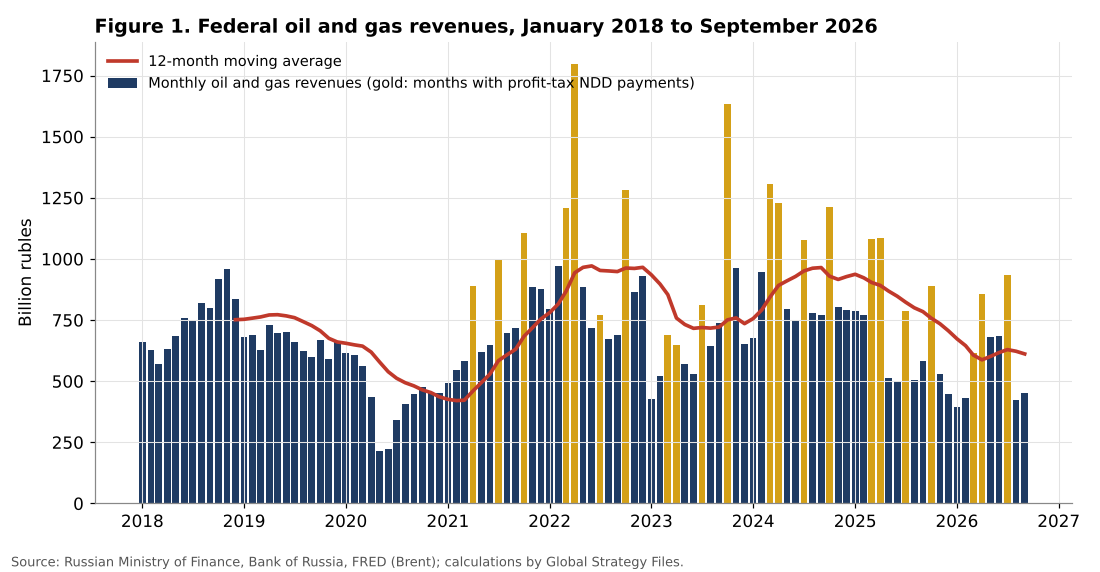
Figure 1 shows monthly oil and gas revenues since January 2018. Two features are immediately visible. The first is the extreme volatility of the monthly series, driven largely by the quarterly profit tax: in the months highlighted in gold, the NDD adds between 200 and 770 billion rubles to revenues. The record month of the series, April 2022, with 1,798 billion rubles, combined very high prices and a profit-tax payment of 766 billion rubles. The second feature is the trend: the 12-month moving average peaked in mid-2022 and has declined since, with an interruption in 2024.
Table 1. Annual oil and gas revenues of the federal budget (billion rubles unless indicated)
| Year | Net revenues | Extraction tax, oil | Extraction tax, gas | Export duties | Profit tax (NDD) | Damper | Other refunds | Net revenues, bn USD | Brent, USD | Refunds as % of gross |
|---|---|---|---|---|---|---|---|---|---|---|
| 2018 | 9,018 | 5,235 | 631 | 3,008 | 0 | 0 | 0 | 143.2 | 71.1 | 0.0 |
| 2019 | 7,927 | 5,176 | 628 | 2,276 | 100 | -283 | -140 | 122.6 | 64.3 | 5.2 |
| 2020 | 5,236 | 3,199 | 482 | 1,132 | 149 | 357 | -221 | 73.4 | 41.8 | -2.8 |
| 2021 | 9,058 | 6,295 | 577 | 2,225 | 1,010 | -674 | -565 | 123.1 | 70.7 | 13.6 |
| 2022 | 11,588 | 8,392 | 1,874 | 2,506 | 1,685 | -2,171 | -972 | 169.5 | 100.8 | 24.6 |
| 2023 | 8,825 | 7,788 | 1,221 | 977 | 1,293 | -1,589 | -1,173 | 102.0 | 82.5 | 27.7 |
| 2024 | 11,133 | 10,110 | 1,450 | 488 | 2,051 | -1,815 | -1,625 | 120.5 | 80.5 | 28.6 |
| 2025 | 8,478 | 7,266 | 894 | 458 | 1,614 | -880 | -1,297 | 101.1 | 69.1 | 25.3 |
| 2026 (Jan to Sep) | 5,471 | 5,321 | 674 | 426 | 843 | -1,220 | -883 | 70.5 | 93.3 | 32.8 |
Source: Russian Ministry of Finance; Bank of Russia; FRED; calculations by the author. Values in dollars converted at monthly average official rates. The damper was positive in 2020 because low prices reversed the mechanism.
Table 1 reveals a structural change that is often overlooked. In 2018, before the damper and the excise refunds were introduced, the state kept the whole of its gross oil and gas taxes. Since 2022, refunds have absorbed between a quarter and a third of gross taxes every year: 24.6 percent in 2022, 27.7 percent in 2023, 28.6 percent in 2024, 25.3 percent in 2025 and 32.8 percent in January to September 2026, the highest share in the series. In other words, the Russian oil tax system now returns to the sector a much larger share of what it collects than a decade ago, and this share increases precisely when prices rise.
Expressed in dollars, the decline is even more striking. Net oil and gas revenues fell from 169.5 billion dollars in 2022 to 101.1 billion in 2025. In the first nine months of 2026 they amounted to 70.5 billion dollars, compared with 77.8 billion in the same period of 2025 and 120.2 billion in the same period of 2022.
5.2 Anatomy of the 2026 decline
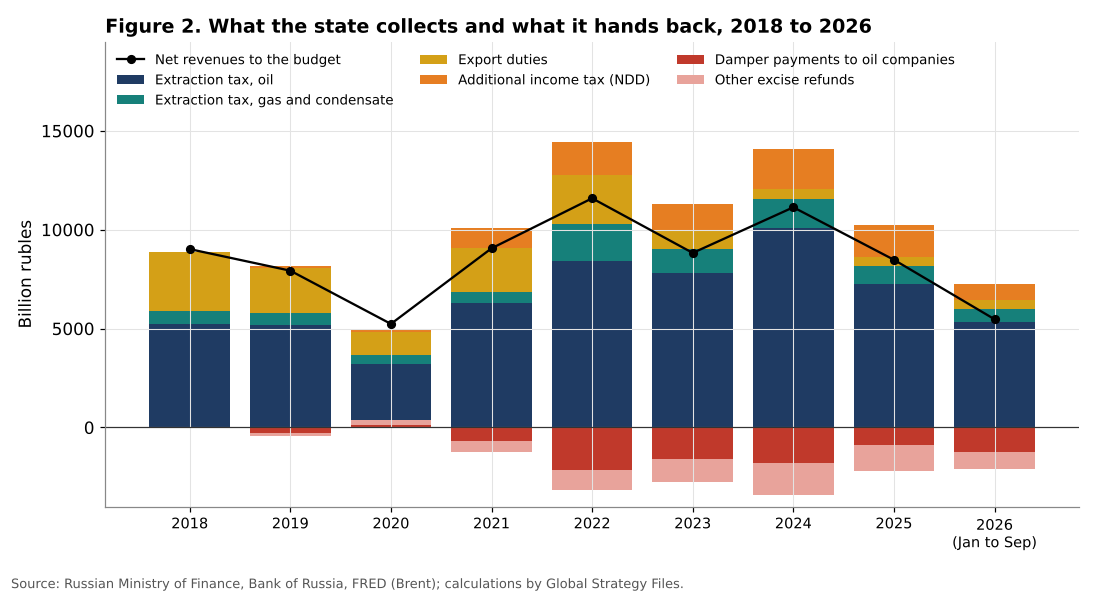
Comparing January to September 2026 with the same period of 2025 makes it possible to attribute the decline of 1,139 billion rubles to its components:
Table 2. Contributions to the change in revenues, January to September 2026 versus 2025 (billion rubles)
| Component | Jan to Sep 2025 | Jan to Sep 2026 | Change |
|---|---|---|---|
| Extraction tax, oil | 5,729 | 5,321 | -408 |
| Extraction tax, gas and condensate | 686 | 674 | -12 |
| Export duties | 339 | 426 | +87 |
| Profit tax (NDD) | 1,281 | 843 | -438 |
| Damper | -713 | -1,220 | -507 |
| Other excise refunds | -1,041 | -883 | +158 |
| Net revenues | 6,610 | 5,471 | -1,139 |
Source: Russian Ministry of Finance; calculations by the author. Components may not sum exactly because of rounding.
Three factors account for almost the entire decline.
The first is the damper, whose payments increased by 507 billion rubles. This is the direct mechanical consequence of higher world prices: the more expensive oil becomes abroad, the more the state must pay refiners to supply the domestic market. In September 2026 alone, the damper cost 305 billion rubles, the second largest monthly payment in the series since 2019, surpassed only by April 2022 (450 billion rubles). Including other excise refunds, the state returned 403 billion rubles in September out of 818 billion of gross taxes, or 49.3 percent.
The second factor is the profit tax, down 438 billion rubles. This decline is largely a calendar effect. The NDD is paid on the results of the previous quarter. The payment of March 2026 (192 billion rubles, against 487 billion in March 2025) reflected the low prices of the fourth quarter of 2025, when Brent averaged about 64 dollars. The price surge of the second quarter of 2026 appears only in the July payment (396 billion, against 302 billion a year earlier), and the high prices of the third quarter will appear in October.
The third factor is the oil extraction tax, down 408 billion rubles despite higher prices. This decline cannot be explained by prices, which were higher. It reflects lower volumes, a wider discount on Urals and a stronger ruble in the first half of the year. The next subsection quantifies this gap.
5.3 The 2026 shortfall: what prices should have delivered
The elasticity regression, estimated on 95 monthly observations from February 2018 to December 2025, gives the following results:
Table 3. Elasticity of gross extraction taxes and duties to the ruble price of oil (2018 to 2025)
| Variable | Coefficient | t statistic |
|---|---|---|
| Constant | -4.531 | -6.23 |
| Log Brent price in rubles, previous month | 1.317 | 15.21 |
| Dummy from March 2022 | -0.294 | -3.18 |
| Dummy from January 2024 | -0.031 | -0.48 |
R squared 0.87. Newey West standard errors. Source: calculations by the author.
The elasticity of 1.32 means that a 10 percent increase in the ruble price of oil raises gross taxes by about 13 percent. The more than proportional response reflects the progressive design of the extraction tax, which is calculated on the excess of the Urals price over a threshold. The dummy for the period after March 2022 is negative and significant: for the same Brent price in rubles, gross revenues have been about 25 percent lower since sanctions (exp(-0.294) = 0.745). This is the fiscal footprint of the Urals discount and of lower export volumes. The completion of the tax manoeuvre in 2024 did not change the level significantly, which is consistent with its design as a revenue-neutral reform.
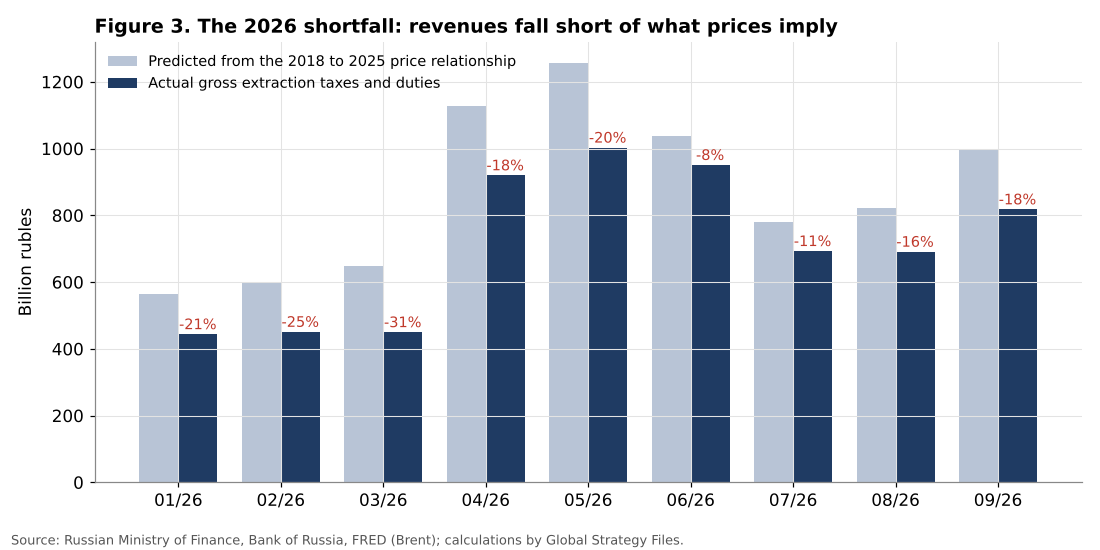
Applied to 2026, the model predicts gross core revenues of 7,835 billion rubles for January to September, against actual revenues of 6,421 billion. The shortfall is 1,414 billion rubles, or 18.0 percent. Every month of 2026 shows a negative gap, ranging from -8 percent in June to -31 percent in March (Figure 3).
Three explanations are consistent with this persistent shortfall:
- Volumes. Oil production fell by 5.6 percent between January and August 2026. Lower output directly reduces the extraction tax base.
- The Urals discount. Comparing the Urals prices used for tax purposes with Brent monthly averages, the discount was about 20.6 dollars in May 2026 (86.52 against 107.1), 21.9 dollars in June (63.52 against 85.4) and 24.8 dollars in July (59.02 against 83.8). CREA estimates a discount of 23 dollars in August and September. A discount of more than 20 dollars on a price of 85 to 115 dollars represents a loss of 20 to 25 percent of the tax base relative to Brent.
- Disruptions to refining and exports. Attacks on refineries and terminals reduced refining runs, petroleum product exports and seaborne loadings. Russian loadings of oil products in September 2026 were about half their level of September 2025, according to CREA.
The magnitude of the shortfall is instructive. The 1.4 trillion rubles lost in nine months relative to the historical relationship represents more than a quarter of the federal deficit accumulated over the same period (5.19 trillion rubles).
5.4 Half the windfall flows back: the damper as an automatic transfer
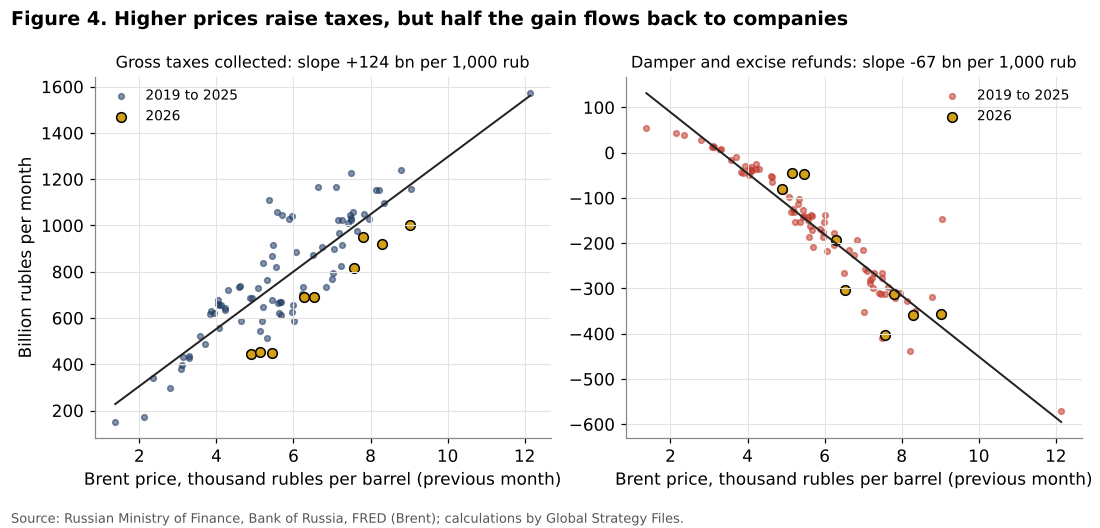
How much of a price increase actually reaches the budget? Over February 2019 to September 2026, a monthly increase of 1,000 rubles in the price of a barrel (previous month) is associated with:
- an increase of 123 billion rubles in gross taxes per month (t statistic 14.3, R squared 0.73);
- an increase of 68 billion rubles in refunds per month (t statistic -22.4, R squared 0.88);
- hence an increase in net revenues of only 55 billion rubles.
In other words, about 55 percent of each additional ruble of gross tax generated by higher prices is returned to oil companies. The refund relationship is remarkably tight, with an R squared of 0.88: the damper behaves like an automatic stabiliser that transfers a large share of the price windfall from the budget to the oil sector, which in turn uses it to keep domestic fuel prices under control.
Under the current tax regime alone (January 2024 to September 2026), the slopes are 164 billion for gross taxes and -78.5 billion for refunds, a return share of 48 percent. The conclusion is the same: roughly half of the price windfall never reaches the Treasury.
This finding changes the usual reading of oil price shocks for Russia. In the past, a rise in world prices was an almost pure gain for the budget. Today it is also a cost: it increases the pressure on the domestic fuel market, which the state must offset by subsidising refiners. In 2026 this cost was amplified by refinery disruptions, which reduced domestic supply and pushed up domestic fuel prices, as the Bank of Russia noted in its September 2026 monetary policy statement.
5.5 Rebound or trend? Reading through the monthly noise
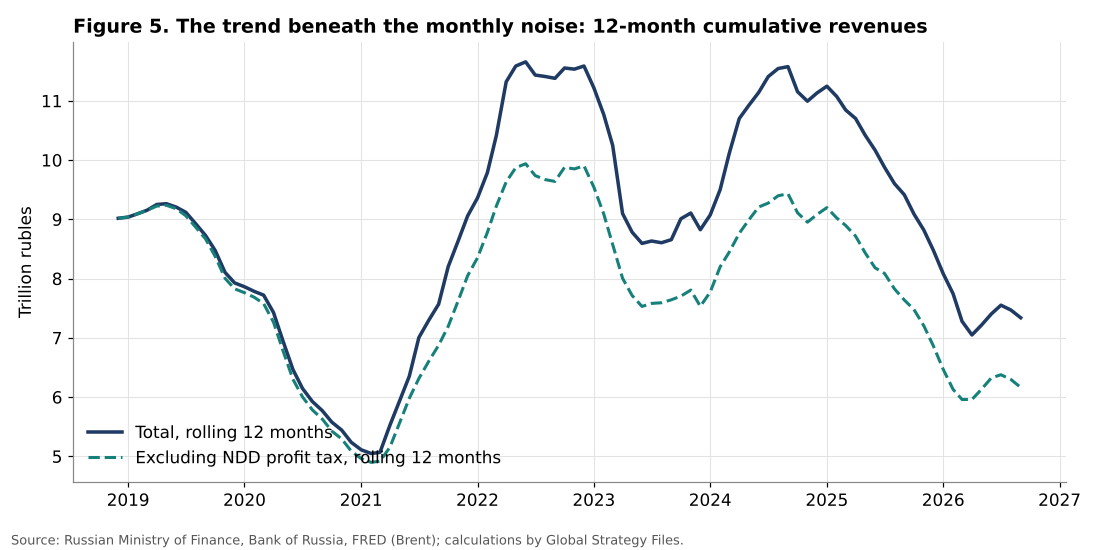
Monthly figures are a poor guide to the fiscal position. September 2026 revenues of 452 billion rubles were 6.6 percent higher than in August, and the high oil prices of September will generate higher extraction taxes in October together with the quarterly profit-tax payment. Using the ratio of the July 2026 profit-tax payment to second-quarter prices, I estimate that the October payment could reach about 400 billion rubles, since the average Brent price in rubles in the third quarter (about 7,940 rubles per barrel) is close to that of the second quarter. October is therefore likely to show a strong monthly rebound.
The trend, however, tells a different story. The 12-month cumulative sum of oil and gas revenues fell to 7.34 trillion rubles in September 2026, compared with 9.41 trillion rubles a year earlier, a decline of 22 percent. Excluding the profit tax, the 12-month sum fell from 7.64 to 6.16 trillion rubles (-19 percent). The peak of the series, 11.66 trillion rubles, was reached in June 2022. Since then, the cumulative revenue has lost 37 percent of its value in nominal rubles, and considerably more in real terms.
The distinction matters for the interpretation of the budget. A rebound in October, however strong, will not change the conclusion that the energy revenue base of the Russian budget has been shrinking for four years.
5.6 How sensitive is the budget to prices and the exchange rate?
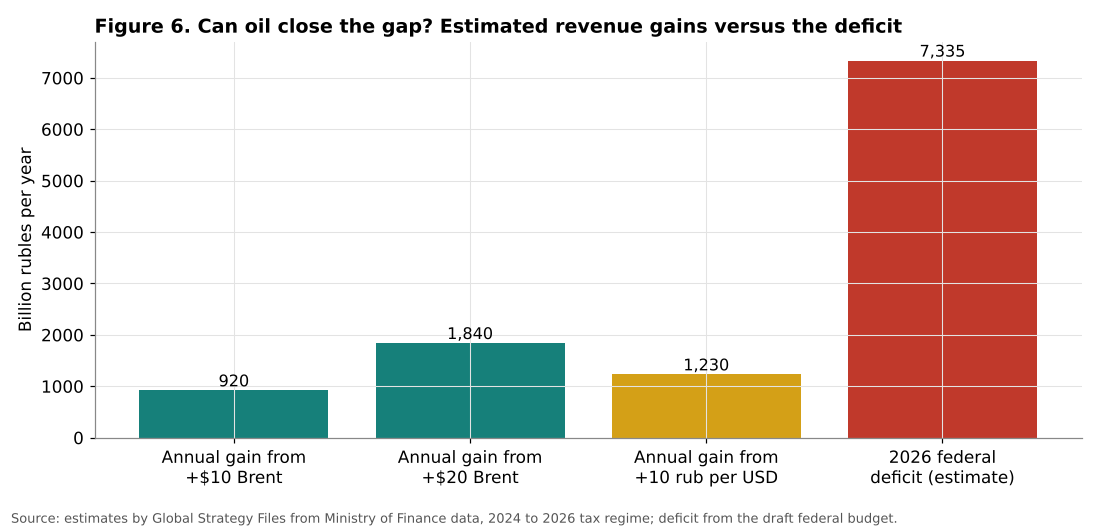
Using the slope of net revenues excluding the profit tax under the current tax regime (90 billion rubles per month for each 1,000 rubles of ruble price per barrel), and the conditions of September 2026 (Brent at 114.2 dollars, 85.1 rubles per dollar), I obtain the following sensitivities:
Table 4. Sensitivity of annual net oil and gas revenues (excluding profit tax)
| Shock | Monthly effect | Annual effect |
|---|---|---|
| Brent +1 dollar per barrel | +7.7 bn rubles | +92 bn rubles |
| Brent +10 dollars per barrel | +77 bn rubles | +920 bn rubles |
| Ruble weaker by 1 ruble per dollar | +10.3 bn rubles | +123 bn rubles |
| Ruble weaker by 10 rubles per dollar | +103 bn rubles | +1,230 bn rubles |
Source: calculations by the author. The fit of the underlying regression is moderate (R squared 0.49), so these values are indicative.
These sensitivities put the fiscal problem in perspective. The estimated 2026 federal deficit is 7.3 trillion rubles. An increase of 10 dollars in Brent would cover about one eighth of it. To close the deficit through oil prices alone, Brent would have to rise by about 80 dollars per barrel above its September 2026 level, which is not a realistic scenario. Similarly, a depreciation of the ruble helps the budget, but a weakening of 10 rubles per dollar would bring in about 1.2 trillion rubles, while adding inflationary pressure that the Bank of Russia would have to offset.
The conclusion is clear: at the current scale of expenditure, oil and gas revenues have become a second-order variable for the balance of the Russian budget.
5.7 The new structure of the budget
The result of these trends is a profound change in the structure of federal revenues. In January to September 2026, oil and gas revenues accounted for 18.5 percent of total federal revenues (5.47 out of 29.64 trillion rubles). Non-oil and gas revenues grew by 18.8 percent, to 24.17 trillion rubles, driven by the increase in value added tax, profit taxes and personal income taxes. The deficit accumulated over nine months (5.19 trillion rubles) is equivalent to 95 percent of oil and gas revenues over the same period.
The draft 2027 budget confirms this orientation. VAT revenues are projected at 20 trillion rubles in 2027, almost three times the 7 trillion rubles expected from oil and gas. Defence spending is planned at 17.1 trillion rubles, more than twice oil and gas revenues. The National Wealth Fund, the traditional buffer of oil windfalls, is expected to be replenished by 1.08 trillion rubles in 2027, a modest amount compared with the deficits planned.
6. Discussion
6.1 Why the windfall did not materialise
The analysis shows that the paradox of 2026, high prices and falling revenues, has four causes that reinforce each other:
1. The damper, which returns about half of every price gain to the oil sector and becomes most costly precisely when prices are high. 2. Lower volumes, caused by production constraints and attacks on infrastructure. 3. The Urals discount, which reduces the tax base by 20 to 25 percent relative to Brent. 4. The calendar of the profit tax, which delays the effect of price increases by one quarter and made the first half of 2026 reflect the low prices of late 2025.
The first three are structural. The fourth is temporary and will partly reverse in October 2026 and January 2027.
6.2 What this means for fiscal sustainability
Russia’s public debt remains low by international standards, and the draft budget projects debt rising from 53.9 trillion rubles at the end of 2027 to 67.9 trillion at the end of 2029. The risk is therefore not an immediate debt crisis. The risk is a slow erosion of fiscal space in a context where domestic borrowing costs are high (the key rate is 14 percent), where the energy buffer no longer adjusts automatically, and where the main spending item, defence, is rigid.
Three implications follow.
First, the fiscal rule has lost part of its stabilising function. Designed to save windfalls when prices are high, it cannot save what does not reach the budget. When half of the price gain is returned to companies and volumes fall, the “additional revenues” that the rule is supposed to channel to the National Wealth Fund shrink. The Ministry of Finance data show that additional revenues were negative in January to March 2026 and in August 2026.
Second, the burden of adjustment has shifted to domestic taxpayers. The growth of non-oil revenues by 18.8 percent in 2026 reflects tax increases, notably the VAT increase to 22 percent from January 2026, which in turn contributed to inflation and to the tightening of monetary policy. The fiscal and monetary dimensions of the Russian economy are therefore closely linked.
Third, the damper creates a fiscal exposure to domestic fuel market disruptions. Each refinery outage both reduces domestic supply and increases the cost of keeping domestic prices stable. In 2026, the state paid the highest damper amounts since 2022 at a time of fuel shortages in several regions.
6.3 Policy options
Three options are available to the authorities, each with costs.
Reform the damper. Reducing the damper coefficients would increase net revenues when prices are high, but would raise domestic fuel prices or reduce supply, with direct inflationary consequences. Given the sensitivity of fuel prices for households, whose inflation expectations already exceed 14 percent, this option is politically and economically costly.
Accept lower energy revenues and adjust spending. This would require reducing the structural primary deficit, which the Bank of Russia considers essential for disinflation. The draft budget projects deficits of about 2 percent of GDP each year to 2029, which suggests limited adjustment.
Rely on domestic taxation and borrowing. This is the path chosen so far. It is sustainable in the medium term given low initial debt, but it increases the cost of capital, weighs on investment and keeps monetary policy tight.
7. Scenarios for 2027
The sensitivities estimated above can be used to outline three scenarios. The draft budget expects about 7 trillion rubles of oil and gas revenues in 2027, on the basis of an oil price assumption of about 50 dollars.
Scenario A: prices stay high, volumes recover. Brent remains around 90 to 100 dollars, export disruptions ease and the discount narrows. With a Urals discount of about 20 dollars, Urals would trade at 70 to 80 dollars, 20 to 30 dollars above the budget assumption. Applying the sensitivity of about 92 billion rubles per dollar per year, net oil and gas revenues would exceed the budget assumption by roughly 1.8 to 2.8 trillion rubles. The deficit would be much smaller than planned, and the National Wealth Fund would be replenished. This scenario depends on geopolitical conditions in the Middle East that are outside Russia’s control.
Scenario B: prices normalise to 65 to 75 dollars. The windfall disappears, the damper falls, and revenues converge towards the budget assumption. The deficit would be close to the projected 5.5 trillion rubles, financed by borrowing.
Scenario C: prices fall below 55 dollars and disruptions continue. Revenues would fall below the budget assumption, the deficit would exceed 2 percent of GDP, and the government would have to draw more heavily on the National Wealth Fund or increase taxes again.
The asymmetry between these scenarios is important. Even in the favourable scenario, about half of the price gain is returned to the oil sector. In the unfavourable scenario, the loss is borne fully by the budget.
8. Conclusion
Can energy revenues still secure the Russian budget? The answer of this analysis is no, at least not at the current level of expenditure and under the current tax system. Five results support this conclusion.
First, oil and gas revenues fell by 17.2 percent in the first nine months of 2026 despite a 21 percent rise in the ruble price of oil.
Second, gross taxes were 18 percent below the level implied by the historical relationship with prices, a shortfall of about 1.4 trillion rubles in nine months, attributable to lower volumes, a discount of more than 20 dollars on Urals and disruptions to refining and exports.
Third, the damper and excise refunds return about half of each price gain to oil companies, which makes the budget much less sensitive to oil prices on the upside than it used to be.
Fourth, the underlying trend is downward: 12-month cumulative revenues have fallen by 22 percent in a year and by 37 percent since their peak in June 2022. A strong month in October 2026 will not reverse this trend.
Fifth, the sensitivity of the budget to oil prices is now modest compared with the deficit: an increase of 10 dollars in Brent covers only one eighth of the 2026 deficit.
Russia’s budget has entered a new regime. Energy remains an important source of revenue, but it is no longer the anchor of public finances. The anchors are now domestic taxation, which is rising, and domestic borrowing, which is expensive. This shift has consequences beyond public finances: it links fiscal policy more closely to inflation and monetary policy, and it makes the Russian economy more dependent on the willingness of domestic taxpayers and savers to finance the state.
The indicators to monitor in the coming months are the October 2026 profit-tax payment, the evolution of the damper as world prices change, monthly production and export volumes, the Urals discount, and the final parameters of the 2027 budget adopted by the State Duma.
Need this analysis for your organisation?
We prepare confidential briefings, executive talks and studies on countries, markets and policies, built on the same method as this article.
Request a briefingSupport independent analysis
Our studies are free to read and carry no advertising. If this one was useful, a small contribution helps us publish the next.
Support our workGo further: books by Global Strategy Files


Frequently asked questions
Why did Russia’s oil and gas revenues fall in 2026 when oil prices rose?
Revenues fell 17.2 percent in the first nine months of 2026 because lower volumes, a Urals discount of 21 to 25 dollars, refinery disruptions and large refunds to oil companies offset higher prices. Gross taxes were 18 percent below what the historical price relationship predicts, a shortfall of about 1.4 trillion rubles.
What is the damper mechanism in Russia’s oil taxation?
The damper is a payment the Russian budget makes to oil companies, together with excise refunds, when export prices are high relative to domestic fuel prices. These refunds absorb about 55 percent of each extra ruble of gross tax, and in September 2026 the damper alone reached 305 billion rubles.
Can oil and gas revenues still secure Russia’s federal budget?
No, not at current spending levels. Twelve month cumulative oil and gas revenues fell to 7.34 trillion rubles, 22 percent less than a year earlier, and the budget now rests mainly on domestic taxes and borrowing. Energy has become a volatile complement rather than the anchor of public finances.
How sensitive is the Russian budget to oil prices in 2026?
Much less sensitive than before. Under current conditions an increase of 10 dollars in the Brent price adds only about 0.9 trillion rubles of annual net revenue, about one eighth of the 2026 deficit, because refunds to oil companies absorb roughly half of each price gain.
Methodological note
All calculations were performed by the author on the official monthly series listed in Section 4. Gross core revenues are defined as the sum of extraction taxes and export duties. The elasticity regression uses the Brent price in rubles lagged one month and Newey West standard errors with 6 lags. The refund share is the ratio of the refund slope to the gross revenue slope with respect to the ruble price of oil. Sensitivities are computed at September 2026 prices and exchange rates. Data are available from the author on request.
References
Bova, E., Medas, P., and Poghosyan, T. (2016). Macroeconomic stability in resource-rich countries: The role of fiscal policy. IMF Working Paper No. 16/36. International Monetary Fund.
Centre for Research on Energy and Clean Air (CREA). (2026). September 2026: Monthly analysis of Russian fossil fuel exports and sanctions.
Frankel, J. A. (2011). A solution to fiscal procyclicality: The structural budget institutions pioneered by Chile. NBER Working Paper No. 16945.
Hilgenstock, B., Ribakova, E., Shapoval, N., Babina, T., Itskhoki, O., and Mylovanov, T. (2023). Russian oil exports under international sanctions. KSE Institute, Kyiv School of Economics.
Meduza. (2026). Russia plans to run budget deficits for the next three years with a combined shortfall of nearly 16 trillion rubles. 30 September 2026.
Ministry of Finance of the Russian Federation. (2026). Information on the formation and use of additional oil and gas revenues of the federal budget in 2018 to 2026. Data file dated 5 October 2026.
Newey, W. K., and West, K. D. (1987). A simple, positive semi-definite, heteroskedasticity and autocorrelation consistent covariance matrix. Econometrica, 55(3), 703 to 708.
Ossowski, R., Villafuerte, M., Medas, P. A., and Thomas, T. (2008). Managing the oil revenue boom: The role of fiscal institutions. IMF Occasional Paper No. 260. International Monetary Fund.
TASS. (2026). Key takeaways from Russia’s draft federal budget for 2027 to 2029. 30 September 2026.
The Insider. (2026). Russia’s oil and gas revenues fall 17% in 2026 despite doubling of Urals crude prices.
Trading Economics. (2026). Russia government budget gap widens in January to September.
Van der Ploeg, F. (2011). Natural resources: Curse or blessing? Journal of Economic Literature, 49(2), 366 to 420.
Bank of Russia. (2026). Statement by Governor Elvira Nabiullina following the Board of Directors meeting on 11 September 2026; official exchange rate database.
Federal Reserve Bank of St. Louis. (2026). Brent crude oil prices, series DCOILBRENTEU. FRED database.
