
Why Women Outlive Men, and Why Technology Could Make Them Less Necessary

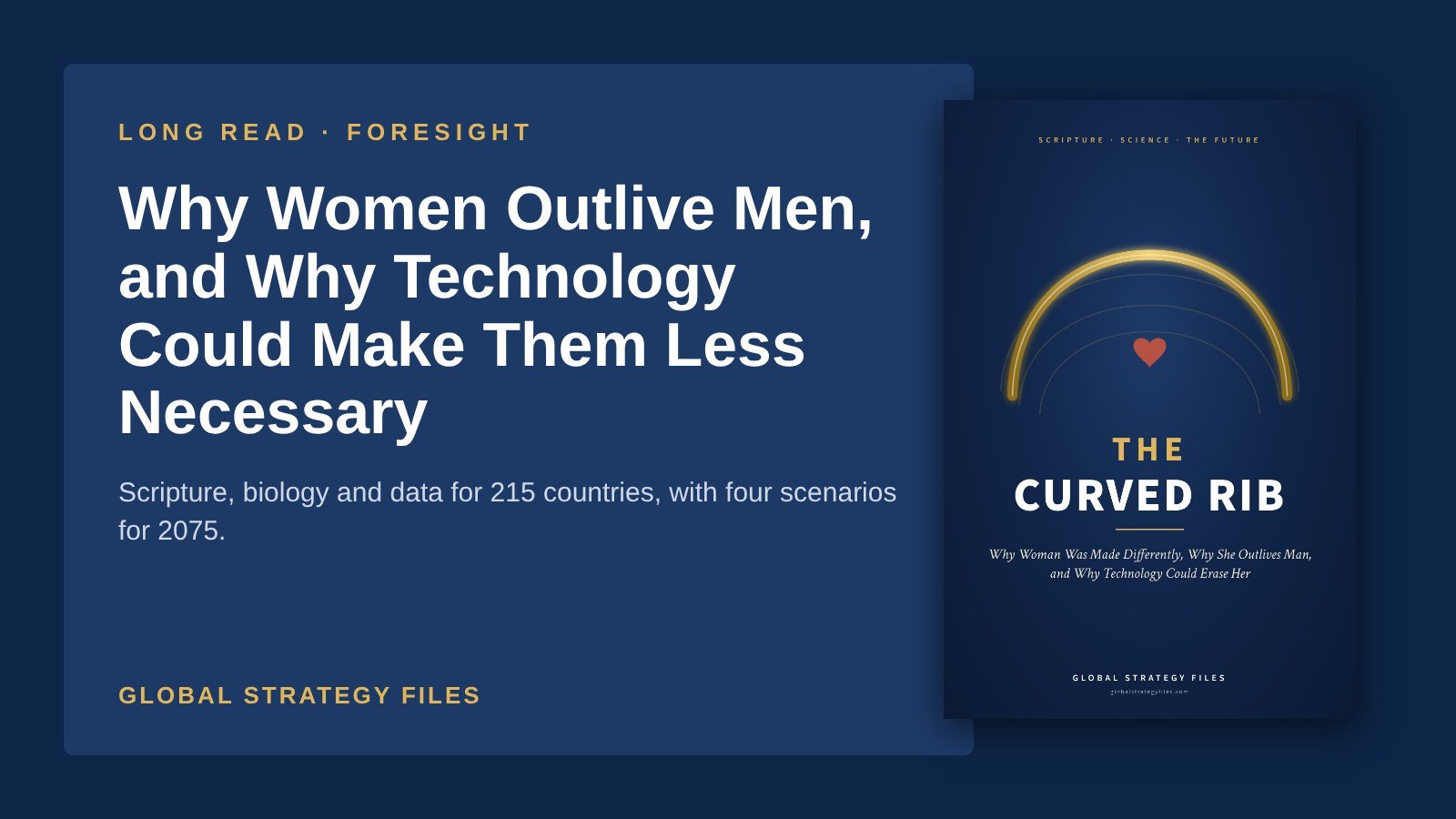
A Global Strategy Files long read drawn from the book The Curved Rib. Scripture, biology, psychology and original analysis of World Bank data for 215 countries, from 1960 to a set of scenarios for 2075.
Global Strategy Files. Foresight, 20 November 2026. Free preview: the first three of thirteen sections.
Key numbers
- 0: the number of countries where men outlive women today. In 1960 there were five.
- 1.22: the median ratio of boys’ to girls’ infant mortality across 196 countries in 2024. The male disadvantage starts in the cradle.
- 184 of 184: countries where men’s suicide rate exceeds women’s, even though women are about twice as likely to be diagnosed with depression.
- 5.5 to 1.7 years: the average gap in life expectancy across 114 countries, today and if men smoked, drank and killed one another at women’s rates.
- 45 percent: our probability that, in 2075, technology will still leave woman’s place intact. The other 55 percent is spread across three worlds in which she is made, in different ways, less necessary.
1. An old image, tested against new data
For three thousand years, the story of woman made from a rib was read as proof that she came second. She was taken from man, so she was part of him; she was made after him, so she was below him. Generations of preachers, jurists and philosophers built on that reading, and generations of women lived inside it.
Our new book, The Curved Rib, proposes a different reading. Look at the rib itself, as an anatomist would. A rib comes in pairs: it has a twin on the other side of the body. It is one of the few bones in the human skeleton that can regrow across a large gap if the membrane around it is left in place, which is why surgeons harvest it for reconstruction. It is curved, and the curve lets it bend under pressure instead of snapping. It guards the heart and the lungs. And, like every curve, it has weak points where it can crack.
Each of these five properties, the book argues, describes a documented feature of female life. Paired: women carry two X chromosomes, a backup copy that men lack. Regrowing: female bodies repair and resist infection better, and women survive famines and epidemics better than men. Curved: under psychological strain women bend, men more often break. Guarding the heart: women live longer almost everywhere, and their hearts fail later. Cracking: women pay a price for this design, in autoimmune disease, in chronic illness, and wherever culture prefers sons.
The image proves nothing by itself. Scripture is not biology, and a metaphor cannot replace a measurement. But used as a lens, the rib organises a surprising amount of what we know. This long read follows that lens through the texts, the cells, the mind and the data, and then turns to the question that gives the book its urgency: whether the technologies of the coming decades could make woman, in some sense, less necessary.
2. What the texts actually say
Start with Genesis, because almost everyone thinks they know it. In fact Genesis contains two creation accounts, not one. In the first, in chapter 1, God creates humanity “in his own image”, and the text immediately adds: “male and female created he them”. There is no sequence, no rib and no hierarchy. Man and woman appear together, in the same sentence and with the same dignity.
The rib belongs to the second account, in chapter 2. Even there, the words have been bent by their translations. The woman is made as an ezer kenegdo, traditionally rendered “a help meet for him”. But ezer appears about 21 times in the Hebrew Bible, and most of those uses refer to God himself, as the helper of Israel. The word implies strength coming to the aid of need, not service. And the word translated “rib”, tsela, is used elsewhere in the Bible mostly for the side of a building or of the Ark of the Covenant. Many scholars now read the passage as the division of one being into two sides, not the extraction of a minor bone.
The Qur’an goes further. It never mentions a rib at all. It speaks of humanity created “from a single soul” (nafs wahida), and of that soul’s mate created from it, so that humanity might “spread from the two of them”. The purpose of the pairing is stated plainly: so that the two may find rest in each other, with “affection and mercy” placed between them. The rib enters Islamic tradition later, through a hadith reported in the canonical collections. Its instruction is not that woman is inferior. It is “treat women well”, and its central image is a curve that breaks if one tries to force it straight.
The oldest parallel is older than both. In a Sumerian poem about the god Enki, a goddess is created to heal his rib. Her name is Nin-ti, which means “Lady of the Rib”. In Sumerian the same syllable, ti, also means “to make live”, so she is also “the Lady who makes live”. The pun, lost in translation, may lie behind the biblical name of Eve, Hawwah, “the mother of all living”.
On the specific question of origin, then, the founding texts are kinder to women than the uses later made of them. The most damaging idea about woman in the Western tradition did not come from scripture at all. It came from Aristotle, who described the female as a “deformed male”, a body in which the generative heat had failed to complete its work. That idea shaped European medicine for nearly two thousand years. Modern biology has reversed it: in the genetics of sex, it is the male line that carries the less complete set.
3. The gap that kept widening
The data tell a story the commentators never imagined. Weighted by population, world life expectancy at birth rose from 52.6 years in 1960 to 75.9 years in 2024 for women, and from 49.3 to 71.1 for men. Both sexes gained more than twenty years, one of the great achievements of human history. But the female advantage did not shrink as living standards rose. It widened, from 3.3 years to about 4.9, and peaked above five years in 2020, during the pandemic.

In 1960, men outlived women in five countries, among them India, Pakistan, Bangladesh and Iran. In each case the reason was not male strength but female hardship: frequent and dangerous childbirth, and the neglect of daughters in poor families. As maternal deaths fell and girls began to receive the same food and care as boys, the anomaly vanished one country at a time. Bangladesh was the last large country to leave the list, in 1995. Since then, women have outlived men in every country in the world, with a single exception for a single year: Zimbabwe in 2007, at the height of an economic collapse and an epidemic.
A universal pattern of this kind calls for an explanation that is also universal. Culture varies enormously from one country to another, and so do diets, religions, wealth and health systems. Something that holds in all of them, in rich and poor countries, in secular and religious ones, at war and at peace, is likely to have roots that go below culture. The rest of this long read follows those roots, and then asks what happens when technology begins to cut them.
PAID ARTICLE · CONTINUE READING
You have read 3 of 13 sections. The other ten are reserved for readers of the full article.
The full article (14 pages, 8 charts, PDF) continues with:
- Why baby boys die 22 percent more often, and what 229 animal species reveal about the second X
- Famines, the pandemic in 165 countries, and where the female advantage stops
- Depression, suicide in 184 countries, and the equality paradox
- The GSF model: how much of the gap is biology, and how much is behaviour
- The Russian exception, and the policy that won back almost ten years of male life
- 142.6 million missing women, artificial wombs, eggs made from skin, and AI at work
- Four worlds of 2075 with GSF probabilities, and what decision makers should do
$19 ($13.30 with code YEAREND30 until 1 December)
THE BOOK BEHIND THIS ARTICLE
The Curved Rib: Why Woman Was Made Differently, Why She Outlives Man, and Why Technology Could Erase Her
29 chapters, 220 pages, 22 figures and 14 tables. Scripture, biology, psychology and original data for 215 countries, with four scenarios for 2075. English PDF, by Global Strategy Files.
$60 ($42 with code YEAREND30 until 1 December)
Read the first part free: The Curved Rib, free excerpt (52 pages, PDF).
Sources for this preview: World Bank, World Development Indicators (GSF calculations); the Hebrew Bible; the Qur’an; Kramer, Sumerian Mythology. Full sources are listed in the complete article.
Global Strategy Files
The opening pages of our four country reports: United States, United Kingdom, Japan and China. A free PDF, sent to your inbox.
You will also receive occasional analysis from Global Strategy Files. Unsubscribe in one click, at any time.