
Can China’s Scale Machine Keep Running? Seven Findings for 2035

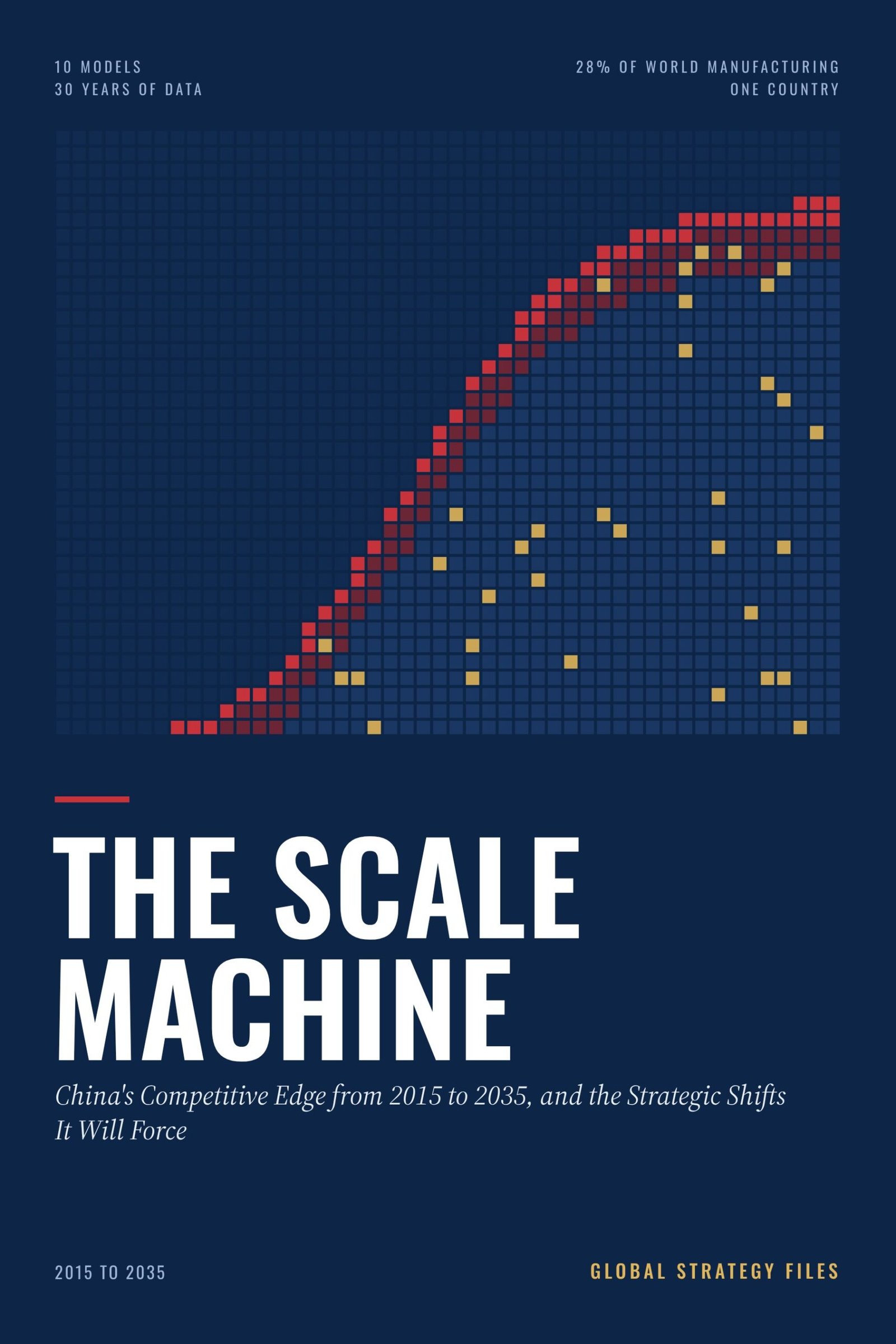
This article presents the main findings of our new book, The Scale Machine: China’s Competitive Edge from 2015 to 2035, and the Strategic Shifts It Will Force (Global Strategy Files, November 2026, 296 pages).
In ten years, China went from being the world’s workshop to being its most formidable industrial competitor. It now produces about 28 percent of the world’s manufacturing output, installs more than half of its industrial robots, dominates batteries, solar power and shipbuilding, and runs a goods surplus of more than one trillion dollars. At the same time its growth is slowing, its population is shrinking, its prices are falling and its households consume a smaller share of output than in any other large economy. Our new book asks how long this scale machine can keep running, and what it will force the rest of the world to do. Here are seven findings, drawn from thirty years of data and ten original models.
1. China is now the second most competitive large economy
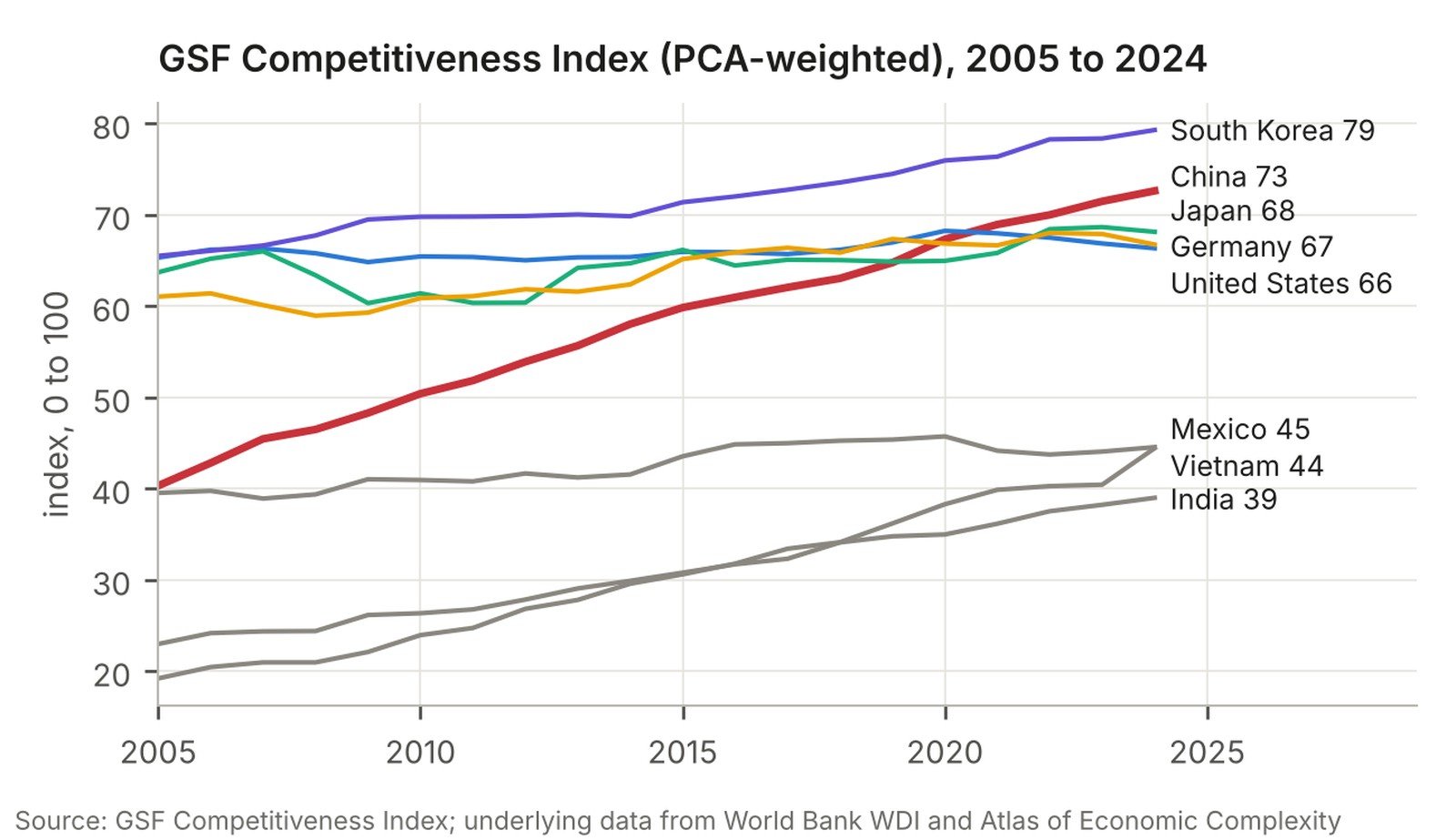
The GSF Competitiveness Index combines ten indicators in six pillars (scale, capability, innovation, productivity, cost and foundations) for eight economies. China’s score rose from 40 in 2005 to 60 in 2015 and 73 in 2024, lifting it from fifth to second place, behind South Korea and ahead of Japan, Germany and the United States. Its lead rests on scale and a fast-rising capability score; its weak point remains productivity, at about 30 percent of the American level.
2. Growth will slow to under 3 percent in the early 2030s
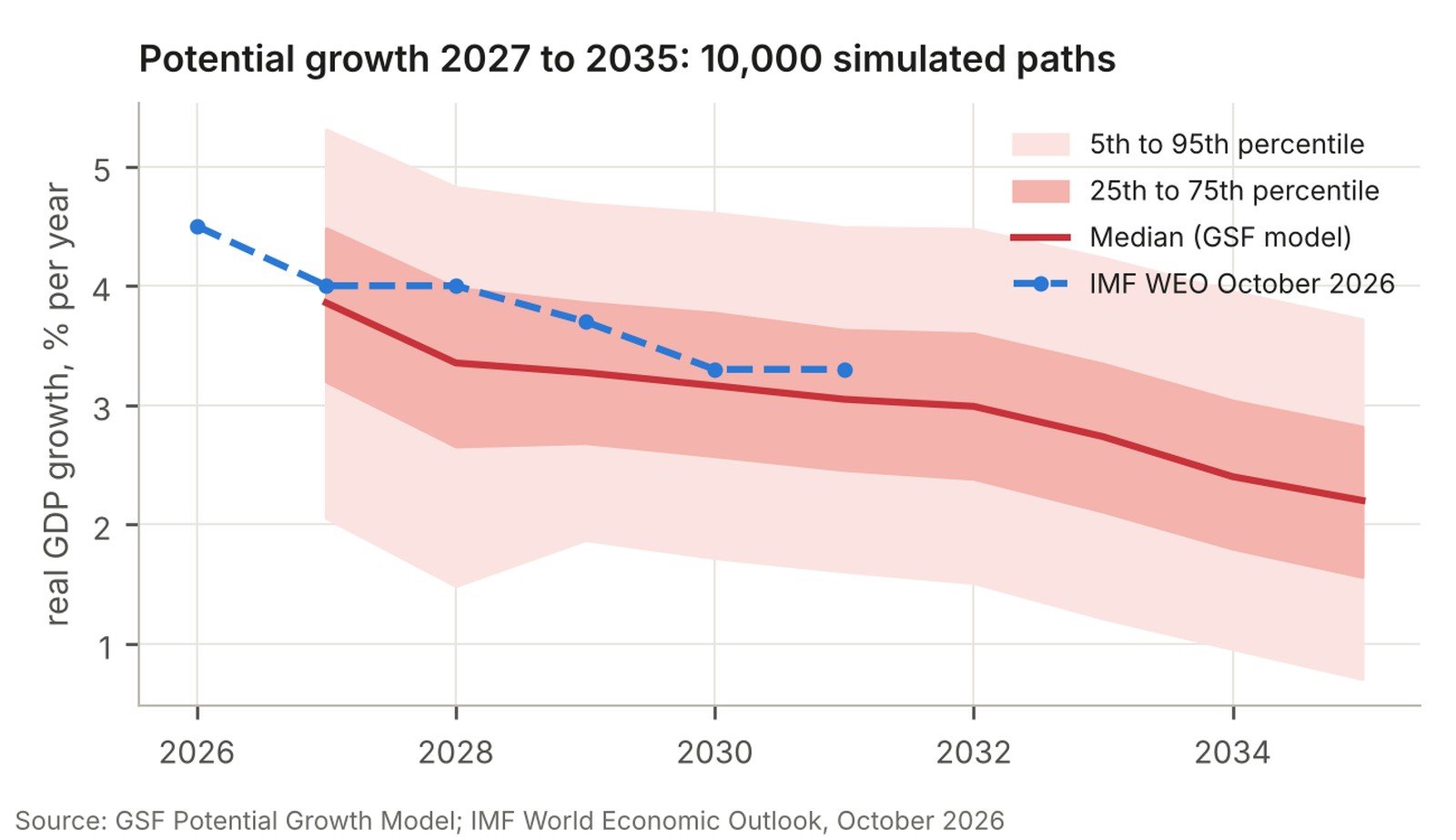
Our potential growth model runs 10,000 simulated futures for the Chinese economy. The median path gives growth of about 3.6 percent a year in 2026 to 2030 and 2.7 percent in 2031 to 2035. The probability of averaging more than 4 percent in the early 2030s is only about 3.5 percent. The single most important variable is productivity: half a point more or less of annual productivity growth shifts median growth by about 0.6 points.
3. China will not overtake the US economy in dollars by 2035
At purchasing power parity, China’s economy has been larger than America’s since the mid 2010s. In dollars, the picture is different. Our median projection puts Chinese GDP at about 30 trillion dollars in 2035, against about 46.5 trillion for the United States. The probability that China’s economy becomes larger in dollar terms by 2035 is about 1.5 percent.
4. Robots are China’s answer to demography
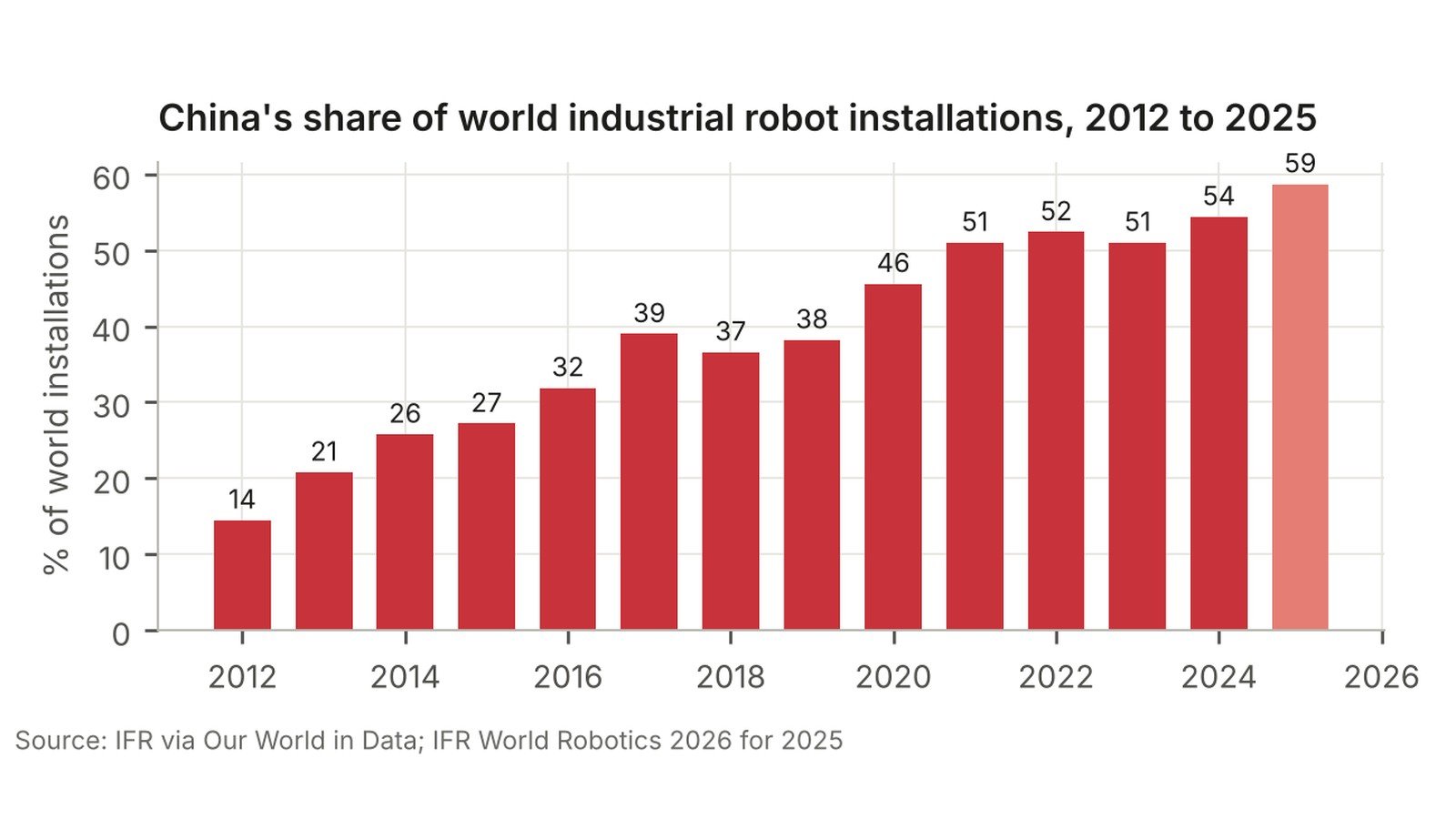
China installed about 59 percent of the world’s industrial robots in 2025, up from 14 percent in 2012. Its robot density in manufacturing has overtaken Germany and Japan, and Chinese firms lead the early market for humanoid robots. Automation will help keep factories running as the workforce shrinks, but it cannot by itself offset the effects of ageing on demand, saving and public finances.
5. The Global South is now China’s largest market
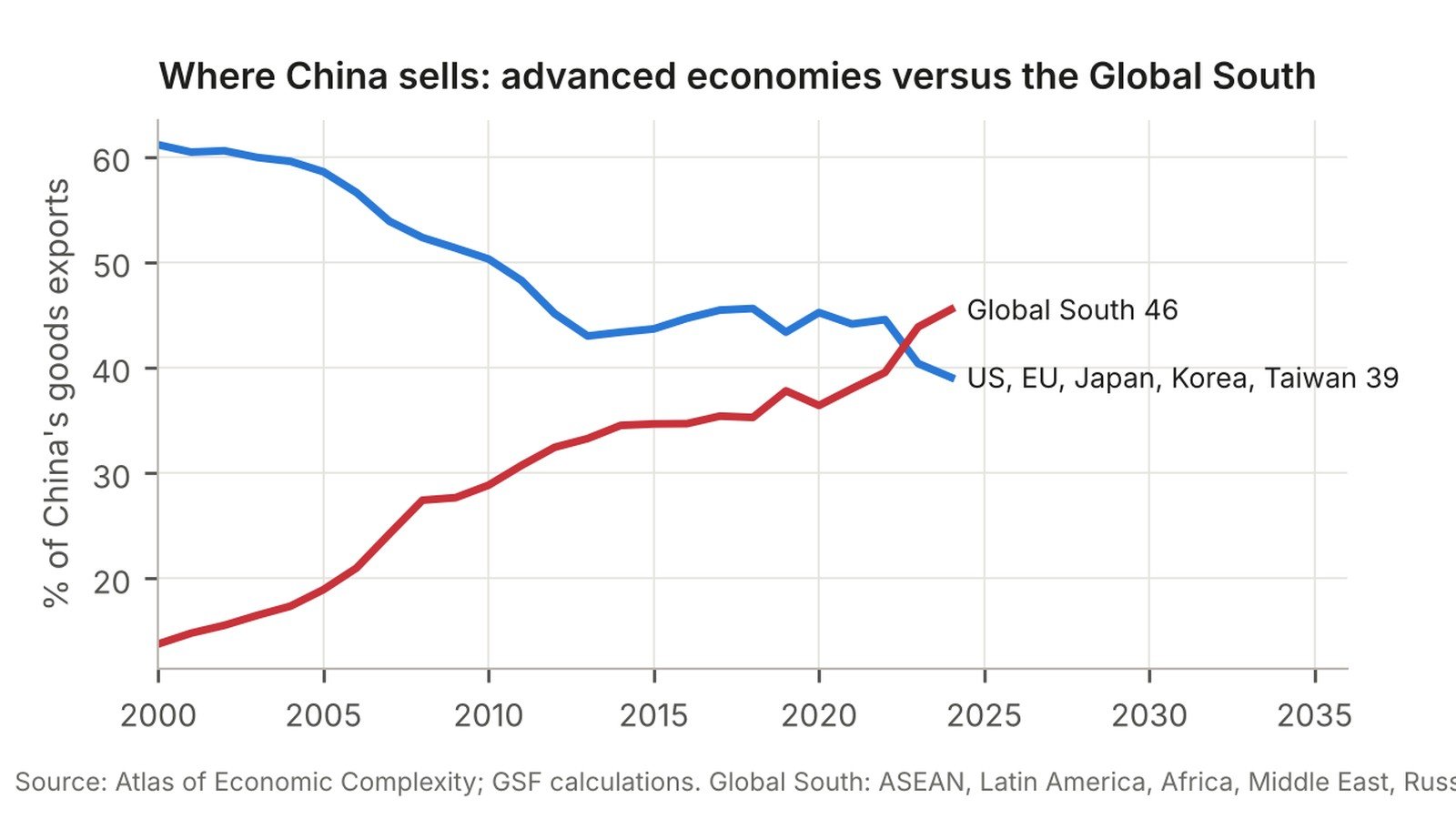
In 2000, the United States, the European Union, Japan, South Korea and Taiwan bought 61 percent of China’s goods exports. In 2024 they bought 39 percent, while Southeast Asia, Latin America, Africa, the Middle East, Russia and Central Asia and South Asia bought 46 percent. China now runs trade surpluses with every one of these regions, which explains why trade defence against Chinese goods is spreading well beyond Washington and Brussels.
6. China’s export share is close to its ceiling
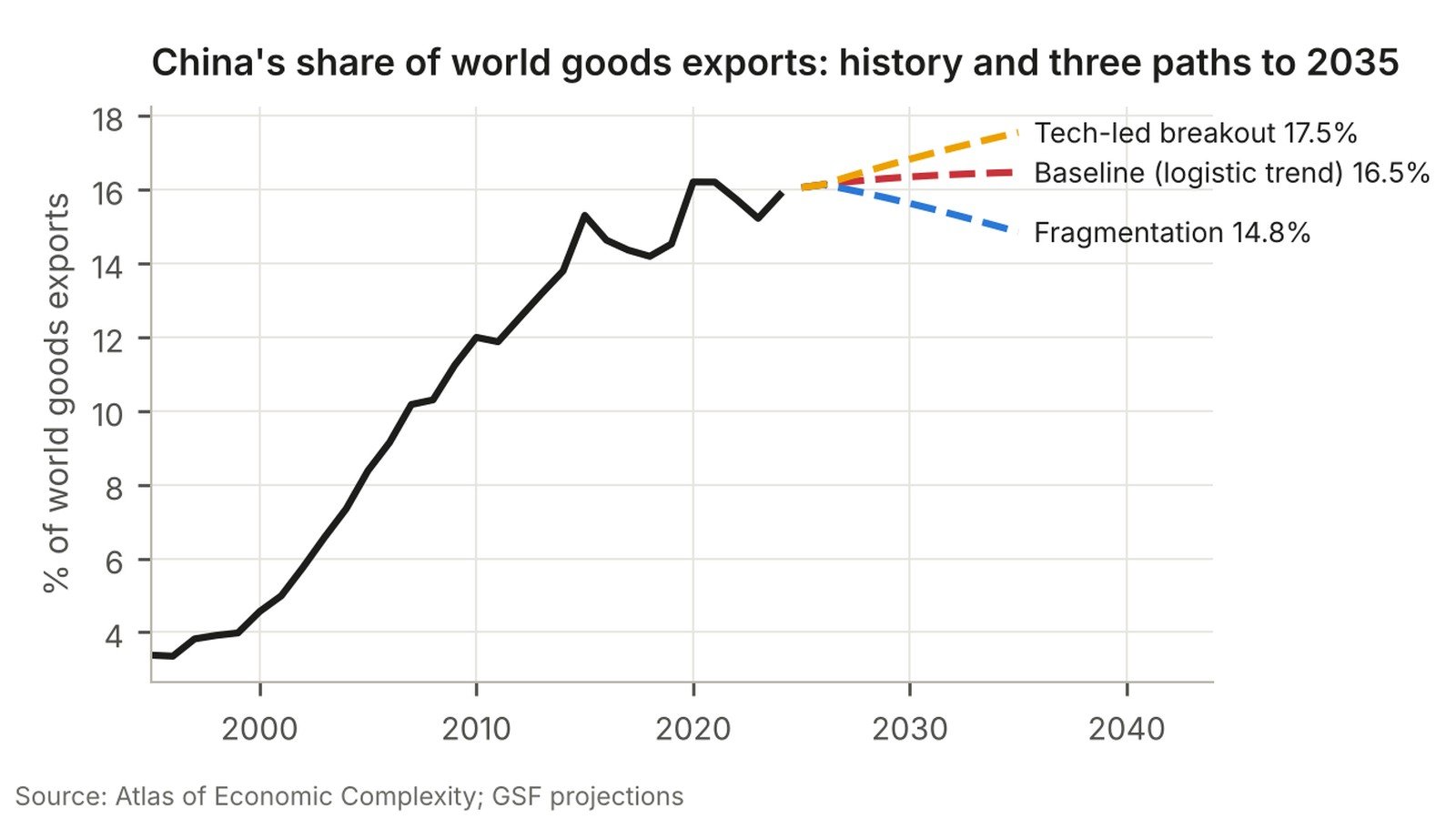
China’s share of world goods exports rose from about 3 percent in 1995 to about 14 percent in 2015 and has fluctuated between 14 and 16 percent since. A logistic model puts its ceiling at about 16.5 percent, and a panel of large exporters shows strong mean reversion in export shares. The decisive change ahead is not the size of China’s share but its composition: cars, machinery, chemicals and power equipment, where the advanced economies compete head on.
7. Tariffs slow the machine but do not stop it
Our trade-shock model estimates that a 30-point increase in American tariffs on all Chinese goods would cost China about 0.6 percent of GDP after trade is rerouted, and a coordinated move by the United States, the European Union and their allies about 1.1 percent. These are significant but manageable losses. The larger risk for China is a lasting loss of access to technology, which would weigh on the productivity growth that decides its future.
Four worlds in 2035
The book combines these models into four scenarios for 2035: the Frontier Republic (15 percent probability), the Fortress Factory (20 percent), the Comfortable Plateau (29 percent) and Japanification with Chinese characteristics (37 percent). It sets out the signposts that will show which world is emerging, and the strategic shifts that each implies for the United States, Europe, Asia and the Global South.
Inside the book
The Scale Machine contains 27 chapters in five parts, an epilogue answering ten questions about 2035 and twenty appendices, with 105 figures and 76 tables. It includes a sector atlas of 24 product groups, profiles of seven competing economies and ten Chinese firms, from BYD and CATL to Huawei, SMIC and Unitree, a chronology from 2013 to 2026 and full statistical tables. It is written for decision makers in government, business and finance.
The opening pages of our four country reports: United States, United Kingdom, Japan and China. A free PDF, sent to your inbox.
You will also receive occasional analysis from Global Strategy Files. Unsubscribe in one click, at any time.