
France’s 2027 Budget: Can the Deficit Be Cut Without Stifling Growth?


France’s 2027 Budget: Can the Deficit Be Cut Without Stifling Growth?
Driss EFFINA, PhD Independent Researcher, Global Strategy Files Reading time: about 31 minutes
Key takeaways
- France's 2027 budget aims to cut the deficit from 5.4 percent of GDP in 2026 to 5.0 percent in 2027, with an adjustment of about 54 billion euros.
- General government interest is forecast to rise from 58.1 billion euros in 2024 to 91.2 billion in 2027.
- Stabilising debt in 2027 would need a primary deficit of about 0.4 percent of GDP, against a forecast 2.1 percent, a gap of 1.7 points.
- Without further consolidation, French public debt would rise toward 130 percent of GDP by the early 2030s.
Abstract
On 1 October 2026, the French government presented its draft budget for 2027 with a stated ambition: to reduce the deficit without stifling growth. The bill aims to bring the general government deficit from 5.4 percent of GDP expected in 2026 to 5.0 percent in 2027, through an effort presented as worth about 54 billion euros, of which 43 billion of new measures split between 25 billion of spending savings and 18 billion of revenue measures. This article tests that ambition with official data from INSEE, the budget bill, the opinion of the Haut Conseil des finances publiques (HCFP) and recent forecasts, and with calculations by the author. It combines a debt dynamics analysis (implicit interest rate, decomposition of the change in the debt ratio, debt-stabilising primary balance, sensitivity to market rates, scenarios to 2032) with an assessment of the growth cost of the adjustment, instrument by instrument, using published fiscal multipliers. Six results stand out. First, the deficit rises in 2026 instead of falling, and the 2027 budget brings it back only slightly below its 2025 level. Second, interest paid by general government rises from 58.1 billion euros in 2024 to 91.2 billion in 2027. Third, the 43 billion euros of new measures would reduce the level of GDP by about 1.0 point after two years in gross terms (range 0.8 to 1.2), and by about 0.6 point once the spending increases contained in the same budget are taken into account, which is consistent with the 0.4 point cost for 2027 growth estimated by the OFCE. Fourth, public consumption and employment account for almost 40 percent of the estimated growth cost, against about 6 percent for taxes on firms. Fifth, among five alternative mixes of the same 43 billion euros, the growth cost ranges from about 0.8 to 1.15 points of GDP: a consolidation relying only on spending would be the most costly in the short run, while mixes leaning on low-multiplier instruments would cost about 0.15 to 0.2 point less, at the price of possible longer-run supply effects that demand multipliers do not capture. Sixth, even after the 2027 budget, a fiscal gap of about 54 billion euros remains to stabilise the debt ratio. The article concludes that France can reduce its deficit without stifling growth only if it spreads the adjustment over several years, protects the instruments with the highest multipliers, and favours measures whose cost falls on savings rather than on consumption.
Keywords: France, budget 2027, public deficit, fiscal consolidation, fiscal multipliers, growth, public debt, interest burden, Haut Conseil des finances publiques
JEL codes: E62, H60, H62, H63, H68
1. Introduction
Every year, the French government presents its budget for the following year at the beginning of October. In most years, the event is technical. In 2026 it was not. The draft budget for 2027 was presented in a context that combined four sources of tension: a public deficit that had started to rise again after falling in 2025; a public debt above 119 percent of GDP; a sharp rise in French government bond yields, with the ten-year rate reaching about 4.8 to 4.9 percent in early October, its highest level since 2002; and a political configuration in which the government has no majority in the National Assembly, six months before a presidential election.
The government’s response is a budget that aims to reduce the deficit to 5.0 percent of GDP in 2027, from 5.4 percent expected for 2026, with an adjustment it puts at about 54 billion euros. The bill freezes the index point of civil servants’ pay, limits the indexation of pensions above certain thresholds, freezes family allowances and housing aid, caps the growth of health insurance spending at 2 percent, reduces transfers to local authorities, and introduces a series of revenue measures. At the same time, it increases defence spending by about 6.5 billion euros.
The question the government has set itself is explicit: how to reduce the deficit without stifling growth. It is not a rhetorical question. With growth forecast at 0.5 percent in 2026, unemployment rising toward 8.5 percent and private investment held back by rising interest rates, a large fiscal adjustment could weaken activity enough to erode part of its own effect on the deficit. Conversely, an adjustment that is too small would leave the debt ratio rising and expose France to a further rise in its borrowing costs, which would also weigh on growth.\n\nCommentary on the French budget usually focuses on the measures themselves, which are politically sensitive. This article takes a different approach and examines the budget as a trade-off between two constraints: the arithmetic of debt and the arithmetic of growth. The questions it addresses are the following. Why did the deficit rise again in 2026? What are the 2027 measures made of, and what does each part cost in terms of growth? Could the same effort be designed differently, at a lower growth cost? How far is the 2027 budget from stabilising the debt, and how fast is the interest burden increasing? And what are the possible trajectories to 2032?
Section 2 presents the context. Section 3 reviews the literature on fiscal consolidation and debt sustainability. Section 4 describes the data and methods. Section 5 presents the results. Section 6 discusses them. Section 7 presents scenarios. Section 8 concludes.
2. Context
2.1 A long history of deficits
France has not had a balanced general government budget since 1974. Over the past fifty years, the deficit has been below 3 percent of GDP in only a minority of years. In the years before the pandemic, consolidation efforts brought the deficit down to 2.3 percent of GDP in 2018 and 2.4 percent in 2019, and the debt ratio stabilised at just under 98 percent of GDP.
The pandemic changed the picture. In 2020, the deficit reached 8.9 percent of GDP and debt rose to 114.9 percent. The deficit fell to 6.6 percent in 2021 and 4.7 percent in 2022, but then rose again to 5.4 percent in 2023 and 5.8 percent in 2024, mainly because revenue fell short of forecasts. In 2025, the deficit fell to 5.1 percent of GDP, better than the 5.4 percent target of the 2025 finance law, thanks to stronger than expected revenue.
2.2 The 2026 setback
The 2026 finance law, adopted only on 2 February 2026 after a long political process and the use of article 49.3 of the Constitution, targeted a deficit of 5.0 percent of GDP. In the 2027 bill, the government now expects 5.4 percent. The main reason is the international environment: the conflict in the Middle East and the rise in energy prices have weakened growth, which the government now forecasts at 0.5 percent for 2026, against about 1 percent previously. At the same time, the rise in interest rates has increased the cost of debt.
The deficit therefore rises in 2026 instead of falling. This is significant because France is subject to an excessive deficit procedure opened by the European Union in July 2024, under which it committed to bring its deficit below 3 percent of GDP by 2029.
2.3 The market context
French borrowing costs have risen considerably over the past year. The ten-year OAT yield rose from about 3.3 percent in February 2026 to 3.8 percent in May and about 4.84 percent on 7 October 2026. The spread between French and German ten-year yields briefly exceeded 130 basis points, its widest level since 2012. The average rate on medium and long-term debt issued by the Agence France Trésor in 2026 was 3.55 percent up to the time of the budget, against 3.14 percent in 2025, and the average rate on short-term treasury bills was 2.38 percent against 2.12 percent.
For 2027, the Agence France Trésor plans a record medium and long-term issuance programme of 340 billion euros, net of buybacks, to cover a financing requirement of 339.7 billion euros, which is 28 billion euros more than in 2026. The increase is mainly due to the growing volume of bonds issued during the crisis years that are now reaching maturity.
2.4 The political context
The government of Prime Minister Sébastien Lecornu does not have an absolute majority in the National Assembly. The 2026 state budget was adopted through article 49.3, which allows adoption without a vote but exposes the government to a motion of censure. The 2026 social security budget was adopted by vote, after an agreement with the Socialist group that included the suspension of the 2023 pension reform. For 2027, the parliamentary calendar is constrained by the presidential election of spring 2027. Several options exist if Parliament does not adopt the budget in time, including the use of ordinances after seventy days, which has never been done under the Fifth Republic, or a special law allowing the state to continue collecting taxes.
2.5 The main measures
The main measures announced on 1 October 2026 include:
- a freeze of the index point for civil servants and a net reduction of 1,076 posts in the state and its agencies;
- the full indexation of pensions below 1,260 euros per month, partial indexation between 1,260 and 2,000 euros, and no indexation above 2,000 euros;
- a reduction of the ceiling of the 10 percent tax allowance for pensioners from 4,439 to 3,000 euros per household;
- a freeze of family allowances and housing aid at their 2026 level;
- a target of 2 percent growth for health insurance spending (ONDAM), with savings on medicines and sick leave;
- a reduction of 2 billion euros in the state’s contribution to local authorities, within an effort of about 5.5 billion euros asked of local governments;
- an increase of about 6.4 to 6.5 billion euros in the armed forces budget;
- revenue measures including the extension of the minimum tax on high incomes, a reduced version of the exceptional surtax on large companies, a levy on dormant assets, an extension of the tax on sugary drinks, and an anti-fraud plan.
The government expects net state tax revenue to reach 375.7 billion euros in 2027, an increase of 18 billion euros, with VAT revenue up 7 billion and income tax revenue up 5.7 billion. The social security deficit is expected to fall from 21.8 billion euros in 2026 to 12.7 billion euros in 2027.
2.6 The opinion of the Haut Conseil des finances publiques
The Haut Conseil des finances publiques (HCFP), the independent fiscal institution attached to the Cour des comptes, published its opinion on the same day. It judged the growth forecast of 1.0 percent for 2027 “optimistic”, noting that most other forecasters are 0.1 to 0.3 point lower and that downside risks predominate. Other forecasts published since confirm this view: the Banque de France projected 0.9 percent for 2027 in September, the IMF 0.7 percent in its October World Economic Outlook, and the OFCE 0.5 percent on 14 October. The HCFP estimated that, with growth in line with other forecasters, the 2027 deficit would be about 5.2 to 5.3 percent of GDP rather than 5.0 percent. It measured the structural effort at about 0.9 point of GDP, or about 28 billion euros, of which 17 billion on revenue and 11 billion on spending, and noted that the rise in interest costs, about 12 billion euros, absorbs a large part of the savings. It described the reduction of the deficit as moderate and considered that a deficit below 3 percent in 2029 appeared very unlikely.
2.7 The composition of the effort as presented
The government presents an effort of 54 billion euros relative to a scenario without new measures: 43 billion euros of new measures in the budget and social security bills, and 11 billion of measures decided earlier that take effect in 2027. Of the 43 billion, 25 billion are spending savings and 18 billion are revenue measures; the government stresses that about 60 percent of the effort falls on spending. According to the itemisation published by the IFRAP, the documented spending savings come from social security (about 8.5 billion euros, including 3.0 billion from the differentiated indexation of pensions and 4.1 billion net from the 2 percent cap on health insurance spending), from the state and its agencies (about 7.7 billion) and from local authorities (about 6.2 billion of reduced resources). On the revenue side, about 10.5 billion euros fall on labour and household income, including the reduction of the tax allowance for pensioners, and 5 billion come from the surtax on large companies.
The bill also protects a number of items: minimum social benefits (RSA, minimum old age pension, disability allowance) are fully indexed, hospital budgets rise by 3 percent, spending on the elderly and disabled by 2.6 percent, the national education budget by 1.1 billion euros, the research tax credit is maintained and the green fund is raised to 1 billion euros. These choices, between control of spending, social protection and public investment, are at the heart of the question examined in this article.
3. Literature review
The analysis of the French budget draws on three strands of literature.
The first concerns debt dynamics and the role of the gap between the interest rate and the growth rate. The standard accounting framework, used by the IMF, the European Commission and national fiscal councils, decomposes the change in the debt ratio into the primary balance, the “snowball effect” linked to the difference between the interest rate and nominal growth, and stock-flow adjustments. Blanchard (2019), in his presidential address to the American Economic Association, argued that when the interest rate is below the growth rate, debt can be less costly in welfare terms than usually assumed, while warning that this situation can reverse. The French case since 2024 illustrates precisely such a reversal in progress.
The second strand concerns fiscal consolidation and its effects on growth. Blanchard and Leigh (2013) showed that fiscal multipliers were underestimated during the European sovereign debt crisis, which led to growth forecast errors in countries that consolidated rapidly. Alesina, Favero and Giavazzi (2019) argued that consolidations based on spending cuts are less costly for growth than those based on tax increases. These debates are relevant to the composition of the French effort, which combines both. For France specifically, the macroeconomic model Mésange, jointly maintained by INSEE and the French Treasury, provides multipliers by instrument: after two years, about 1.4 for public investment, 1.1 for an identical rise in all public spending, 0.8 for a cut in the CSG and 0.6 for a cut in employer social contributions; the more recent Mésange 3.0 version gives a short-term multiplier of about 1.3 for public investment and about 0.8 for a generic mix of public spending. OECD estimates for France, compiled by FIPECO, give two-year multipliers of about 1.0 for public investment, 0.6 for transfers to households and for household income tax, and 0.3 for indirect taxes. The empirical literature, reviewed by the OFCE, also shows that multipliers are higher when the economy is weak, when monetary policy cannot offset the fiscal shock and when several countries consolidate at the same time.
The third strand concerns fiscal rules and institutions in Europe. Blanchard, Leandro and Zettelmeyer (2021) proposed replacing numerical rules with standards based on debt sustainability analysis. The reform of the European economic governance framework adopted in 2024 moved in this direction, with country-specific adjustment paths based on net primary expenditure. The French medium-term plan and the HCFP opinion are framed in these terms, and the HCFP checks that net primary spending growth, forecast at 0.7 percent in 2027, stays below the recommended ceiling.
At the national level, the annual reports of the Cour des comptes on the situation and outlook of public finances, and the opinions of the HCFP, provide the most detailed assessments. This article uses their framework but carries out its own calculations on the 2027 bill.
4. Data and methodology
4.1 Sources
The data used are:
- INSEE annual national accounts, base 2020, published in May 2026: deficit, debt, spending, revenue and interest for 2019 to 2025;
- INSEE quarterly debt release for the second quarter of 2026;
- the 2027 budget bill and its press kit (1 October 2026): growth, inflation, deficit, debt, spending ratio and interest forecasts for 2026 and 2027;
- the Agence France Trésor: financing programme and debt service of the state for 2026 and 2027;
- the opinion of the HCFP on the 2027 bills (n° 2026-5), as reported in the press and by the Senate’s news service;
- the itemisation of the 2027 measures published by the IFRAP;
- the forecasts of the Banque de France (15 September 2026), the IMF (13 October 2026) and the OFCE (14 October 2026);
- published fiscal multipliers for France: Mésange (INSEE and French Treasury), Mésange 3.0, and OECD values compiled by FIPECO.
4.2 Nominal GDP
Nominal GDP for 2025 is derived from INSEE ratios (gross debt of 3,460.5 billion euros equals 115.7 percent of GDP, giving about 2,991 billion euros). Nominal GDP for 2026 and 2027 is estimated by applying the government’s forecasts for real growth (0.5 and 1.0 percent) and consumer price inflation (2.1 and 1.8 percent), using consumer prices as a proxy for the GDP deflator. This approximation can introduce a small error of a few tenths of a point in the ratios.
4.3 Derived indicators
1. Interest burden. Interest paid by general government in national accounts terms, in billions of euros and as a share of GDP. 2. Implicit interest rate. Interest paid in year t divided by gross debt at the end of year t-1. 3. Primary deficit. Total deficit minus interest paid, as a share of GDP. 4. Decomposition of the change in the debt ratio. The change in the debt ratio between t-1 and t is split into: the primary deficit; the snowball effect, equal to d(t-1) × (i – g) / (1 + g), where d is the debt ratio, i the implicit interest rate and g nominal growth; and a residual covering stock-flow adjustments (changes in cash holdings, financial transactions, valuation effects) and approximation errors. 5. Debt-stabilising primary balance. The primary balance that keeps the debt ratio constant: pb* = d × (i – g) / (1 + g). When i is below g, the debt ratio can be stabilised with a small primary deficit. 6. Fiscal gap. The difference between the forecast primary deficit and the debt-stabilising primary deficit. 7. Interest rate sensitivity. The additional interest cost, in billions of euros, of a permanent 100 basis point increase in market rates, assuming that the short-term debt stock (about 292 billion euros) is repriced within the first year and that medium and long-term issuance of about 340 billion euros per year is repriced progressively. 8. Growth cost of the adjustment. The 43 billion euros of new measures are classified into seven instruments (public consumption and employment, cash transfers to households, health spending in kind, public investment, taxes on households and labour, taxes on firms, other revenue). Each amount is multiplied by a two-year fiscal multiplier taken from the published ranges (low, central and high values), and the sum is expressed as a share of 2027 GDP. The result is the loss of GDP level after two years relative to a situation without the measures. Where the itemisation does not specify the nature of a saving, the author assumes that half of the reduced resources of local authorities falls on investment and that undocumented savings fall on operating spending. 9. Net deficit reduction. The gross effort minus the deficit deterioration caused by lower activity, using a budget semi-elasticity to output of 0.6, the order of magnitude estimated by the European Commission for France. 10. Alternative mixes. The same 43 billion euros are reallocated across instruments in four alternative designs, and the growth cost and net deficit reduction are recalculated. 11. Debt scenarios. Projections of the debt ratio to 2032 using the debt accumulation identity, with assumptions on the deficit, real growth, inflation and a gradual convergence of the implicit interest rate toward the market rate, at the speed of about one eighth per year, consistent with an average debt maturity of about eight years.
4.4 Limitations
The government forecasts for 2026 and 2027 are not outturns, and the HCFP considers the 2027 growth forecast optimistic. The multipliers are demand-side, two-year estimates: they do not capture the possible longer-run effects of taxes and spending on labour supply, investment and productivity, nor the possible confidence effects of a credible consolidation on interest rates. The classification of measures by instrument is approximate. The interest figures for 2026 and 2027 come from the press kit and may be revised. The decomposition contains a residual that partly reflects the approximation of nominal GDP. The scenarios are illustrative and depend on their assumptions.
5. Results
5.1 The deficit and debt trajectory
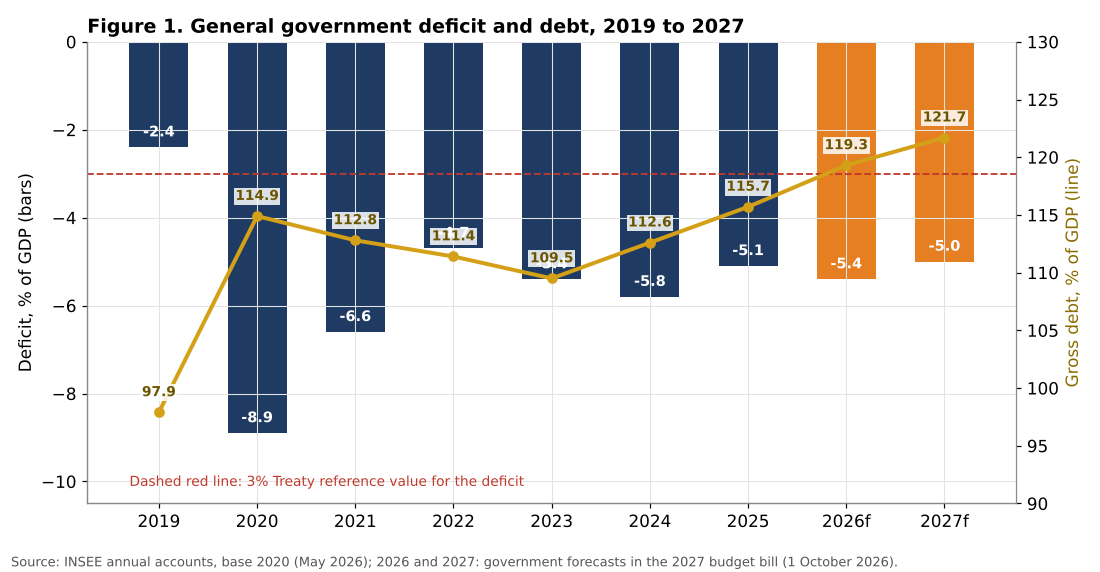
Figure 1 shows the general government deficit and debt from 2019 to 2027.
| Year | Deficit (% GDP) | Gross debt (% GDP) | Spending (% GDP) | Revenue (% GDP) |
|---|---|---|---|---|
| 2019 | -2.4 | 97.9 | 55.2 | 52.8 |
| 2020 | -8.9 | 114.9 | 61.7 | 52.8 |
| 2021 | -6.6 | 112.8 | 59.5 | 52.9 |
| 2022 | -4.7 | 111.4 | 58.4 | 53.7 |
| 2023 | -5.4 | 109.5 | 56.8 | 51.4 |
| 2024 | -5.8 | 112.6 | 57.0 | 51.2 |
| 2025 | -5.1 | 115.7 | 57.3 | 52.2 |
| 2026f | -5.4 | 119.3 | 57.1 | n.a. |
| 2027f | -5.0 | 121.7 | 56.9 | n.a. |
Table 1. General government accounts. Source: INSEE (2019 to 2025), 2027 budget bill (2026 and 2027 forecasts).
The first observation is that the debt ratio has risen every year since 2023, from 109.5 to an expected 121.7 percent of GDP in 2027, an increase of more than 12 points in four years. At the end of the second quarter of 2026, gross debt reached 3,595.5 billion euros, or 119.0 percent of GDP, a record. The debt increased by 59.6 billion euros in the second quarter alone.
The second observation is that the deficit has been above 5 percent of GDP for four consecutive years (2023 to 2026), and will remain at that level in 2027 even if the government’s plan is fully implemented. Since 2019, France has never come close to the 3 percent reference value of the European treaties.
The third observation is that the improvement of 2025, when the deficit fell from 5.8 to 5.1 percent, has not been sustained. The deficit rises again to 5.4 percent in 2026, and the 2027 target of 5.0 percent would bring it back only slightly below the 2025 level. In other words, between 2025 and 2027, the deficit would be practically stable, while the debt ratio would rise by six points.
5.2 The composition of the effort and its growth cost
Before turning to debt dynamics, it is useful to ask what the 2027 measures are made of and what they cost in terms of activity. The deficit is the result of spending that remains at a historically high level, 56.9 percent of GDP in 2027 against 55.2 percent in 2019, and of revenue that fell from 53.7 percent of GDP in 2022 to 51.2 percent in 2024 before partly recovering. The 2027 budget acts on both sides, and Figure 2 shows how.
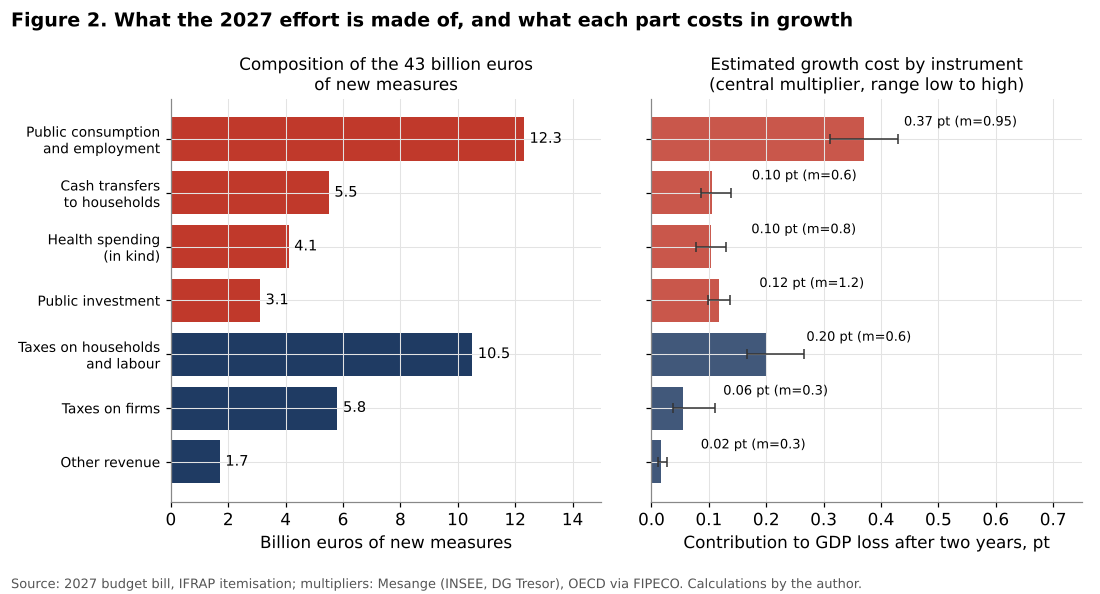
The left panel classifies the 43 billion euros of new measures into seven instruments. Public consumption and employment (the freeze of operating credits and of the civil service index point, staff reductions, and the operating part of the reduced resources of local authorities) is the largest item, at about 12.3 billion euros. Cash transfers to households (partial de-indexation of pensions, freeze of family allowances and housing aid) account for about 5.5 billion, health spending in kind for about 4.1 billion, and public investment, through the part of the effort borne by local authorities, for about 3.1 billion. On the revenue side, taxes on households and labour represent about 10.5 billion euros, taxes on firms about 5.8 billion and other revenue about 1.7 billion.
The right panel applies a two-year multiplier to each instrument. The central values are 0.95 for public consumption and employment, 1.2 for public investment, 0.8 for health spending, 0.6 for cash transfers and household taxes, and 0.3 for taxes on firms and other revenue, within ranges drawn from the Mésange model and the OECD estimates for France.
| Instrument | Amount (bn euros) | Multiplier (low, central, high) | GDP loss, central (pt) |
|---|---|---|---|
| Public consumption and employment | 12.3 | 0.8, 0.95, 1.1 | 0.37 |
| Cash transfers to households | 5.5 | 0.5, 0.6, 0.8 | 0.10 |
| Health spending in kind | 4.1 | 0.6, 0.8, 1.0 | 0.10 |
| Public investment | 3.1 | 1.0, 1.2, 1.4 | 0.12 |
| Taxes on households and labour | 10.5 | 0.5, 0.6, 0.8 | 0.20 |
| Taxes on firms | 5.8 | 0.2, 0.3, 0.6 | 0.06 |
| Other revenue | 1.7 | 0.2, 0.3, 0.5 | 0.02 |
| Total | 43.0 | 0.97 |
Table 2. Growth cost of the 2027 new measures by instrument, two-year horizon. Calculations by the author.
Three results emerge. First, in gross terms, the 43 billion euros of new measures, equal to about 1.36 points of GDP, would reduce the level of GDP by about 0.97 point after two years in the central case, within a range of 0.79 to 1.24 point. The implied average multiplier is about 0.7.
Second, the growth cost is concentrated. Public consumption and employment, which account for 29 percent of the measures, account for 38 percent of the estimated growth cost. Taxes on firms, which account for 13 percent of the measures, account for only about 6 percent of the cost. The savings borne by local authorities, if they fall partly on investment, have a cost out of proportion to their size, because public investment has the highest multiplier.
Third, the gross figure overstates the actual fiscal impulse, because the same budget also increases some spending, notably defence by about 6.4 billion euros. The OFCE estimates the primary effort at 1.2 points of GDP but the primary fiscal impulse, which nets out these increases and the spontaneous evolution of spending, at about 0.8 point of GDP. Scaling the author’s estimate to this net impulse gives a loss of GDP level of about 0.57 point after two years (range 0.46 to 0.73), most of which would be felt in 2027. This is consistent with the OFCE’s own estimate that the budget will reduce growth by about 0.4 point in 2027, and it explains a large part of the gap between the government’s growth forecast of 1.0 percent and the forecasts of other institutions.
The net deficit reduction is smaller than the gross effort, because lower activity reduces tax revenue and raises some spending. With a budget semi-elasticity of 0.6, the gross effort of 1.36 points of GDP produces a net deficit reduction of about 0.78 point in the central case. In other words, about a sixth of the effort is lost through its own effect on growth, before taking into account the rise in interest costs.
5.3 Could the same effort cost less growth?
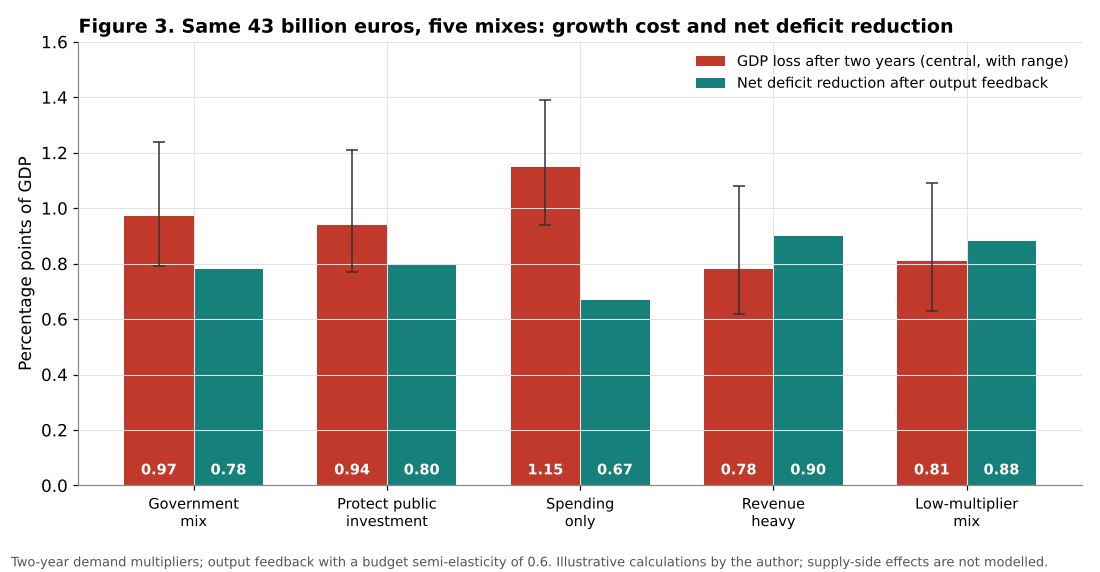
Figure 3 compares five ways of distributing the same 43 billion euros.
| Mix | GDP loss after two years (pt, central) | Range | Net deficit reduction (pt) | GDP loss per point of net deficit reduction |
|---|---|---|---|---|
| Government mix (25 spending, 18 revenue) | 0.97 | 0.79 to 1.24 | 0.78 | 1.24 |
| Protect public investment | 0.94 | 0.77 to 1.21 | 0.80 | 1.18 |
| Spending only | 1.15 | 0.94 to 1.39 | 0.67 | 1.70 |
| Revenue heavy | 0.78 | 0.62 to 1.08 | 0.90 | 0.87 |
| Low-multiplier mix | 0.81 | 0.63 to 1.09 | 0.88 | 0.92 |
Table 3. Growth cost of alternative consolidation mixes of 43 billion euros. Calculations by the author.
The government mix is a middle option. A consolidation based only on spending, with larger cuts in operating spending, transfers and health, would cost about 1.15 point of GDP after two years, about 0.2 point more, and would reduce the deficit by only 0.67 point net. A revenue-heavy mix, in which taxes on firms and households provide 30 of the 43 billion euros, would cost about 0.78 point. A mix designed around low-multiplier instruments, combining taxes on firms, taxes on capital income and high incomes, savings on the transfers received by the best-off pensioners and moderate operating savings, would cost about 0.81 point while preserving public investment. Simply shifting the investment cuts of local authorities to operating spending would reduce the cost by only about 0.03 point, because the amounts involved are small, but it would avoid weakening the capital stock.
These results must be read with care. They rely on demand-side multipliers over two years. The literature summarised by Alesina, Favero and Giavazzi (2019) argues that tax-based consolidations are more costly in the medium term, because higher taxes reduce incentives to work and invest, while spending-based consolidations can be accompanied by confidence effects. Other studies, including those of the OFCE and the IMF, find smaller differences once monetary policy and the state of the cycle are taken into account. In France, where the rate of compulsory levies is already 43.6 percent of GDP, a revenue-heavy strategy would also face limits in terms of tax competitiveness. The conclusion is therefore not that one side should be preferred, but that within each side the choice of instruments matters as much as the total: cuts in investment and in the spending of households with a high propensity to consume cost more growth than measures falling on savings, profits and the highest incomes.
5.4 The interest burden
Interest paid by general government, in national accounts terms, rose from 58.1 billion euros in 2024 to 64.7 billion in 2025, an increase of 11.2 percent. According to the government’s forecasts, it will reach 79.2 billion euros in 2026 and 91.2 billion in 2027. In three years, the interest bill would therefore increase by about 33 billion euros, or 57 percent.
| Year | Interest (bn euros) | % of GDP | Implicit rate on debt (%) |
|---|---|---|---|
| 2024 | 58.1 | 1.98 | n.a. |
| 2025 | 64.7 | 2.16 | 1.96 |
| 2026f | 79.2 | 2.58 | 2.29 |
| 2027f | 91.2 | 2.89 | 2.49 |
Table 4. Interest paid by general government. Source: INSEE, 2027 budget bill; ratios and implicit rate calculated by the author.
As a share of GDP, interest rises from 1.98 percent in 2024 to 2.16 percent in 2025, 2.58 percent in 2026 and 2.89 percent in 2027. The implicit interest rate on debt, calculated by the author as interest divided by the debt stock at the end of the previous year, rises from 1.96 percent in 2025 to 2.29 percent in 2026 and 2.49 percent in 2027.
For the state alone, the debt service in budgetary terms (charge de la dette) is forecast at 72.9 billion euros in 2027, against 62.6 billion in the revised 2026 forecast and 59.3 billion in the initial 2026 finance law. The increase of 10.3 billion euros in a single year is larger than the increase in the armed forces budget (about 6.5 billion euros) and more than three times the savings expected from the freeze of family allowances, housing aid and the back-to-school allowance combined.
Three factors explain this rise. First, the debt stock is growing by more than 150 billion euros per year. Second, market rates have risen, and new issuance is made at rates well above those of the bonds that mature. Third, the inflation-indexed part of the debt, about one tenth of the state’s negotiable debt, generates additional costs when inflation rises.
The implicit interest rate of 2.49 percent in 2027 is still well below the ten-year market rate of about 4.8 percent. This means that the interest burden will continue to rise for several years even if rates stabilise, as old debt issued at low rates is gradually replaced by new debt issued at higher rates.
5.5 Why the debt ratio rises
Figure 4 decomposes the annual change in the debt ratio.
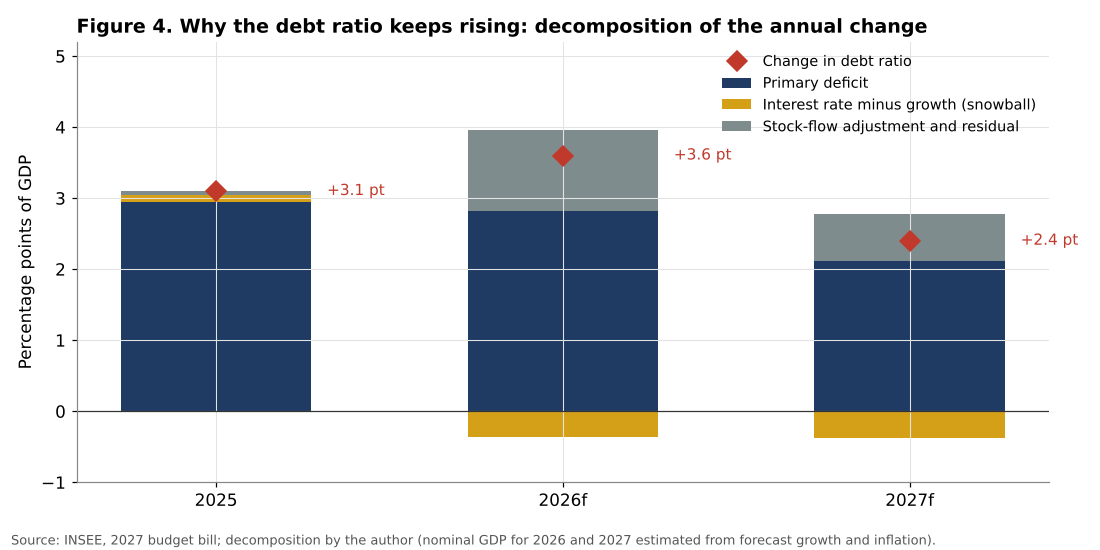
In 2025, the debt ratio rose by 3.1 points. Almost all of this increase, 2.9 points, came from the primary deficit, that is, the deficit excluding interest. The snowball effect was close to zero, because the implicit interest rate (1.96 percent) was close to nominal growth (1.87 percent).
In 2026, the debt ratio rises by 3.6 points according to the government’s forecasts. The primary deficit contributes 2.8 points. The snowball effect is slightly negative, about -0.4 points, because nominal growth (about 2.6 percent by the author’s estimate) exceeds the implicit interest rate (2.29 percent). The residual of 1.1 points reflects stock-flow adjustments, notably the increase in the state’s cash holdings needed to cover a growing volume of redemptions, and the approximation of nominal GDP.
In 2027, the debt ratio rises by 2.4 points. The primary deficit contributes 2.1 points, the snowball effect about -0.4 points, and the residual about 0.7 points.
The key lesson is that the rise in the French debt ratio is driven by the primary deficit, not by interest rates. As long as nominal growth exceeds the implicit interest rate, the snowball effect helps rather than harms. But the margin is narrowing: in 2027, the gap between nominal growth (2.82 percent) and the implicit rate (2.49 percent) is only about a third of a point. With market rates at almost 5 percent and nominal growth below 3 percent, the gap will close within a few years and then turn unfavourable, unless growth accelerates.
5.6 The fiscal gap
Figure 5 compares the forecast primary balance for 2027 with the primary balance that would stabilise the debt ratio.
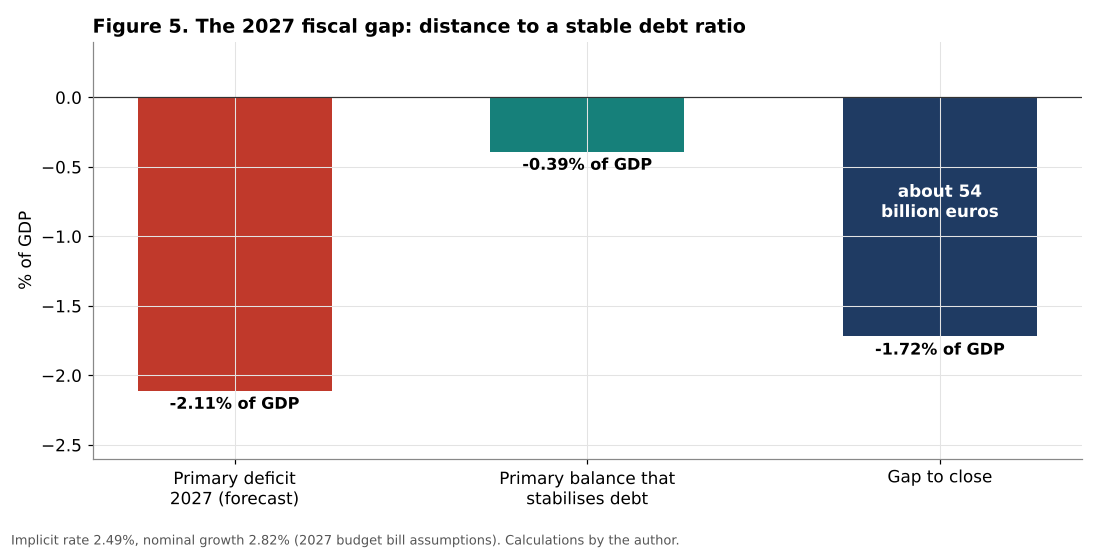
With a debt ratio of 121.7 percent, an implicit interest rate of 2.49 percent and nominal growth of 2.82 percent, the debt ratio would be stable with a primary deficit of about 0.39 percent of GDP. The forecast primary deficit for 2027 is 2.11 percent of GDP. The gap is therefore about 1.72 percentage points of GDP, or about 54 billion euros.
This result is striking. The fiscal gap that remains after the 2027 budget is of the same order of magnitude as the effort presented in the budget itself. In other words, to stabilise the debt ratio, France would need a second adjustment of roughly the same size as the one it is attempting in 2027.
Moreover, this calculation assumes that the favourable gap between growth and the interest rate persists. If the implicit rate rose to equal nominal growth, the debt-stabilising primary balance would be zero, and the gap would increase to 2.1 points of GDP, about 66 billion euros. If the implicit rate exceeded growth by one point, as could happen within a few years if market rates remain at current levels, the debt-stabilising primary balance would become a surplus of about 1.2 percent of GDP, and the gap would reach about 3.3 points, or more than 100 billion euros.
5.7 Sensitivity to interest rates
The author estimates the additional interest cost of a permanent rise of 100 basis points in all market rates, starting in 2027:
| Year after the shock | Additional interest cost (bn euros) |
|---|---|
| 1 | about 4.6 |
| 2 | about 8.0 |
| 3 | about 11.4 |
| 5 | about 18.2 |
| 10 | about 35 |
Table 5. Sensitivity of general government interest to a permanent 100 basis point rise in market rates. Calculations by the author.
The effect is gradual because only short-term debt and new issuance are repriced each year. After one year, a 100 basis point rise costs about 4.6 billion euros; after five years, about 18 billion; after ten years, when most of the debt has been refinanced, about 35 billion, or more than 1 percent of GDP.
Since the ten-year rate has risen by about 1.4 to 1.5 points over the twelve months to October 2026, the cumulative effect of the rate rise already observed, if it persists, would be of the order of 25 billion euros per year after five years. This is half of the effort presented in the 2027 budget.
6. Discussion
6.1 A necessary but insufficient budget
The 2027 budget represents a real effort. It includes measures that are politically costly, such as the freeze of civil servants’ pay, the partial de-indexation of pensions and the freeze of family and housing benefits. It is also the first budget in several years to propose a net reduction in state employment.
However, the analysis shows that the effort is largely absorbed by spending pressures and rising interest costs. The deficit falls by only 0.4 points of GDP between 2026 and 2027, and remains at about the 2025 level. The debt ratio continues to rise. The fiscal gap to stabilise the debt remains at about 54 billion euros. And the HCFP judges the growth forecast optimistic, which means that the deficit could be higher than 5 percent.
The budget is therefore necessary, in the sense that without it the deficit would rise further and the debt dynamics would worsen. But it is insufficient, in the sense that it does not put debt on a declining path.
6.2 The interest rate trap
The most worrying finding is the speed of the rise in interest costs. Between 2024 and 2027, interest rises by about 33 billion euros. This is a structural change in French public finances: for a decade after 2012, falling interest rates allowed France to finance growing debt at a declining cost. This period is over.
The mechanism is gradual but powerful. Even if market rates stabilise at their current level, the implicit rate on debt will continue to rise for several years as old debt is refinanced. And each year in which the primary deficit remains high adds to the stock of debt that must be refinanced at higher rates.
This creates the risk of an interest rate trap, in which an increasing share of the fiscal effort is absorbed by interest, which makes it harder to reduce the deficit, which in turn increases debt and interest. The French situation is not yet a trap, since the snowball effect is still favourable. But the margin is narrowing quickly.
6.3 The market dimension
The rise in the spread between French and German yields to more than 130 basis points reflects the market’s assessment of French fiscal and political risk. France remains a highly rated issuer with a deep and liquid debt market, and demand for French debt remains strong. However, a persistent spread has a direct cost: each 10 basis points of additional spread on 340 billion euros of annual issuance costs about 340 million euros in the first year, and much more as it accumulates.
The political context adds to uncertainty. The possibility that the budget is not adopted through the normal procedure, the approach of the presidential election, and the history of the 2026 budget, adopted only in February, all increase the risk premium.
6.4 Where the effort goes
The effort presented in the budget is largely absorbed before it reaches the deficit. The HCFP measures the structural effort at about 28 billion euros, much less than the 43 billion euros of new measures, because spending pressures absorb a large part of the savings: the rise in pensions despite their partial de-indexation, the increase in defence credits of about 6.4 billion euros, the growth of health spending and, above all, the rise in interest costs of about 12 billion euros in 2027. To this must be added the effect of the adjustment on activity, which reduces tax revenue. The net reduction in the deficit, about 0.4 point of GDP between 2026 and 2027 in the government’s own forecast, is therefore much smaller than the gross effort of about 1.4 points of GDP.
This absorption has a direct implication for the growth question. Each euro of effort that is absorbed by interest costs is a euro that weighs on activity without reducing the deficit. The rise in interest costs therefore does not only increase debt: it also raises the growth cost of each point of deficit reduction. This is the strongest argument for reducing the deficit early and credibly, before the rise in market rates fully passes through to the cost of debt.
6.5 Reducing the deficit without stifling growth: what the evidence suggests
The analysis of the growth cost of the 2027 measures and of the alternative mixes leads to five principles.
Spread the adjustment, but commit to it. Fiscal multipliers are higher when the economy is weak, when unemployment is rising and when monetary policy cannot offset the fiscal shock. In 2026 and 2027, French growth is close to zero, unemployment is rising and the European Central Bank sets its policy for the whole euro area. These are conditions in which a rapid adjustment is particularly costly. An adjustment of about 0.5 to 0.7 point of GDP per year, maintained over five years and anchored in a credible multi-year law, would cost less growth than larger annual adjustments followed by reversals, provided that it is seen as durable by markets.
Protect the instruments with the highest multipliers. Public investment has the highest multiplier, about 1.2 to 1.4 after two years. Cutting it saves little money and costs a lot of growth, and also reduces future potential output. The 2027 budget protects some priorities, notably national education and research, but asks local authorities, which carry out most public investment, to contribute about 6 billion euros. The risk is that the effort falls on local investment, as it did in 2014 to 2017. Earmarking the local effort to operating spending would reduce the growth cost slightly and protect the capital stock.
Favour measures that fall on savings rather than on consumption. Measures that reduce the income of households with a high propensity to consume, such as low-income workers and modest pensioners, have higher multipliers than measures that fall on profits, capital income or high incomes, which are partly saved. The 2027 budget follows this logic in part, by fully indexing minimum social benefits and pensions below 1,260 euros per month and by asking large companies and high incomes to contribute. The analysis suggests that pushing this logic further would reduce the growth cost, within the limits set by tax competitiveness.
Act on the largest spending items over time. The arithmetic of the fiscal gap shows that annual budgets based on freezes and de-indexations cannot close a gap of 54 billion euros. Lasting savings require reforms of the largest spending items, pensions and health, whose effects build up gradually and therefore cost little growth in the short term. This is also why such reforms are politically difficult: their benefits are deferred, while their costs are immediate for specific groups.
Support potential growth. The decisive variable for debt sustainability is nominal growth. Measures that raise the employment rate, notably of older workers and young people, the productivity of firms and private investment, have a double effect: they increase growth and reduce the deficit. In this respect, the maintenance of the research tax credit and the extension of the green industry tax credit in the 2027 budget are consistent with the objective, but their effects are long term.
6.6 The composition debate
The French political debate on the budget is largely a debate about composition: whether the effort should rely more on spending cuts or on tax increases, and which groups should bear it. The calculations in this article show that, in the short run, the difference between a spending-only and a revenue-heavy consolidation of the same size is about 0.35 point of GDP after two years. Spending-based consolidations tend to be less damaging to growth in the medium term according to Alesina, Favero and Giavazzi (2019), but this result has been debated, and the effects depend on the type of spending and taxes involved.
In the French case, the choice is also constrained. Spending on pensions, health and interest is rising automatically and represents a growing share of the total. Defence spending is rising for strategic reasons. On the revenue side, the rate of compulsory levies is already among the highest in the OECD, at 43.6 percent of GDP in 2025. Any lasting solution will probably require action on both sides, and above all on the largest spending items.
6.7 The European framework
Under the excessive deficit procedure, France committed to reducing its deficit below 3 percent by 2029. The HCFP judges this objective very unlikely. If France does not comply with the path agreed with the European Council, it could face increased surveillance and, in theory, financial sanctions, although these have never been applied. More importantly, credibility with European partners and markets depends on the perceived seriousness of the medium-term plan.
6.8 Growth as the decisive variable
The analysis underlines the importance of growth. With nominal growth of 2.8 percent and an implicit interest rate of 2.5 percent, the debt dynamics are manageable with an effort of 1.7 points of GDP. With nominal growth of 2 percent, the effort required rises to about 2.1 points. Policies that raise potential growth, through employment, productivity and investment, would therefore have a direct effect on debt sustainability. This is the subject of the next articles in this series, which examine the French debt burden and French industry in more detail.
7. Scenarios to 2032
7.1 Assumptions
Figure 6 presents three scenarios for the debt ratio between 2027 and 2032.
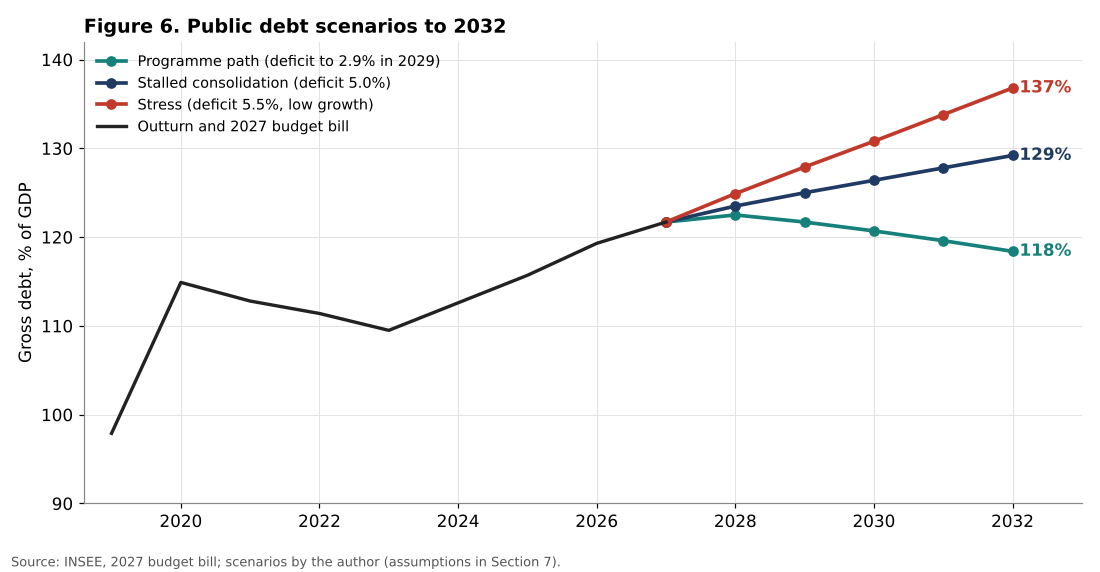
All scenarios start from the government’s forecast of 121.7 percent of GDP at the end of 2027. The implicit interest rate converges gradually toward an assumed market rate, at a speed of about one eighth per year.
Programme path. The deficit falls to 4.4 percent of GDP in 2028 and 2.9 percent in 2029, in line with the commitment to return below 3 percent, then to about 2.4 percent in 2031. Real growth is about 1.2 to 1.3 percent per year, inflation 1.8 percent, and the market rate stabilises at 4.0 percent. The debt ratio peaks at about 122.5 percent in 2028 and falls to about 118 percent in 2032.
Stalled consolidation. The deficit remains at 5.0 percent of GDP each year. Real growth is about 1 percent, inflation 1.8 percent, and the market rate stabilises at 4.5 percent. The debt ratio rises steadily to about 129 percent in 2032.
Stress. The deficit drifts up to 6.0 percent of GDP by 2032 as interest costs rise and growth weakens. Real growth is below 1 percent, inflation 1.5 percent, and the market rate rises to 5.0 percent. The debt ratio reaches about 137 percent in 2032.
7.2 Interpretation
The programme path is the only one in which the debt ratio falls, and it requires a reduction of the deficit by about 2.6 points of GDP in two years after 2027, an effort without precedent in recent French history. The HCFP’s scepticism about the 2029 objective is consistent with this assessment.
The stalled consolidation scenario, in which the deficit remains at the 2027 level, is in some respects the most likely if political conditions do not allow further major adjustments. In this scenario, debt rises by about 1.5 points of GDP per year, and the interest burden continues to increase, reaching about 4 percent of GDP in the early 2030s by the author’s estimate, as the implicit rate converges from 2.5 percent toward the market rate.
The stress scenario shows how quickly the situation could deteriorate if adverse factors combined: weak growth, higher rates and fiscal slippage. In this case, debt would exceed 135 percent of GDP before 2032, and the interest burden would approach that of the largest spending items of the state.
7.3 Indicators to monitor
The author suggests monitoring:
1. The ten-year OAT yield and the spread with Germany. 2. Quarterly growth and the HCFP’s assessment of the growth forecast. 3. Monthly state budget execution, especially tax revenue. 4. The final outcome of the parliamentary process and the measures actually adopted. 5. The interest burden in successive revisions of the forecasts.
8. Conclusion
The 2027 French budget aims to reduce the deficit from 5.4 to 5.0 percent of GDP without stifling growth, with an effort presented as worth 54 billion euros. The analysis in this article leads to six conclusions.
First, France has lost a year: the deficit rises in 2026 instead of falling, mainly because of the energy shock and weaker growth, and the 2027 target would bring it back only slightly below its 2025 level.
Second, the adjustment has a real but moderate growth cost. The 43 billion euros of new measures would reduce the level of GDP by about 1.0 point after two years in gross terms, and by about 0.6 point once the spending increases in the same budget are taken into account, consistent with the 0.4 point cost for 2027 growth estimated by the OFCE. The government’s growth forecast of 1.0 percent appears optimistic in this light, as the HCFP noted.
Third, the cost depends on the instruments. Public consumption and employment account for almost 40 percent of the growth cost, public investment has the highest cost per euro, and taxes on firms the lowest. Among five mixes of the same size, the growth cost ranges from about 0.78 to 1.15 point of GDP.
Fourth, the interest burden is rising fast, from 58 billion euros in 2024 to 91 billion in 2027, and it absorbs a large part of the effort, which raises the growth cost of each point of deficit reduction.
Fifth, even after the 2027 budget, a gap of about 1.7 points of GDP, or about 54 billion euros, remains between the forecast primary deficit and the level that would stabilise the debt ratio.
Sixth, without further consolidation, the debt ratio would continue to rise toward 130 percent of GDP by the early 2030s.
To the question asked by the government, the answer is therefore qualified. France can reduce its deficit without stifling growth, but not in a single budget, and not with any instruments. It needs a gradual and credible multi-year adjustment, that protects public investment and the incomes of households with the highest propensity to consume, that relies more on measures falling on savings, and that addresses the largest spending items through structural reforms whose effects build up over time. The 2027 budget moves partly in this direction, but it is a step rather than a turning point.
Need this analysis for your organisation?
We prepare confidential briefings, executive talks and studies on countries, markets and policies, built on the same method as this article.
Request a briefingSupport independent analysis
Our studies are free to read and carry no advertising. If this one was useful, a small contribution helps us publish the next.
Support our workGo further: books by Global Strategy Files

Frequently asked questions
What is in France’s 2027 budget?
The 2027 draft budget, presented on 1 October 2026, aims to reduce the general government deficit from 5.4 percent of GDP expected in 2026 to 5.0 percent in 2027, through an adjustment the government presents as worth about 54 billion euros.
How much does France pay in interest on its debt?
Interest paid by French general government is forecast to rise from 58.1 billion euros in 2024 to 91.2 billion in 2027, as the implicit interest rate on the debt rises from 1.96 to 2.49 percent.
Is the 2027 budget enough to stabilise French debt?
No. Stabilising the debt ratio in 2027 would require a primary deficit of about 0.4 percent of GDP, against a forecast of 2.1 percent. The remaining gap of about 1.7 points of GDP, about 54 billion euros, equals a second adjustment of the same size.
Why did France’s deficit rise in 2026?
The 2026 deficit, expected at 5.4 percent of GDP, is higher than the 5.1 percent of 2025, mainly because of the energy shock linked to the conflict in the Middle East and weaker growth, which means France lost a year on its consolidation path.
Methodological note
All derived indicators, decompositions and scenarios were calculated by the author. Historical data come from INSEE annual national accounts (base 2020, May 2026) and the INSEE quarterly debt release for the second quarter of 2026. Forecasts for 2026 and 2027 come from the 2027 budget bill and its press kit of 1 October 2026. State financing data come from the Agence France Trésor. Nominal GDP for 2026 and 2027 is estimated from forecast real growth and consumer price inflation. The implicit interest rate is interest paid in year t divided by debt at the end of year t-1. The growth cost of the measures uses two-year fiscal multipliers by instrument taken from Mésange (INSEE and French Treasury, 2017), Mésange 3.0 and OECD estimates for France compiled by FIPECO, and a budget semi-elasticity of 0.6; the classification of measures by instrument follows the government’s presentation and the IFRAP itemisation, with the assumptions stated in Section 4. The scenarios assume a gradual convergence of the implicit rate toward market rates at a speed of about one eighth per year. All figures should be read as estimates subject to revision.
References
Agence France Trésor (2026). The State Budget: Financing Programme for 2027. Paris.
Alesina, A., Favero, C. and Giavazzi, F. (2019). Austerity: When It Works and When It Doesn’t. Princeton: Princeton University Press.
Banque de France (2026). Macroeconomic Interim Projections, September 2026. Paris, 15 September 2026.
Bardaji, J., Campagne, B., Khder, M.-B., Lafféter, Q., Simon, O. and others (2017). Le modèle macroéconométrique Mésange : réestimation et nouveautés. Document de travail INSEE G2017/04 and DG Trésor 2017/04.
Blanchard, O. (2019). Public Debt and Low Interest Rates. American Economic Review, 109(4), 1197 to 1229.
Blanchard, O. and Leigh, D. (2013). Growth Forecast Errors and Fiscal Multipliers. American Economic Review, 103(3), 117 to 120.
Blanchard, O., Leandro, A. and Zettelmeyer, J. (2021). Redesigning EU Fiscal Rules: From Rules to Standards. Economic Policy, 36(106), 195 to 236.
Cour des comptes (2026). La situation et les perspectives des finances publiques. Paris.
Direction générale du Trésor (2026). Retour sur les prévisions de finances publiques du Gouvernement pour l’année 2025. Trésor-Éco, August 2026.
European Union (2024). Regulation (EU) 2024/1263 of the European Parliament and of the Council on the effective coordination of economic policies and on multilateral budgetary surveillance. Official Journal of the European Union.
FIPECO (2017). L’effet multiplicateur d’une variation du déficit public. Fiches de l’encyclopédie des finances publiques, May 2017.
Gouvernement de la République française (2026). Projet de loi de finances pour 2027 et projet de loi de financement de la sécurité sociale pour 2027. Dossier de presse, 1 October 2026.
Haut Conseil des finances publiques (2026). Avis n° 2026-5 relatif aux projets de lois de finances et de financement de la sécurité sociale pour l’année 2027. Paris.
Haut Conseil des finances publiques (2026). Avis n° HCFP-2026-5 relatif aux projets de lois de finances et de financement de la sécurité sociale pour l’année 2027. Paris.
IFRAP (2026). Dépenses, recettes : premier bilan du budget 2027. Paris, October 2026.
INSEE (2026). Comptes nationaux des administrations publiques: premiers résultats, année 2025. Informations Rapides, March 2026.
INSEE (2026). Dette trimestrielle de Maastricht des administrations publiques, deuxième trimestre 2026. Informations Rapides, September 2026.
INSEE (2026). Les comptes de la Nation en 2025. Insee Première, May 2026.
International Monetary Fund (2026). World Economic Outlook, October 2026. Washington, DC.
OFCE (2026). Coup de chaud sur l’économie française. Perspectives 2026 2027 pour l’économie française. Paris, 14 October 2026.
