
Does the Debt Burden Reduce the French State’s Capacity to Act? Interest, Budget Choices and Room for Manoeuvre in 2026


Does the Debt Burden Reduce the French State’s Capacity to Act? Interest, Budget Choices and Room for Manoeuvre in 2026
Driss EFFINA, PhD Independent Researcher, Global Strategy Files Reading time: about 30 minutes
Key takeaways
- French general government debt reached 119.0 percent of GDP at the end of the second quarter of 2026.
- Non-residents held 57.5 percent of negotiable State debt in early 2026, up from 48.5 percent in early 2022.
- About 1,163 billion euros of State bonds, 44 percent of the stock, mature between 2027 and 2031.
- Interest could rise from 2.9 percent of GDP in 2027 to between 3.7 and 4.9 percent in 2032.
Abstract
The French Treasury’s economic, social and financial report for 2027 (RESF 2027), published on 6 October 2026, describes the rise in debt service as an automatic factor that worsens public finances in 2026 and again in 2027. This article asks a broader question: does the burden of debt now reduce the capacity of the French State to act? It answers with data from the 2027 budget bill and its mission sheets, INSEE, Eurostat, the Agence France Trésor (AFT), the Banque de France and the Cour des comptes, and with calculations by the author. Six findings stand out. First, in the 2027 budget bill the mission that carries the State’s debt service reaches 74.5 billion euros, up 14.1 billion in one year, and the debt charge itself, 72.9 billion euros, becomes the largest item of the State budget once civil service pensions are set aside, ahead of the school education mission (65.5 billion) and the defence mission (63.4 billion), and more than three times the ecology mission (22.5 billion). Second, of the 21.2 billion euro increase in the State’s general budget between 2026 and 2027, about two thirds go to the debt and almost one third to defence, leaving about 2 percent for all other missions combined. Third, the State’s debt charge absorbs 19.4 percent of its net tax revenue in 2027, against 17.5 percent in 2026. Fourth, the State accounts for 82 percent of Maastricht debt, non-residents hold 57.5 percent of negotiable State debt, and about 1,163 billion euros of bonds, 44 percent of the stock, must be refinanced between 2027 and 2031 at much higher rates. Fifth, with a deficit maintained at 5 percent of GDP, interest paid by general government would rise from 2.9 percent of GDP in 2027 to between 3.7 and 4.9 percent in 2032, adding between 70 and 114 billion euros a year to the 2025 bill, the equivalent of three to five times the current ecology mission. Sixth, the burden constrains the State through three channels: it crowds out discretionary spending, it narrows the room for counter-cyclical policy, and it ties the cost of every future policy to market sentiment. The article concludes that the debt burden already reduces the State’s capacity to act, not by preventing it from financing its priorities, but by forcing a growing share of each new euro of spending and each euro of fiscal effort to be devoted to the past rather than to the future.
Keywords: France, public debt, interest burden, crowding out, fiscal space, State budget, refinancing risk, Agence France Trésor, RESF 2027
JEL codes: E43, E62, H63, G12
1. Introduction
For a decade after the euro area sovereign debt crisis, French public debt was a paradox. It grew steadily, from about 85 percent of GDP in 2010 to almost 98 percent in 2019 and above 110 percent after the pandemic, but its cost fell. Interest rates declined to historically low levels, then turned negative on part of the yield curve. In 2020 and 2021, France could borrow for ten years at a rate close to zero. The interest paid on a growing debt stock fell, and the question of the burden of debt seemed to have become theoretical.
That period has ended. Since 2022, interest rates have risen, first with the tightening of monetary policy by the European Central Bank, then, in 2025 and 2026, with the rise of risk premiums specific to France. In early October 2026, the French ten-year yield reached about 4.8 to 4.9 percent, its highest level since 2002, and the spread with Germany exceeded 130 basis points for the first time since 2012. Interest paid by general government rose from 58.1 billion euros in 2024 to 64.7 billion in 2025, and the government forecasts 79.2 billion for 2026 and 91.2 billion for 2027.
The previous article in this series analysed the 2027 budget and showed that, even after the planned adjustment, a fiscal gap of about 54 billion euros remains between the forecast primary deficit and the level that would stabilise the debt ratio. The present article asks a question that is more political than accounting: does the burden of debt reduce the capacity of the State to act? The RESF 2027, published by the French Treasury on 6 October 2026, presents the rise in debt service as an automatic factor that worsens the public balance in 2026 and 2027. The question is how far this automatic factor now shapes budgetary choices and the margins available to finance public policies.\n\nTo answer it, the article proceeds in steps. It first places the debt charge among the State’s main spending missions and measures how much of the increase in State spending it absorbs. It then examines the debt itself: how large it is compared with other European countries, who owes it within the public sector, who holds it, when it must be refinanced, and how fast its cost will rise. Finally, it assesses through which channels the debt burden constrains the State, and what could loosen the constraint.
Section 2 presents the context. Section 3 reviews the literature on the burden of public debt. Section 4 presents the data and methods. Section 5 presents the results. Section 6 discusses them. Section 7 presents scenarios for the interest burden to 2032. Section 8 concludes.
2. Context
2.1 The long rise of French debt
French public debt has risen almost continuously for half a century. It was about 20 percent of GDP in the late 1970s, passed 60 percent in the early 2000s, rose sharply after the 2008 financial crisis to about 85 percent in 2010 and 95 percent in 2015, and stabilised at just under 98 percent between 2017 and 2019. The pandemic pushed it to 114.9 percent in 2020. After falling slightly to 109.5 percent in 2023, as high inflation increased nominal GDP, it rose again to 112.6 percent in 2024, 115.7 percent in 2025 and 119.0 percent in the second quarter of 2026. The government forecasts 119.3 percent at the end of 2026 and 121.7 percent at the end of 2027.
2.2 The rate environment
Three phases can be distinguished in the evolution of French borrowing costs over the past decade. From 2014 to 2021, rates fell to historically low levels, supported by the asset purchase programmes of the European Central Bank. From 2022 to 2024, they rose rapidly as the ECB raised its policy rates to fight inflation. Since mid-2024, and especially in 2025 and 2026, a French-specific premium has been added, reflecting political uncertainty and the persistence of high deficits. The average rate on medium and long-term debt issued by the AFT was 3.14 percent in 2025 and 3.55 percent in 2026 up to the end of September. The ten-year constant maturity rate was 4.08 percent on 18 August 2026 and about 4.84 percent on 7 October 2026.
2.3 Ratings
France lost its double-A rating at Fitch in September 2025, when the agency downgraded it to A+. Fitch affirmed the A+ rating with a stable outlook in March 2026. The ratings of the major agencies remain in the high investment grade category, and French debt remains one of the most liquid sovereign markets in the world. But the trend of the past years has been downward, and the gap with the best-rated euro area countries has widened.
2.4 The European framework
France has been subject to an excessive deficit procedure since July 2024. The reformed European fiscal framework requires it to follow an agreed path of net primary expenditure, with the aim of putting the debt ratio on a plausibly declining path. The government’s stated aim is to bring the deficit below 3 percent of GDP in 2029, an objective that the Haut Conseil des finances publiques considers very unlikely.
3. Literature review
The literature on the burden of public debt addresses several distinct questions.
The first is whether there is a level of debt beyond which growth suffers. Reinhart and Rogoff (2010) reported that growth was markedly lower in countries with debt above 90 percent of GDP, a result that was challenged by Herndon, Ash and Pollin (2014), who identified coding errors and methodological choices that weakened it. The current consensus is that there is no universal threshold, but that high debt reduces the room for manoeuvre in the face of shocks and can raise interest rates.
The second question concerns the relationship between the interest rate and the growth rate. Blanchard (2019) showed that when the interest rate on public debt is persistently below the growth rate, debt can be rolled over without a fiscal cost in the long run, but that this condition can reverse and that it does not hold indefinitely for all countries. Mauro and Zhou (2021) documented that negative interest-growth differentials have been common historically, including for emerging economies, but that they can turn positive abruptly when market sentiment changes.
The third question concerns the role of debt holders and the structure of debt. Arslanalp and Tsuda (2014) built a database of sovereign debt holders and showed that the share of foreign holders affects the vulnerability of a country to changes in global risk appetite. A high share of foreign holders can lower borrowing costs in normal times, by broadening the investor base, but can amplify volatility in times of stress. The maturity of debt also matters: a long average maturity delays the transmission of higher rates to the interest bill, which gives time but does not eliminate the effect.
The fourth question concerns the specific situation of euro area countries, which borrow in a currency they do not control. De Grauwe (2012) argued that this makes them vulnerable to self-fulfilling liquidity crises, a risk that the ECB’s commitment to act, notably through the Transmission Protection Instrument created in 2022, is designed to contain. The conditions for the activation of this instrument include compliance with the European fiscal framework, which links the protection of French debt to the credibility of its consolidation path.
At the national level, the annual reports of the Cour des comptes on public finances and the work of the AFT provide detailed analyses of the structure and cost of French debt. In June 2026, the Cour des comptes warned that “all the signals are red” and that the interest charge could reach about 100 billion euros, or 3 percent of GDP, by 2029.
4. Data and methodology
4.1 Data
- Debt stock: INSEE annual national accounts (May 2026) and quarterly Maastricht debt for the second quarter of 2026.
- International comparison: Eurostat quarterly government debt release of 21 July 2026 (first quarter of 2026, provisional), and Eurostat April 2026 notification for 2025 deficits.
- Negotiable State debt, maturity and holders: AFT monthly bulletin of August 2026, with data at 31 July 2026; holders data from the Banque de France for the first quarter of 2026.
- Interest: INSEE for 2024 and 2025; 2027 budget bill for 2026 and 2027; Cour des comptes report of 25 June 2026 for the 2029 order of magnitude.
- State budget by mission: mission sheets of the 2027 budget bill (credits of the general budget, excluding the State’s direct pension contributions, 2026 finance law and 2027 bill); totals of the general budget and net State tax revenue from the 2027 budget bill.
- RESF 2027: French Treasury, 6 October 2026, for the macroeconomic and public finance framework.
4.2 Methods
1. Crowding-out indicators. The author compares the mission that carries the State’s debt service (“Engagements financiers de l’État”) with the main spending missions in 2026 and 2027, decomposes the increase in the State’s general budget between 2026 and 2027 by mission, and computes the State’s debt charge as a share of its net tax revenue. In the scenarios, the additional interest relative to 2025 is expressed in multiples of the budgets of the main missions. 2. Subsector analysis. The change in consolidated Maastricht debt between the end of 2024 and the second quarter of 2026 is attributed to the State, the other central government bodies (ODAC), local governments and social security. 3. Refinancing wall. The principal of medium and long-term State bonds maturing each year from 2026 to 2035 is taken from the AFT bulletin. The author computes the share of the current stock that matures between 2027 and 2031. 4. Refinancing cost. The additional annual interest in 2031 from refinancing the bonds maturing between 2027 and 2031 is estimated as the amount maturing multiplied by the difference between an assumed market rate (3.5, 4.0 or 4.5 percent) and the implicit average cost of debt in 2025 (1.96 percent, calculated as interest paid in 2025 divided by debt at the end of 2024). This is an approximation: the bonds that mature were issued at various rates, some above and some below the average. 5. Cost of new borrowing. The interest on new net borrowing of about 155 billion euros per year over five years is estimated at an assumed rate of 4 percent. 6. Interest scenarios. Starting from the 2027 forecasts (debt of about 3,840 billion euros, interest of 91.2 billion), the author projects the interest burden to 2032, assuming a deficit of 5 percent of GDP each year, real growth of 1 percent, inflation of 1.8 percent, and an implicit interest rate that converges toward the market rate at a speed of one eighth per year, consistent with an average maturity of about eight and a half years.
4.3 Limitations
The mission figures are budget bill credits and may be amended by Parliament; the comparison between missions is made on credits of the general budget excluding pension contributions, while the decomposition of the total increase uses the totals of the general budget as presented, which include them. The international comparison uses provisional data. The holders data are at market value and refer to negotiable State debt, not to total Maastricht debt. The refinancing cost estimate ignores the precise coupons of the maturing bonds and the effect of inflation-indexed debt. The scenarios are illustrative.
5. Results
5.1 The debt charge among the State’s missions
Figure 1 compares the mission that carries the State’s debt service with the main spending missions of the State budget, in the 2026 finance law and in the 2027 budget bill.
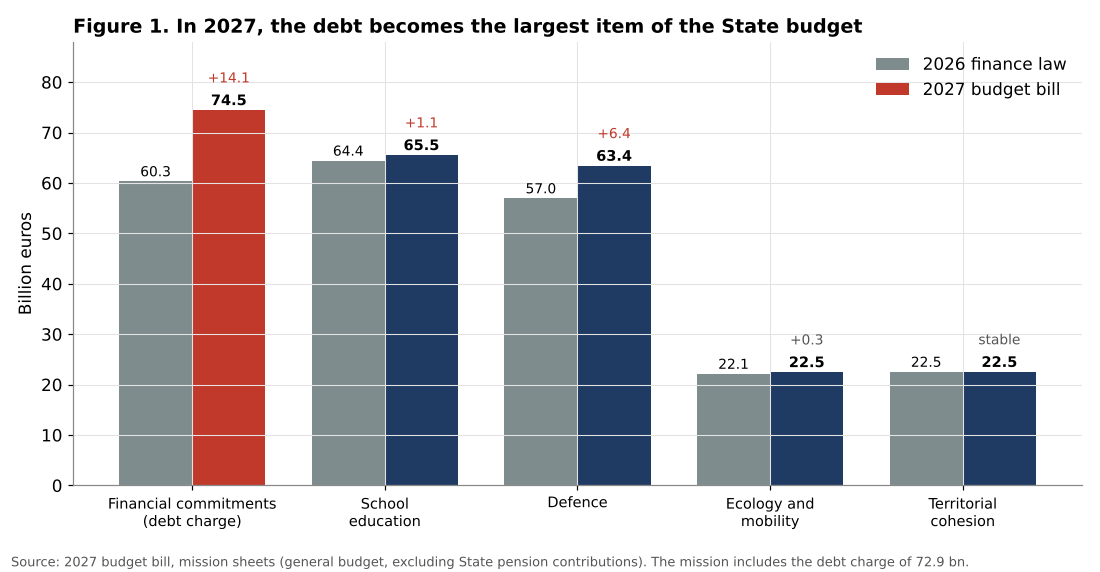
| Mission | 2026 finance law (bn euros) | 2027 budget bill (bn euros) | Change (bn euros) |
|---|---|---|---|
| Financial commitments of the State (including debt charge) | 60.3 | 74.5 | +14.1 |
| School education | 64.4 | 65.5 | +1.1 |
| Defence | 57.0 | 63.4 | +6.4 |
| Ecology, development and sustainable mobility | 22.1 | 22.5 | +0.3 |
| Territorial cohesion | 22.5 | 22.5 | 0.0 |
Table 1. Credits of the main missions of the State’s general budget, excluding State pension contributions. Source: 2027 budget bill, mission sheets.
The debt charge of the State, which accounts for almost all of the mission “Engagements financiers de l’État”, rises from 59.3 billion euros in the 2026 finance law, and 62.6 billion in the revised 2026 forecast, to 72.9 billion euros in 2027. Measured against the initial 2026 law, the increase is 13.7 billion euros in a single year; against the revised forecast, it is 10.3 billion. In both cases, it is the largest increase of any item of the State budget, larger than the increase in defence credits decided under the military programming law.
The comparison of levels is equally telling. Once the State’s contributions to civil service pensions are set aside, the debt charge becomes the largest single item of the State budget in 2027. It exceeds both the school education mission (65.5 billion euros) and the defence mission (63.4 billion). It is more than three times the mission dedicated to ecology, development and sustainable mobility (22.5 billion), and more than three times the territorial cohesion mission, which finances housing aid and urban policy.
5.2 Where the extra spending goes
Figure 2 decomposes the increase of the State’s general budget between 2026 and 2027.
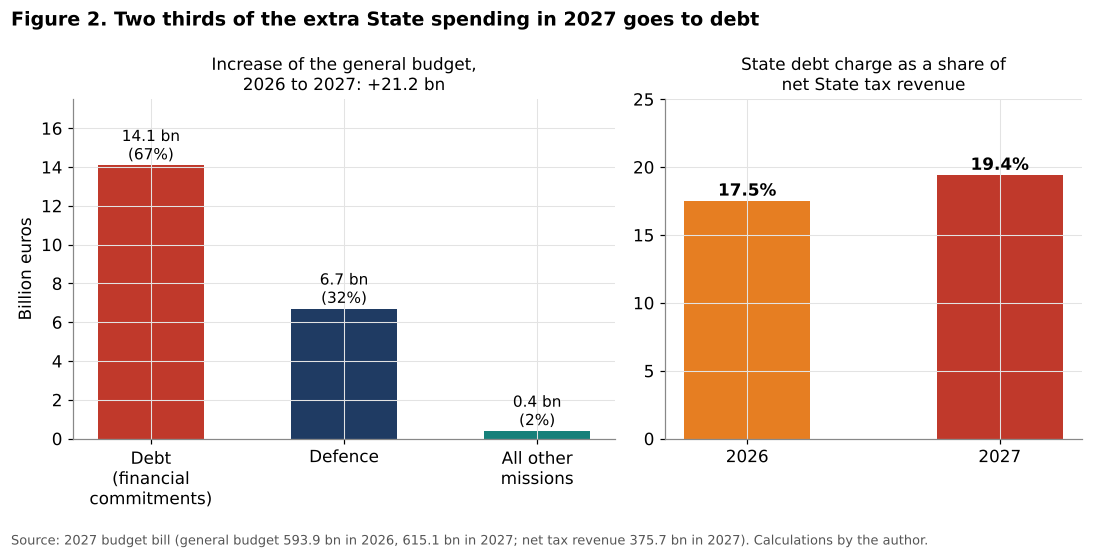
The general budget of the State rises from 593.9 billion euros in 2026 to 615.1 billion in 2027, an increase of 21.2 billion euros. Of this increase, 14.1 billion, or about two thirds, goes to the mission that carries the debt charge, and 6.7 billion, or almost a third, to defence. All the other missions combined, from education and research to justice, security, ecology and culture, share about 0.4 billion euros, or about 2 percent of the increase. Since inflation is forecast at 1.8 percent in 2027, this means that the credits of most missions other than defence decline in real terms.
The right panel shows the same constraint from the revenue side. The State’s debt charge represents 17.5 percent of its net tax revenue in 2026 and 19.4 percent in 2027. In other words, almost one euro in five of the taxes collected by the State in 2027 will be used to pay interest on its debt, before any public service is financed.
These two indicators give a precise meaning to the question of this article. The debt burden does not prevent the State from financing its priorities: in 2027, it finances a large increase in defence and preserves education. But it absorbs most of the room for manoeuvre that the growth of revenue would otherwise provide, so that the financing of any new priority requires savings elsewhere.
5.3 France in European comparison
Table 2 compares the debt ratios of the most indebted European countries and of the euro area in the first quarter of 2026.
With a debt ratio of 117.6 percent of GDP in the first quarter of 2026, France ranks third in the European Union, after Greece (143.5 percent) and Italy (138.9 percent), and ahead of Belgium (109.1 percent) and Spain (101.6 percent). The euro area average is 88.9 percent and the EU average 82.9 percent. Germany’s ratio is 64.4 percent.
| Country | Debt Q1 2026 (% GDP) | Change over one year (pp) | Deficit 2025 (% GDP) |
|---|---|---|---|
| Greece | 143.5 | -9.4 | +1.7 |
| Italy | 138.9 | +1.7 | -3.1 |
| France | 117.6 | +4.0 | -5.1 |
| Belgium | 109.1 | +3.1 | -5.2 |
| Spain | 101.6 | -1.7 | -2.4 |
| Portugal | 91.0 | -3.9 | +0.7 |
| Germany | 64.4 | +2.4 | -2.7 |
| Euro area | 88.9 | +1.7 | -2.9 |
Table 2. Debt and deficit in selected euro area countries. Source: Eurostat (21 July 2026 and 22 April 2026 releases).
France’s debt ratio rose by 4.0 points in one year, more than that of any other large euro area economy. Over the same period, Greece reduced its ratio by 9.4 points, Portugal by 3.9 points and Spain by 1.7 points. Italy, often seen as the most fragile large economy of the euro area, had a deficit of 3.1 percent of GDP in 2025, two points lower than France.
The comparison with the countries of southern Europe is striking. In 2012, at the height of the sovereign debt crisis, France was seen as part of the stable core of the euro area, while Spain, Portugal and Greece were under financial assistance programmes or close to it. In 2026, these three countries have primary surpluses or small deficits and declining debt ratios, while France has the second largest deficit in the euro area, after Belgium, and a rising ratio.
5.4 Who owes the debt?
At the end of the second quarter of 2026, the State accounted for 2,942.1 billion euros, or 81.8 percent of the total. Social security accounted for 309.4 billion, local governments for 274.9 billion and the other central government bodies for 69.2 billion.
Between the end of 2024 and the second quarter of 2026, total debt increased by 289.4 billion euros, of which 255.6 billion, or 88.3 percent, came from the State. Social security debt increased by 22 billion euros, reflecting the return of social security deficits since 2025. Local government debt increased only slightly, by 12.3 billion euros.
This breakdown shows that the French debt problem is primarily a problem of the State budget. Local governments are subject to a balanced budget rule for their operating section and can borrow only to invest. Social security debt is managed partly through the CADES, which has its own repayment resources. The State, on the other hand, finances its deficits entirely by borrowing on the markets, and its deficit was 128.1 billion euros in 2025.
5.5 Negotiable State debt
The AFT manages the negotiable debt of the State, which reached 2,882 billion euros at the end of July 2026, against 2,430 billion at the end of 2023, an increase of 452 billion euros in thirty-one months. This debt consists of:
- medium and long-term bonds (OAT): 2,662 billion euros, of which 313 billion are indexed to inflation (OATi and OAT€i), or 10.9 percent of the total negotiable debt;
- short-term treasury bills (BTF): 220 billion euros, or 7.6 percent of the total.
The average maturity of the negotiable debt is about eight years and five to six months, and has been remarkably stable since 2023. This long maturity is a strength: it means that a rise in rates passes only gradually into the interest bill. But it also means that the effect of the rate rise of 2022 to 2026 will continue to be felt for many years.
5.6 The refinancing wall
Figure 3 shows the principal of medium and long-term bonds maturing each year.
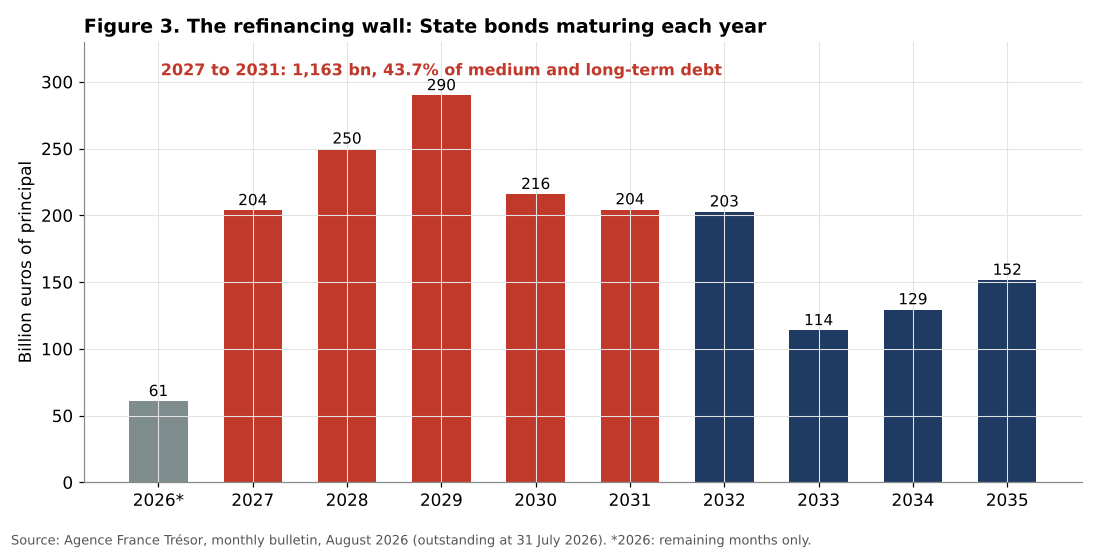
The amounts maturing are very large: 203.7 billion euros in 2027, 249.8 billion in 2028, 289.8 billion in 2029, 215.8 billion in 2030 and 204.3 billion in 2031. In total, 1,163 billion euros will mature over these five years, or 43.7 percent of the current stock of medium and long-term bonds.
A large part of these bonds was issued between 2016 and 2021, when rates were very low. They will have to be refinanced at current rates, which are considerably higher. This is the main channel through which the rate rise will increase the interest bill in the coming years.
The author’s estimate of the additional cost is as follows:
| Assumed market rate | Additional annual interest in 2031 from refinancing 2027 to 2031 maturities (bn euros) |
|---|---|
| 3.5% | about 18 |
| 4.0% | about 24 |
| 4.5% | about 30 |
Table 3. Estimated additional interest from refinancing the bonds maturing between 2027 and 2031, relative to an average cost of 1.96 percent. Calculations by the author.
To this must be added the cost of new borrowing. If the deficit remains at about 5 percent of GDP, the State and other public entities will need to borrow about 155 billion euros of new money each year. At 4 percent, five years of new borrowing would add about 31 billion euros to the annual interest bill. Combining the two effects, and starting from 64.7 billion euros in 2025, interest paid by general government could reach about 119 billion euros in 2031 at a market rate of 4 percent. This is consistent with the order of magnitude given by the Cour des comptes, which expects about 100 billion euros in 2029.
5.7 Who holds the debt?
Figure 4 shows the structure of the holders of negotiable State debt.
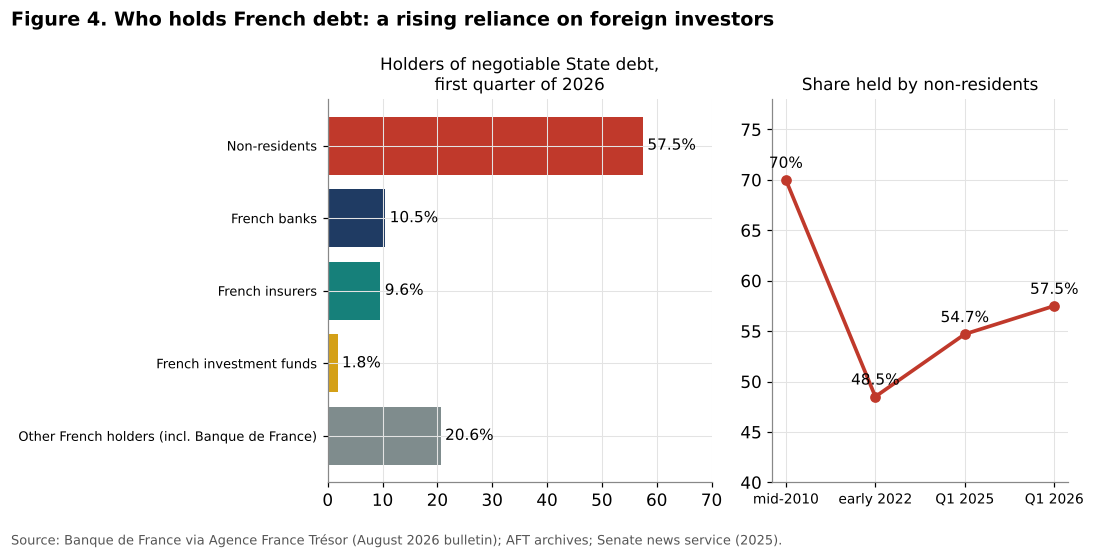
In the first quarter of 2026, non-residents held 57.5 percent of negotiable State debt, at market value. French banks held 10.5 percent, French insurers 9.6 percent, French investment funds 1.8 percent, and other French holders, including the Banque de France, 20.6 percent.
The share of non-residents has followed a U-shaped path. It exceeded 70 percent around 2010, when foreign investors, notably central banks and international asset managers, were major buyers of French debt. It fell to 48.5 percent in early 2022, mainly because the Banque de France, as part of the Eurosystem, bought large amounts of French debt under the ECB’s asset purchase programmes. Since 2022, the Eurosystem has stopped buying and has been reducing its holdings as bonds mature, and the share of non-residents has risen again, to 54.7 percent in the first quarter of 2025 and 57.5 percent in the first quarter of 2026.
The composition by instrument is uneven. Non-residents hold 84 percent of short-term BTFs, 55 percent of nominal OATs, 34 percent of OAT€i indexed to euro area inflation and only 17 percent of OATi indexed to French inflation.
The rising share of non-residents has two sides. On the positive side, it shows that French debt remains attractive to international investors, and it broadens the investor base at a time when the Eurosystem is withdrawing. On the negative side, foreign investors are generally more sensitive to changes in relative risk than domestic investors, and a sudden change in sentiment could lead to larger price movements. The withdrawal of the Eurosystem, which was a stable and price-insensitive holder, means that French debt is now more exposed to market judgement than at any time in the past decade.
5.8 The interest bill
Figure 5 shows the evolution of interest paid by general government.
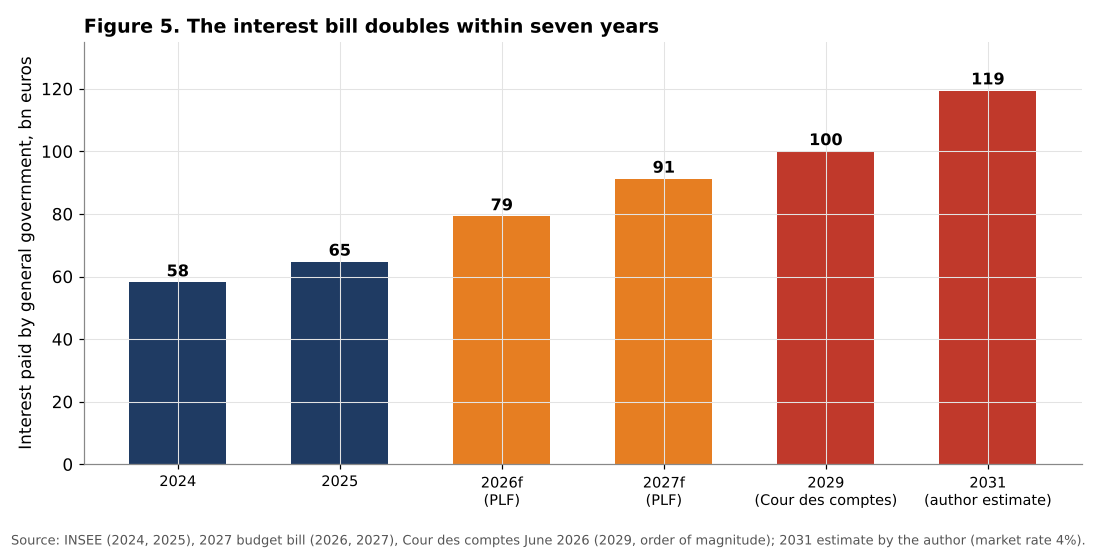
Interest rose from 58.1 billion euros in 2024 to 64.7 billion in 2025. The government forecasts 79.2 billion in 2026 and 91.2 billion in 2027. The Cour des comptes expects about 100 billion euros in 2029. The author’s estimate for 2031, at a market rate of 4 percent, is about 119 billion euros. Between 2024 and 2031, the interest bill would therefore roughly double.
To put these figures in perspective, the State’s debt service in budgetary terms, forecast at 72.9 billion euros in 2027, will be one of the largest items of State expenditure, comparable to the largest ministerial budgets. Each additional 10 billion euros of interest is equivalent to about one third of a point of GDP.
At the end of the second quarter of 2026, public debt amounted to about 52,000 euros per inhabitant, on the basis of a population of about 69 million.
5.9 Two channels of immediate sensitivity: short-term bills and inflation-indexed bonds
Most French debt is long-term and fixed-rate, which slows the transmission of market rates. Two components of the negotiable debt, however, transmit shocks almost immediately.
The first is the stock of short-term treasury bills, 220 billion euros at the end of July 2026. These bills have an average maturity of about four months and are therefore repriced several times a year. A rise of one percentage point in short-term rates increases the annual cost of this stock by about 2.2 billion euros within a year. Conversely, a cut in the policy rates of the European Central Bank lowers it quickly. The share of bills in the negotiable debt, 7.6 percent, is moderate by international standards, and the AFT has kept it stable, which limits this exposure.
The second is the stock of inflation-indexed bonds, 313 billion euros, or 10.9 percent of negotiable debt. The principal of these bonds is revalued each year in line with French or euro area consumer prices, and this revaluation is recorded as a cost. The author estimates that each additional percentage point of inflation increases the annual cost of indexed debt by about 3 billion euros. This is consistent with the Cour des comptes, which attributed about 4 billion euros of the increase in the 2026 interest charge to the inflation shock linked to energy prices. Indexed debt is attractive in normal times, because investors accept a lower real yield in exchange for protection against inflation, but it means that an energy shock, such as the one caused by the conflict in the Middle East in 2026, raises the cost of debt at the same time as it weakens growth.
Taken together, these two channels mean that roughly one fifth of the negotiable debt reacts within a year to changes in short-term rates or in inflation. The remaining four fifths react only as bonds mature, which is why the refinancing wall analysed above is the dominant channel over a five-year horizon.
5.10 What the interest bill displaces
A rising interest bill does not only increase the deficit; it changes the composition of public spending. The 2027 budget illustrates this. The State’s debt service is forecast to increase by about 10 billion euros between 2026 and 2027, while most ministries other than defence, education and research see their credits frozen in value, which implies a reduction in real terms. In other words, a large part of the increase in State spending in 2027 goes to bondholders rather than to public services or investment.
Over a longer period, the effect is cumulative. If interest rises from 2.2 percent of GDP in 2025 to about 4 percent in the early 2030s, as in the central scenario of Section 7, the additional 1.8 points of GDP, about 55 to 60 billion euros at today’s prices, would have to be found either through higher taxes, lower primary spending, or a higher deficit. This is comparable to the entire budget of a large ministry. The burden of debt is therefore not an abstract accounting concept: it determines the room available for every other public policy.
The scenarios of Section 7 allow this crowding-out to be quantified more precisely:
| Market rate scenario | Additional interest in 2032 compared with 2025 (bn euros) | In multiples of the 2027 ecology mission | In multiples of the 2027 defence mission |
|---|---|---|---|
| 3.5 percent | 70 | 3.1 | 1.1 |
| 4.5 percent | 92 | 4.1 | 1.4 |
| 5.5 percent | 114 | 5.1 | 1.8 |
Table 4. Additional general government interest in 2032 relative to 2025, compared with the budgets of the main missions in the 2027 bill. Calculations by the author.
Even in the most favourable scenario, the additional interest that general government will pay in 2032 compared with 2025, about 70 billion euros a year, would exceed the whole defence mission of 2027 and represent three times the ecology mission. In the least favourable scenario, it would approach twice the defence budget. These amounts will have to be financed by higher taxes, lower primary spending or higher deficits, and every year in which the deficit remains high increases them further.
6. Discussion
6.1 Does the debt burden reduce the State’s capacity to act?
The results allow a direct answer to the question of this article. The debt burden constrains the capacity of the State to act through three channels.
The budgetary channel: crowding-out of discretionary spending. In 2027, two thirds of the increase in the State’s general budget goes to the debt, almost one third to defence, and the other missions share the remaining 2 percent, which implies a decline in real terms for most of them. The debt charge becomes the largest item of the State budget excluding pensions, and absorbs almost one euro in five of net State tax revenue. This does not mean that the State can no longer finance its priorities: it can, as the increase in defence credits shows. But each new priority must now be financed by savings elsewhere, and the margin that the spontaneous growth of revenue used to provide is absorbed by interest. The RESF 2027 itself describes the rise in debt service as an automatic factor that worsens the public balance, which means that part of each year’s fiscal effort is spent before it is decided.
The macroeconomic channel: less room for counter-cyclical policy. In 2020 and 2022, France responded to the pandemic and to the energy shock with large fiscal support, financed at very low rates. In 2026, faced with a new energy shock linked to the conflict in the Middle East and a sharp slowdown, the government has had to raise its deficit forecast while presenting an adjustment budget for 2027. With a deficit above 5 percent of GDP, a debt ratio near 120 percent and interest rising quickly, the room to support activity in a downturn has narrowed considerably. This is the most important loss of capacity to act, because it concerns the State’s ability to protect households and firms in the next crisis.
The financial channel: dependence on market sentiment. With 57.5 percent of negotiable State debt held by non-residents, more than 1,100 billion euros of bonds to refinance in five years and a spread with Germany above 130 basis points, the cost of every future policy now depends partly on how markets judge the credibility of French public finances. A rise of 100 basis points in market rates would cost about 4.6 billion euros in the first year and about 18 billion after five years. A political choice that markets judge unfavourably could therefore cost more through interest than it saves or spends directly.
At the same time, the burden should not be exaggerated. Interest represents about 2.9 percent of GDP in 2027, less than in the early 1990s, and the long average maturity of the debt spreads the rise over several years. France borrows without difficulty, its investor base is broad, and part of the interest it pays is income for French households and institutions. The State’s capacity to act also depends on choices other than debt: the level of taxation, the efficiency of spending and the priorities chosen. The debt burden reduces the margins; it does not determine how they are used.
6.2 From a stock problem to a flow problem
For a long time, the French debate on public debt focused on its stock: the symbolic thresholds of 100 percent of GDP, then 3,000 billion euros. The analysis in this article suggests that the burden of debt is now mainly a question of flow: how much of each year’s budget is absorbed by interest.
This shift matters because interest is the most rigid of all public expenditures. It cannot be reduced by political decision, and any default or restructuring is excluded for a country like France. The only ways to reduce it are to reduce the stock of debt, to obtain lower rates, or to grow faster. All three take time.
The shift from stock to flow also changes how the debt should be monitored. The ratio of debt to GDP remains a useful headline indicator, but it moves slowly and can be flattered by inflation, as in 2023, when high nominal growth lowered the ratio even though the deficit was rising. Indicators based on flows, such as interest as a share of GDP, interest as a share of public revenue, or the gap between the implicit interest rate and nominal growth, give an earlier and more precise signal of the pressure that debt exerts on the budget. On these indicators, the deterioration since 2024 is clearer than on the debt ratio alone: interest as a share of GDP rises by almost one point between 2024 and 2027, and the favourable gap between growth and the implicit interest rate shrinks to about a third of a point. Public debate and fiscal rules would benefit from giving these flow indicators more weight.
6.3 The maturity cushion is wearing out
The long average maturity of French debt has protected the State from the rate rise so far. In 2025, the implicit cost of debt was still only about 2 percent, while market rates were above 3 percent. But this protection is temporary. With more than 1,100 billion euros of bonds to refinance in five years, the gap between the average cost and market rates will close progressively. The maturity cushion buys time; it does not change the destination.
6.4 Vulnerability to sentiment
The rising share of non-resident holders, the withdrawal of the Eurosystem and the widening of the spread with Germany all point to an increased sensitivity of French borrowing costs to investor sentiment. The ECB’s Transmission Protection Instrument provides a backstop against disorderly market dynamics, but its activation is conditional on compliance with the European fiscal framework. This creates a direct link between the credibility of the French consolidation plan and the cost of French debt.
The French situation is not comparable to that of the countries that lost market access in 2010 to 2012. France has a deep and liquid market, a diversified investor base, a large economy and strong institutions. But the comparison with Italy, Spain and Portugal, which have all reduced their deficits significantly, shows that markets now judge France on its trajectory as well as on its fundamentals.
6.5 The distributional dimension
The interest paid on public debt is an income for its holders. With 57.5 percent of negotiable State debt held by non-residents, more than half of the interest paid by the State goes abroad. The rest goes to French banks, insurers, funds and households, notably through life insurance contracts. A rising interest bill therefore represents a growing transfer from taxpayers to bondholders, partly outside the country. This is one reason why the question of debt is also a question of national income, not only of public accounts.
6.6 What can restore room for manoeuvre?
Three levers can reduce the burden of debt over time.
The first is the primary balance. A durable reduction of the primary deficit, as discussed in the previous article, is the only lever fully under the control of the government.
The second is the risk premium. A credible, multi-year consolidation plan, adopted with a stable majority, could reduce the spread with Germany. Each reduction of 50 basis points in the spread on 340 billion euros of annual issuance saves 1.7 billion euros in the first year and much more over time.
The third is growth. Higher nominal growth reduces the debt ratio and increases revenue. Structural reforms that raise employment and productivity, and a stable framework for investment, would help, but their effects are slow.
6.7 Lessons from other euro area countries
The experience of other euro area countries offers useful points of comparison. Italy has run primary surpluses for most of the past three decades, with the exception of the pandemic years and the period of the building renovation tax credit, which allowed it to stabilise a very high debt ratio despite low growth. Its deficit of 3.1 percent of GDP in 2025 reflects a primary surplus, since its interest burden is close to 4 percent of GDP. Spain and Portugal consolidated significantly after the sovereign debt crisis, and benefited in recent years from strong growth, notably in tourism and services, and from high inflation that raised nominal GDP. Portugal recorded a surplus in 2025. Greece, after a deep crisis and a restructuring of its debt, has run primary surpluses and reduced its debt ratio by more than 9 points in one year.
These examples show that large reductions in debt ratios are possible when primary balances are positive and nominal growth is sustained. They also show that the political and social conditions for such adjustments are demanding, and that in the case of Greece, the adjustment came at a very high social cost. France is in a different position: its debt is held with confidence, its rates are still moderate, and it has time to choose its path. The comparison nevertheless underlines that France is now the large euro area country with the least favourable fiscal dynamics, which explains the change in market perception.
7. Scenarios for the interest burden to 2032
7.1 Method and assumptions
Figure 6 presents three scenarios for interest paid by general government as a share of GDP from 2027 to 2032.
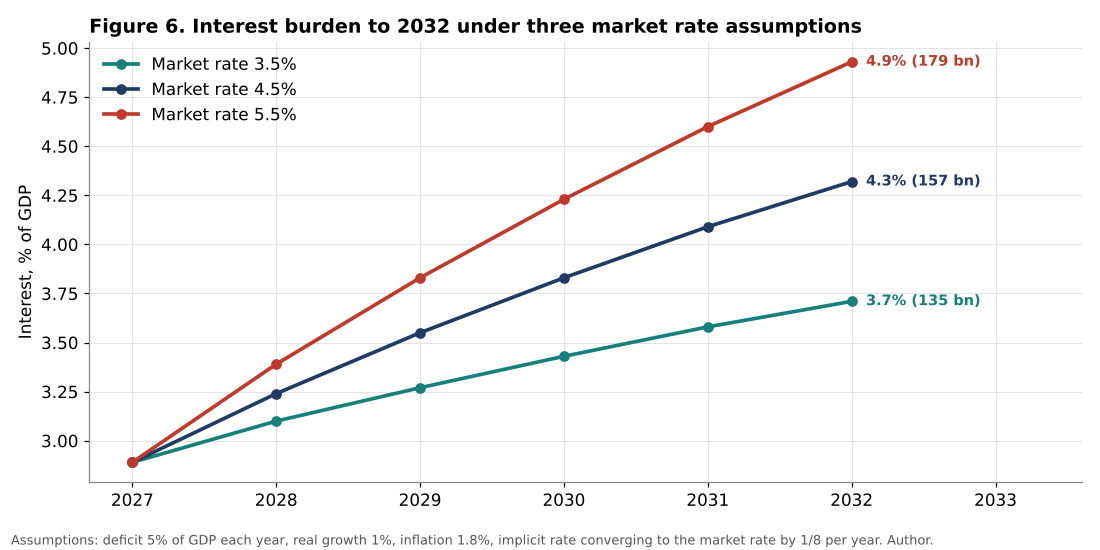
All three scenarios assume a deficit of 5 percent of GDP each year, real growth of 1 percent and inflation of 1.8 percent. They differ only by the level at which the market rate stabilises: 3.5, 4.5 or 5.5 percent. The implicit rate on debt converges toward the market rate at a speed of one eighth per year.
7.2 Results
Market rate at 3.5 percent. Interest rises from 2.9 percent of GDP in 2027 to 3.3 percent in 2029 and 3.7 percent in 2032, or about 135 billion euros.
Market rate at 4.5 percent. Interest reaches 3.6 percent of GDP in 2029 and 4.3 percent in 2032, or about 157 billion euros.
Market rate at 5.5 percent. Interest reaches 3.8 percent of GDP in 2029 and 4.9 percent in 2032, or about 179 billion euros.
In all three scenarios, the interest burden in 2032 is higher than the current deficit target of 3 percent of GDP for the whole of public finances. This means that, with a deficit maintained at 5 percent, the primary balance would have to improve steadily simply to keep the total deficit constant, and the primary deficit would have to shrink to between about 0.1 and 1.3 percent of GDP by 2032.
7.3 Interpretation
These scenarios show that the trajectory of the interest burden is already largely determined by decisions taken in the past and by the level of market rates. Even in the most favourable scenario, interest increases by almost one point of GDP in five years. In the least favourable scenario, it increases by two points.
The difference between the scenarios, about 44 billion euros in 2032, is equivalent to the full effort of a budget like that of 2027. This illustrates the importance of the risk premium: a credible fiscal path that lowers rates by one point would save as much as a large consolidation package.
8. Conclusion
This article has asked whether the burden of debt reduces the capacity of the French State to act. Its main conclusions are:
1. In the 2027 budget bill, the State’s debt charge, 72.9 billion euros, becomes the largest item of the State budget excluding pensions, ahead of school education and defence, and more than three times the ecology mission. 2. Of the 21.2 billion euro increase in the State’s general budget in 2027, about two thirds go to the debt and almost one third to defence; all other missions share about 2 percent. 3. The State’s debt charge absorbs 19.4 percent of its net tax revenue in 2027, against 17.5 percent in 2026. 4. At 119.0 percent of GDP in the second quarter of 2026, France has the third highest debt ratio in the European Union, and its ratio is rising faster than that of any other large euro area country. The State accounts for 82 percent of the debt and 88 percent of its recent increase. 5. Non-residents hold 57.5 percent of negotiable State debt, and about 1,163 billion euros of bonds, 44 percent of the medium and long-term stock, must be refinanced between 2027 and 2031 at much higher rates. 6. With a deficit maintained at 5 percent of GDP, interest paid by general government would reach between 3.7 and 4.9 percent of GDP in 2032, adding 70 to 114 billion euros a year compared with 2025, more than the whole 2027 defence mission even in the most favourable case.
The answer to the question is therefore yes, but in a specific sense. The debt burden does not yet prevent the State from financing its priorities, and France keeps a deep market and a long debt maturity. But it already absorbs most of the room for manoeuvre created by the growth of revenue, it narrows the space for counter-cyclical policy, and it makes the cost of every future policy dependent on market sentiment. The longer the deficit remains high, the larger the share of each new euro that will be devoted to the past rather than to the future. Restoring the State’s capacity to act therefore requires, first of all, a credible reduction of the primary deficit, which is the only lever that acts on the stock of debt, on the risk premium and on the interest bill at the same time.
Need this analysis for your organisation?
We prepare confidential briefings, executive talks and studies on countries, markets and policies, built on the same method as this article.
Request a briefingSupport independent analysis
Our studies are free to read and carry no advertising. If this one was useful, a small contribution helps us publish the next.
Support our workGo further: books by Global Strategy Files

Frequently asked questions
How large is French public debt in 2026?
French general government debt reached 119.0 percent of GDP at the end of the second quarter of 2026, the highest level ever recorded and the third highest ratio in the European Union after Greece and Italy.
Who holds French government debt?
Increasingly foreign investors. The share of negotiable State debt held by non-residents rose from 48.5 percent in early 2022 to 57.5 percent in the first quarter of 2026, which increases France’s exposure to changes in international investor sentiment.
How much French debt must be refinanced by 2031?
About 1,163 billion euros of medium and long-term State bonds, 44 percent of the stock, mature between 2027 and 2031. Refinancing them at 4 percent instead of about 2 percent would add about 24 billion euros a year to the interest bill by 2031.
How high could France’s interest bill go?
Interest paid by general government, 58 billion euros in 2024, could exceed 110 billion euros by the early 2030s. Projections under three market rate assumptions show interest rising from 2.9 percent of GDP in 2027 to between 3.7 and 4.9 percent in 2032.
Methodological note
All derived figures, estimates and scenarios were calculated by the author. Debt and interest data come from INSEE (annual accounts of May 2026 and quarterly debt for the second quarter of 2026). International comparisons come from Eurostat releases of 22 April 2026 and 21 July 2026. Data on negotiable State debt, maturity, redemptions and holders come from the AFT monthly bulletin of August 2026 (data at 31 July 2026) and from the Banque de France. Forecasts for 2026 and 2027 come from the 2027 budget bill. Mission credits come from the mission sheets of the 2027 budget bill; the totals of the general budget (593.9 and 615.1 billion euros) and net State tax revenue (375.7 billion euros in 2027, 18 billion more than in 2026) come from the bill as presented on 1 October 2026. The 2029 interest figure is an order of magnitude given by the Cour des comptes in June 2026. The refinancing cost estimate uses the 2025 implicit interest rate (1.96 percent) as the average cost of the maturing bonds. Population is approximated at 69 million.
References
Agence France Trésor (2026). Bulletin mensuel, n° 435, August 2026. Paris.
Arslanalp, S. and Tsuda, T. (2014). Tracking Global Demand for Advanced Economy Sovereign Debt. IMF Economic Review, 62(3), 430 to 464.
Blanchard, O. (2019). Public Debt and Low Interest Rates. American Economic Review, 109(4), 1197 to 1229.
Cour des comptes (2026). La situation et les perspectives des finances publiques. Paris, 25 June 2026.
De Grauwe, P. (2012). The Governance of a Fragile Eurozone. Australian Economic Review, 45(3), 255 to 268.
Direction générale du Trésor (2026). Rapport économique, social et financier 2027 (RESF 2027). Paris, 6 October 2026.
Eurostat (2026). Euro area government deficit at 2.9% and EU at 3.1% of GDP. Euro indicators, 22 April 2026.
Eurostat (2026). Government debt at 88.9% of GDP in euro area. Euro indicators, 21 July 2026.
Herndon, T., Ash, M. and Pollin, R. (2014). Does High Public Debt Consistently Stifle Economic Growth? A Critique of Reinhart and Rogoff. Cambridge Journal of Economics, 38(2), 257 to 279.
INSEE (2026). Dette trimestrielle de Maastricht des administrations publiques, deuxième trimestre 2026. Informations Rapides, September 2026.
INSEE (2026). Les comptes de la Nation en 2025. Insee Première, May 2026.
Mauro, P. and Zhou, J. (2021). r minus g Negative: Can We Sleep More Soundly? IMF Economic Review, 69(1), 197 to 229.
Ministère de l’Économie, des Finances et de la Souveraineté industrielle et numérique (2026). Projet de loi de finances pour 2027 et fiches missions. Paris, 1 October 2026.
Reinhart, C. and Rogoff, K. (2010). Growth in a Time of Debt. American Economic Review, 100(2), 573 to 578.
