
Heatwaves and Drought in France: Is Climate Becoming a Macroeconomic Brake?

Heatwaves and Drought in France: Is Climate Becoming a Macroeconomic Brake?
Driss EFFINA, PhD Independent Researcher, Global Strategy Files Reading time: about 27 minutes
Key takeaways
- Mainland France recorded 53 heatwave days in summer 2026, against a previous record of 31 days in 2022.
- The summer cost about 0.1 point of GDP, about 3 billion euros, mostly in agriculture, where maize grain output fell 35 percent.
- Vegetable prices rose 13.8 percent year on year in August 2026 and fresh product prices 5.8 percent.
- Meeting France's 2030 emissions goal of 279 million tonnes needs cuts of about 4.9 percent a year, 2.3 times the 2025 pace.
Abstract
The summer of 2026 was the hottest ever recorded in France. Mainland France experienced 53 days of heatwave, against a previous record of 31 days in 2022, together with the driest summer since 1959 and a historic soil drought. In its economic report attached to the 2027 budget, the Ministry of the Economy estimates that heatwaves and drought will reduce GDP growth in 2026 by about 0.1 point. This article examines whether climate is becoming a macroeconomic brake for France. It assesses the consequences of the 2026 summer for production, construction sites, prices and growth prospects, using data from INSEE, the Banque de France, Météo-France, Santé publique France, the Citepa and the Haut Conseil pour le climat, and calculations by the author. The analysis shows that the measurable macroeconomic cost of the summer, about 0.1 point of GDP or about 3 billion euros of value added, is concentrated in agriculture, where output falls by about 4 percent, of which about 3 points are attributed to heat; maize grain production falls by 35 percent. Outside agriculture, the Banque de France estimates the effect at about 0.05 point of GDP in the third quarter, with construction, chemicals, wood and paper and hospitality most affected. Prices of fresh products rose by 5.8 percent year on year in August and vegetable prices by 13.8 percent. Broader cost estimates, including health, fires and damage, reach 10 to 16 billion euros. The article then turns to mitigation: French greenhouse gas emissions fell by 2.1 percent in 2025, to about 359 million tonnes, but reaching the 2030 objective of 279 million tonnes would require a pace of about 4.9 percent per year, 2.3 times faster. At the 2025 pace, the objective would be reached only around 2037. Illustrative calculations show that if summers like 2026 became one year in two, as climate projections suggest is plausible by mid-century, the expected annual cost could reach 0.05 to 0.25 point of GDP. The article concludes that climate is not yet a major brake on French growth in aggregate, but that it is becoming a recurring sectoral shock, a source of price volatility and a risk to public finances, and that its cost will rise nonlinearly unless adaptation and emission reductions accelerate.
Keywords: France, climate change, heatwave, drought, agriculture, growth, inflation, adaptation, greenhouse gas emissions, SNBC
JEL codes: Q54, Q51, E23, E31, Q15, Q58
1. Introduction
For a long time, macroeconomists treated weather as noise. A cold winter or a hot summer could move quarterly figures, but these effects were assumed to cancel out over time and to have no lasting influence on growth. Climate change challenges this assumption. When extreme events become more frequent and more intense, they stop being random disturbances around a trend and start shaping the trend itself.
The summer of 2026 has brought this question to the centre of the French economic debate. According to Météo-France, it was the hottest summer ever recorded in France, with an average temperature of 24 degrees, 3.6 degrees above normal, against 2.7 degrees above normal in 2003 and 2.3 degrees in 2022. The country experienced three heatwaves totalling 53 days. Ninety percent of the territory reached at least 35 degrees at least once, and 40 percent reached 40 degrees. Rainfall was 40 percent below normal, making it the driest summer since 1959. Seventy-three departments were placed at least once on red heatwave alert. Santé publique France estimated more than 7,300 excess deaths during the successive episodes, a provisional figure expected to be revised upward.
In its economic, social and financial report (RESF) attached to the 2027 budget bill, published on 6 October 2026, the Directorate General of the Treasury states that the heatwaves and drought of the summer would weigh on activity in 2026 by about 0.1 point of GDP. INSEE reached the same order of magnitude in its September economic outlook, and the Banque de France in its monthly business survey.
A loss of 0.1 point of GDP may seem small. But it is one fifth of the growth forecast for 2026 (0.5 percent), it comes on top of the energy shock linked to the conflict in the Middle East, and it reflects only the most measurable effects. This article therefore asks a broader question: is climate becoming a macroeconomic brake for France? It examines the consequences of the summer for production, construction sites, prices and growth prospects, then places these effects in the context of the French climate trajectory, including the pace of emission reductions against the 2030 objectives.
Section 2 presents the context. Section 3 reviews the literature on the economic effects of heat. Section 4 presents the data and methods. Section 5 presents the results. Section 6 discusses them. Section 7 presents scenarios. Section 8 concludes.
2. Context
2.1 A warming that is faster in France than globally
According to the Haut Conseil pour le climat (HCC), the independent body that assesses French climate policy, warming due to human activities reached about 1.4 degrees globally in 2025, increasing by about 0.27 degrees per decade. In mainland France, observed warming between 1900 to 1930 and 2016 to 2025 reached 2.2 degrees, of which 1.7 degrees are attributed to human activities. France is warming faster than the global average, as are most mid-latitude land areas.
The national reference trajectory for adaptation to climate change (TRACC), adopted with the third national adaptation plan (PNACC-3) in 2025, asks public and private actors to prepare for warming of 4 degrees in mainland France by 2100. According to the HCC, without additional action, the number of heatwave days would be multiplied by about three by 2030, five by 2050 and ten by 2100 relative to the reference period, and heatwaves would extend from May to October.
2.2 The summer of 2026
The summer of 2026 combined several extremes. Heat arrived early, with record temperatures for the season at the end of May, although below the official heatwave threshold. The first heatwave, from 17 to 30 June, was the most intense since 1947, with 72 departments on red alert. A second wave followed from 4 to 19 July, and a third from 28 July to 19 August. In total, INSEE counts 53 heatwave days, using the Météo-France definition: at least three consecutive days with a national average temperature above 23.4 degrees, including at least one day above 25.3 degrees.
The drought was equally severe. Soil moisture reached historically low levels from June. Water restrictions reached crisis level in many departments, and tens of thousands of people were temporarily deprived of tap water. The risk of fire remained high for 74 consecutive days, and by the end of August the area burned was six times higher than the average of the previous twenty years. Sea surface temperatures were 2 degrees above normal in the Channel and 2.8 degrees in the Mediterranean.
2.3 The macroeconomic context
The summer came at a time when the French economy was already weak. GDP was flat in the second quarter of 2026, according to the latest revision. The conflict in the Middle East had raised energy and fertiliser prices. The government revised its growth forecast for 2026 from about 1 percent to 0.5 percent, and the Banque de France estimated third quarter growth at about 0.1 percent. In this context, even a small additional shock matters for growth, employment and public finances.
2.4 The climate policy framework
France has committed to carbon neutrality by 2050. The national low-carbon strategy (SNBC), currently in its third version, sets carbon budgets by period and by sector. For the period 2024 to 2028, the average annual budget is 347 million tonnes of CO2 equivalent, and the objective for 2030 is 279 million tonnes, excluding land use. The HCC published its opinion on the draft SNBC 3 in March 2026 and its annual report in June 2026.
3. Literature review
The economic literature on the effects of temperature and extreme heat has grown rapidly over the past fifteen years.
The first strand estimates the effect of temperature on aggregate output. Dell, Jones and Olken (2012) used year-to-year variations in temperature across countries and found that higher temperatures significantly reduce economic growth in poor countries, but have little effect in rich countries. Burke, Hsiang and Miguel (2015) found a nonlinear relationship between temperature and productivity, with output peaking at an annual average temperature of about 13 degrees and declining sharply at higher temperatures, a relationship that applies to rich and poor countries alike. These studies imply that the costs of warming increase more than proportionally with temperature.
The second strand focuses on heatwaves in Europe. García-León and co-authors (2021) estimated the effect of heatwaves on labour productivity in European regions and found that the heatwaves of 2003, 2010, 2015 and 2018 reduced GDP by about 0.3 to 0.5 percent in the years concerned, against about 0.2 percent on average for 1981 to 2010. They projected that these losses could be several times larger by 2060 without adaptation. The most affected regions are in southern Europe, including parts of southern France.
The third strand concerns prices. Kotz and co-authors (2024), working with the European Central Bank, found that high temperatures raise food and headline inflation, with effects that persist for about a year. They estimated that the extreme summer heat of 2022 raised food inflation in Europe by about 0.7 percentage points. This means that heatwaves are not only a supply shock that reduces output, but also a source of inflation that complicates monetary policy.
The fourth strand concerns the costs of climate policy. The report by Pisani-Ferry and Mahfouz (2023) for France Stratégie estimated the additional investment needed for the French climate transition at about 2 percentage points of GDP per year by 2030, and analysed its consequences for growth, public finances and inequality. The HCC refers to estimates by the Network for Greening the Financial System, according to which the cost of inaction could reach 30 to 50 percent of global GDP by 2100, against an additional investment of 1 to 2 percent of global GDP per year by 2030 for the transition.
This literature suggests three conclusions relevant to France. The effect of a single hot summer on the GDP of a rich, diversified economy is small. The effect is concentrated in specific sectors, notably agriculture, construction and outdoor activities. And the costs rise nonlinearly as extreme events become more frequent and more intense.
4. Data and methodology
4.1 Data
- Climate: Météo-France via INSEE and press syntheses: heatwave days, temperature anomalies, rainfall.
- Production and harvests: INSEE, Note de conjoncture of 10 September 2026, including Agreste harvest estimates.
- Business activity: Banque de France, monthly business survey published on 15 September 2026, with value added forecasts by sector for the third quarter.
- Prices: INSEE consumer price index for fresh products and vegetables.
- Health: Santé publique France provisional excess mortality estimates.
- Emissions: Citepa barometer of April 2026 (sector detail) and HCC annual report of June 2026 (latest pre-estimate for 2025).
- Policy objectives: SNBC 3 targets and carbon budgets as reported by the Citepa.
4.2 Methods
1. Heatwave frequency. Comparison of the number of heatwave days in 2026 with previous years. 2. Harvest and agricultural output. Volume changes in 2026 compared with 2025, and the share attributed to heat by INSEE. 3. GDP cost. Conversion of the official estimate of 0.1 point of GDP into euros, using estimated nominal GDP for 2026 of about 3,070 billion euros. 4. Sectoral effects. Analysis of the Banque de France third quarter value added forecasts and of survey responses on weather-related disruptions. 5. Emission trajectory. Calculation of the annual rate of decline required to move from 359 million tonnes in 2025 to 279 million tonnes in 2030, comparison with observed rates, projection of emissions at the current pace, and calculation of the year in which the 2030 objective would be reached at that pace. 6. Sector gaps. Comparison of 2025 sectoral emissions with the average annual SNBC 3 budgets for 2024 to 2028. 7. Expected annual cost. An illustrative calculation of the expected annual GDP loss as the product of the probability of a 2026-type summer and the GDP loss associated with it, under three frequencies and three loss assumptions.
4.3 Limitations
The official estimates of the cost of the summer cover mainly agriculture, and the effects on productivity, health, tourism and capital are not fully quantified. Emissions data come from different vintages: the 2025 total (359 million tonnes) is the latest pre-estimate cited by the HCC in June 2026, while the sector detail comes from the Citepa barometer of April 2026, which put the total at about 364 million tonnes. The 2030 objective and sector budgets are those of the SNBC 3 as reported by the Citepa. The expected cost calculation is illustrative and does not model adaptation.
5. Results
5.1 An unprecedented summer
Figure 1 shows the number of heatwave days in selected years.
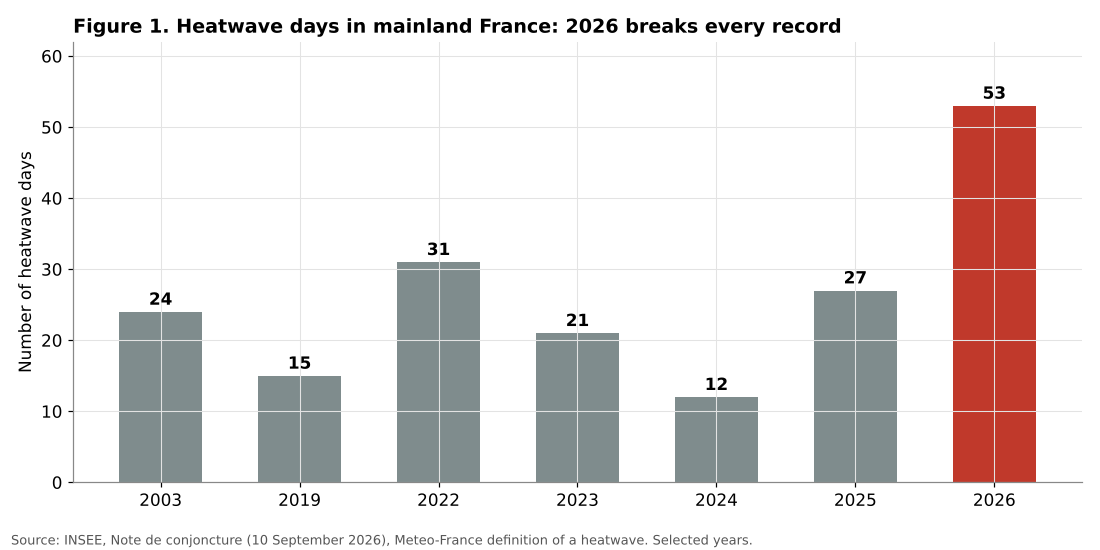
With 53 heatwave days, the summer of 2026 exceeded the previous record of 2022 (31 days) by 70 percent. It also exceeded 2003 (24 days), the reference summer in French memory, which caused about 15,000 excess deaths. Recent summers had already been intense: 27 heatwave days in 2025 and 21 in 2023. Four of the last five years had more heatwave days than 2019.
| Year | Heatwave days | Average summer temperature anomaly |
|---|---|---|
| 2003 | 24 | +2.7 °C |
| 2019 | 15 | n.a. |
| 2022 | 31 | +2.3 °C |
| 2023 | 21 | n.a. |
| 2024 | 12 | n.a. |
| 2025 | 27 | n.a. |
| 2026 | 53 | +3.6 °C |
Table 1. Heatwave days and summer temperature anomalies. Source: INSEE (September 2026), Météo-France.
Météo-France noted that the temperatures of the summer of 2026 would correspond to an ordinary summer in a France warmed by 4 degrees, the level that the TRACC asks the country to prepare for by 2100. In other words, 2026 offers a preview of the climate that the national adaptation plan considers plausible by the end of the century.
5.2 Production: agriculture bears the brunt
Figure 2 shows the change in harvests in 2026 compared with 2025.
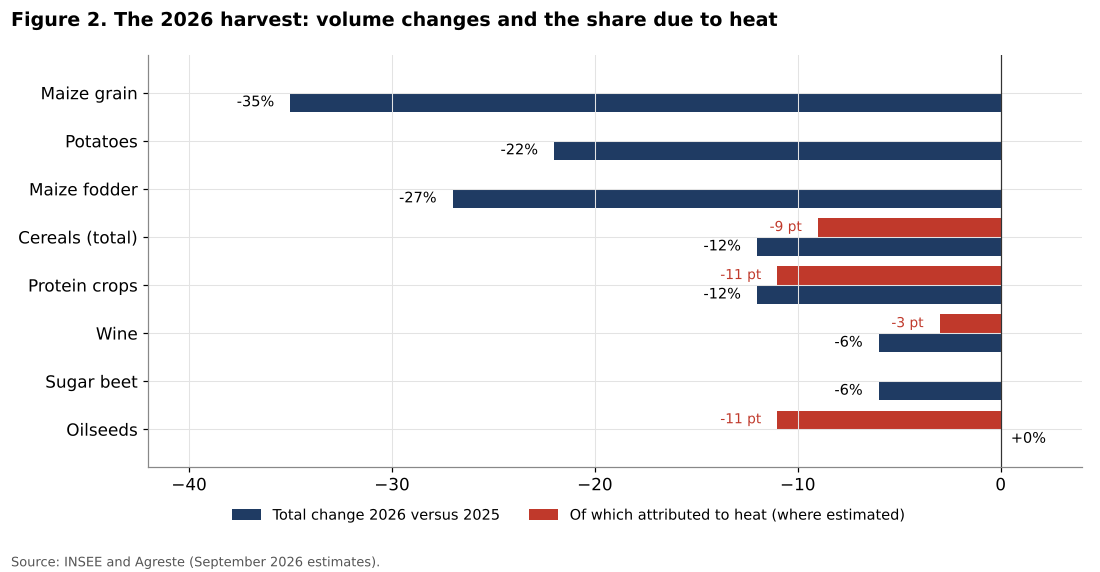
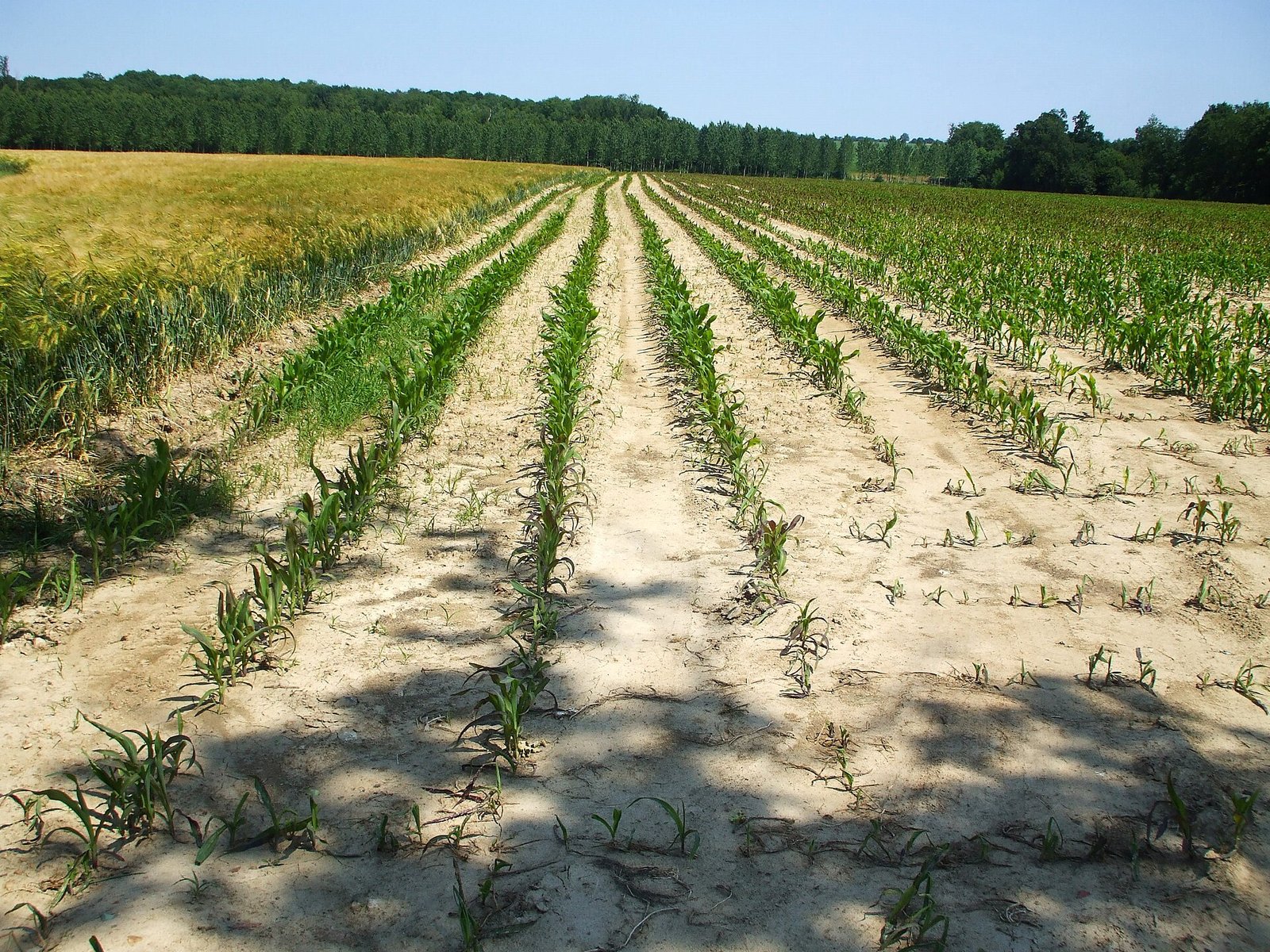
The effects on agriculture are severe. According to INSEE and Agreste, total cereal production falls by 12 percent, of which 9 points are attributed to heat through lower yields. Maize grain production collapses by 35 percent, to 9.0 million tonnes, with a 21 percent fall in area and a 19 percent fall in yield, to 70.3 quintals per hectare, the lowest since 2003. Fodder maize falls by 27 percent, potatoes by 22 percent, and protein crops by 12 percent. Oilseed production is stable overall, but heat reduced it by 11 points relative to what would otherwise have been a strong year; sunflower yields are the lowest since at least 1980. Wine production falls by about 6 percent, to about 34 million hectolitres. The growth of permanent grassland, essential for livestock, was 36 percent below the 1989 to 2018 average at 20 August.
Overall, INSEE estimates that agricultural output falls by about 4 percent in volume in 2026, of which about 3 points are due to heat. Since agricultural value added falls almost one for one with output, because intermediate consumption is rigid, this translates into a loss of about 0.1 point of GDP. The Treasury, in a hearing before Parliament, put the fall in agricultural value added at about 8 percent, against 15 percent in 2003.
The comparison with 2003 is instructive. In 2003, INSEE estimates that the heatwave reduced growth by about 0.3 point, through plant production. In 2026, despite a much hotter and longer summer, the estimated effect is smaller, about 0.1 point. Two factors explain this difference. First, agriculture weighs less in the economy than in 2003. Second, part of the losses of the 2026 harvest is recorded in the national accounts as a reduction of the annual production targets, which are distributed across several quarters.
In euros, a loss of 0.1 point of GDP corresponds to about 3 billion euros of value added in 2026. This is the most measurable part of the cost. Broader estimates are much higher: the Minister for Ecological Transition mentioned direct and indirect costs of 10 to 15 billion euros, and a parliamentary mission estimated the total bill of drought, heatwaves and fires at about 16 billion euros. These broader estimates include damage, emergency spending, health costs and losses that do not appear directly in GDP.
5.3 Construction sites and other sectors
Figure 3, left panel, shows the Banque de France’s forecasts of value added by sector for the third quarter of 2026.
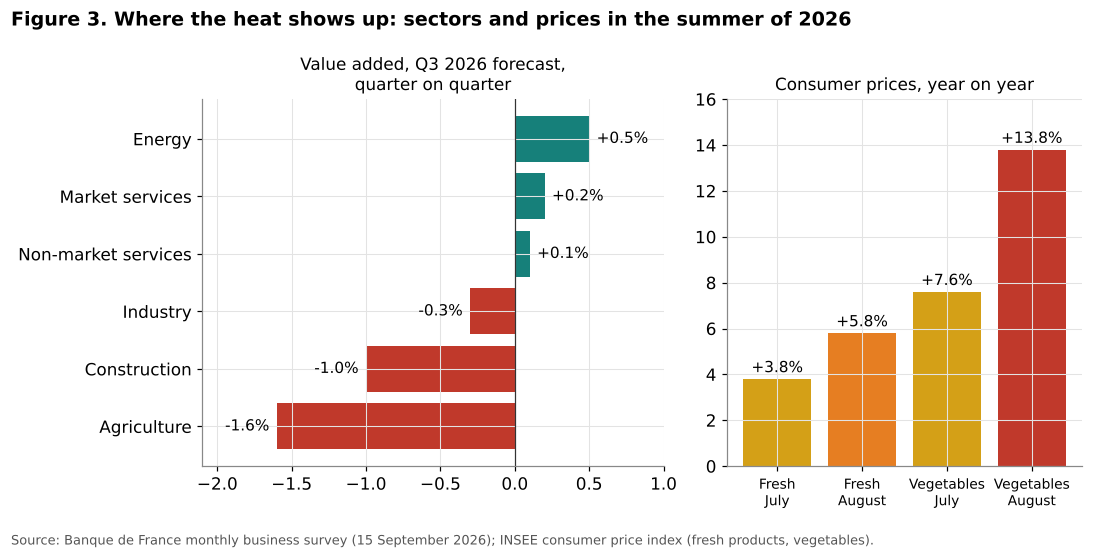
The Banque de France expects agricultural value added to fall by 1.6 percent in the third quarter, construction by 1.0 percent and industry by 0.3 percent, while energy rises by 0.5 percent and market services by 0.2 percent. It estimates that the heatwave reduces third quarter GDP by about 0.05 point outside agriculture, and by about 0.1 point over the year as a whole, mainly through agriculture.
Construction illustrates the sectoral nature of the shock. In its August survey, the Banque de France reports that construction activity continued to increase but well below expectations, especially for structural work (gros œuvre), which is carried out outdoors and is most exposed to heat. Firms cited heatwaves, storms and water cuts as factors disrupting construction sites. At the same time, finishing work (second œuvre) remained dynamic, driven by air-conditioning and heat protection work, mainly in public buildings. Heat therefore reduces activity on some sites while creating demand for adaptation work on others. The regulatory framework for working in heat was strengthened in 2025, and the HCC recommends setting stoppage thresholds based on a heat stress index combining temperature and humidity, which would further formalise interruptions of outdoor work during heat episodes.
In industry, the Banque de France reports that chemicals, other manufacturing and wood, paper and printing declined in August, with firms citing heatwaves, storms and water cuts as obstacles to production. The capacity utilisation rate fell slightly, to 76.4 percent. Historically, INSEE notes, French manufacturing has shown little sensitivity to heat, but water availability for cooling and processes has become a constraint in some sites.
In services, accommodation and catering grew less than expected in August, affected by the heatwave and by fewer foreign customers. The heat therefore did not boost tourism activity as one might have expected; extreme temperatures discouraged some visitors.
In energy, the effects were mixed. Electricity consumption rose during the three heatwaves because of air conditioning. But the August episode reduced national electricity output because of greater unavailability of nuclear reactors, some of which must limit their output when river temperatures are too high to cool them without harming aquatic life. Press reports indicated that about a fifth of the nuclear fleet was unavailable at one point during the summer, for all reasons combined.
5.4 Prices
Figure 3, right panel, shows the evolution of consumer prices for fresh products and vegetables.
Prices of fresh products rose by 5.8 percent year on year in August 2026, after 3.8 percent in July. Vegetable prices rose by 13.8 percent in August, after 7.6 percent in July, the fastest increase since early 2024. INSEE detected no clear heat effect on fruit and potato prices at that stage.
These price effects are consistent with the literature. Kotz and co-authors (2024) estimate that the heat of 2022 raised food inflation in Europe by about 0.7 percentage point. In 2026, the price effects of heat add to those of the energy shock, which raised the cost of fertilisers, transport and processing. The Banque de France reports that agri-food firms faced rising input costs and strengthened their price increases in August.
The effect on headline inflation remains moderate because fresh products have a small weight in the consumer basket. But the effect on households is regressive: food accounts for a larger share of the budget of low-income households, and price spikes on vegetables are highly visible.
5.5 Health and labour
The health toll of the summer is large. Santé publique France estimated more than 7,300 excess deaths across the successive episodes, including 5,764 during the June heatwave alone, with a provisional total expected to be revised upward once the August episode is assessed. In 2025, the HCC counted more than 5,700 deaths attributable to heat over the summer. These human costs are not captured in GDP, but they represent a major dimension of the climate shock.
Heat also reduces labour productivity, especially for outdoor and physical work, as documented by García-León and co-authors (2021). The French official estimates do not quantify this channel, which is difficult to measure with available data. The Treasury acknowledged that heat can reduce labour productivity in physical or outdoor work but did not provide a figure. This is a significant gap, because the literature suggests that labour productivity is the main channel through which heatwaves reduce GDP in Europe.
5.6 The mitigation side: emissions against the 2030 objective
The macroeconomic cost of climate change depends on the pace of global warming, to which France contributes through its emissions, and on France’s own adaptation. Figure 4 shows French greenhouse gas emissions and the trajectory required to reach the 2030 objective.
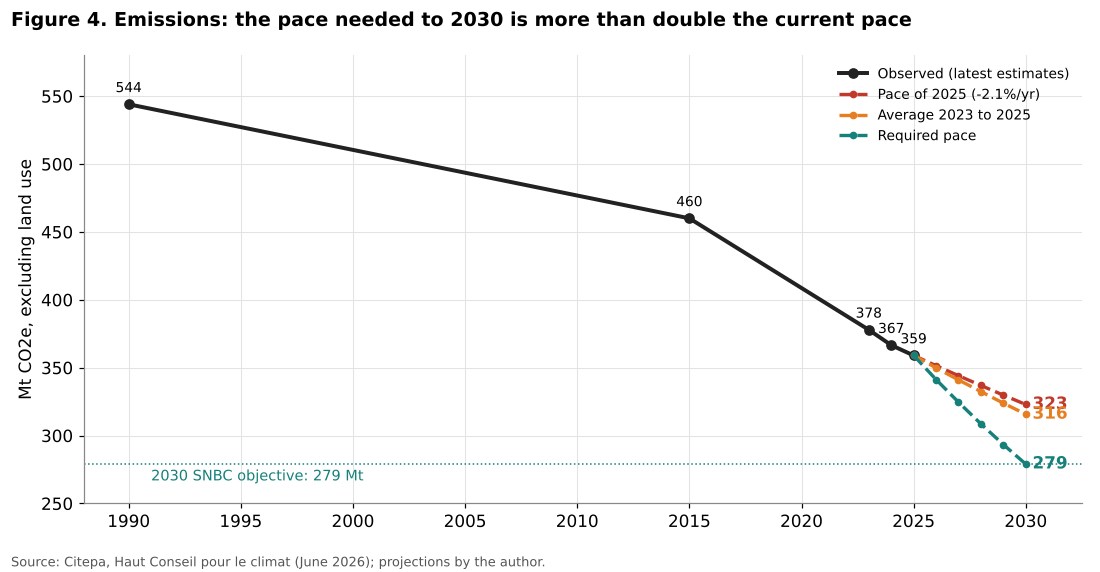
According to the latest estimates cited by the HCC in June 2026, French territorial emissions, excluding land use, were about 359 million tonnes of CO2 equivalent in 2025, 2.1 percent lower than in 2024, after a decline of 3.0 percent in 2024. They are about 34 percent below their 1990 level (about 544 million tonnes) and 22 percent below their 2015 level (about 460 million tonnes). The HCC notes that about half of the decline in 2025 came from lower activity in industry and livestock rather than from structural decarbonisation.
The author’s calculations show the scale of the remaining effort:
| Indicator | Value |
|---|---|
| Emissions 2025 | about 359 Mt CO2e |
| SNBC objective 2030 | 279 Mt CO2e |
| Required average annual decline 2025 to 2030 | about 4.9% per year, about 16 Mt per year |
| Observed decline 2024 | -3.0% |
| Observed decline 2025 | -2.1% |
| Average annual decline 2023 to 2025 | about -2.5% |
| Emissions in 2030 at the 2025 pace | about 323 Mt |
| Gap to the objective in 2030 at the 2025 pace | about 44 Mt |
| Year in which 279 Mt is reached at the 2025 pace | about 2037 |
Table 2. Emission trajectory and gap analysis. Source: Citepa, HCC; calculations by the author.
To reach 279 million tonnes in 2030, emissions would have to fall by about 4.9 percent per year from 2025, or about 16 million tonnes per year. This is 2.3 times the pace observed in 2025. At the 2025 pace, emissions would be about 323 million tonnes in 2030, 44 million tonnes above the objective, and the objective would be reached only around 2037. At the average pace of 2023 to 2025, emissions would be about 316 million tonnes in 2030. The HCC itself concludes that the pace must at least double to average more than 4 percent per year in 2026, 2027 and 2028, and notes that the SNBC 3 trajectory postpones much of the effort to the end of the period.
5.7 Emissions by sector
Figure 5 compares 2025 emissions with the average annual SNBC 3 budgets for 2024 to 2028 in the four sectors for which budgets are reported.
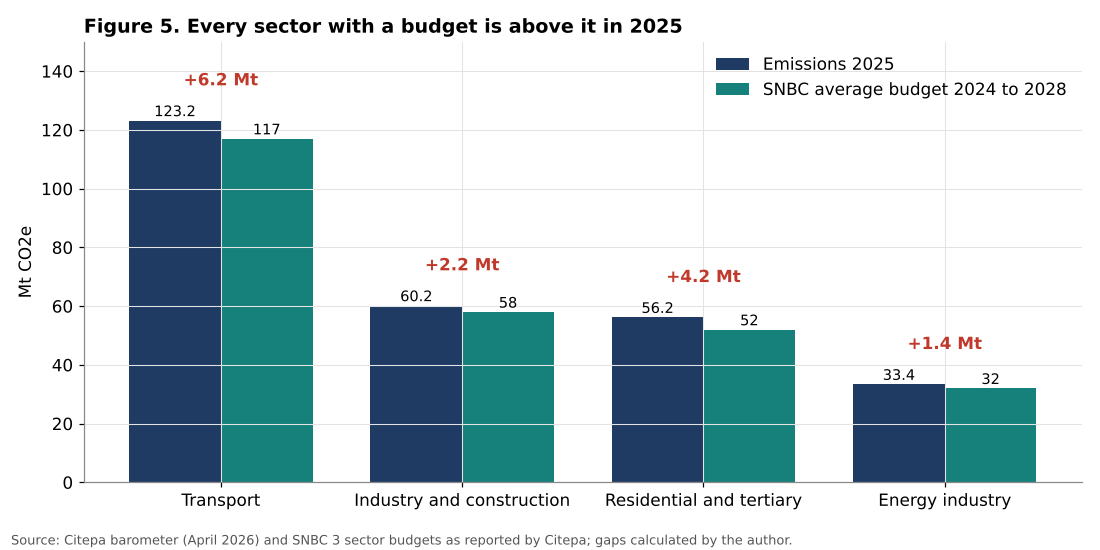
All four sectors are above their average budget in 2025, according to the Citepa barometer of April 2026:
- Transport, the largest emitting sector with about a third of the total, emitted 123.2 million tonnes in 2025, 6.2 million tonnes above its average budget of 117. Its emissions fell by only 1.4 percent in 2025. To reach its 2030 objective of 92 million tonnes, it would need to reduce emissions by about 5.7 percent per year.
- Residential and tertiary buildings emitted 56.2 million tonnes, 4.2 million above their budget of 52, with a decline of 1.5 percent in 2025. The HCC notes that the decline in this sector slowed in 2024 and 2025.
- Industry and construction emitted 60.2 million tonnes, 2.2 million above their budget of 58, after a decline of 3.5 percent, largely due to lower production.
- The energy industry emitted 33.4 million tonnes, 1.4 million above its budget of 32, with a slight increase of 0.5 percent.
Agriculture, which accounts for about 21 percent of emissions, fell by 1.2 percent in 2025, partly because of the decline in livestock. Waste accounts for about 4 percent.
The sector analysis shows that the gap is concentrated in transport and buildings, the two sectors where emissions depend on the daily decisions of households (car use, heating) and on long-lived capital stocks (vehicles, buildings). These are also the sectors where the transition requires the largest investments and raises the most sensitive social questions.
5.8 The carbon sink
The land use sector, including forests, is supposed to absorb part of the remaining emissions to reach carbon neutrality. The HCC notes that the forest carbon sink has deteriorated markedly since 2015, because of droughts, pests and other climate impacts. This is a direct feedback between climate impacts and mitigation: heatwaves and droughts, such as those of 2026, weaken forests, increase fire risks and reduce the capacity of the land sector to absorb carbon. The drought of 2026 and the fires of the summer are likely to have further reduced the sink.
6. Discussion
6.1 Is climate a macroeconomic brake?
The analysis gives a nuanced answer. In aggregate, the measurable effect of the 2026 summer on French GDP is small, about 0.1 point, and concentrated in agriculture. Outside agriculture, the effects are sectoral and localised. On this narrow measure, climate is not yet a major brake on French growth.
However, three considerations suggest that this conclusion understates the economic significance of climate.
First, the official estimates cover only part of the costs. They do not include losses of labour productivity, health costs, damage to infrastructure and buildings, fire costs, or the long-term effects on soils, forests and water resources. Broader estimates of the cost of the summer, between 10 and 16 billion euros, are three to five times higher than the measured loss of value added.
Second, the effects are rising. The summer of 2026 had 53 heatwave days, against 15 in 2019. Climate projections suggest that such summers will become common. Since the economic damage of heat rises nonlinearly with temperature, as the literature shows, the costs of future summers could rise faster than their frequency.
Third, the effects interact with other shocks. In 2026, the heatwave came on top of an energy shock and a period of weak growth. Higher food prices added to the cost of living pressures caused by energy. Weaker activity reduced tax revenue at a time of fiscal stress. The combination of shocks matters more than each shock taken separately.
6.2 Construction and the adaptation economy
The construction sector illustrates the two faces of climate change for the economy. On the one hand, heat disrupts outdoor work and reduces productivity. On the other, adaptation creates demand for new activities: air conditioning, insulation against heat, shading, green spaces, water management, the cooling of hospitals and schools. In August 2026, the dynamism of finishing work driven by heat protection partly offset the weakness of structural work.
This suggests that climate change does not simply reduce output; it changes its composition. Resources are diverted from other uses to adaptation. In national accounts terms, this can even increase GDP in the short term, since adaptation spending is counted as output. But it represents a cost in terms of welfare, because these resources could otherwise have been used to increase consumption or productive capacity.
6.3 Prices and monetary policy
The price effects of heatwaves pose a challenge for monetary policy. A heatwave is a negative supply shock that raises prices and reduces output simultaneously. If such shocks become more frequent, they could add volatility and an upward bias to food inflation, as Kotz and co-authors (2024) suggest. Central banks, including the European Central Bank, have started to integrate climate risks into their analysis. For households, recurrent spikes in food prices erode purchasing power, especially for low-income groups.
6.4 Public finances
Climate shocks also weigh on public finances. The RESF 2027 includes a box on the effect of the heatwave on public finances. The channels are lower revenue because of lower activity, emergency spending (fire fighting, water supply, health), agricultural support, and compensation through the natural disaster insurance scheme (CatNat), which the HCC describes as weakened by growing impacts. In the context of the fiscal constraint analysed in the previous articles of this series, each additional climate shock reduces the room for manoeuvre.
At the same time, the HCC recommends sizing the green fund for local governments in the 2027 budget bill so that they can finance priority adaptation measures, and integrating the needs of the ecological transition into the next multi-year public finance law. The 2027 budget bill raises the green fund to 1 billion euros, a modest amount compared with the needs identified by local governments.
6.5 Mitigation and adaptation: two sides of the same problem
The analysis of emissions shows that France is not on track to meet its 2030 objective. At the current pace, the objective would be reached seven years late. This matters for France’s credibility in European and international climate negotiations, and for its exposure to the costs of European carbon pricing, including the planned second carbon market for buildings and road transport fuels.
But it also matters because the costs of adaptation depend on the global success of mitigation. France accounts for less than 1 percent of global emissions, so its own emissions have a negligible effect on its own climate. However, the European and global effort, to which France contributes, determines whether warming in France stays close to the levels that the TRACC projects for mid-century, about 2.7 degrees in 2050, or continues toward 4 degrees by 2100. The difference between these two scenarios, in terms of heatwave frequency and economic cost, is very large.
6.6 The investment question
Both adaptation and mitigation require investment. The HCC notes that climate investment in the European Union reached 534 billion euros in 2025, against an estimated need of 878 billion euros per year to meet the 2030 objectives. In France, Pisani-Ferry and Mahfouz (2023) estimated the additional investment needed at about 2 points of GDP per year by 2030. In a context of high public debt and rising interest rates, financing this investment is a major challenge. The temptation will be to postpone it. But the analysis of the 2026 summer suggests that postponing adaptation increases future costs, and that postponing mitigation increases the long-term costs of adaptation.
7. Scenarios
7.1 The expected annual cost of hot summers
Figure 6 presents an illustrative calculation of the expected annual cost of hot summers.
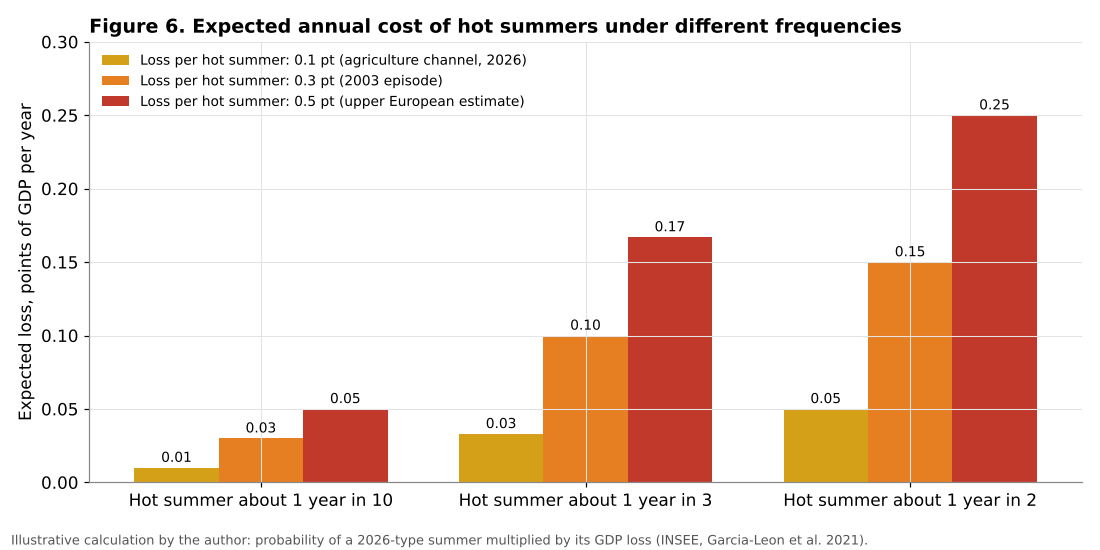
The expected annual cost is the probability that a given year has a 2026-type summer multiplied by the GDP loss associated with such a summer. The author considers three frequencies, about one year in ten, one year in three and one year in two, and three levels of loss: 0.1 point of GDP, the official estimate for 2026, which covers mainly agriculture; 0.3 point, the estimate for 2003; and 0.5 point, the upper estimate of García-León and co-authors (2021) for European heatwaves, which includes labour productivity.
| Frequency of a 2026-type summer | Loss 0.1 pt | Loss 0.3 pt | Loss 0.5 pt |
|---|---|---|---|
| About 1 year in 10 | 0.01 | 0.03 | 0.05 |
| About 1 year in 3 | 0.03 | 0.10 | 0.17 |
| About 1 year in 2 | 0.05 | 0.15 | 0.25 |
Table 3. Expected annual GDP loss from hot summers, points of GDP. Illustrative calculation by the author.
If summers like 2026 remained rare, about one year in ten, and their cost remained limited to agriculture, the expected annual cost would be negligible, about 0.01 point of GDP. If they became one year in two, as the TRACC projections suggest is plausible by mid-century, and if their cost included productivity losses, the expected annual cost could reach 0.25 point of GDP per year, about 7 to 8 billion euros at today’s prices, every year.
An expected cost of 0.25 point of GDP per year is equivalent to about half of the growth forecast for 2026, or to a significant part of the potential growth of the French economy, estimated at around 1 percent per year. Over a decade, it would cumulate to a loss of about 2.5 points of GDP. This calculation does not include the costs of damage to capital, health costs or the costs of adaptation, which would add to the total.
7.2 Three trajectories
Scenario 1: Adaptation keeps pace. Investments in water management, crop varieties, irrigation efficiency, building cooling and work organisation reduce the sensitivity of the economy to heat. Even if hot summers become more frequent, the cost per summer falls. The expected annual cost remains below 0.1 point of GDP.
Scenario 2: Partial adaptation. Adaptation progresses in some sectors, such as buildings and health, but lags in others, such as agriculture and water. Hot summers become more frequent and their cost per episode remains around 0.1 to 0.3 point of GDP. The expected annual cost rises to about 0.05 to 0.15 point of GDP.
Scenario 3: Insufficient adaptation and accelerating warming. Hot summers become the norm and their cost rises nonlinearly, with significant productivity, health and capital losses. The expected annual cost exceeds 0.2 point of GDP, and climate becomes a lasting brake on growth, especially in the south of France.
7.3 Indicators to monitor
The author suggests monitoring:
1. The number of heatwave days and the soil moisture index each summer. 2. Agricultural output and yields, especially for maize, cereals and fodder. 3. Business survey responses on weather-related disruptions in construction and industry. 4. Food and vegetable price inflation during and after summer. 5. The annual pace of emission reduction against the required 4.9 percent per year.
8. Conclusion
The summer of 2026 has shown that climate is becoming a macroeconomic issue for France. The main conclusions of the analysis are:
1. With 53 heatwave days, the summer of 2026 exceeded the previous record by 70 percent, and corresponded to what an ordinary summer could be in a France warmed by 4 degrees. 2. The measurable cost is about 0.1 point of GDP, or about 3 billion euros of value added, concentrated in agriculture, where output falls by about 4 percent and maize grain production by 35 percent. 3. Outside agriculture, construction, energy-intensive industries and hospitality were disrupted, with an effect of about 0.05 point of GDP in the third quarter. 4. Prices of vegetables rose by 13.8 percent year on year in August, adding to the cost of living pressures from the energy shock. 5. Broader cost estimates, including health, fires and damage, reach 10 to 16 billion euros, and more than 7,300 excess deaths were recorded. 6. Emissions fell by 2.1 percent in 2025, but the 2030 objective requires a pace of about 4.9 percent per year; at the current pace, it would be reached only around 2037. 7. If summers like 2026 became one year in two, their expected cost could reach up to 0.25 point of GDP per year.
Climate is therefore not yet a major brake on French growth in aggregate, but it has become a recurring sectoral shock, a source of price volatility and a growing risk for public finances. Its cost will rise nonlinearly with warming. The economic case for adaptation is strong, because each euro invested in reducing the sensitivity of agriculture, buildings, work and water systems to heat reduces future losses. And the case for accelerating emission reductions is equally strong, because the costs of adaptation depend on the extent of global warming. The 2027 budget, constrained by debt and interest costs, offers limited resources for either. This is perhaps the most important finding: the fiscal and climate challenges of France are not separate issues, but two constraints that will increasingly have to be managed together.
Need this analysis for your organisation?
We prepare confidential briefings, executive talks and studies on countries, markets and policies, built on the same method as this article.
Request a briefingSupport independent analysis
Our studies are free to read and carry no advertising. If this one was useful, a small contribution helps us publish the next.
Support our workGo further: books by Global Strategy Files

Frequently asked questions
How much did the 2026 heatwaves cost the French economy?
The measurable macroeconomic cost of summer 2026 is about 0.1 point of GDP, or about 3 billion euros of value added, concentrated in agriculture, where maize grain production fell 35 percent. Broader estimates including health, fires and damage reach 10 to 16 billion euros.
How did the 2026 drought affect food prices in France?
Fresh product prices rose by 5.8 percent year on year in August 2026 and vegetable prices by 13.8 percent, after the hottest summer on record, the driest since 1959 and a historic soil drought. Mainland France recorded 53 heatwave days that summer.
Is France on track to meet its 2030 climate target?
No. Emissions fell 2.1 percent in 2025 to about 359 million tonnes, but reaching the 2030 objective of 279 million tonnes would require cuts of about 4.9 percent a year, 2.3 times faster. At the 2025 pace, the target would be reached around 2037.
Is climate becoming a brake on French growth?
Not yet in aggregate, but it is becoming a recurring sectoral shock. If summers like 2026 occurred one year in two, as projections suggest is plausible by mid-century, the expected annual cost could reach 0.05 to 0.25 point of GDP.
Methodological note
All derived indicators and calculations were produced by the author. Heatwave days and harvest data come from the INSEE Note de conjoncture of 10 September 2026, which uses the Météo-France definition of heatwaves and Agreste harvest estimates. Sector value added forecasts come from the Banque de France monthly business survey of 15 September 2026. Price data come from INSEE. The GDP cost in euros applies the official 0.1 point estimate to an estimated 2026 nominal GDP of about 3,070 billion euros. Emissions for 2025 (359 million tonnes) are the latest pre-estimate cited by the HCC in June 2026; 1990 and 2015 values are derived from the percentage declines reported by the HCC. Sector emissions and SNBC 3 budgets come from the Citepa barometer of April 2026, which used an earlier vintage. The required pace is calculated as a constant annual rate from 2025 to 2030. The expected cost calculation is illustrative.
References
Banque de France (2026). Enquête mensuelle de conjoncture, début septembre 2026. Paris, 15 September 2026.
Burke, M., Hsiang, S. M. and Miguel, E. (2015). Global Non-linear Effect of Temperature on Economic Production. Nature, 527, 235 to 239.
Citepa (2026). Baromètre des émissions de gaz à effet de serre, estimation pour l’année 2025. Paris, April 2026.
Dell, M., Jones, B. F. and Olken, B. A. (2012). Temperature Shocks and Economic Growth: Evidence from the Last Half Century. American Economic Journal: Macroeconomics, 4(3), 66 to 95.
Direction générale du Trésor (2026). Rapport économique, social et financier, projet de loi de finances pour 2027. Paris, 6 October 2026.
García-León, D., Casanueva, A., Standardi, G., Burgstall, A., Flouris, A. D. and Nybo, L. (2021). Current and Projected Regional Economic Impacts of Heatwaves in Europe. Nature Communications, 12, 5807.
Haut Conseil pour le climat (2026). Avis sur le projet de troisième stratégie nationale bas-carbone. Paris, March 2026.
Haut Conseil pour le climat (2026). Rapport annuel 2026. Dangers climatiques : la France face à ses responsabilités. Paris, June 2026.
INSEE (2026). Note de conjoncture: Vigilance orange sur la croissance. Paris, 10 September 2026.
Kotz, M., Kuik, F., Lis, E. and Nickel, C. (2024). Global Warming and Heat Extremes to Enhance Inflationary Pressures. Communications Earth and Environment, 5, 116.
Ministère de la Transition écologique (2025). Troisième plan national d’adaptation au changement climatique (PNACC-3). Paris.
Pisani-Ferry, J. and Mahfouz, S. (2023). Les incidences économiques de l’action pour le climat. France Stratégie, Paris.
