
Brazil’s Oil Windfall in 2026: What the IMF Article IV Reveals About Growth, Public Debt and the Use of Hydrocarbon Revenue

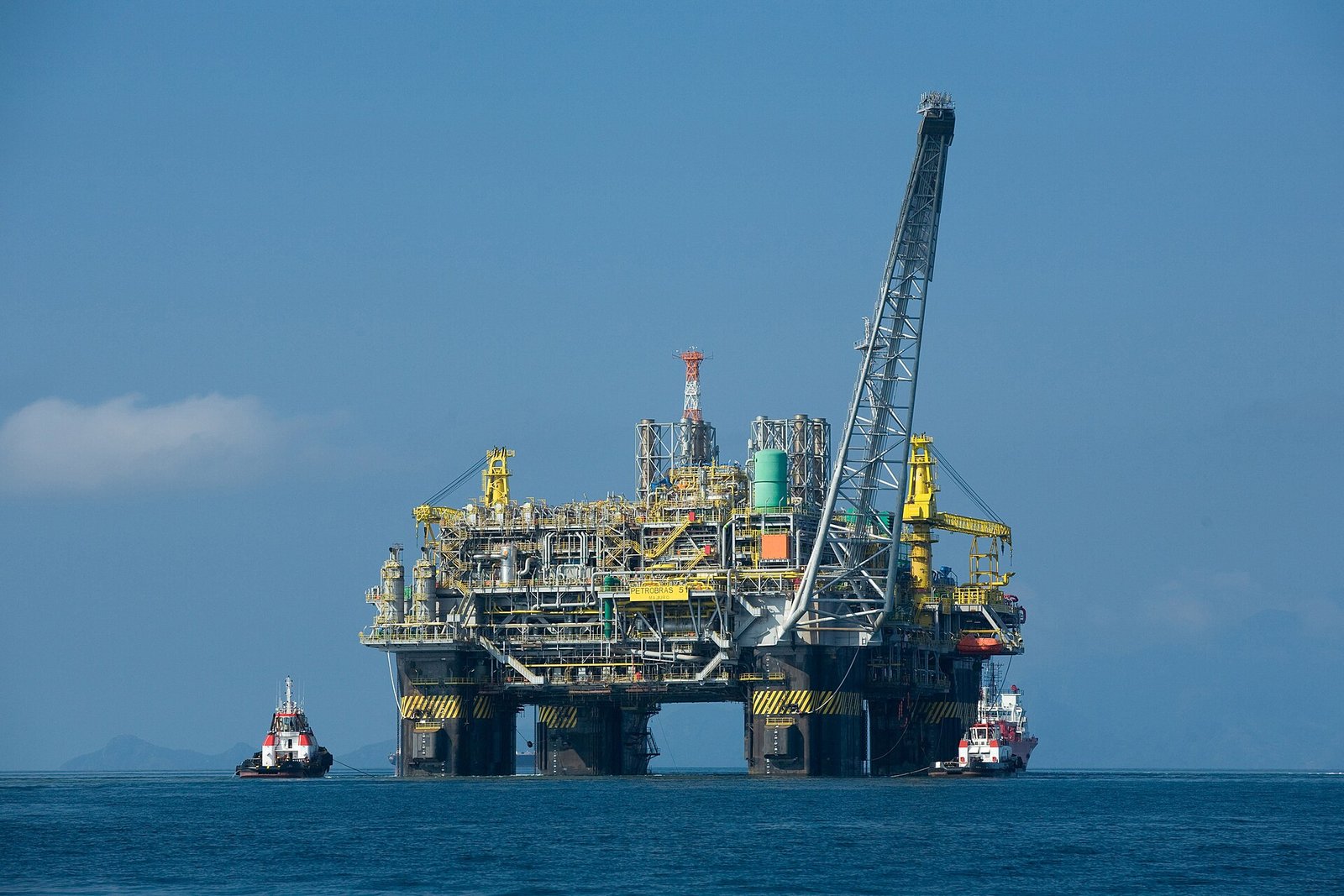
Brazil’s Oil Windfall in 2026: What the IMF Article IV Reveals About Growth, Public Debt and the Use of Hydrocarbon Revenue
Driss EFFINA, PhD Independent Researcher, Global Strategy Files Reading time: about 25 minutes
Key takeaways
- The IMF assumes an average oil price of US$89 per barrel in 2026, against US$68 in 2025, giving Brazil windfall revenue of about 0.5 percent of GDP.
- Net oil exporter gains add about 0.4 percentage points to Brazil's growth in 2026, according to the IMF Article IV staff report.
- The IMF projects gross public debt rising from 93.3 percent of GDP in 2025 to 105.3 percent in 2031.
- Only about 0.1 percent of GDP of the 2026 windfall is expected to be saved, while fuel price support costs about 0.4 percent.
Abstract
The escalation of conflict in the Middle East in 2026 pushed world oil prices sharply higher, turning Brazil, now a major net exporter of crude oil, into one of the beneficiaries of the shock. In July 2026, the Executive Board of the International Monetary Fund concluded its Article IV consultation with Brazil. The staff report assumes an average oil price of US$89 per barrel in 2026, against US$68 in 2025, estimates oil-related revenue windfalls at about 0.5 percent of GDP in 2026, and finds that the net oil-exporter gains add about 0.4 percentage points to growth this year. Yet the same report projects that general government gross debt, on the IMF definition, will rise from 93.3 percent of GDP in 2025 to 105.3 percent in 2031, and it recommends that oil windfalls be saved. This article uses the IMF data to measure the place of oil in Brazil’s macroeconomic and fiscal picture, with the author’s own calculations. The author derives the primary balance needed to stabilise public debt implied by the IMF projections, about 2.0 to 2.2 percent of GDP, and shows that it is of the same order of magnitude as total oil-related revenue, which the IMF places at 2 to 3 percent of GDP. Of the 2026 windfall, only about 0.1 percent of GDP is expected to be saved, while fuel price support measures cost about 0.4 percent of GDP, financed partly by a temporary 12 percent tax on crude oil exports. Three scenarios show that saving windfalls of 0.5 percent of GDP per year would lower the debt ratio by about 3 points by 2031, while an oil price slump could raise it by more than 3 points. The article concludes that Brazil’s oil wealth is large enough to make a difference to public finances, but only if it is managed through a rule-based fiscal framework rather than spent as it arrives.
Keywords: Brazil, oil, pre-salt, IMF Article IV, fiscal policy, public debt, resource revenue, windfall, Petrobras, natural resource management
JEL codes: E62, H63, Q32, Q33, Q48, O54
1. Introduction
Twenty years ago, Brazil was a modest oil producer, roughly self-sufficient in crude. The discovery of the vast “pre-salt” deposits in the Santos and Campos basins, announced from 2006 onwards, transformed this position. Pre-salt fields, located under a thick layer of salt several kilometres below the seabed, are among the most productive offshore fields in the world. Their development by Petrobras and international partners has made Brazil the largest oil producer in Latin America and one of the ten largest in the world. In 2024, Brazil produced on average about 3.4 million barrels of oil per day, according to the National Agency of Petroleum, Natural Gas and Biofuels (ANP), of which roughly three quarters came from pre-salt fields, and production has continued to grow as new floating production units came online. Crude oil has become one of the country’s two most important export products by value, alongside soybeans.
In 2026, this position took on a new significance. The war in the Middle East disrupted oil supply and pushed prices well above the levels expected at the start of the year. For oil importers, the shock was a cost. For Brazil, which exports a large share of its crude production, it was, on balance, a gain: higher export revenues, higher royalties and taxes, and higher dividends from Petrobras, in which the federal government is the controlling shareholder.
The IMF’s 2026 Article IV consultation with Brazil, concluded by the Executive Board on 23 July 2026, provides the most comprehensive official assessment of the macroeconomic and fiscal implications of this shock. This article uses the data and analysis of the Article IV report, together with the author’s own calculations, to answer four questions. How large is oil in Brazil’s fiscal accounts? What does the 2026 shock mean for growth, inflation and the external balance? How is the windfall being used? And what difference would a different use of oil revenue make for public debt?
Section 2 presents the context. Section 3 reviews the literature. Section 4 describes the data and methods. Section 5 presents the results. Section 6 discusses them. Section 7 presents scenarios. Section 8 concludes.
2. Context
2.1 The pre-salt and the legal framework
The pre-salt discoveries led to a significant change in the legal framework for oil. Until 2010, oil exploration in Brazil was governed by a concession regime, under which companies paid royalties and, for the most productive fields, a “special participation” tax. In 2010, a production-sharing regime was introduced for the pre-salt area, under which the state receives a share of the oil produced, managed by a public company created for this purpose, Pré-Sal Petróleo. A Social Fund was created to receive part of the government’s oil revenue and finance education and health.
Oil revenue is distributed among the federal government, producing states and municipalities, and, through special funds, non-producing states and municipalities. The distribution of royalties has been the subject of long political and legal disputes, notably between producing states such as Rio de Janeiro and Espírito Santo and the rest of the federation.
2.2 Petrobras and fuel prices
Petrobras, a mixed-economy company controlled by the federal government, dominates the Brazilian oil sector. Its pricing policy for fuels has been a recurring political issue. Between 2016 and 2023, Petrobras applied a policy of parity with international import prices, which transmitted world price fluctuations directly to domestic fuel prices. Since 2023, it has followed a policy that gives more weight to domestic costs and smooths the pass-through of international prices. The IMF notes that Petrobras remains profitable while smoothing this pass-through.
This matters for the 2026 shock. Brazil exports crude oil but imports refined products: according to the IMF, it imports about a quarter of its diesel consumption, as well as most of its fertilisers. A rise in world oil prices therefore raises export revenue but also the cost of essential imports for transport and agriculture.
2.3 The 2026 shock and the policy response
The escalation of the Middle East conflict in 2026 raised world oil prices well above the levels assumed at the start of the year. The IMF baseline, based on futures prices in mid-May 2026, assumes an average price of US$89 per barrel in 2026 and US$79 in 2027, against US$68 in 2025. The IMF’s severe downside scenario assumes about US$110 per barrel in 2026 and US$125 in 2027. By late September 2026, market prices had moved above US$105, closer to the severe scenario than to the baseline.
The Brazilian government responded with measures to limit the impact on domestic fuel prices, costing about 0.4 percent of GDP in 2026 according to the IMF, financed by a temporary ad valorem tax of 12 percent on crude oil exports and by oil revenue windfalls.
2.4 The fiscal backdrop
The oil shock occurs in a difficult fiscal context. According to the IMF, general government gross debt rose from 84.0 percent of GDP in 2023 to 93.3 percent in 2025 on the IMF definition, and from 73.8 to 78.6 percent on the authorities’ definition, which excludes government securities held by the central bank. The general government overall deficit was 7.4 percent of GDP in 2025, mainly because of high interest payments. The fiscal framework adopted in 2023 limits the growth of primary spending and sets primary balance targets, but the IMF considers that more ambitious reforms are needed to put debt on a firmly downward path.
3. Literature review
The literature on natural resource revenue is vast. Four strands are relevant here.
The first is the “resource curse” literature. Sachs and Warner (2001) documented the tendency of resource-rich countries to grow more slowly than resource-poor countries. Van der Ploeg (2011), in a comprehensive survey, showed that the curse is not inevitable and depends on institutions, the quality of governance and macroeconomic management. Frankel (2012) reviewed the mechanisms of the curse, including the volatility of commodity prices, the “Dutch disease” effect on manufacturing, and procyclical fiscal policy, and proposed remedies such as structural budget rules and independent assessment of commodity prices, inspired by the Chilean experience.
The second strand concerns the use of oil revenue at the local level in Brazil. Caselli and Michaels (2013), using the variation in offshore oil royalties received by Brazilian municipalities, found that municipalities receiving large oil windfalls reported higher spending, but that this had little measurable effect on the provision of public goods and household living standards, suggesting leakage and inefficiency. This study is directly relevant to the debate on how Brazil should use its oil revenue.
The third strand concerns the optimal intertemporal management of exhaustible resource revenue. Hartwick (1977) showed that a country can maintain consumption over time if it invests the rents from exhaustible resources in reproducible capital. The permanent income hypothesis applied to oil wealth suggests spending only the return on the accumulated wealth and saving the rest.
The fourth strand concerns fiscal frameworks for resource-rich countries. Baunsgaard, Villafuerte, Poplawski-Ribeiro and Richmond (2012), in an IMF Staff Discussion Note, recommended anchoring fiscal policy on the non-resource balance, using price-smoothing rules, and building buffers during booms. These principles underlie the recommendations of the 2026 Article IV for Brazil.
This article contributes by applying these principles to the 2026 IMF projections and by quantifying, with simple calculations, how the use of oil revenue would affect the trajectory of Brazilian public debt.
4. Data and methodology
4.1 Sources
The analysis uses:
- the IMF’s press release on the conclusion of the 2026 Article IV consultation with Brazil (23 July 2026) and its table of selected economic indicators;
- the IMF staff report for the 2026 Article IV, in particular the paragraphs on the oil shock, the use of windfalls, the fiscal framework and the oil price assumptions;
- the IMF’s press release at the end of the staff visit (1 June 2026);
- ANP statistics for the order of magnitude of oil production.
4.2 Debt-stabilising primary balance
The change in the debt ratio d between two years can be written as: d(t) minus d(t-1) = [(r minus g) / (1 + g)] × d(t-1) minus pb(t) plus stock-flow adjustments, where r is the effective nominal interest rate, g the nominal growth rate and pb the primary balance. Using the IMF projections for debt and the primary balance from 2027 to 2031, the author solves for the implied combined term (r minus g) / (1 + g), which includes stock-flow adjustments, and averages it over 2027 to 2031. The year 2026 is excluded because it includes large stock-flow adjustments. The debt-stabilising primary balance in each year is this average term multiplied by the debt ratio.
4.3 Calibration of the windfall
The IMF estimates the 2026 oil revenue windfall at about 0.5 percent of GDP. The author relates this to the increase in the assumed oil price from US$68 in 2025 to US$89 in 2026, to obtain an approximate sensitivity of oil revenue to the oil price.
4.4 Debt scenarios
Starting from the IMF baseline, the author constructs two alternative debt paths: one in which oil windfalls of 0.5 percent of GDP per year are saved (0.4 percent in 2026, since the IMF expects 0.1 percent to be saved in the baseline), and one in which an oil price slump reduces oil revenue by 0.7 percent of GDP per year from 2027. Interest effects on the accumulated difference are ignored, which slightly understates the differences.
4.5 Limitations
The analysis relies on the IMF projections, which were prepared in May and June 2026 with an oil price assumption that subsequent market developments have exceeded. The debt-stabilising balance is an approximation that includes stock-flow adjustments. The scenarios are illustrative.
5. Results
5.1 Growth and inflation
Figure 1 shows the IMF’s projections for growth and inflation.
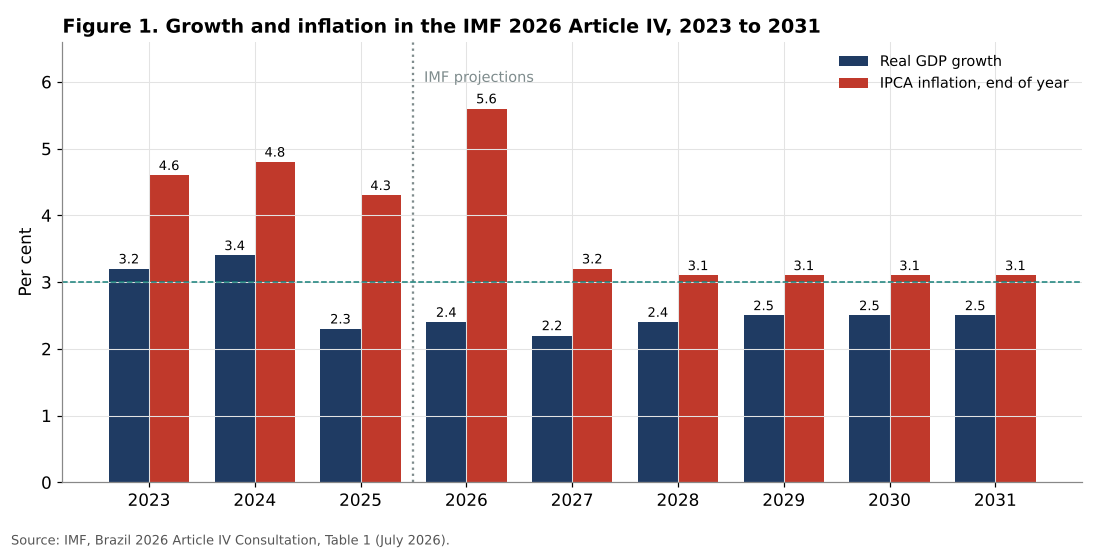
After growth of 3.2 percent in 2023 and 3.4 percent in 2024, the Brazilian economy slowed to 2.3 percent in 2025, as the very tight monetary policy weighed on household consumption. The IMF projects growth of 2.4 percent in 2026, 2.2 percent in 2027 and about 2.5 percent over the medium term. Part of the 2026 growth comes from the oil shock: the IMF estimates that the net gains of Brazil as an oil exporter add about 0.4 percentage points to growth in 2026 relative to pre-war projections, an effect that fades in 2027. The report also identifies the acceleration of hydrocarbon production as one of the structural factors supporting medium-term growth.
On inflation, the oil shock works in the opposite direction. The IMF projects IPCA inflation of 5.6 percent at the end of 2026, against 4.3 percent in 2025, before a decline to 3.2 percent in 2027 and convergence to the 3 percent target by mid-2028. Higher fuel prices, even with smoothing by Petrobras and government support measures, raise transport and food costs.
The combination is typical of an oil exporter facing an oil price shock: higher income and growth, but also higher inflation, which constrains monetary policy. The IMF considered that a slower normalisation of the policy rate than expected before the war was appropriate.
5.2 A public debt that keeps rising
Figure 2 shows the IMF’s projections for public debt.
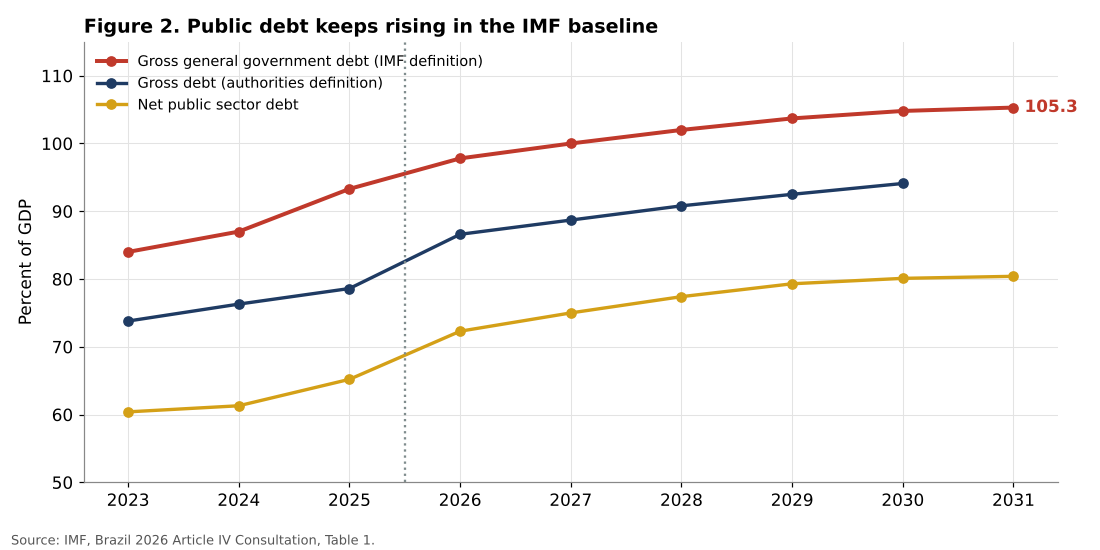
On the IMF’s definition, which includes government securities held by the central bank, general government gross debt rose from 84.0 percent of GDP in 2023 to 87.0 percent in 2024 and 93.3 percent in 2025. The IMF projects that it will continue to rise, to 97.8 percent in 2026, 100.0 percent in 2027 and 105.3 percent in 2031. On the authorities’ definition, gross debt rises from 78.6 percent in 2025 to 94.1 percent in 2030. Net public sector debt, which deducts government assets, including international reserves, rises from 65.2 percent in 2025 to 80.4 percent in 2031.
| Indicator (% of GDP) | 2025 | 2026 | 2027 | 2028 | 2029 | 2030 | 2031 |
|---|---|---|---|---|---|---|---|
| Gross debt, IMF definition | 93.3 | 97.8 | 100.0 | 102.0 | 103.7 | 104.8 | 105.3 |
| Gross debt, authorities’ definition | 78.6 | 86.6 | 88.7 | 90.8 | 92.5 | 94.1 | n.a. |
| Net public sector debt | 65.2 | 72.3 | 75.0 | 77.4 | 79.3 | 80.1 | 80.4 |
| General government primary balance | -0.1 | -0.3 | -0.2 | 0.4 | 0.7 | 1.0 | 1.1 |
| Current account balance | -2.9 | -2.5 | -2.4 | -2.1 | -1.9 | -1.8 | -1.7 |
Table 1. IMF projections for Brazil. Source: IMF, 2026 Article IV Consultation, Table 1.
The striking feature of these projections is that debt continues to rise even as the primary balance improves from a small deficit in 2025 to a surplus of 1.1 percent of GDP in 2031. The reason is the high cost of debt. With a Selic rate of 13.75 to 15 percent in 2025 and 2026 and inflation around 4 to 5 percent, the real interest rate on public debt is very high, and it exceeds the growth rate of the economy by a large margin.
5.3 The fiscal gap and oil revenue
Figure 3 compares the IMF’s projected primary balance with the debt-stabilising primary balance calculated by the author.
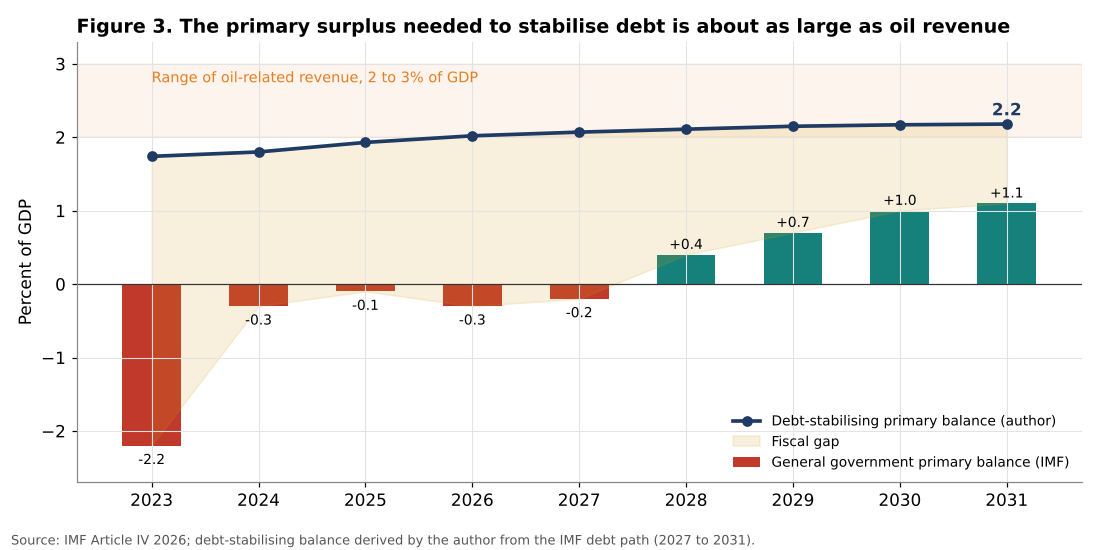
From the IMF’s debt and primary balance projections for 2027 to 2031, the author derives an implied average combined interest-growth term of about 2.1 percent of the debt stock per year. Applied to the debt ratio, this gives a debt-stabilising primary surplus of about 2.0 percent of GDP in 2026, rising to about 2.2 percent in 2031 as debt increases. The IMF’s projected primary balance, which reaches 1.1 percent of GDP in 2031, therefore falls short of the stabilising level by about 1.1 percentage points of GDP at the end of the projection period, and by more in earlier years.
The comparison with oil revenue is revealing. According to the IMF, oil-related revenue, including royalties, special participation, income taxes paid by oil companies and dividends, has fluctuated in a range of 2 to 3 percent of GDP in recent years, and is set to increase. In other words, the total oil revenue of the Brazilian state is of the same order of magnitude as the primary surplus needed to stabilise public debt. Put differently, if Brazil were able to save all of its oil revenue, it would be close to stabilising its debt; if it spends all of it, as has largely been the case, the debt continues to rise.
This comparison is not a recommendation to save all oil revenue, which would be neither realistic nor necessarily optimal. But it shows the scale of what is at stake: oil revenue is large enough to matter for the trajectory of public debt.
5.4 The 2026 windfall and how it is used
Figure 4 shows the oil price assumptions and the use of the 2026 windfall.
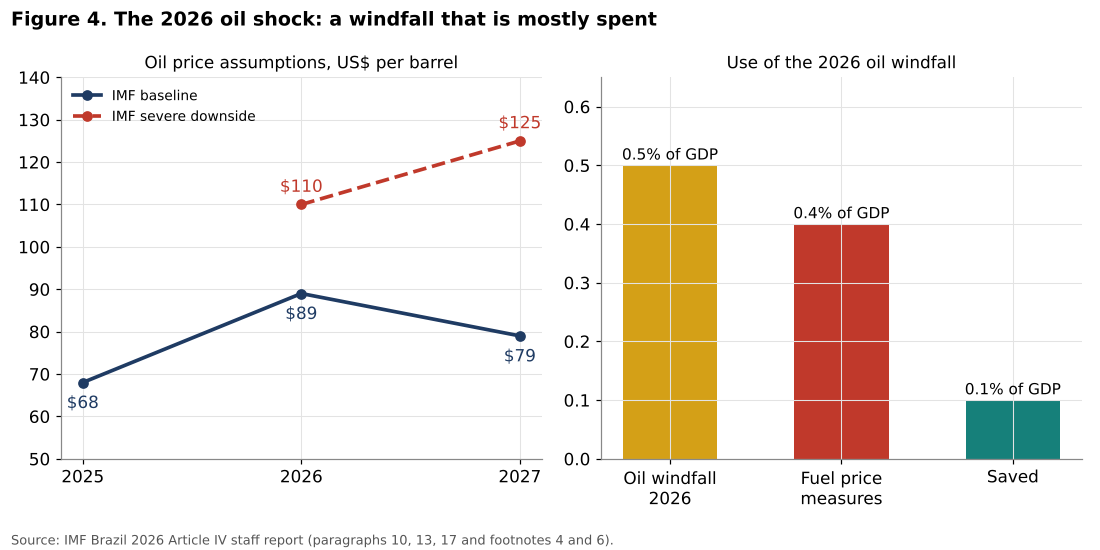
The IMF estimates the oil-related revenue windfall in 2026 at about 0.5 percent of GDP. Relating this to the increase of US$21 in the assumed average oil price between 2025 and 2026, the author obtains an approximate sensitivity of about 0.024 percent of GDP of additional revenue for each additional dollar per barrel. On this basis, a price closer to the IMF’s severe scenario, US$110 per barrel, would generate a windfall of about 1.0 percent of GDP in 2026, roughly double the baseline estimate.
How is the windfall used? According to the IMF, only about 0.1 percent of GDP is expected to be saved. The rest is largely offset, at the federal level, by social spending and transfers to subnational governments, which receive a large share of royalties. In addition, the measures to limit fuel price increases cost about 0.4 percent of GDP in 2026. They are financed partly by the windfall and partly by a new temporary tax of 12 percent on crude oil exports.
The IMF’s recommendations on this point are clear. It recommends saving oil revenue windfalls while providing only targeted and temporary support to vulnerable households. It suggests replacing the export tax with a pre-defined tax on excess profits of energy companies, which would be more predictable and less distortive, and considering market insurance, such as put options, to protect the budget against falls in oil prices, as Mexico has done for many years. More fundamentally, it recommends incorporating oil price volatility into the fiscal framework, so that spending is linked to structural revenues rather than to temporary windfalls.
5.5 The external balance and the fiscal balance
Figure 5 shows the current account and the overall fiscal balance.
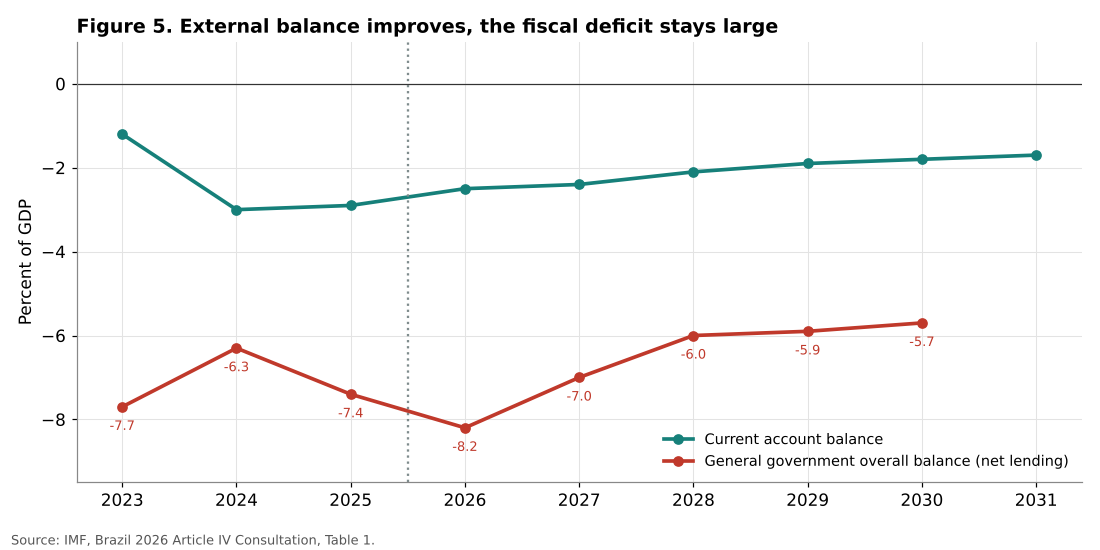
The external position benefits from oil. The IMF projects that the current account deficit will narrow from 2.9 percent of GDP in 2025 to 2.5 percent in 2026 and 1.7 percent in 2031, supported by strong exports, notably of hydrocarbons. Foreign direct investment, at about 2 percent of GDP, comfortably finances the deficit, and gross international reserves were about US$358 billion at the end of 2025. Brazil does not face an external financing problem.
The fiscal position is the opposite. The general government overall deficit (net lending and borrowing) was 7.4 percent of GDP in 2025 and is projected at 8.2 percent in 2026, before gradually narrowing to 5.7 percent in 2030. The difference between the small primary deficit and the large overall deficit is accounted for by interest payments of about 7 to 8 percent of GDP. In other words, Brazil’s fiscal problem is not mainly one of primary spending exceeding revenue, but of very high interest costs on a large debt.
This contrast between a sound external position and a fragile fiscal position is characteristic of Brazil. It means that the oil windfall, which improves both, has a stronger effect on the external accounts, where it is less needed, than on the public finances, where it is mostly spent.
5.6 Oil in the export basket and in production
Although the IMF report does not give detailed oil production figures, it confirms the growing role of hydrocarbons in Brazilian exports and growth. Brazil’s oil production has increased substantially over the past decade as pre-salt fields came online, and the deployment of new floating production, storage and offloading units by Petrobras and its partners continued in 2025 and 2026. Exploration of new frontiers, such as the Equatorial Margin off the northern coast, could extend the life of Brazilian production in the 2030s, although it raises significant environmental concerns.
The growth of oil production has changed the structure of Brazilian exports. Crude oil now competes with soybeans for the position of the country’s leading export product by value. The concentration of exports in a few commodities, soybeans, crude oil and iron ore, exposes Brazil’s terms of trade to world commodity prices, as the IMF notes in its analysis of the real exchange rate, which appreciated partly because of oil price movements.
At the same time, Brazil’s energy matrix is unusually clean. According to the IMF, renewables supply about 90 percent of electricity and about 50 percent of total energy supply. Brazil is therefore in the unusual position of being both a major oil exporter and a country with a largely renewable domestic energy system, which gives it an advantage in the energy transition but also raises questions about the long-term value of its oil reserves.
6. Discussion
6.1 The risk of a procyclical use of oil revenue
The analysis shows that the 2026 oil windfall is being used mainly to finance additional spending and fuel price support, with only a small fraction saved. This is a classic pattern in resource-rich countries, documented by Frankel (2012) and others: revenue windfalls during booms are spent, and spending is difficult to reduce when prices fall, leading to procyclical fiscal policy and rising debt.
Brazil’s municipal experience, analysed by Caselli and Michaels (2013), suggests that oil revenue spent at the local level has not been very effective in improving public services. The large share of royalties transferred to producing states and municipalities, and the rigidity of Brazilian public spending, make it difficult to save windfalls.
6.2 The case for a fiscal rule linked to oil
The IMF’s recommendation to incorporate oil price volatility into the fiscal framework deserves attention. Several countries have adopted rules that separate structural from temporary oil revenue. Chile’s structural balance rule, which uses independent committees to estimate the long-term copper price, is the best known example. Norway’s rule limits the use of oil revenue to the expected real return on its sovereign fund. Colombia has also adopted a fiscal rule that accounts for oil revenue.
For Brazil, such a rule could take the form of a reference oil price, set by an independent committee, above which oil revenue would be automatically saved, for example in a stabilisation fund or by reducing debt. The calculations in this article suggest that saving windfalls of the order of 0.5 percent of GDP per year would make a measurable difference to the debt trajectory.
6.3 Fuel price policy
The fuel price measures adopted in 2026 reflect a political reality: in a country where road transport dominates and diesel prices affect food prices, governments are under strong pressure to limit fuel price increases. But untargeted fuel subsidies are costly and benefit higher-income households, which consume more fuel, more than the poor. Targeted support, through cash transfers to low-income households and specific support for public transport, would be more efficient. The export tax on crude oil, while providing revenue, introduces a distortion in the incentives for oil production and exports, which is why the IMF recommends replacing it with a predictable tax on excess profits.
6.4 The long-term question
Beyond the 2026 shock, the long-term question is how Brazil should manage its oil wealth in a world that is gradually moving away from fossil fuels. If demand for oil declines in the 2040s and 2050s, oil reserves that are not produced in the coming decades may lose much of their value. This argues for continued development of existing fields, but also for saving a larger share of the revenue they generate, to transform a depleting natural asset into financial or productive assets, following the Hartwick rule.
Brazil’s clean electricity system, its potential in renewables, biofuels and green hydrogen, and its agricultural strength give it alternatives to oil as a source of long-term growth. The Ecological Transformation Plan, which the IMF encourages Brazil to implement, aims to exploit these advantages. Oil revenue saved today could finance part of this transformation.
6.5 The interaction with monetary policy
The oil shock also complicates monetary policy. Higher fuel prices raise inflation, which leads the central bank to maintain high interest rates, which in turn raises the cost of public debt. Saving the windfall would reduce aggregate demand and help the central bank, allowing a faster reduction of interest rates and therefore lower interest payments. In this sense, fiscal prudence in the use of oil revenue has a double dividend: it reduces debt directly and indirectly, through lower interest rates.
6.6 Petrobras between the state and the market
Petrobras occupies a dual position that complicates the management of oil revenue. As a listed company with private shareholders, it must be run profitably and pay dividends according to its policy. As a company controlled by the federal government, it is also expected to contribute to public objectives, including the stability of fuel prices and investment in refining and energy transition projects. Each of these roles has a fiscal cost or benefit. Higher dividends raise federal revenue in the short term; lower fuel prices protect consumers but reduce the company’s profits and future dividends; higher investment may raise production and revenue in the long term. A clear and stable framework defining these trade-offs, separate from short-term political pressures, would make oil revenue more predictable and easier to manage within a fiscal rule.
7. Scenarios to 2031
7.1 Three debt paths
Figure 6 presents three paths for gross general government debt on the IMF definition.
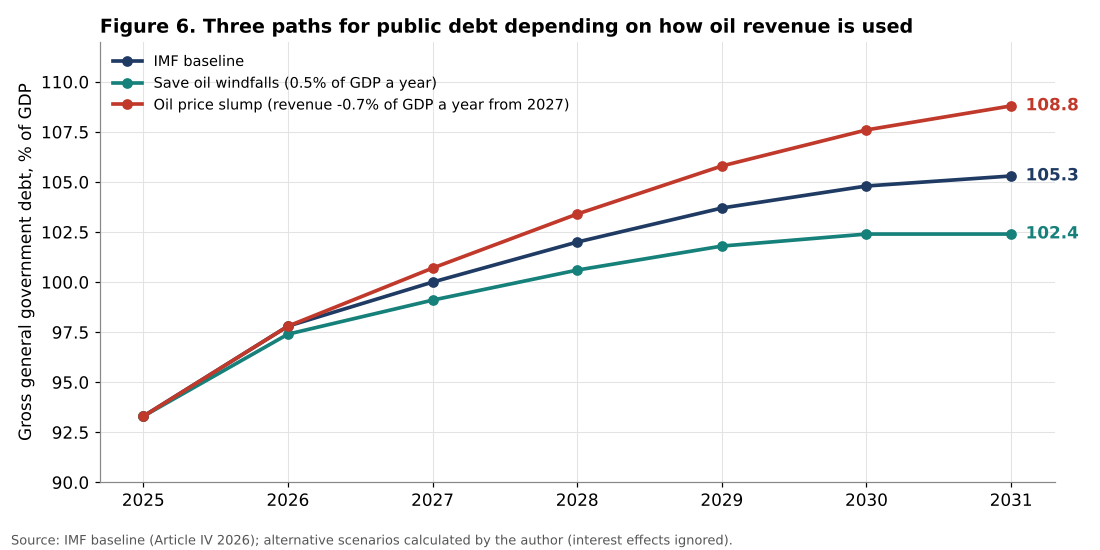
IMF baseline. Debt rises from 93.3 percent of GDP in 2025 to 105.3 percent in 2031. Only about 0.1 percent of GDP of the 2026 oil windfall is saved.
Saving oil windfalls. Brazil saves an additional 0.4 percent of GDP in 2026 and 0.5 percent of GDP per year from 2027 to 2031, through a rule that allocates oil revenue above a reference price to debt reduction. Debt reaches about 102.4 percent of GDP in 2031, about 3 points below the baseline. Taking into account the lower interest payments on the reduced debt, the difference would be somewhat larger.
Oil price slump. Oil prices fall sharply from 2027, for example because of the end of the conflict and weaker world demand, reducing oil revenue by 0.7 percent of GDP per year relative to the baseline without offsetting spending cuts. Debt reaches about 108.8 percent of GDP in 2031, about 3.5 points above the baseline.
7.2 Interpretation
The difference between the best and worst scenarios is about 6 points of GDP in 2031. This is significant, but it also shows that oil alone cannot solve Brazil’s debt problem. Even in the scenario where windfalls are saved, debt continues to rise until 2030 and only stabilises at the end of the period. Stabilising debt at a lower level requires broader reforms, including reducing spending rigidities, rationalising tax expenditures and lowering the cost of debt through greater fiscal credibility, as the IMF recommends.
The scenarios also illustrate the asymmetry of oil risk. If oil prices remain high, as they were in late 2026, the windfall could be twice as large as in the IMF baseline, and saving it would have a larger effect. If prices fall, the loss of revenue would add to debt unless spending is adjusted. A fiscal rule that saves windfalls in good years would provide a buffer for bad years.
7.3 How a simple oil revenue rule would work
To make the idea of an oil rule concrete, the author applies the sensitivity estimated above, about 0.024 percent of GDP of revenue per dollar per barrel, to a hypothetical rule with a reference price of US$70 per barrel, close to the 2025 average. Under such a rule, revenue generated by prices above the reference would be saved, and revenue shortfalls below it would be covered by drawing on the savings.
| Average oil price (US$ per barrel) | Revenue relative to the reference price (% of GDP) | Rule outcome |
|---|---|---|
| 60 | -0.24 | Draw on savings |
| 70 | 0.00 | Neutral |
| 79 (IMF 2027 baseline) | +0.21 | Save |
| 89 (IMF 2026 baseline) | +0.45 | Save |
| 110 (IMF severe scenario 2026) | +0.95 | Save |
| 125 (IMF severe scenario 2027) | +1.31 | Save |
Table 2. Illustrative oil revenue rule with a reference price of US$70. Source: calculations by the author based on the IMF windfall estimate.
The table shows that in 2026 and 2027, under any of the IMF’s price assumptions, such a rule would have required saving between about 0.2 and 1.3 percent of GDP per year. Over two years at the severe scenario prices, the cumulative saving would exceed 2 percent of GDP. Conversely, if prices fell to US$60, the rule would allow the budget to draw about 0.24 percent of GDP from the accumulated savings, cushioning the adjustment. The reference price itself should be set by an independent committee on the basis of long-term price expectations, as in Chile, to avoid the temptation to raise it during booms.
The practical difficulty is that a large part of oil revenue accrues to states and municipalities through royalties and special participation, and to the federal government through Petrobras dividends, which depend on decisions of the company’s board. A national rule would therefore need to cover several levels of government and several revenue streams, which requires political agreement within the federation. This complexity is one reason why Brazil, unlike Norway or Chile, has never adopted a comprehensive rule for its resource revenue, despite the creation of the pre-salt Social Fund.
7.4 Indicators to monitor
1. The oil price and the Petrobras fuel pricing decisions. 2. Monthly federal revenue from royalties, special participation and dividends. 3. The duration of the temporary export tax on crude oil and any replacement by an excess profits tax. 4. ANP data on oil production, especially from new pre-salt units. 5. The trajectory of the primary balance and of gross debt compared with the IMF projections.
8. Conclusion
This article has examined the role of oil in Brazil’s macroeconomic and fiscal position in 2026, using the IMF’s 2026 Article IV consultation and the author’s own calculations. The main conclusions are:
1. The 2026 oil shock benefits Brazil as a net oil exporter, adding about 0.4 percentage points to growth and improving the external balance, but it also raises inflation, which the IMF projects at 5.6 percent at the end of 2026. 2. Public debt continues to rise in the IMF baseline, from 93.3 percent of GDP in 2025 to 105.3 percent in 2031 on the IMF definition, because of very high interest costs. 3. The primary surplus needed to stabilise debt, about 2.0 to 2.2 percent of GDP according to the author’s calculation, is of the same order of magnitude as total oil-related revenue, which the IMF places at 2 to 3 percent of GDP. 4. Of the 2026 windfall of about 0.5 percent of GDP, only about 0.1 percent is expected to be saved, while fuel price measures cost about 0.4 percent of GDP. 5. Saving windfalls of about 0.5 percent of GDP per year would lower the debt ratio by about 3 points by 2031, while an oil price slump could raise it by about 3.5 points.
Brazil’s oil wealth is a significant asset, large enough to make a difference to its public finances. But the experience of 2026 suggests that, without an explicit rule, windfalls tend to be spent as they arrive. A fiscal framework that separates structural from temporary oil revenue, as the IMF recommends, would turn this volatile income into a stable source of fiscal strength, and would help Brazil prepare for a future in which oil may be worth less than it is today.
Need this analysis for your organisation?
We prepare confidential briefings, executive talks and studies on countries, markets and policies, built on the same method as this article.
Request a briefingSupport independent analysis
Our studies are free to read and carry no advertising. If this one was useful, a small contribution helps us publish the next.
Support our workGo further: books by Global Strategy Files


Frequently asked questions
How does the 2026 oil price shock affect Brazil?
Brazil benefits as a net oil exporter. The IMF assumes oil at US$89 per barrel in 2026 against US$68 in 2025, estimates windfall revenue at about 0.5 percent of GDP and finds that net oil exporter gains add about 0.4 percentage points to growth.
What does the IMF say about Brazil’s public debt?
The IMF’s 2026 Article IV projects general government gross debt rising from 93.3 percent of GDP in 2025 to 105.3 percent in 2031. Stabilising debt would require a primary surplus of about 2.0 to 2.2 percent of GDP.
Is Brazil saving its oil windfall?
Mostly not. Of the 2026 windfall of about 0.5 percent of GDP, only about 0.1 percent is expected to be saved, while fuel price support measures cost about 0.4 percent of GDP, financed partly by a temporary 12 percent tax on crude oil exports.
How could oil revenue help stabilise Brazil’s debt?
Total oil-related revenue, at 2 to 3 percent of GDP, is of the same order as the primary surplus needed to stabilise debt. Saving windfalls of 0.5 percent of GDP a year would lower the debt ratio by about 3 points by 2031.
Methodological note
The macroeconomic data and projections are from the IMF’s 2026 Article IV consultation with Brazil (press releases of 1 June and 23 July 2026 and the staff report). The debt-stabilising primary balance is derived by the author from the IMF’s projections of debt and primary balance for 2027 to 2031, solving the debt dynamics equation for the implied interest-growth term. The sensitivity of oil revenue to oil prices is a simple calibration on the IMF’s estimate of the 2026 windfall. The debt scenarios modify the IMF baseline by the stated amounts and ignore second-round interest effects. Oil production figures are orders of magnitude from ANP.
References
Baunsgaard, T., Villafuerte, M., Poplawski-Ribeiro, M. and Richmond, C. (2012). Fiscal Frameworks for Resource Rich Developing Countries. IMF Staff Discussion Note SDN/12/04. International Monetary Fund.
Caselli, F. and Michaels, G. (2013). Do Oil Windfalls Improve Living Standards? Evidence from Brazil. American Economic Journal: Applied Economics, 5(1), 208 to 238.
Frankel, J. A. (2012). The Natural Resource Curse: A Survey of Diagnoses and Some Prescriptions. In R. Arezki, C. Pattillo, M. Quintyn and M. Zhu (eds.), Commodity Price Volatility and Inclusive Growth in Low-Income Countries. International Monetary Fund, Washington, DC.
Hartwick, J. M. (1977). Intergenerational Equity and the Investing of Rents from Exhaustible Resources. American Economic Review, 67(5), 972 to 974.
International Monetary Fund (2026). IMF Staff Completes 2026 Article IV Visit to Brazil. Press Release No. 26/179, 1 June 2026.
International Monetary Fund (2026). IMF Executive Board Concludes 2026 Article IV Consultation with Brazil. Press Release No. 26/257, 23 July 2026.
International Monetary Fund (2026). Brazil: 2026 Article IV Consultation, Staff Report. Washington, DC.
Sachs, J. D. and Warner, A. M. (2001). The Curse of Natural Resources. European Economic Review, 45(4 to 6), 827 to 838.
Van der Ploeg, F. (2011). Natural Resources: Curse or Blessing? Journal of Economic Literature, 49(2), 366 to 420.
