
Germany’s Car Industry in 2026: Why the Electric Boom at Home Is Not Reviving National Production

Germany’s Car Industry in 2026: Why the Electric Boom at Home Is Not Reviving National Production
Driss EFFINA, PhD Independent Researcher, Global Strategy Files Reading time: about 26 minutes
Key takeaways
- Battery electric cars took 34.5 percent of German new car registrations in September 2026, outnumbering petrol and diesel combined for the first time.
- German car production fell 4 percent in the first nine months of 2026, to about 15 percent below its 2019 level.
- About 80 percent of the 1.5 million cars of production lost between 2017 and 2025 is explained by lower exports.
- Foreign brands accounted for 45.9 percent of electric car registrations in Germany in September 2026.
Abstract
In September 2026, battery electric cars accounted for 34.5 percent of new car registrations in Germany, and for the first time in a single month they outnumbered petrol and diesel cars combined. Including plug-in hybrids, electric drives took 45.3 percent of the market. Yet in the same month, foreign orders for German manufacturers fell by 16 percent, production in German plants was flat, and over the first nine months of 2026 production fell by 4 percent, to about 15 percent below its 2019 level. Employment in the industry has fallen to its lowest level since the comparable series began in 2005. This article asks why the rapid electrification of the German market has not translated into a recovery of German car production. It uses data from the German Association of the Automotive Industry (VDA) and the Federal Motor Transport Authority (KBA) and constructs four original indicators: a decomposition of the fall in production since 2017 into exports and domestic deliveries, an estimate of 2026 annual volumes, a proxy for the share of the German market supplied by domestic production, and three production scenarios to 2030. The results show that about 80 percent of the 1.5 million cars of production lost between 2017 and 2025 is explained by lower exports, not by a weaker home market. Production in 2026 is estimated at about 3.98 million cars, 29.5 percent below 2017. The German market itself, at about 3.0 million registrations, remains about 17 percent below its 2019 level, and an increasing share of electric demand is met by imported brands: foreign brands accounted for 45.9 percent of electric registrations in September 2026. The article concludes that German car production depends far more on world markets than on the domestic transition, and that electrification at home cannot by itself offset the loss of export markets, notably in China and the United States.
Keywords: Germany, automobile industry, electric vehicles, exports, industrial production, China, tariffs, employment, industrial policy
JEL codes: L62, F14, F23, O14, Q55, R11
1. Introduction
For more than half a century, the car industry has been the backbone of German manufacturing. It is the country’s largest industrial sector by turnover, its leading exporter, and a symbol of its engineering reputation. Its brands, from Volkswagen and Mercedes-Benz to BMW and Porsche, are known throughout the world, and its supply chains employ hundreds of thousands of people in small and medium-sized firms across the country.
Since 2018, the industry has faced a succession of shocks: the diesel emissions scandal and new testing procedures, the semiconductor shortage, the pandemic, the energy crisis, and the rise of Chinese competition in electric vehicles. Each time, observers expected a recovery. Each time, it proved partial.
In 2026, the domestic market sends a mixed signal. On the one hand, the German market is electrifying faster than ever. Driven by a new purchase subsidy introduced in May 2026 and by falling vehicle prices, battery electric registrations rose by 58 percent in the first nine months of the year, and by 95 percent in September alone. On the other hand, production in German plants is falling, foreign orders are declining, and employment continues to shrink.
This contrast is the subject of the present article. Its central question is simple: why does the electric boom at home not revive German car production? Answering it requires measuring where the industry has lost volume, how much of the domestic market is supplied by domestic plants, and how dependent production is on exports.
The article is organised as follows. Section 2 sets out the context. Section 3 reviews the literature. Section 4 describes the data and methodology. Section 5 presents the results. Section 6 discusses them. Section 7 presents scenarios to 2030. Section 8 concludes.
2. Context
2.1 An export industry
German car production has always been oriented towards exports. According to the VDA, Germany exported 4.4 million passenger cars in 2015 and 2016, more than three quarters of its production. In 2025, it exported 3.17 million cars, 76.5 percent of production. Germany’s car manufacturers also produce large volumes abroad, in China, the United States, Mexico, Spain and Central Europe, and these foreign plants have grown in importance over the past two decades.
2.2 The production decline since 2017
German passenger car production peaked at about 5.7 million cars in 2015 to 2017. It fell to 5.1 million in 2018, when new emissions testing procedures (WLTP) disrupted model approvals, to 4.7 million in 2019, then collapsed to 3.5 million in 2020 and 3.1 million in 2021 because of the pandemic and the semiconductor shortage. It recovered to 4.1 million in 2023 and has remained around that level: 4.07 million in 2024 and 4.15 million in 2025.
2.3 The electric transition
The German market for electric cars has been strongly influenced by subsidies. The environmental bonus (Umweltbonus), introduced in 2016 and greatly increased in 2020, drove battery electric registrations from about 63,000 in 2019 to 524,000 in 2023. Its abrupt end in December 2023 caused a fall to 381,000 in 2024. In 2025, registrations recovered to more than 545,000, a market share of 19.1 percent. In May 2026, a new subsidy programme was launched, offering up to 6,000 euros for a new electric car depending on household income and the number of children. By early October, more than 100,000 applications had been approved, and the government had budgeted for about 800,000 electric and plug-in hybrid vehicles.
2.4 Trade policy
The industry operates in an increasingly hostile trade environment. In October 2024, the European Union imposed countervailing duties of up to 35.3 percent on battery electric cars imported from China, on top of the standard 10 percent tariff. In 2025, the United States imposed tariffs on imported cars; a framework agreement between the United States and the European Union in the summer of 2025 set a tariff of 15 percent on European cars, much higher than the 2.5 percent that applied before. Meanwhile, the Chinese market, which had been the most profitable market for German manufacturers for two decades, has become dominated by domestic brands, especially in electric vehicles.
2.6 The regulatory framework
The electrification of the European market is driven not only by subsidies but by regulation. European Union rules set fleet average limits on carbon dioxide emissions for new cars, which become stricter over time and are designed to make the sale of new combustion cars progressively uneconomic, with a target of zero emissions for new cars from 2035. Manufacturers that exceed their limits face penalties, which gives them a strong incentive to sell electric cars, if necessary at reduced margins. In 2025, the European Union gave manufacturers more flexibility by allowing compliance to be averaged over several years, and the debate on the 2035 target has continued since then.
For German manufacturers, these rules mean that the share of electric cars in their European sales must rise rapidly, regardless of demand conditions in individual countries. This creates a strong incentive to produce affordable electric models, but also to produce them where costs are lowest, which is not always Germany.
2.5 The situation in September 2026
The VDA and KBA figures for September 2026 summarise the situation:
| Indicator | September 2026 | Change | January to September 2026 | Change |
|---|---|---|---|---|
| New registrations | 256,800 | +9% | 2.22 million | +5% |
| of which battery electric | 88,600 | +95% | 604,100 | +58% |
| of which plug-in hybrid | 27,700 | 0% | 247,500 | +14% |
| Production in Germany | 392,200 | 0% | 3.03 million | -4% |
| Exports | 288,800 | +1% | 2.29 million | -4% |
| Domestic orders | n.a. | +4% | n.a. | n.a. |
| Foreign orders | n.a. | -16% | n.a. | n.a. |
Table 1. German car market and production, 2026. Source: VDA, KBA.
According to Destatis data published in August 2026, the industry employed 691,500 people at the end of June 2026, 42,300 fewer than a year earlier (-5.8 percent), the lowest level since the comparable series began in 2005. The ifo business climate index for the car industry fell to -35.0 in September from -22.0 in August.
3. Literature review
Four strands of literature help to interpret the situation.
The first concerns the location of multinational production. Head and Mayer (2019) studied how car manufacturers choose where to produce the models they sell in different markets. They showed that frictions such as distance, tariffs and the costs of coordinating production abroad shape the location of production, and that trade agreements and tariffs shift production between countries. This framework helps to understand why German manufacturers increasingly produce for the Chinese and American markets in local plants, and why higher tariffs accelerate this shift.
The second strand concerns the effects of trade shocks on manufacturing regions. Autor, Dorn and Hanson (2013) documented the impact of Chinese import competition on local labour markets in the United States. Dauth, Findeisen and Suedekum (2014) showed that, for Germany, the rise of China and Eastern Europe had a net positive effect in the 2000s, because German exports to these regions grew faster than imports from them. The current situation can be read as the reversal of this favourable configuration: China has become a competitor rather than a market.
The third strand concerns electrification. The International Energy Agency’s Global EV Outlook reports document the rapid growth of electric car sales worldwide, the dominance of China in production and battery supply chains, and the falling cost of electric vehicles. These reports show that the global electric market is increasingly supplied by Chinese manufacturers, both in China and abroad.
The fourth strand concerns European industrial competitiveness. The report on the future of European competitiveness prepared by Mario Draghi for the European Commission in 2024 identified the car industry as a sector where Europe risked losing its leadership because of high energy costs, slow adoption of new technologies and dependence on Chinese battery supply chains.
This article adds to these studies a quantitative decomposition of the German production decline, which shows the relative weight of export markets and the domestic market.
4. Data and methodology
4.1 Data
The analysis uses:
- VDA annual data on passenger car exports (1957 to 2025) and the export ratio for 2024 and 2025;
- VDA annual data on passenger car production in Germany, 2015 to 2025, with 2024 and 2025 derived as exports divided by the export ratio;
- KBA data on new registrations by drive type, 2015 to 2025, and monthly releases for 2026;
- VDA monthly releases on production, exports and orders, September 2026;
- Destatis data on employment in the industry, as reported in October 2026.
4.2 Estimates for 2026
Annual 2026 values are estimated by applying the year-on-year changes for January to September 2026 to the 2025 annual totals: production -4 percent, exports -4 percent, registrations +5 percent, battery electric registrations +58 percent. This assumes that the last quarter follows the trend of the first three.
4.3 Decomposition of the production decline
Production can be written as the sum of exports and domestic deliveries (production that is not exported). The change in production between two years is therefore the sum of the change in exports and the change in domestic deliveries. This identity ignores changes in stocks, which can be significant in a given year but are small over long periods.
4.4 Domestic supply proxy
To estimate how much of the German market is supplied by German plants, the author divides domestic deliveries (production minus exports) by new registrations. This is a proxy: it ignores stocks and the fact that some domestic deliveries may be registered as commercial vehicles or later exported as used cars. But its evolution over time gives a useful indication.
4.5 Limitations
The production figures for 2024 and 2025 are derived from VDA export data and export ratios. KBA figures include cars produced by German brands abroad and imported into Germany, such as Volkswagen group cars produced in Spain, the Czech Republic or Slovakia. The domestic supply proxy therefore measures production in German plants, not sales of German brands.
5. Results
5.1 Five years below the old level
Figure 1 shows production, exports and new registrations from 2015 to 2026.
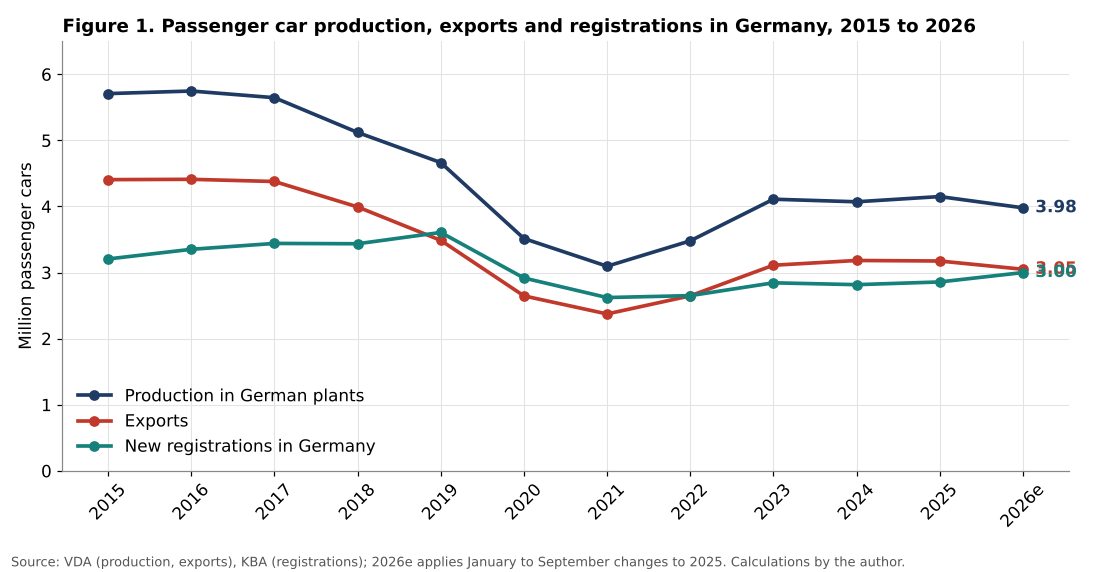
The three series tell a clear story. Production and exports fell sharply between 2017 and 2021 and recovered partially in 2022 and 2023, but they have stagnated since then and are falling again in 2026. On the author’s estimates, production will reach about 3.98 million cars in 2026, 29.5 percent below 2017, and exports about 3.05 million, 30 percent below 2017.
New registrations, by contrast, are more stable. They fell from 3.6 million in 2019 to 2.6 million in 2021 and have since recovered to about 2.86 million in 2025 and about 3.0 million in 2026. This is still about 17 percent below the 2019 level, which reflects the high price of new cars, the weakness of consumer confidence and the uncertainty about electric technology that many households felt during the long debate over subsidies.
The export ratio, measured as exports divided by production, has remained remarkably stable at 75 to 78 percent throughout the period. In 2025 it was 76.5 percent. German car production is therefore not becoming less export-oriented; it is shrinking in absolute terms while maintaining the same structure.
| Year | Production (million) | Exports (million) | Export ratio (%) | Registrations (million) |
|---|---|---|---|---|
| 2017 | 5.65 | 4.38 | 77.5 | 3.44 |
| 2019 | 4.66 | 3.49 | 74.8 | 3.61 |
| 2021 | 3.10 | 2.37 | 76.7 | 2.62 |
| 2023 | 4.11 | 3.11 | 75.7 | 2.85 |
| 2025 | 4.15 | 3.17 | 76.5 | 2.86 |
| 2026e | 3.98 | 3.05 | 76.6 | 3.00 |
Table 2. Production, exports and registrations. Source: VDA, KBA; 2026 estimates by the author.
5.2 Where the volume was lost
Figure 2 decomposes the fall in production since 2017.
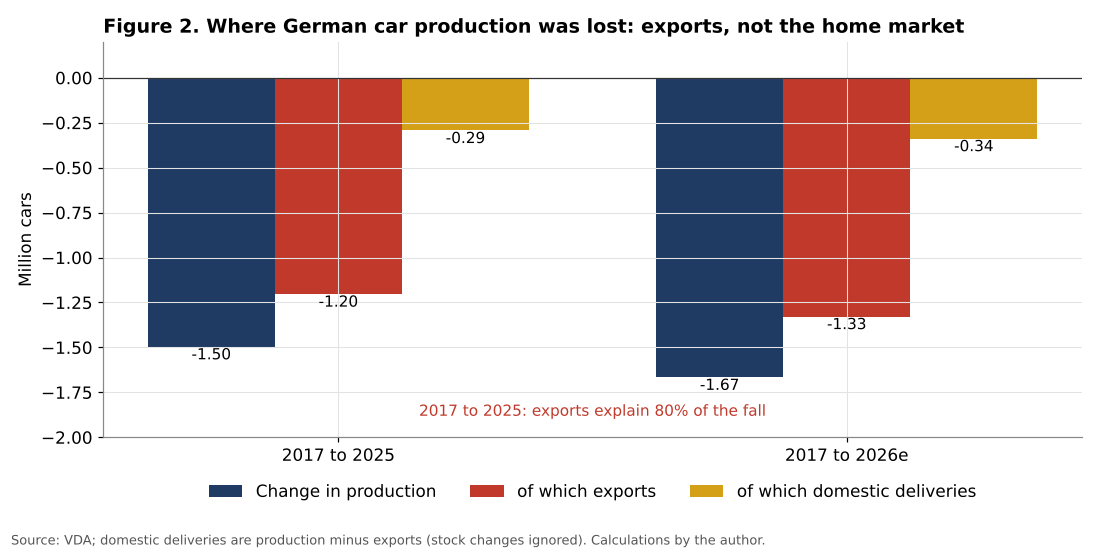
Between 2017 and 2025, German production fell by about 1.50 million cars. Of this fall, about 1.20 million, or 80 percent, is explained by lower exports, and only about 0.29 million, or 20 percent, by lower domestic deliveries. Between 2017 and 2026, on the author’s estimates, the fall reaches about 1.67 million cars, of which 1.33 million comes from exports.
This decomposition contains the main answer to the question of the article. The German car industry has lost volume primarily in foreign markets. Even a full recovery of the domestic market would not restore production to its former level, because the domestic market absorbed only about 1.27 million German-built cars in 2017 and about 0.98 million in 2025. The 1.2 million cars of lost exports are almost as large as total domestic deliveries.
Several factors explain the decline in exports. Demand in Europe, the main export destination, has been weak since the pandemic. German manufacturers have shifted production of some models to plants in lower-cost countries, notably in Central and Eastern Europe and Spain. Exports to China have fallen as Chinese consumers have turned to domestic brands, especially for electric cars. And exports to the United States have been affected by the 2025 tariffs, although some manufacturers have also expanded their American plants.
5.3 The electric surge at home
Figure 3 shows battery electric registrations and their market share.
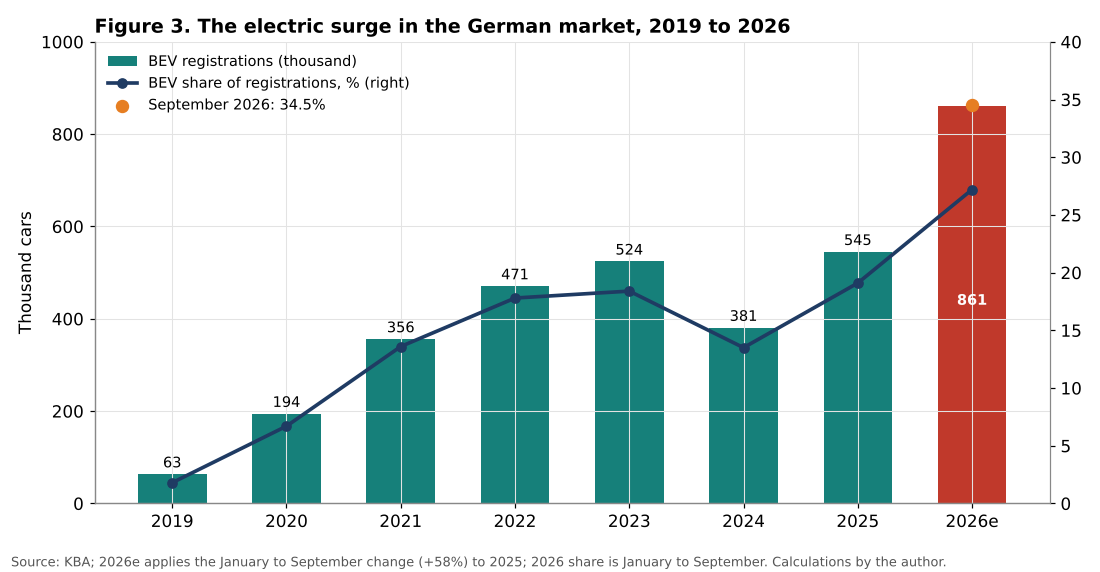
The electrification of the German market is spectacular. Battery electric registrations reached 604,100 in the first nine months of 2026, 58 percent more than a year earlier, and their market share rose to 27.2 percent, compared with 19.1 percent in 2025 and 13.5 percent in 2024. In September 2026 alone, the share reached 34.5 percent. If the trend continues, the author estimates that about 860,000 battery electric cars will be registered in 2026, by far a record.
The new subsidy has played a major role. Private registrations of electric cars rose by 171 percent in September, and electric cars accounted for 48.7 percent of private new car purchases in that month. Fleet registrations, which had previously driven the electric market, grew more slowly.
The growth of electric demand is also visible in orders. Domestic orders for electric cars from German manufacturers rose by 79 percent in September and by 66 percent over the first nine months.
5.4 Home demand up, foreign demand down
Figure 4 contrasts domestic and foreign orders.
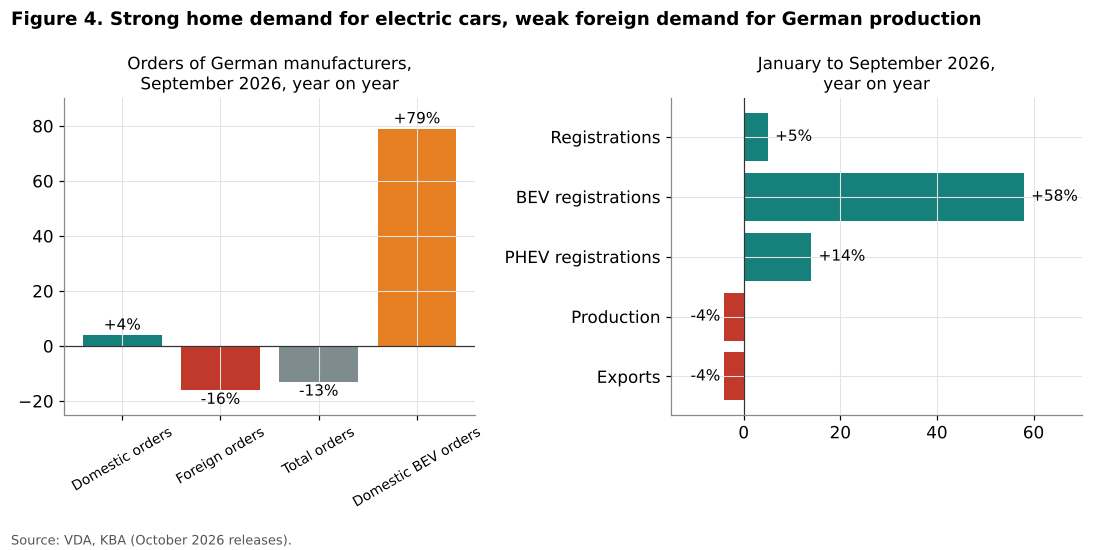
In September 2026, domestic orders rose by 4 percent, but foreign orders fell by 16 percent, so that total orders fell by about 13 percent. Over the first nine months, registrations in Germany rose by 5 percent and battery electric registrations by 58 percent, but production and exports both fell by 4 percent.
This divergence shows that the domestic electric boom is too small to compensate for the loss of foreign demand. Since about three quarters of German production is exported, a 16 percent fall in foreign orders weighs much more on production than a 4 percent rise in domestic orders.
5.5 Who supplies the German market?
Figure 5 shows the share of the German market supplied by domestic deliveries of cars built in Germany.
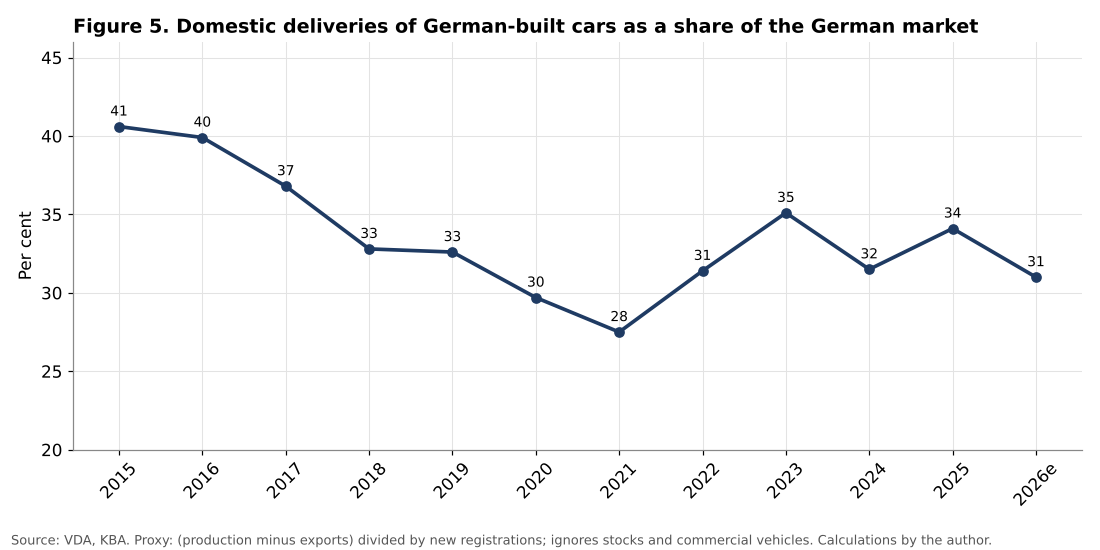
The proxy fell from about 41 percent in 2015 to about 30 percent in 2020 and 28 percent in 2021, recovered to 35 percent in 2023, and stood at about 34 percent in 2025. The author estimates that it will fall to about 31 percent in 2026, because registrations are rising while production is falling.
In other words, about two thirds of the new cars registered in Germany are imported, including cars of German brands produced in other European countries. The electric surge is accentuating this trend, because a large part of electric demand is met by imported models. According to the importers’ association VDIK, import brands accounted for 45.9 percent of battery electric registrations in September 2026 (40,627 cars, more than double the number a year earlier), and for 44.6 percent of the total car market in the first nine months of the year. Tesla registered 12,552 cars in September (+269 percent), and Chinese brands such as BYD, Leapmotor and Xpeng recorded strong growth from a low base. The best-selling electric model of the first nine months, the Skoda Elroq, is produced by a Volkswagen group brand in the Czech Republic.
The German subsidy programme, which does not discriminate according to the place of production, thus supports demand in Germany, but a significant part of this demand benefits plants located outside Germany.
5.6 Employment
The fall in production has consequences for employment. With 691,500 employees at the end of June 2026, the industry has lost 42,300 jobs in one year and is at its lowest level since the comparable statistical series began in 2005. Several manufacturers and suppliers have announced restructuring plans involving tens of thousands of jobs over the coming years. The transition to electric vehicles also changes the nature of employment: electric powertrains have fewer components than combustion engines, which reduces the need for labour in engine and transmission production, a traditional strength of German suppliers.
5.7 Electric production in German plants
The decline in total production hides a shift in its composition. According to the VDA, German plants produced about 1.56 million electric cars, battery electric and plug-in hybrid combined, in the first eleven months of 2025, a record. Relative to total production of about 4.15 million cars in 2025, this suggests that roughly two cars in five built in Germany already have an electric drive. In other words, the German industry is not standing still: it is converting its plants to electric models at a rapid pace.
This conversion, however, takes place within a shrinking total. The arithmetic is simple. If electric production rises while total production falls, combustion production is falling even faster. Each combustion car that is no longer produced removes demand for engines, gearboxes, exhaust systems and fuel injection components, which are the specialities of many German suppliers. Electric cars have their own components, notably batteries, power electronics and electric motors, but a large part of the value of a battery comes from cells, and the cell industry is dominated by Asian producers, many of which have built plants in Central Europe rather than in Germany.
The value added per car produced in Germany therefore depends on where the battery cells come from. A German-assembled electric car with imported cells contains less domestic value added than a combustion car with a German engine. This is one of the reasons why the electric transition, even when it takes place in German plants, does not automatically preserve the industrial base.
5.8 Prices and the size of the market
The German market remains about 17 percent below its 2019 size. One explanation is price. New car prices rose substantially between 2020 and 2023, because of supply shortages, higher material costs and a shift of manufacturers towards larger and more expensive models, which offered higher margins when volumes were constrained. Many households postponed purchases or turned to the used car market.
The electric segment has recently become more affordable, as battery costs have fallen and new, smaller models have entered the market, including models from Chinese brands. The new subsidy, worth up to 6,000 euros for lower and middle income households, has further reduced the effective price. The rise of private electric registrations by 171 percent in September 2026 shows that price is a decisive factor for private buyers.
This has an important implication for German production. The segment that is growing fastest, affordable electric cars for private buyers, is the one in which German manufacturers have historically been least present and where Chinese and other foreign brands are most competitive. The premium segment, where German brands are strongest, is growing more slowly.
6. Discussion
6.1 An export problem, not a market problem
The main finding of this analysis is that the decline of German car production is above all an export problem. This has implications for policy. Measures that support domestic demand, such as purchase subsidies, can help the transition to electric vehicles and support the market, but they cannot by themselves restore production, because domestic demand accounts for less than a quarter of German production.
The future of German car production therefore depends on its competitiveness in world markets, notably in Europe, the United States and China, and on manufacturers’ decisions about where to produce. These decisions depend on labour and energy costs, on access to markets, and on the location of battery supply chains.
6.2 The China reversal
For two decades, China was the main growth market for German manufacturers. They sold millions of cars there, both imported from Germany and produced locally in joint ventures. This model is now under pressure. Chinese consumers have turned massively to electric cars, a segment dominated by Chinese brands such as BYD, which offer modern vehicles at lower prices. German brands, which built their reputation on combustion engines, have lost market share in China.
At the same time, Chinese manufacturers are expanding abroad, including in Europe. Despite the European countervailing duties, Chinese brands are increasing their presence in Germany, as shown by the growth of BYD, Leapmotor and Xpeng in September 2026. Some are building or planning plants in Europe, notably in Hungary and Spain, which would allow them to avoid the duties.
6.3 The American tariffs
The United States is Germany’s largest single export market for cars by value. The tariffs imposed in 2025, settled at 15 percent for European cars, make exports from Germany more expensive and encourage manufacturers to expand production in their American plants. BMW and Mercedes-Benz already produce a large share of their SUVs in the United States, and part of this production is exported from there to the rest of the world, including China. Higher American tariffs therefore tend to shift production away from Germany.
6.4 Costs and competitiveness
German plants face high costs compared with other locations. Industrial energy prices rose sharply after 2022 and have increased again in 2026 with the Middle East conflict, as discussed in the next article in this series. Labour costs are among the highest in the world. Regulatory requirements are demanding. These costs are not new, but they matter more when margins are under pressure from Chinese competition and when electric cars, which have lower margins than premium combustion cars, make up a growing share of production.
6.5 The electric opportunity
The situation is not without opportunities. German manufacturers have invested heavily in electric platforms and several new models launched in 2025 and 2026 are selling well. German plants produced about 1.56 million electric cars (battery electric and plug-in hybrid) in the first eleven months of 2025, a record. If these models also succeed in export markets, especially in Europe, they could help to stabilise production.
The question is whether German manufacturers will choose to produce their new electric models in Germany. Several have announced investments in German plants for electric production and battery assembly, while others are expanding in lower-cost countries. The balance of these decisions will determine the future of production.
6.6 Policy options
The analysis suggests several policy considerations:
1. Purchase subsidies support the domestic transition but have limited effects on production, since a large share of demand is met by imports. Policymakers should be realistic about what they can achieve for industrial employment. 2. The competitiveness of German plants depends on energy costs, which are partly under the control of policy through network charges, taxes and the expansion of renewable energy. 3. Trade policy matters. The future of German exports depends on access to the European, American and Chinese markets, which requires managing trade tensions with both the United States and China. 4. The development of a European battery supply chain, from raw materials to cells, would reduce dependence on Chinese suppliers and increase the domestic value added of electric cars.
6.7 The supplier industry and the regions
The analysis has focused on vehicle production, but much of the employment in the German car industry is in its suppliers. Many of these are medium-sized companies located in regions such as Baden-Württemberg, Bavaria, Lower Saxony and Saxony, often in small towns where they are the main employer. These firms are exposed to a double shock: the fall in total production and the shift from combustion to electric components.
The fall in employment by 42,300 jobs in one year, to the lowest level in the comparable series, which begins in 2005, reflects both shocks. Some suppliers have found new markets, including in the defence industry, which is expanding rapidly as discussed in the previous article in this series, but such conversions are limited in scale. For the regions concerned, the transition raises questions of retraining, regional development and social cohesion that go beyond the car industry itself.
6.8 Lessons from other industrial adjustments
Other advanced economies have experienced the decline of a national car industry. In the United Kingdom, domestic car production fell sharply from the 1970s, and the industry that survived was largely owned by foreign manufacturers. In Australia, domestic car production ended entirely in 2017 after the withdrawal of the last manufacturers. In Italy, car production has fallen to a fraction of its former level. These examples show that a national car industry is not guaranteed by the size of the home market or by tradition.
Germany’s situation is very different: its manufacturers remain among the largest and most profitable in the world, and its engineering base is deep. But the examples are a reminder that production can migrate quickly when costs and market access change. The relevant question for Germany is not whether its car companies will survive, but how much of their production will remain in the country.
6.9 What the domestic market can still do
Although the domestic market cannot replace exports, it is not irrelevant. A strong home market for electric cars allows manufacturers to reach the volumes needed to make new platforms profitable, provides a showcase for new models, and supports the development of charging infrastructure and related services. The German market is the largest in Europe, and its rapid electrification in 2026 gives German manufacturers an advantage of scale on their own doorstep, provided their models are competitive in price.
The policy question is therefore not whether to support the domestic transition, but how to do so in a way that also strengthens production. Measures that improve the conditions for producing electric cars and batteries in Germany, such as lower energy costs, faster approval of industrial sites and support for skills, are likely to have more effect on production than measures that only raise demand.
7. Scenarios to 2030
7.1 Method
The author builds three scenarios for German car production to 2030, based on the identity production = exports + domestic deliveries. The starting point is the 2026 estimate: about 3.05 million exports and about 0.93 million domestic deliveries.
Continued erosion. Exports continue to fall by 4 percent per year, as manufacturers shift production abroad and lose market share to Chinese competitors. Domestic deliveries fall by 1 percent per year, as imports take a growing share of the electric market. Production falls to about 3.48 million cars in 2030, about 38 percent below 2017.
Stabilisation. Exports decline by 1 percent per year and domestic deliveries rise by 1 percent per year, as new electric models produced in Germany partly offset the loss of combustion volumes. Production stabilises at about 3.9 million cars.
Electric export recovery. German electric models succeed in Europe and other markets, exports grow by 2.5 percent per year and domestic deliveries by 2 percent. Production rises to about 4.37 million cars in 2030, still about 23 percent below 2017.
7.2 Results
Figure 6 presents the three scenarios.
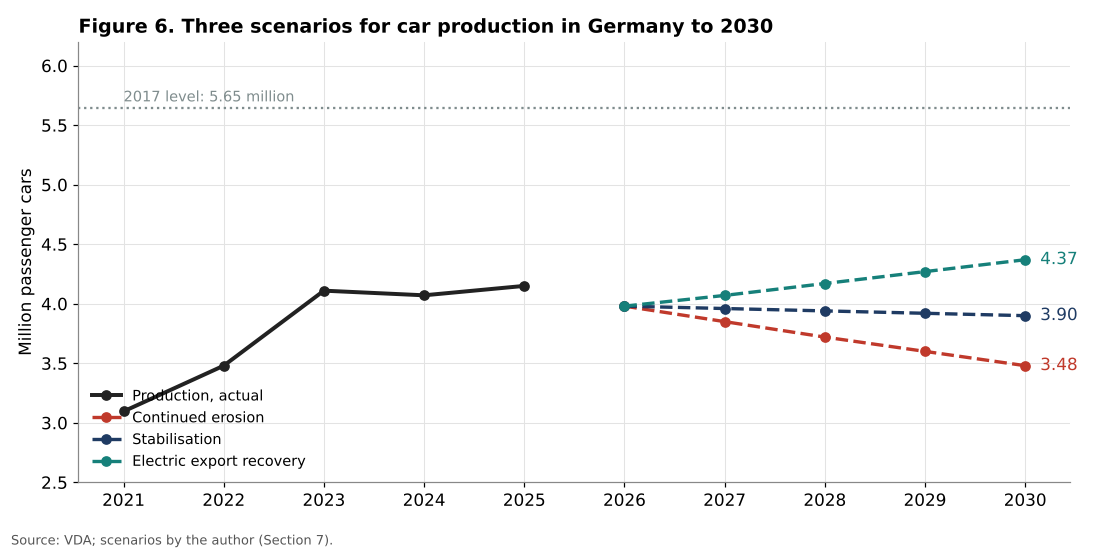
Even in the most favourable scenario, production in 2030 remains well below the level of 2015 to 2017. A return to 5.6 million cars is not realistic in any plausible configuration of markets and costs. The difference between the scenarios, about 0.9 million cars in 2030, corresponds to tens of thousands of jobs in the industry and its supply chain.
The scenarios also show that the decisive variable is exports. In all three scenarios, domestic deliveries change by less than 0.1 million cars per year, while exports vary much more. The future of German car production will be decided in foreign markets.
7.4 Implications for employment
The scenarios can be translated, very roughly, into employment. If the relationship between production and employment observed between 2025 and 2026 continued, each loss of 100,000 cars of annual production would be associated with a loss of several thousand jobs in vehicle assembly and many more in the supply chain. On this basis, the gap of about 0.9 million cars between the erosion and recovery scenarios in 2030 corresponds to a difference of tens of thousands of jobs. This estimate is only indicative, because productivity, automation and the shift to electric models also affect employment, but it shows what is at stake in the competition for export markets.
7.3 Indicators to watch
The author suggests monitoring:
1. VDA monthly foreign orders, the best leading indicator of production. 2. Production of electric cars in German plants and their share of exports. 3. The share of foreign brands in German electric registrations. 4. Announcements of new production locations by German manufacturers. 5. Trade policy decisions in the United States, China and the European Union.
8. Conclusion
The German car market is electrifying rapidly: battery electric cars accounted for 34.5 percent of registrations in September 2026, and electric drives including plug-in hybrids for 45.3 percent. But the domestic electric boom has not revived German car production, which fell by 4 percent in the first nine months of 2026 and is about 15 percent below 2019.
The analysis shows why. About 80 percent of the 1.5 million cars of production lost between 2017 and 2025 is explained by lower exports. Domestic deliveries account for less than a quarter of production, and a growing share of the German market, especially the electric segment, is supplied by imports, with foreign brands accounting for almost half of electric registrations in September 2026. Foreign orders fell by 16 percent in September, while domestic orders rose by only 4 percent.
The future of German car production therefore depends on world markets: on the ability of German manufacturers to compete with Chinese electric cars, on access to the American market under higher tariffs, and on decisions about where to produce new electric models. Domestic subsidies can accelerate the transition, but they cannot replace lost export markets. The electric boom at home is necessary for the industry’s future, but it is not sufficient to revive national production.
Need this analysis for your organisation?
We prepare confidential briefings, executive talks and studies on countries, markets and policies, built on the same method as this article.
Request a briefingSupport independent analysis
Our studies are free to read and carry no advertising. If this one was useful, a small contribution helps us publish the next.
Support our workGo further: books by Global Strategy Files

Frequently asked questions
How popular are electric cars in Germany in 2026?
Very popular. In September 2026 battery electric cars accounted for 34.5 percent of new registrations in Germany and outnumbered petrol and diesel cars combined for the first time. Including plug-in hybrids, electric drives took 45.3 percent of the market.
Why is German car production falling despite the electric boom?
Because exports have collapsed. About 80 percent of the 1.5 million cars of production lost between 2017 and 2025 is explained by lower exports, not a weaker home market, and foreign orders fell 16 percent in September 2026.
How many cars will Germany produce in 2026?
German car production in 2026 is estimated at about 3.98 million cars, 29.5 percent below 2017, after production fell 4 percent in the first nine months of the year to about 15 percent below its 2019 level.
Are foreign brands gaining in the German electric car market?
Yes. Foreign brands accounted for 45.9 percent of electric car registrations in Germany in September 2026, so an increasing share of domestic electric demand is met by imported brands rather than German production. The German market itself remains about 17 percent below its 2019 level.
Methodological note
All calculations were carried out by the author. Exports and export ratios are from the VDA annual statistics; production for 2024 and 2025 is derived from these figures (exports divided by the export ratio); production for 2015 to 2023 and registrations for 2015 to 2025 are VDA annual figures, cross-checked against press reports of the VDA tables. Registrations are from the KBA. Monthly data for 2026 are from VDA and KBA releases of October 2026, as reported in the specialised press. The 2026 annual estimates apply January to September changes to 2025 totals. The domestic supply proxy is production minus exports divided by registrations and ignores stock changes and commercial vehicles. The scenarios are illustrative.
References
Autor, D. H., Dorn, D. and Hanson, G. H. (2013). The China Syndrome: Local Labor Market Effects of Import Competition in the United States. American Economic Review, 103(6), 2121 to 2168.
Dauth, W., Findeisen, S. and Suedekum, J. (2014). The Rise of the East and the Far East: German Labor Markets and Trade Integration. Journal of the European Economic Association, 12(6), 1643 to 1675.
Draghi, M. (2024). The Future of European Competitiveness. Report for the European Commission. Brussels.
European Commission (2024). Commission Implementing Regulation (EU) 2024/2754 imposing a definitive countervailing duty on imports of new battery electric vehicles designed for the transport of persons originating in the People’s Republic of China. Official Journal of the European Union, October 2024.
Head, K. and Mayer, T. (2019). Brands in Motion: How Frictions Shape Multinational Production. American Economic Review, 109(9), 3073 to 3124.
International Energy Agency (2025). Global EV Outlook 2025. Paris: IEA.
Kraftfahrt-Bundesamt (2020 to 2026). Fahrzeugzulassungen; annual balances of battery electric registrations (2019: 63,281; 2020: 194,163; 2021: 355,961; 2022: 470,559; 2024: 380,609).
Kraftfahrt-Bundesamt (2026). Fahrzeugzulassungen: Neuzulassungen von Personenkraftwagen, September 2026. Flensburg.
Verband der Automobilindustrie (2026). Jahreszahlen: Export; Pkw-Produktion und Export, September 2026. Berlin.
Statistisches Bundesamt (Destatis) (2026). Beschäftigte in der Automobilindustrie, erstes Halbjahr 2026. Wiesbaden, August 2026.
Verband der Internationalen Kraftfahrzeughersteller (VDIK) (2026). Neuzulassungen September 2026.
