
Defence and Infrastructure as Germany’s New Growth Engine? Measuring the Public Investment Push of 2025 to 2029

Defence and Infrastructure as Germany’s New Growth Engine? Measuring the Public Investment Push of 2025 to 2029
Driss EFFINA, PhD Independent Researcher, Global Strategy Files Reading time: about 27 minutes
Key takeaways
- Germany raised its 2026 growth forecast from 0.5 to 1.3 percent in October 2026, citing exports and state investment.
- German government gross investment rose 12.3 percent in 2025, driven by a 47.7 percent jump in equipment, mostly military procurement.
- The 500 billion euro infrastructure fund had paid out 51.1 billion euros by July 2026, about 77 percent of an even path.
- By 2029 the public investment push could raise German GDP by about 0.5 to 2.5 percent, with a central estimate of 1.5 percent.
Abstract
On 8 October 2026, the German Federal Government raised its growth forecast for 2026 from 0.5 to 1.3 percent, citing robust exports and state investment in defence and infrastructure. For the first time in decades, public demand is presented as the main engine of the German recovery. This article examines whether that engine can durably pull private investment along with it. It uses Destatis national accounts, NATO defence expenditure statistics, the federal budget for 2027 and the government’s autumn projection, and builds five indicators of its own: long-run averages of the investment ratio, an index of nominal investment by asset since 2019, the euro path implied by the defence spending targets, the pace of outflows from the 500 billion euro infrastructure fund compared with an even path, and a decomposition of projected growth into a fiscal component and the rest of the economy. Three scenarios estimate the effect of the push on the level of GDP in 2029. The results show that the push is real but uneven. Government gross investment rose by 12.3 percent in 2025, its largest increase since 2000, driven by a 47.7 percent jump in equipment, essentially military procurement. Defence spending, measured by NATO, rose by about 150 percent between 2014 and 2024 and is planned to reach 3.5 percent of GDP in 2029, which the author translates into about 176 billion euros. By contrast, the infrastructure fund had paid out 51.1 billion euros by the end of July 2026, about 77 percent of an even twelve-year path. Total investment remains weak: the investment ratio fell from 21.6 percent of GDP in 2022 to 20.2 percent in 2025, and equipment investment in current prices is only 8.7 percent above 2019. On the author’s estimate, roughly half of the growth projected for 2026 comes from fiscal measures. The scenarios suggest that by 2029 the push could raise the level of GDP by between about 0.5 and 2.5 percent, with a central value of about 1.5 percent. Whether it becomes a lasting growth engine depends less on the amounts than on execution, on the share of spending that stays in Germany, and on whether private firms follow.
Keywords: Germany, public investment, defence spending, infrastructure, fiscal multiplier, crowding in, debt brake, special fund, growth
JEL codes: E22, E62, H54, H56, H63, O52
1. Introduction
For most of the past two decades, Germany has been the European economy that invested too little in its own future. Its public investment ratio was the lowest in the G7 through the 2010s, its bridges, railways and schools accumulated a large maintenance backlog, and its armed forces, the Bundeswehr, were chronically underequipped. At the same time, the federal government ran budget surpluses, protected by a constitutional “debt brake” that limited structural borrowing to 0.35 percent of GDP.
In March 2025, this framework changed. The outgoing Bundestag amended the Basic Law to exempt defence spending above 1 percent of GDP from the debt brake, to create a special fund of 500 billion euros for infrastructure and climate neutrality over twelve years, and to give the federal states (Länder) a limited borrowing capacity of their own. Combined with the commitment made by NATO allies at the summit of The Hague in June 2025 to raise core defence spending to 3.5 percent of GDP by 2035, this marked the largest fiscal shift in the history of the Federal Republic outside reunification.
Eighteen months later, the effects are beginning to show in the data. In its autumn projection of 8 October 2026, the Federal Government expects GDP to grow by 1.3 percent in 2026, after two years of contraction and growth of only 0.2 percent in 2025. The government explicitly names state investment in defence and infrastructure as one of the two main drivers, the other being exports.
This raises a central question, which is the subject of this article: can public investment become a durable engine of growth in Germany, in the sense that it pulls private investment along rather than replacing it? Or will it remain a temporary demand impulse, financed by debt, that fades once the money is spent?
To answer this question, the article proceeds in four steps. It first measures the investment problem that the new policy is meant to solve. It then quantifies the scale and pace of the two components of the push, defence and infrastructure. It estimates the contribution of fiscal measures to the growth projected for 2026 and 2027. Finally, it builds three scenarios for the effect of the push on the level of GDP in 2029.
Section 2 sets out the context. Section 3 reviews the literature on public investment multipliers, defence spending and crowding in. Section 4 describes the data and methodology. Section 5 presents the results. Section 6 discusses them. Section 7 presents the scenarios. Section 8 concludes.
2. Context
2.1 A decade of underinvestment
According to the economic research department of KfW, the public development bank, German gross public investment averaged about 2.2 percent of GDP in the 2010s, the lowest level in the G7. In the United States and Japan, the ratio was around 4 percent. Net public investment in construction, which measures new public buildings and infrastructure after depreciation, was negative every year from 2004 to 2019, meaning that the public capital stock in buildings and infrastructure was shrinking in real terms.
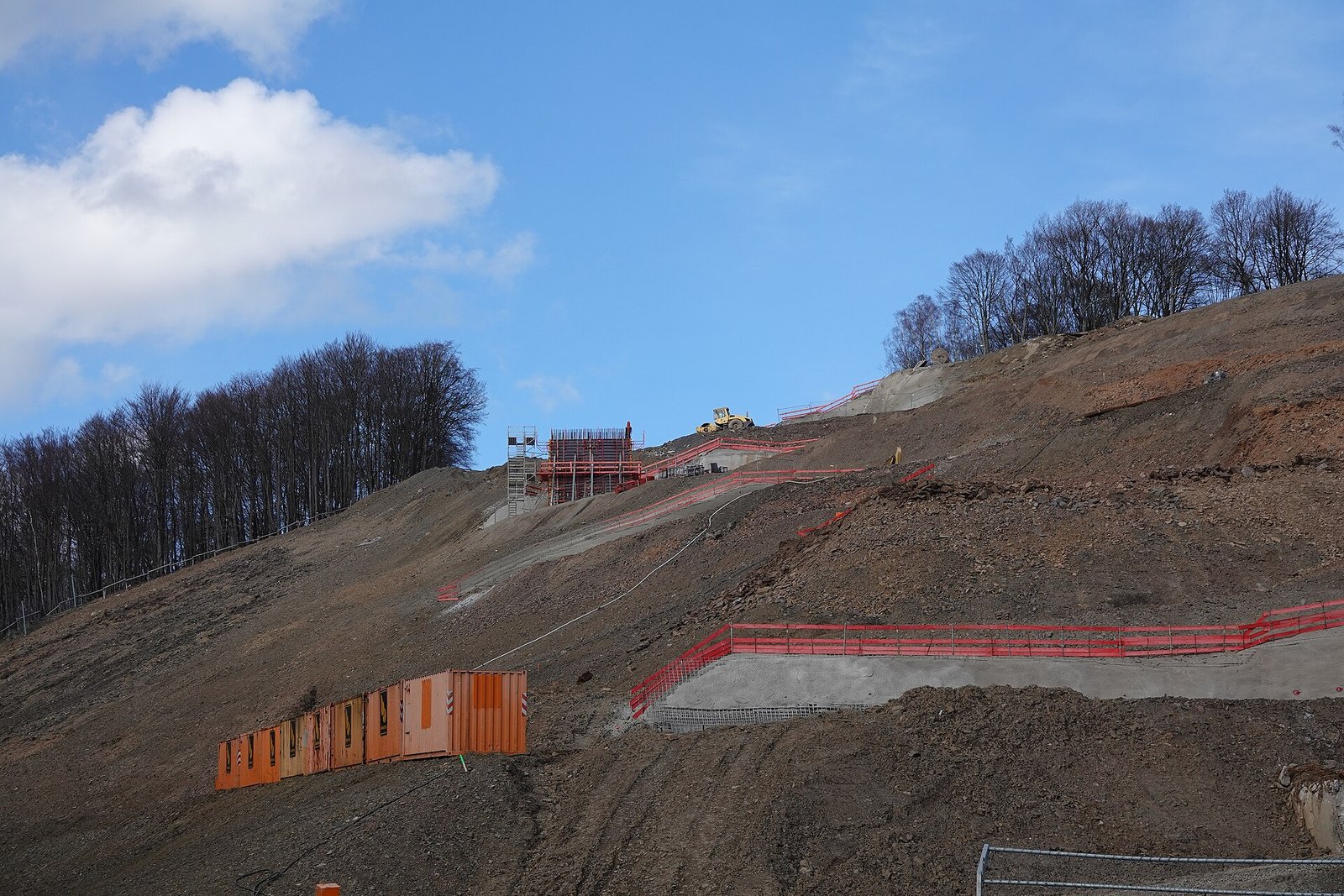
The consequences became visible in the 2020s. The closure in December 2021 of the Rahmede valley bridge on the A45 motorway, which had to be demolished, became a symbol of the deterioration of German infrastructure. Deutsche Bahn’s punctuality fell to historic lows. Municipalities reported large backlogs of investment in schools and roads.
2.2 The Zeitenwende and the Bundeswehr
In February 2022, after the Russian invasion of Ukraine, Chancellor Olaf Scholz announced a “Zeitenwende”, a turning point in German security policy, and a special fund of 100 billion euros for the Bundeswehr. NATO data show that German defence expenditure, which had been around 1.2 percent of GDP for most of the 2010s, rose to 1.61 percent in 2023 and to an estimated 2.00 percent in 2024, reaching the alliance target for the first time.
2.3 The 2025 reform of the debt brake
In March 2025, the Bundestag and Bundesrat approved an amendment to the Basic Law with three components:
- defence and certain security expenditure above 1 percent of GDP is no longer subject to the debt brake;
- a special fund for infrastructure and climate neutrality (Sondervermögen Infrastruktur und Klimaneutralität) of 500 billion euros is created, financed by borrowing and to be used over twelve years, with 100 billion euros earmarked for the Länder and 100 billion euros for the Climate and Transformation Fund;
- the Länder may run structural deficits of up to 0.35 percent of GDP collectively.
2.4 The 2027 budget and the financial plan
The draft federal budget for 2027, approved by the cabinet on 6 July 2026, illustrates the scale of the shift. Total spending is planned at 555.4 billion euros. Federal investment rises to 117.5 billion euros in 2027, compared with 78.9 billion euros in 2025. Core defence spending increases from 82.2 billion euros in 2026 to 109 billion euros in 2027, and to 130.1 billion euros including support for Ukraine and other security spending. Total borrowing for 2027 is 203.6 billion euros, of which 118.7 billion in the core budget and 54.9 billion through the infrastructure fund. The finance ministry expects defence spending to rise from 2.8 percent of GDP in 2026 to 3.5 percent in 2029, and plans to commit 783.8 billion euros to defence-related spending between 2026 and 2030.
The cost of this borrowing is significant. According to the financial plan, federal interest payments are expected to rise from 41.9 billion euros in 2027 to 80.7 billion euros in 2030.
2.5 The macroeconomic situation in autumn 2026
The German economy contracted by 0.9 percent in 2023 and by 0.5 percent in 2024, and grew by only 0.2 percent in 2025. In 2026, growth has been positive: 0.4 percent quarter on quarter in the first quarter and 0.3 percent in the second. Inflation, however, has risen with the energy shock linked to the conflict in the Middle East: consumer prices rose by 3.3 percent year on year in September 2026, with energy prices up 14.9 percent. Unemployment stood at 2.994 million in September, a rate of 6.4 percent. In August, industrial production rose by 2.0 percent month on month, but new orders fell by 10.6 percent, largely because of the absence of large orders that had inflated the previous month.
The autumn projection forecasts growth of 1.3 percent in 2026, 1.1 percent in 2027 and 0.6 percent in 2028, and consumer price inflation of 2.7, 3.0 and 2.2 percent respectively. The joint forecast of the leading economic research institutes, published at the end of September, had very similar growth figures and projected a general government deficit rising from 4.1 percent of GDP in 2026 to 4.7 percent in 2028.
3. Literature review
The question of whether public spending stimulates or crowds out private activity is one of the oldest in macroeconomics. Four strands of research are relevant here.
The first strand concerns the productivity of public capital. Aschauer (1989), in a widely cited paper, argued that the slowdown of US productivity growth in the 1970s was linked to the decline in public infrastructure investment, and estimated a very high return on public capital. Later work found smaller but still positive effects. Bom and Ligthart (2014), in a meta-analysis of several decades of research, estimated an average output elasticity of public capital of about 0.08 in the short run and about 0.12 for core infrastructure in the long run.
The second strand estimates the short-run multiplier of public investment. Abiad, Furceri and Topalova (2016), using data for advanced economies, found that an increase in public investment of 1 percent of GDP raises output by about 0.4 percent in the same year and by about 1.5 percent after four years, with larger effects when there is economic slack and when investment is efficient. For Germany specifically, Rieth, Clemens and Michelsen (2024) estimated a public investment multiplier that rises over time and exceeds one. Using their framework, the German Institute for Economic Research (DIW) estimated that an additional 100 billion euros of public investment over four years would raise GDP by about 1.5 percent on average over the period, with each euro generating slightly more than two euros of value added.
The third strand concerns defence spending. Defence spending differs from infrastructure spending in that it does not create productive capital for the civilian economy, and a large part of it may be spent on imports. Studies of US military spending, notably Ramey (2011) and Barro and Redlick (2011), estimate multipliers of defence purchases on GDP of about 0.6 to 1.0. Auerbach and Gorodnichenko (2012) found that multipliers are much higher in recessions than in expansions. In a recent report for the Kiel Institute, Ilzetzki (2025) reviewed the historical evidence on defence build-ups and concluded that they can raise output and, when they involve research and development and domestic production, have positive effects on productivity, but that they do not pay for themselves.
The fourth strand concerns crowding in and crowding out. Public investment can crowd in private investment if it raises the productivity of private capital, for example by improving transport networks, or if it creates demand for private suppliers. It can crowd out private investment if it absorbs scarce resources, such as construction capacity and skilled labour, raising their prices, or if the associated borrowing raises interest rates. The balance between these effects depends on the state of the economy and on the sectors involved.
This article contributes to this literature by measuring the German push as it is actually being implemented, with data up to October 2026, rather than as it was planned.
4. Data and methodology
4.1 Sources
The analysis uses:
- Destatis national accounts: gross fixed capital formation in current prices by type of asset, 1991 to 2025, and press releases on government investment in 2025 and the first quarter of 2026;
- the investment ratio (gross fixed capital formation as a percentage of GDP) published by Destatis for the German Sustainable Development Strategy (indicator 8.3), 1991 to 2025;
- NATO, Defence Expenditure of NATO Countries (2014 to 2025), for defence spending in euros and as a share of GDP;
- the draft federal budget for 2027 and the financial plan to 2030;
- the Federal Government’s autumn projection of 8 October 2026 and its annual economic report of January 2026;
- monitoring data on the infrastructure special fund, as reported in August 2026.
4.2 Indicators
The author computes:
1. Average investment ratios by decade, to place the current situation in historical perspective. 2. Shares of equipment and construction in total investment. 3. An index of nominal investment by asset since 2019 (2019 = 100). Because construction prices have risen much faster than equipment prices since 2021, nominal construction growth overstates real activity. This is noted in the interpretation. 4. The euro value of planned defence spending. The finance ministry’s targets of 2.8 percent of GDP in 2026 and 3.5 percent in 2029 are converted into euros using nominal GDP of 4,460 billion euros in 2025 and an assumed nominal growth rate of 3 percent per year. 5. The pace of the infrastructure fund. An even path is defined as 500 billion euros spread equally over 144 months starting in January 2025. Actual cumulative outflows are compared with this path. 6. A decomposition of projected growth. The Federal Government stated in January 2026 that fiscal measures would add about two thirds of a percentage point to growth in 2026, and in October that fiscal measures for infrastructure, defence and other investment could add about 1 percent to GDP by the end of 2027. The author therefore attributes 0.67 points of the 1.3 percent projected for 2026 and about 0.33 points of the 1.1 percent projected for 2027 to fiscal measures. This is an approximation. 7. Scenarios for 2029, described in Section 7.
4.3 Limitations
The national accounts data for 2023 to 2025 are provisional. The investment ratio series published for the sustainability indicator and the asset breakdown may come from slightly different vintages. NATO percentages are calculated on GDP at 2021 prices and may differ slightly from those calculated on current prices. The decomposition of growth and the scenarios depend on assumptions about multipliers, import shares and execution, which are uncertain.
5. Results
5.1 The investment problem
Figure 1 shows Germany’s investment ratio from 1991 to 2025, with averages by period.
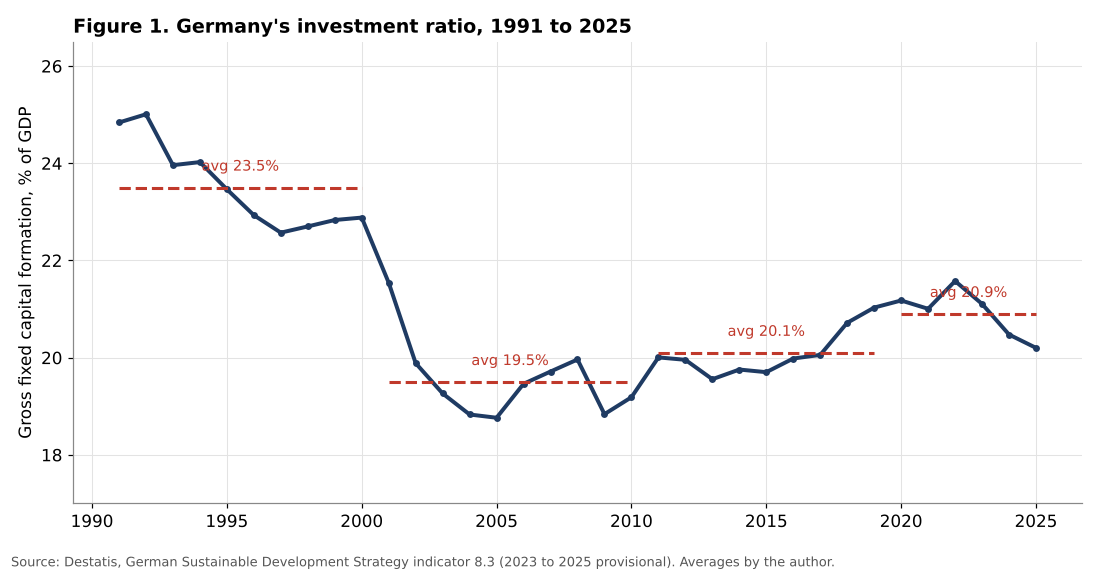
After reunification, the investment ratio was high, about 23.5 percent of GDP on average between 1991 and 2000, driven by the reconstruction of eastern Germany. It then fell sharply to an average of 19.5 percent in 2001 to 2010, reaching a low of 18.8 percent in 2005 and in 2009. It recovered gradually in the 2010s, averaging 20.1 percent in 2011 to 2019, and peaked at 21.6 percent in 2022.
Since 2022, the ratio has fallen again: 21.1 percent in 2023, 20.5 percent in 2024 and 20.2 percent in 2025. In other words, despite the start of the public investment push, total investment relative to the size of the economy has declined for three years in a row. The public push has not yet compensated for the weakness of private investment.
The composition of investment has also changed. In 2025, equipment accounted for 29.6 percent of total gross fixed capital formation in current prices, compared with 33.3 percent in 2019. Construction accounted for 50.9 percent, compared with 48.6 percent in 2019. Other assets, mainly research and development and software, made up the rest.
| Year | Total GFCF (bn EUR) | Equipment (bn EUR) | Construction (bn EUR) | Investment ratio (% GDP) |
|---|---|---|---|---|
| 2019 | 748.2 | 249.1 | 363.3 | 21.0 |
| 2021 | 780.0 | 235.6 | 404.2 | 21.0 |
| 2022 | 865.4 | 264.0 | 447.8 | 21.6 |
| 2023 | 898.1 | 277.1 | 454.2 | 21.1 |
| 2024 | 898.3 | 269.0 | 456.4 | 20.5 |
| 2025 | 915.1 | 270.7 | 466.0 | 20.2 |
Table 1. Gross fixed capital formation in current prices and investment ratio. Source: Destatis.
5.2 Six years without real investment growth
Figure 2 shows the evolution of nominal investment by asset since 2019.
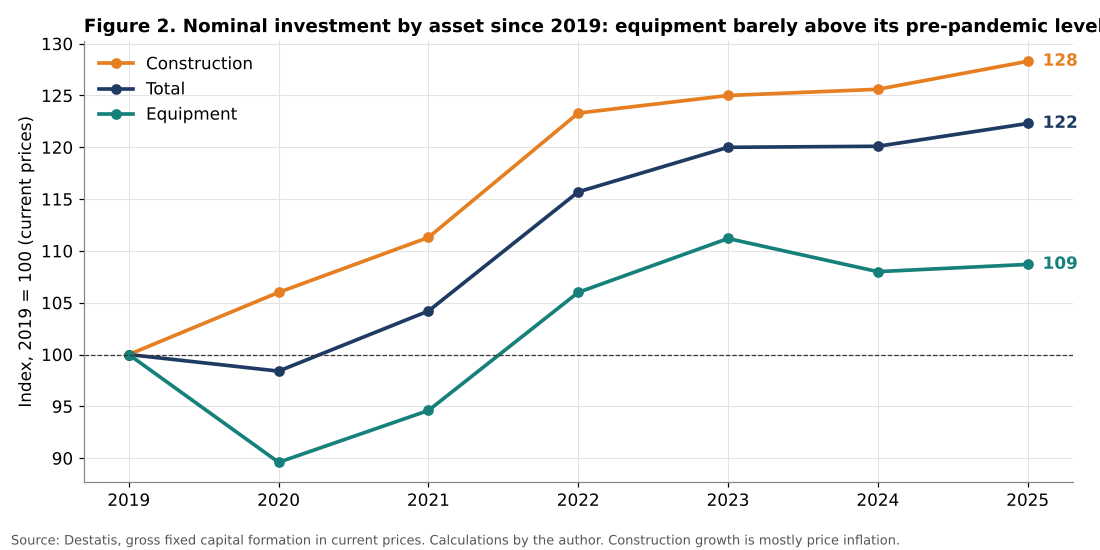
In current prices, total investment in 2025 was 22.3 percent higher than in 2019. But this figure is misleading. Most of the increase reflects prices, not volumes. Construction investment rose by 28.3 percent in nominal terms, but construction prices rose by considerably more over the period, after the sharp increase in material and labour costs in 2021 to 2023. In real terms, construction investment fell by 0.9 percent in 2025 alone.
The clearest indicator is equipment investment, where price increases have been more moderate. In current prices, equipment investment in 2025 was only 8.7 percent higher than in 2019, which, after accounting for price increases, implies a real decline. It fell by 2.9 percent in nominal terms in 2024 and rose by only 0.6 percent in 2025. In real terms, it fell by 2.3 percent in 2025. Machinery and equipment are the core of business investment in productive capacity, and their stagnation over six years is the most direct evidence of the weakness of private investment in Germany.
According to the DIW, business investment in the third quarter of 2024 was about 6.5 percent below its level at the end of 2019, and about 28 percent below the path that would have resulted from a continuation of the 2016 to 2018 trend. This is the gap that public investment is supposed to help close.
5.3 The public push: strong in equipment, weak in construction
The national accounts for 2025 show that the public push has started, but in a very specific form. According to Destatis, government gross investment rose by 12.3 percent in 2025, to 147.5 billion euros, the largest increase since 2000. However, this increase was concentrated almost entirely in equipment, which rose by 47.7 percent, mainly because of deliveries of military weapons systems and other procurement for the Bundeswehr. Government construction investment rose by only 2.0 percent in nominal terms, and investment in other assets such as research and software by 5.2 percent.
The trend continued in the first quarter of 2026, but at a slower pace: government investment rose by 3.2 percent year on year, with equipment up 10.7 percent and construction down 1.5 percent, which Destatis attributed partly to cold weather in January and February.
The government investment ratio reached 3.3 percent of GDP in 2025. This is a clear improvement on the 2.2 percent average of the 2010s, but it is still below the euro area average of 3.7 percent and the EU average of 3.9 percent. Investment represented 6.5 percent of total government spending in 2025, compared with 6.1 percent in 2024 and 5.9 percent in 2023.
These figures contain the main finding of this section. So far, the public investment push is essentially a defence push. Infrastructure investment, which is the component most likely to raise the productivity of private capital, has hardly increased.
5.4 The scale of the defence build-up
Figure 3 shows German defence expenditure from 2014 to 2024, according to NATO, and the planned path to 2029.
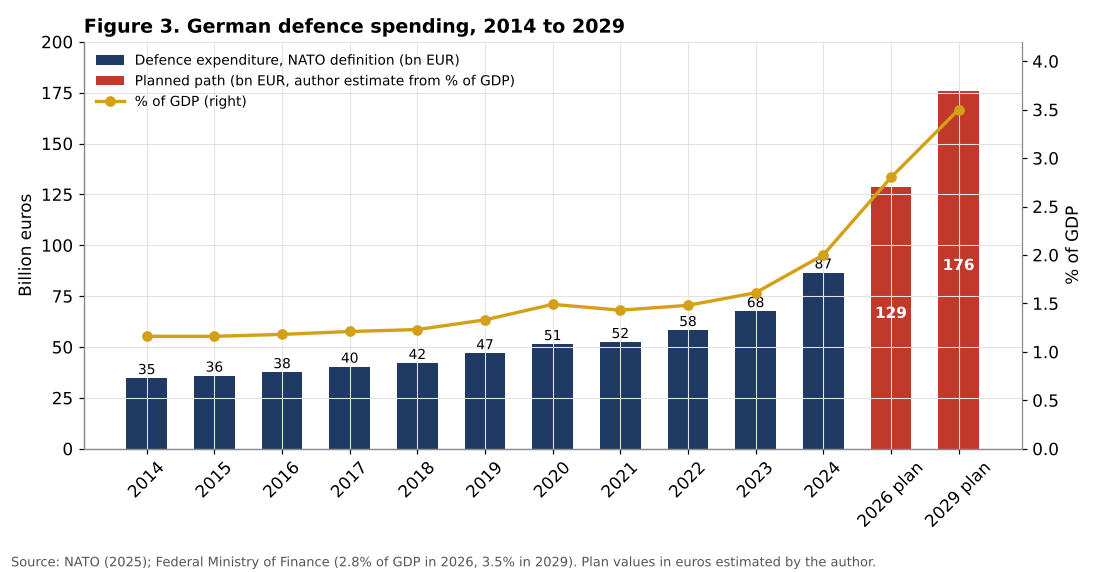
German defence expenditure rose from 34.7 billion euros in 2014 to 86.6 billion euros in 2024 (estimate), an increase of about 149 percent. As a share of GDP, it rose from 1.16 percent to 2.00 percent. The share of equipment in defence spending also increased, from about 13 percent in 2014 to about 21 percent in 2024, which explains why defence spending appears increasingly in investment statistics.
The planned path is much steeper. The finance ministry expects defence spending to reach 2.8 percent of GDP in 2026 and 3.5 percent in 2029. Using the author’s GDP path, this corresponds to about 129 billion euros in 2026 and about 176 billion euros in 2029. The increase between 2024 and 2029 would be about 89 billion euros per year, roughly 2 percent of GDP. These estimates are consistent with the budget figures: 130.1 billion euros of total defence and security spending in 2027.
| Indicator | 2014 | 2019 | 2024 | 2026 | 2029 |
|---|---|---|---|---|---|
| Defence spending (bn EUR) | 34.7 | 46.9 | 86.6 | about 129 (plan) | about 176 (plan) |
| % of GDP | 1.16 | 1.33 | 2.00 | 2.8 (plan) | 3.5 (plan) |
| Equipment share (%) | 12.9 | 14.7 | 21.2 | n.a. | n.a. |
Table 2. German defence spending. Source: NATO (2014 to 2024, 2024 estimated); Federal Ministry of Finance targets; euro values for 2026 and 2029 estimated by the author.
For comparison, according to NATO estimates for 2025, France spent about 2.05 percent of GDP on defence, the United Kingdom 2.40 percent, Italy 2.01 percent and Poland 4.48 percent, and the average for European allies and Canada was 2.27 percent. Germany is therefore moving from being one of the lowest spenders among large European allies to one of the highest, and, in absolute terms, to the largest defence budget in Europe.
5.5 The infrastructure fund: a slow start
Figure 4 compares the outflows from the infrastructure special fund with an even path.
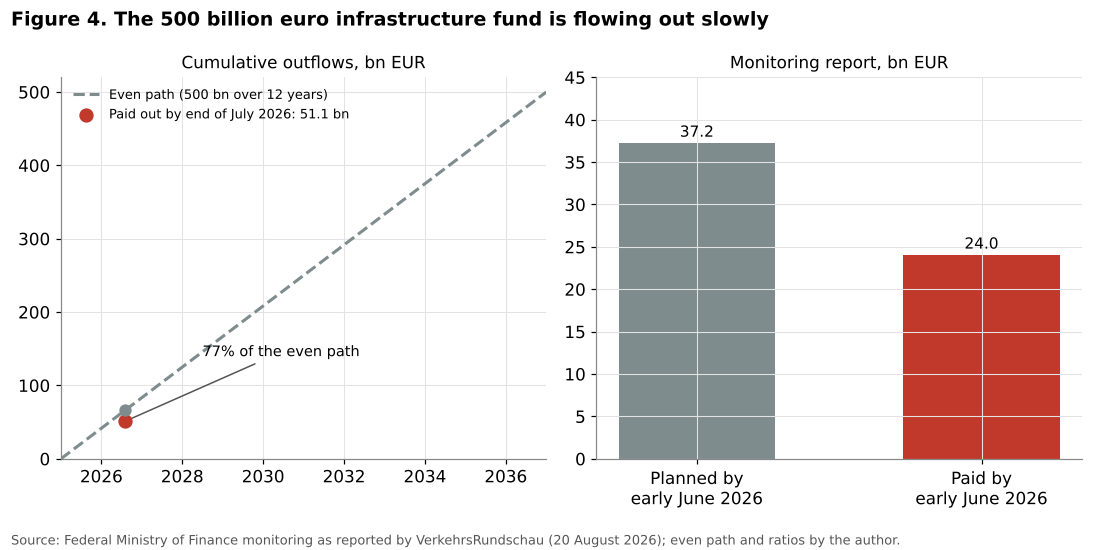
By the end of July 2026, about nineteen months after the start of the fund’s lifetime, 51.1 billion euros had been paid out, about 10 percent of the total. An even path, spreading 500 billion euros over 144 months, would have reached about 66 billion euros by that date. Actual outflows were therefore about 77 percent of the even path. At the pace observed so far, the fund would take about 15.5 years to be fully spent, rather than twelve.
An earlier monitoring report, from early June 2026, had found that about 24 billion euros had been paid out against 37.2 billion euros planned at that point, a completion rate of about 65 percent. The improvement between June and July suggests that the pace is accelerating, but it remains below plan. In January 2026, it had been reported that only 24 billion euros had been invested by the end of 2025.
Several reasons explain the slow start. Infrastructure projects require planning, approval and tendering procedures that take years in Germany. Responsibility is spread between the federal government, the Länder and municipalities. Construction capacity is limited. Moreover, economic research institutes have questioned whether the fund is financing genuinely additional investment, or partly replacing investment that would otherwise have been financed from the core budget. The government rejects this interpretation and argues that the comparisons are distorted. The data available do not allow a definitive answer, but the question is central to the assessment of the push.
On average, the fund represents about 41.7 billion euros per year, or about 0.9 percent of GDP in 2026. If it is spent in full and on additional projects, it would raise the government investment ratio by almost one percentage point, to well above the EU average.
5.6 How much of the recovery is fiscal?
Figure 5 decomposes the growth projected by the Federal Government for 2026 and 2027.
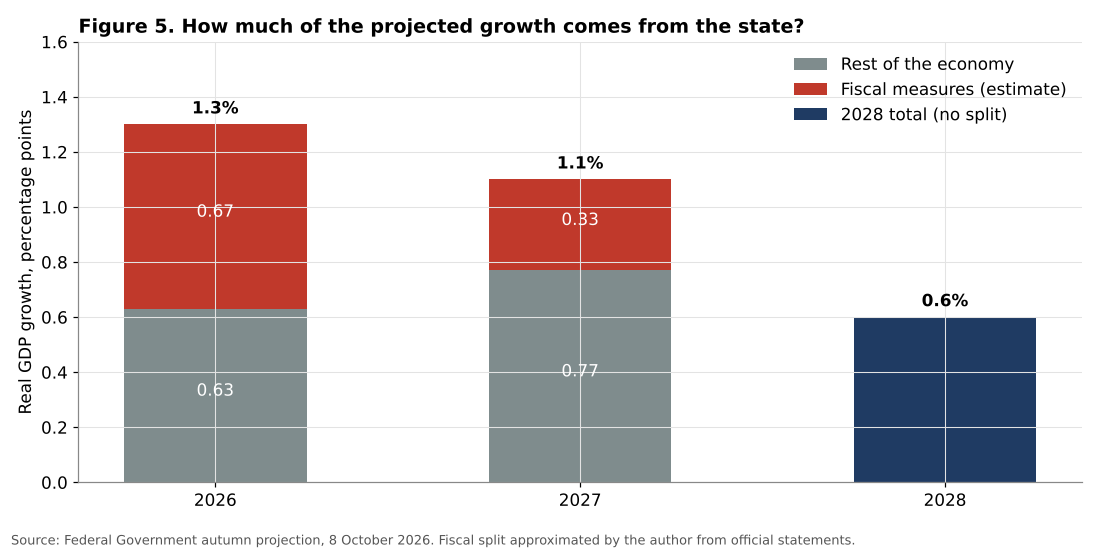
On the basis of official statements, the author attributes about 0.67 percentage points of the 1.3 percent growth projected for 2026 to fiscal measures, leaving about 0.63 points for the rest of the economy. For 2027, fiscal measures would contribute about 0.33 points of the 1.1 percent projected, leaving about 0.77 points.
This means that roughly half of the growth projected for 2026 depends on public spending. Without it, Germany would grow by about 0.6 percent, which is little more than its estimated potential growth rate, itself very low because of demographic ageing and weak productivity. The projected slowdown to 0.6 percent in 2028, when the fiscal impulse is expected to fade, confirms that the government itself does not expect the push to generate a self-sustaining private recovery within the forecast horizon.
The autumn projection also states that private consumption and investment are likely to remain subdued because of higher energy and consumer prices. In other words, the growth engine is public, and the private economy is not yet following.
6. Discussion
6.1 A defence push before an infrastructure push
The first conclusion of the analysis is that the public investment push has so far been mainly a defence push. This has important consequences for its growth effects.
Defence spending is demand, but its effects on the productive capacity of the civilian economy are indirect. Tanks, aircraft and ammunition do not raise the productivity of private firms, unlike roads, railways, broadband networks or energy grids. The literature suggests that defence multipliers are lower than infrastructure multipliers, and they are lower still when equipment is imported. A significant share of German procurement, notably combat aircraft and air defence systems, is purchased from abroad, particularly from the United States. Every euro spent on imported equipment adds to GDP only through domestic installation, maintenance and related services.
There are, however, channels through which defence spending can support the German economy more durably. The domestic defence industry, which includes companies producing armoured vehicles, ammunition, naval vessels and electronics, is expanding capacity and hiring. Some firms in the automotive and mechanical engineering sectors, facing weak demand in their traditional markets, are converting part of their capacity to defence production. And, as Ilzetzki (2025) emphasises, defence research and development can generate technological spillovers. The extent of these effects will depend on procurement choices: the more Germany buys from domestic and European suppliers, the greater the effect on domestic output and employment.
6.2 Execution is the binding constraint
The slow outflow of the infrastructure fund illustrates the second main conclusion: in Germany, the constraint on public investment is no longer money but the capacity to spend it. Planning procedures, legal challenges, shortages of engineers in public administrations, and limited construction capacity all slow the conversion of budget allocations into actual projects.
This has two implications. First, the growth effect of the fund will be spread over a longer period than planned. Second, if spending accelerates while construction capacity remains limited, part of the effect may be absorbed by higher prices rather than higher volumes. Construction prices in Germany have already risen sharply since 2021, and a large public programme could push them up further, crowding out private construction, especially residential construction, which has been weak since 2022.
The government has announced measures to accelerate planning and approval procedures. Their effectiveness will be one of the key determinants of the success of the programme.
6.3 Crowding in or crowding out?
The question of whether public investment will crowd in private investment does not have a single answer. It depends on the type of investment and the state of the economy.
There are good reasons to expect crowding in for infrastructure. Germany’s transport and digital networks have been underfunded for years, and their deterioration imposes costs on private firms. Improving them should raise the return on private investment. Moreover, the economy has significant slack: industrial capacity utilisation is low, and unemployment has risen. In such conditions, the literature suggests that public investment multipliers are high and crowding out is limited.
For defence, the picture is more mixed. In sectors where defence demand competes with civilian demand for specialised inputs and skilled workers, such as electronics or precision engineering, crowding out is possible. In sectors with spare capacity, such as parts of the automotive supply chain, defence orders may support activity that would otherwise have disappeared.
The financial channel matters too. Higher government borrowing has contributed to higher German bond yields since 2025, and federal interest payments are expected to almost double by 2030. If higher yields raise the cost of capital for private firms, this could offset part of the stimulus. So far, however, the main constraints on private investment in Germany appear to be energy costs, regulation, uncertainty and weak demand, rather than the cost of financing.
6.4 Sustainability
The push is financed by debt. The research institutes project a general government deficit rising to 4.7 percent of GDP in 2028, well above the 3 percent reference value of the European fiscal rules, although the rules now provide some flexibility for defence spending. Germany starts from a relatively low debt ratio, which gives it more room than most of its European partners. But the rise in interest payments, from 41.9 billion euros in 2027 to 80.7 billion euros in 2030 according to the financial plan, shows that the room is not unlimited. If the push does not raise potential growth, the debt will become a burden on future budgets.
This is why the composition of spending matters. Infrastructure investment that raises productivity can, in the long run, partly pay for itself through higher growth and tax revenue, as the DIW estimates suggest. Defence spending, whatever its strategic justification, is unlikely to do so.
6.5 What would make the push a durable engine?
The analysis suggests four conditions for the public push to become a durable growth engine rather than a temporary impulse:
1. Execution: the infrastructure fund must be spent at the planned pace, which requires faster planning and approval. 2. Additionality: the fund must finance additional projects rather than replace core budget investment. 3. Domestic and European sourcing: defence procurement should, where possible, favour suppliers that produce in Germany and Europe, so that spending stays in the economy and supports industrial capacity. 4. Complementary reforms: private investment depends on factors that public spending cannot directly influence, such as energy prices, regulation and the availability of skilled labour. Without improvements in these areas, private firms are unlikely to follow the state.
7. Scenarios to 2029
7.1 Method
The author estimates the effect of the push on the level of GDP in 2029, relative to a baseline without the push. The calculation combines two components:
- Defence: an increase in defence spending from about 2.4 percent of GDP in 2025 (estimate) to 3.5 percent in 2029, that is, about 1.1 percentage points of GDP.
- Infrastructure: outlays from the special fund at full pace, about 41.7 billion euros per year, or about 0.83 percent of GDP in 2029.
For each component, the effect on GDP is the increase in spending multiplied by a multiplier and, for defence, by the share of spending that goes to domestic production.
Low scenario. Defence multiplier 0.5, domestic share 50 percent; infrastructure multiplier 0.8, with only 70 percent of the fund additional; a crowding-out effect equal to 0.1 times the total impulse. GDP in 2029 would be about 0.55 percent higher than without the push.
Central scenario. Defence multiplier 0.7, domestic share 65 percent; infrastructure multiplier 1.2, fund fully additional; no net crowding in or out. GDP would be about 1.5 percent higher.
High scenario. Defence multiplier 1.0, domestic share 80 percent; infrastructure multiplier 1.5; crowding in equal to 0.2 times the total impulse. GDP would be about 2.5 percent higher.
7.2 Results
Figure 6 summarises the three scenarios.
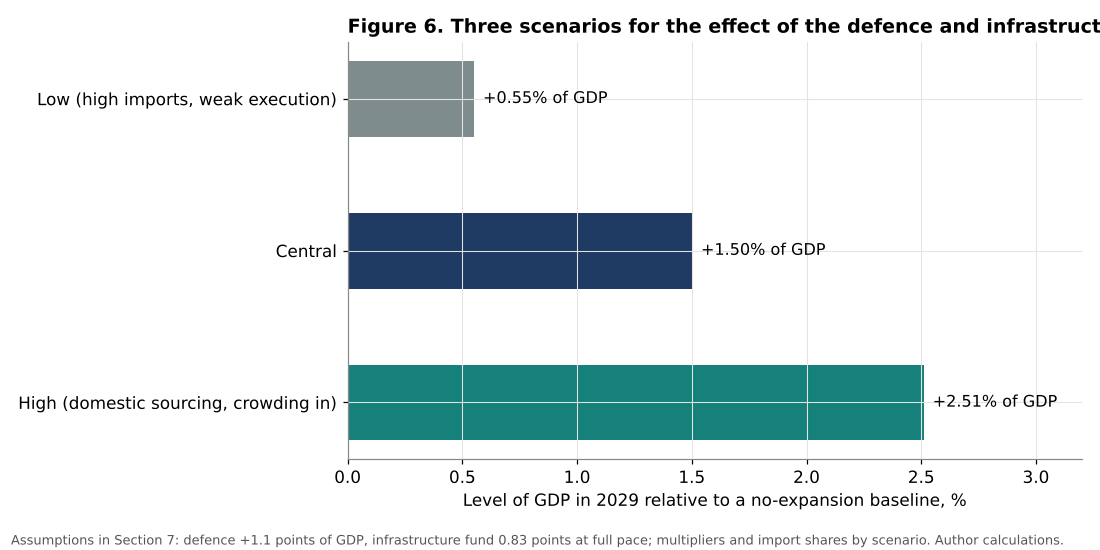
The range is wide, from about 0.5 to 2.5 percent of GDP. The central estimate of about 1.5 percent is consistent with the government’s statement that fiscal measures could add about 1 percent to GDP by the end of 2027, extended to 2029 with the further rise in defence spending.
Spread over four years, the central scenario implies an average contribution of about 0.4 percentage points per year to growth. This is significant for an economy whose potential growth is estimated at well under 1 percent, but it is not enough on its own to restore the growth rates of the 2010s.
The difference between the scenarios comes mainly from three factors: the share of defence spending that stays in Germany, the additionality and execution of the infrastructure fund, and the response of private investment. These are precisely the factors identified in Section 6 as the conditions for a durable effect.
7.3 What happens after 2029?
The scenarios concern the level of GDP. If the push stops growing after 2029, its contribution to growth will fall to zero and may become negative when infrastructure spending declines. A durable effect requires either that private investment takes over, or that public investment raises the productive capacity of the economy, so that potential growth is higher. The first evidence on private investment, which is still falling relative to GDP, is not encouraging. The productivity effects of infrastructure will only appear over several years.
7.4 Indicators to watch
The author suggests five indicators to monitor:
1. Quarterly government investment by asset in the national accounts, especially construction. 2. Monthly outflows from the infrastructure special fund. 3. Private equipment investment and industrial orders, excluding large orders. 4. Construction prices, as a signal of capacity constraints. 5. The share of defence procurement contracts awarded to German and European suppliers.
8. Conclusion
Germany has embarked on the largest public investment programme in its post-reunification history. This article has measured its scale and early effects using official data.
The main findings are:
1. Germany’s investment ratio fell from 21.6 percent of GDP in 2022 to 20.2 percent in 2025, and equipment investment in current prices is only 8.7 percent above its 2019 level, which implies a decline in real terms. 2. Government gross investment rose by 12.3 percent in 2025, its largest increase since 2000, but this increase was driven by a 47.7 percent rise in equipment, essentially military, while government construction investment grew by only 2 percent. 3. Defence spending rose from 34.7 billion euros in 2014 to 86.6 billion in 2024 and is planned to reach about 176 billion euros, or 3.5 percent of GDP, in 2029. 4. The 500 billion euro infrastructure fund had paid out 51.1 billion euros by the end of July 2026, about 77 percent of an even path. 5. About half of the growth projected for 2026 depends on fiscal measures, and the government expects growth to slow to 0.6 percent in 2028. 6. By 2029, the push could raise the level of GDP by about 0.5 to 2.5 percent, with a central estimate of about 1.5 percent.
The answer to the question posed by the Federal Government’s projections, whether defence and infrastructure can become a new growth engine, is therefore conditional. They are already a source of demand, and they explain a large part of the German recovery in 2026. But they are not yet a source of durable growth. For that, infrastructure must be built faster, defence spending must support domestic industrial capacity, and private firms must regain the confidence to invest. The money is now available; what Germany needs to show is that it can turn it into capital.
Need this analysis for your organisation?
We prepare confidential briefings, executive talks and studies on countries, markets and policies, built on the same method as this article.
Request a briefingSupport independent analysis
Our studies are free to read and carry no advertising. If this one was useful, a small contribution helps us publish the next.
Support our workGo further: books by Global Strategy Files


Frequently asked questions
Is defence spending driving German growth in 2026?
Partly. Government gross investment rose by 12.3 percent in 2025, its largest increase since 2000, driven by a 47.7 percent jump in equipment, mostly military procurement, and roughly half of the growth projected for 2026 comes from fiscal measures.
How much will Germany spend on defence by 2029?
Germany plans defence spending of 3.5 percent of GDP in 2029, which the author translates into about 176 billion euros. Defence spending measured by NATO already rose by about 150 percent between 2014 and 2024.
How fast is Germany’s infrastructure fund being spent?
Slowly. The 500 billion euro infrastructure fund had paid out 51.1 billion euros by the end of July 2026, about 77 percent of an even twelve-year spending path, so execution is the main constraint. Equipment investment in current prices is only 8.7 percent above 2019.
Will public investment revive the German economy?
It could help. Scenarios suggest the push could raise the level of GDP by about 0.5 to 2.5 percent by 2029, but total investment remains weak, with the investment ratio falling from 21.6 percent of GDP in 2022 to 20.2 percent in 2025.
Methodological note
All indicators and charts were produced by the author from official data. Investment data in current prices are from Destatis (national accounts, as published in 2026), and the investment ratio from the Destatis indicator 8.3 of the German Sustainable Development Strategy. Government investment figures for 2025 and the first quarter of 2026 are from a Destatis press release of June 2026. Defence data are from NATO’s 2025 report on defence expenditure (2024 estimated). Budget figures are from the draft 2027 federal budget approved on 6 July 2026. The euro values of the defence targets for 2026 and 2029 use nominal GDP of 4,460 billion euros in 2025 and nominal growth of 3 percent per year. The defence ratio for 2025 (about 2.4 percent) is an estimate. The even path of the infrastructure fund assumes equal monthly outflows over 144 months from January 2025. The decomposition of projected growth and the scenarios are illustrative and rest on explicit assumptions.
References
Abiad, A., Furceri, D. and Topalova, P. (2016). The Macroeconomic Effects of Public Investment: Evidence from Advanced Economies. Journal of Macroeconomics, 50, 224 to 240.
Aschauer, D. A. (1989). Is Public Expenditure Productive? Journal of Monetary Economics, 23(2), 177 to 200.
Auerbach, A. J. and Gorodnichenko, Y. (2012). Measuring the Output Responses to Fiscal Policy. American Economic Journal: Economic Policy, 4(2), 1 to 27.
Barro, R. J. and Redlick, C. J. (2011). Macroeconomic Effects from Government Purchases and Taxes. Quarterly Journal of Economics, 126(1), 51 to 102.
Bom, P. R. D. and Ligthart, J. E. (2014). What Have We Learned from Three Decades of Research on the Productivity of Public Capital? Journal of Economic Surveys, 28(5), 889 to 916.
Bundesministerium der Finanzen (2026). Regierungsentwurf des Bundeshaushalts 2027 und Finanzplan bis 2030. Berlin, July 2026.
Bundesregierung (2026). Herbstprojektion 2026 der Bundesregierung. Berlin, 8 October 2026.
DIW Berlin (2025). Öffentliche Investitionen sind notwendig, selbsttragend und kurbeln die Wirtschaft an. DIW aktuell Nr. 107, 13 February 2025.
Ilzetzki, E. (2025). Guns and Growth: The Economic Consequences of Defense Buildups. Kiel Report No. 2. Kiel Institute for the World Economy.
KfW Research (2025). Investitionsentwicklung in Deutschland. Fokus Volkswirtschaft Nr. 485, January 2025.
NATO (2025). Defence Expenditure of NATO Countries (2014 to 2025). Brussels.
Ramey, V. A. (2011). Can Government Purchases Stimulate the Economy? Journal of Economic Literature, 49(3), 673 to 685.
Rieth, M., Clemens, M. and Michelsen, C. (2024). An Estimation and Decomposition of the Government Investment Multiplier. DIW Discussion Paper 2106.
Statistisches Bundesamt (Destatis) (2026). Höchster Anstieg seit 2000: Bruttoinvestitionen des Staates 2025 gegenüber 2024 um 12,3 % gestiegen. Press release, June 2026.
Statistisches Bundesamt (Destatis) (2026). Bruttoanlageinvestitionen in jeweiligen Preisen, 1970 to 2025; Bruttoinlandsprodukt 2025. Wiesbaden.
