The Productivity Quarter: Is the AI Payoff Finally Showing Up in US Data?


Driss EFFINA, PhD Independent Researcher, Global Strategy Files. Decoded, 10 November 2026. Reading time: about 8 minutes.
Key takeaways
- US nonfarm business productivity rose at an annual rate of 3.6 percent in the third quarter of 2026, according to the Bureau of Labor Statistics preliminary estimate published on 5 November. Output grew 3.7 percent while hours worked rose only 0.1 percent.
- Unit labor costs fell 0.7 percent on the quarter. Firms produced more without paying more per unit of output, a rare combination in a year marked by energy inflation.
- The gain did not come from factories. Manufacturing productivity rose only 0.3 percent, which points to services and business activity as the source, where artificial intelligence tools are spreading fastest.
- The Federal Reserve already says that “productivity growth is strong, and capital investment is robust.” The question for 2027 is whether this is a lasting shift in the American growth model or one strong quarter.
The number that changes the conversation
For two years the debate over artificial intelligence and the American economy has been carried by investment figures: data centres, chips, power contracts, capital spending plans worth hundreds of billions of dollars. Productivity, the variable that actually decides whether that money raises living standards, was the missing piece. The third quarter of 2026 is the first time it has spoken loudly.
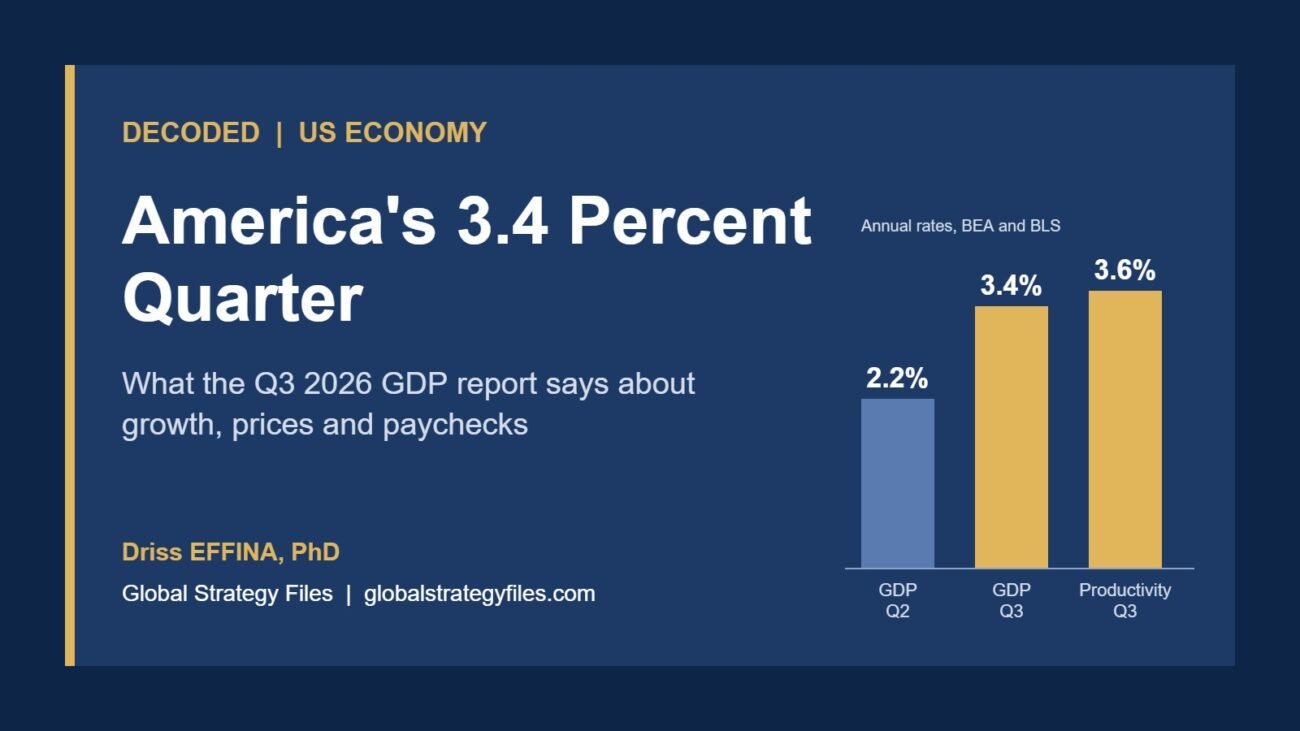
The Bureau of Labor Statistics reports that labor productivity in the nonfarm business sector increased 3.6 percent at an annual rate between July and September. Over the past year, productivity is up 2.1 percent. The second quarter was also revised up, from 1.4 to 2.1 percent, after the annual update of the national accounts by the Bureau of Economic Analysis.
The anatomy of the quarter is what makes it remarkable. Output grew 3.7 percent, while hours worked increased by only 0.1 percent. In plain terms, almost all of the extra production came from getting more out of each hour of work, not from adding more hours. That is precisely the signature economists expect from a general purpose technology once it starts to diffuse.
The Q3 2026 productivity report in figures
| Nonfarm business sector | Q3 2026, annual rate | Change from a year earlier |
|---|---|---|
| Labor productivity | 3.6% | 2.1% |
| Output | 3.7% | 2.3% |
| Hours worked | 0.1% | 0.2% |
| Hourly compensation | 2.9% | 4.5% |
| Real hourly compensation | 1.1% | 1.0% |
| Unit labor costs | -0.7% | 2.4% |
Source: U.S. Bureau of Labor Statistics, Productivity and Costs, Third Quarter 2026, preliminary, 5 November 2026. Quarterly figures are seasonally adjusted annual rates.
Why falling unit labor costs matter for inflation
Unit labor costs measure what firms pay in wages and benefits for each unit they produce. When compensation rises faster than productivity, unit labor costs climb and businesses come under pressure to raise prices. When productivity outpaces pay, the opposite happens.
In the third quarter, hourly compensation rose 2.9 percent, but productivity rose 3.6 percent, so unit labor costs fell 0.7 percent. For a Federal Reserve that still describes inflation as elevated, this is the most comforting line in the release. It means that the labor market is not, for now, the channel through which the 2026 energy shock is turning into persistent inflation.
The year over year comparison is less flattering: unit labor costs are still up 2.4 percent on a year earlier, and hourly compensation is up 4.5 percent. One quarter of falling costs does not erase a year of increases. But the direction is the one policymakers want to see, and it arrived through higher output rather than through weaker wages.
Where the gain came from: not the factory floor
The manufacturing detail is revealing. Productivity in total manufacturing rose just 0.3 percent in the third quarter. Durable goods manufacturing did better, at 2.2 percent, but nondurable manufacturing fell 1.7 percent. Unit labor costs in manufacturing increased 2.7 percent.
| Sector, Q3 2026 | Productivity, annual rate | Unit labor costs, annual rate |
|---|---|---|
| Nonfarm business | 3.6% | -0.7% |
| Total manufacturing | 0.3% | 2.7% |
| Durable manufacturing | 2.2% | 0.5% |
| Nondurable manufacturing | -1.7% | 5.0% |
Source: U.S. Bureau of Labor Statistics, Productivity and Costs, Third Quarter 2026, preliminary.
If the aggregate rose 3.6 percent while manufacturing barely moved, the acceleration must sit mostly in the much larger nonmanufacturing part of the business sector: professional services, finance, trade, logistics, health administration and software. These are the activities where language models, coding assistants and automated document workflows have been adopted most widely since 2024. The data do not prove causation, and the BLS does not attribute the gain to any technology. But the pattern is consistent with what an early wave of AI diffusion should look like: gains in office work first, physical production later.
The investment side of the story
The national accounts published a week earlier fit the same picture. The BEA reports that real GDP grew at an annual rate of 3.4 percent in the third quarter, up from 2.2 percent in the second. Within business investment, equipment spending was led by information processing equipment, mostly computers and peripheral equipment. On the trade side, imports rose, with capital goods other than automotive as the largest contributor.
Real final sales to private domestic purchasers, the cleanest gauge of underlying demand, rose 4.9 percent after 4.6 percent in the second quarter. In other words, America is spending heavily on the machines of the digital economy, and it is now beginning to show the output gains that should follow such spending. Capital deepening, meaning more and better equipment per worker, is one of the two classic sources of productivity growth. The other, more efficient use of all inputs together, is where AI software would leave its mark.
The labor market: more output, steady hiring
A frequent fear about AI is that productivity gains will come at the expense of jobs. The latest employment report does not support that fear for now. The BLS reports that nonfarm payrolls rose by 165,000 in October 2026, and that August and September combined were revised up by 84,000. The unemployment rate edged down to 4.1 percent and the participation rate rose to 61.9 percent.
Professional, scientific and technical services, the sector most exposed to generative AI tools, added 33,000 jobs in October. The information sector, by contrast, lost about 1,000. Average hourly earnings rose 3.1 percent over twelve months, to 38.00 dollars. Real hourly compensation in the productivity data is up 1.0 percent over the year, a modest but positive share of the gains for workers.
| Labor market indicator, October 2026 | Value |
|---|---|
| Nonfarm payroll change | +165,000 |
| Revision to August and September combined | +84,000 |
| Unemployment rate | 4.1% |
| Labor force participation rate | 61.9% |
| Average hourly earnings, 12-month change | 3.1% |
| Professional, scientific and technical services jobs | +33,000 |
Source: U.S. Bureau of Labor Statistics, The Employment Situation, October 2026, 6 November 2026.
What it means for the Federal Reserve
The Federal Open Market Committee kept the federal funds target range at 3.75 to 4 percent on 28 October. Its statement described economic activity as “expanding at a strong pace” and noted that “productivity growth is strong, and capital investment is robust.” The vote was 10 to 2, with Lisa D. Cook and Beth M. Hammack preferring a quarter point increase.
The productivity data cut both ways for the December meeting. On one side, falling unit labor costs weaken the case for a hike: if firms can absorb wage increases through higher output, labor costs are not feeding inflation. On the other side, faster productivity growth can raise the neutral interest rate, the level of rates that neither stimulates nor restrains the economy. A stronger supply side allows faster growth without inflation, but it also means the current policy rate may be less restrictive than it looks. Expect this argument to feature prominently in the next round of Fed communication.
Three tests for a durable AI payoff
A single quarter is not a trend. Quarterly productivity figures are volatile and frequently revised; the preliminary estimate will be updated when the BEA revises GDP on 25 November. Whether the third quarter marks a turning point depends on three tests.
- Persistence. The past year shows productivity up 2.1 percent. A durable shift would require that pace, or better, to hold through 2027 rather than fade after a burst of reorganisation.
- Diffusion. Gains concentrated in a few large technology firms raise profits but not broad living standards. The real prize is adoption by the millions of mid-sized firms in services, health care and logistics. October’s job gains in professional and technical services are an early, encouraging sign.
- Resource constraints. The AI buildout runs on electricity, chips and skilled labor. If power prices and grid bottlenecks raise the cost of computing, part of the productivity dividend will be absorbed by higher energy bills for households and firms.
The message of the third quarter is nonetheless clear. For the first time in this investment cycle, the American economy produced substantially more without working more hours and without raising its labor cost per unit. If that pattern survives revisions and repeats, 2026 may be remembered less for its energy shock than as the year the AI boom began to pay.
GO DEEPER
Artificial Intelligence and Durable American Growth
Investment, productivity diffusion and the resource constraints behind the boom. Can the artificial intelligence buildout become a lasting engine of American prosperity? Dr. Driss Effina tests the case with public data, econometric models and transparent scenarios. 300 pages, English.
PDF: $30 (full color paperback: $34)
Read the front matter and Chapter 1 free: free excerpt (PDF).
Sources
- U.S. Bureau of Labor Statistics, Productivity and Costs, Third Quarter 2026, Preliminary, 5 November 2026.
- U.S. Bureau of Labor Statistics, The Employment Situation, October 2026, 6 November 2026.
- U.S. Bureau of Economic Analysis, GDP (Advance Estimate), 3rd Quarter 2026, 29 October 2026.
- Board of Governors of the Federal Reserve System, Federal Reserve issues FOMC statement, 28 October 2026.
Driss EFFINA, PhD
The opening pages of our four country reports: United States, United Kingdom, Japan and China. A free PDF, sent to your inbox.
You will also receive occasional analysis from Global Strategy Files. Unsubscribe in one click, at any time.