The End of a Ninety-Year Tax: Mortgage Rates, Public Revenue and House Prices After the Abolition of the Imputed Rental Value in 2029

Executive Summary
On 28 September 2025, Swiss voters approved by 57.7 percent the end of one of the oldest and most unusual features of their tax system: the taxation of the imputed rental value of owner-occupied homes. Introduced in 1934 as a crisis levy, the imputed rental value adds to the taxable income of homeowners the rent they would have to pay if they were tenants, while allowing them to deduct mortgage interest and maintenance costs. On 1 April 2026, the Federal Council set the entry into force of the reform for 1 January 2029. From that date, owner-occupiers will no longer be taxed on the imputed rent, but will no longer be able to deduct maintenance costs or mortgage interest, except for a temporary deduction for first-time buyers.
The reform is often described as a gift to homeowners and a cost to the public purse. That is true only at today's interest rates. The Federal Tax Administration estimates the revenue loss at about CHF 1.8 billion a year at an average mortgage rate of 1.5 percent, but expects the reform to raise revenue if rates rise above about 3 percent. The fiscal and economic effects of the reform therefore depend on a variable that nobody controls: the path of Swiss mortgage rates after 2029.
This article makes that dependence explicit. It calibrates the revenue effect of the reform on the official estimates, models the average rate on outstanding mortgages from monthly SNB data on new mortgage business since 2009, and simulates 50,000 paths of rates and revenue from 2026 to 2040 under four scenarios. It then examines four typical households and the effect of the reform on house prices. The main findings are the following.
- The reform breaks even at an average mortgage rate of 2.83 percent. Each percentage point of mortgage rates is worth about CHF 1.34 billion of annual revenue for the Confederation, cantons and communes combined. At the current average rate on outstanding mortgages, about 1.4 percent, the loss is about CHF 1.9 billion a year, of which about 22 percent falls on the Confederation and 78 percent on the cantons and communes.
- A revenue loss is almost certain for a decade. Because most Swiss mortgages are fixed for several years, the average rate on outstanding mortgages adjusts slowly: in the model, it closes half of any gap with new-business rates in about three and a half years. In the central scenario, which extrapolates the behaviour of rates since 2009, the probability that the reform raises revenue in any year before 2040 is practically zero, and the cumulative loss from 2029 to 2035 is CHF 13.5 billion (between CHF 12 and 15 billion in 80 percent of simulations).
- Only a sustained rate shock would reverse the sign. If new mortgage rates rose to about 4 percent from 2027 and stayed there, the average outstanding rate would cross the break-even level only in 2032, and the reform would raise revenue from then on. Even in that scenario, the cumulative balance from 2029 to 2035 is roughly zero. A gradual normalisation towards 2.5 percent leaves a loss of about CHF 1.2 billion a year in 2035.
- The winners are older and debt-free owners. A retired couple without a mortgage, in a home worth CHF 1.2 million, saves about CHF 4,700 a year regardless of interest rates. A mid-career owner with a 50 percent mortgage gains at today's rates but loses above 3.1 percent. A young family with an 80 percent mortgage gains about CHF 2,800 a year at 1.5 percent thanks to the first-time buyer deduction, but loses above about 2 percent once that deduction expires.
- House prices should rise modestly. For a buyer with a 65 percent mortgage, the capitalised value of the tax change is about 5.4 percent of the property's value in the central scenario, 1.7 percent if rates normalise and 6.1 percent if they stay low. These are upper bounds, since supply, credit rules and the mix of buyers will dampen the effect, but they suggest that the reform will add to the upward pressure on prices of owner-occupied homes, which have risen by about a third since 2016.
- Renovations will be brought forward. Because maintenance costs remain deductible until the end of 2028 and cease to be deductible afterwards, owners have an incentive of about 25 to 30 percent of the cost to carry out work before 2029. This will produce a boom in renovation activity in 2027 and 2028 followed by a slump in 2029, unless the cantons maintain deductions for energy-saving investments, as the law allows.
The conclusion is that the abolition of the imputed rental value is, for the foreseeable future, a tax cut for homeowners worth about CHF 2 billion a year, financed mainly by the cantons. It becomes a tax increase only if mortgage rates return durably to levels last seen before 2009. The cantons, which also bear the risk of SNB payouts analysed in the eighth article of this series, should plan for the loss rather than for the break-even.
Key results at a glance
| Indicator | Value |
|---|---|
| Break-even average mortgage rate | 2.83 percent |
| Revenue effect per percentage point of mortgage rates | CHF 1.34 billion a year |
| Average rate on outstanding mortgages, September 2025 | 1.37 percent |
| Expected annual revenue loss from 2029, central scenario | CHF 1.92 billion |
| Cumulative loss 2029 to 2035: central (80% range) | CHF 13.5 billion (12.0 to 15.1) |
| Year the outstanding rate crosses break-even, rate shock scenario | 2032 |
| Annual saving, retired debt-free couple (home CHF 1.2 million) | about CHF 4,700 |
| Capitalised value for a buyer with a 65% mortgage: low / central / normalisation | 6.1 / 5.4 / 1.7 percent of value |
Source: author's calculations; see Sections 4 to 9.
1. Introduction
Switzerland is one of the very few countries that tax the imputed rent of owner-occupied housing. The logic is that of neutrality between tenants and owners: a tenant pays rent out of taxed income, while an owner enjoys the same housing service without paying rent; to treat both equally, the owner is taxed on the rent he saves, and allowed to deduct the costs of producing that housing service, notably mortgage interest and maintenance. The system was introduced in 1934 as a temporary crisis levy and was never abolished, despite repeated attempts.
In practice, the system was unpopular with homeowners, who saw it as a tax on income they did not receive, and was criticised by economists for encouraging debt: because mortgage interest is deductible, households have an incentive to keep their mortgages rather than repay them, which contributes to the very high level of household debt in Switzerland, among the highest in the world relative to GDP. The cantons set the imputed rent, usually at 60 to 70 percent of the market rent, which in practice gives a tax advantage to owners compared with a strictly neutral system.
After several failed attempts, parliament adopted a reform on 20 December 2024, linked to a constitutional amendment allowing cantons to levy a special property tax on second homes. Voters approved the amendment on 28 September 2025, which allowed the reform to proceed. The Federal Council set its entry into force for 1 January 2029, rejecting the request of mountain cantons, where second homes are concentrated, for a further year of delay.
The reform is now certain; its effects are not. They depend on the level of mortgage rates over the coming decades, on the structure of mortgage debt and on how owners and the housing market respond. This article quantifies these effects.
2. What Changes in 2029
Table 1 summarises the main elements of the reform.
Table 1. The reform of home ownership taxation in force from 1 January 2029
| Element | Until 2028 | From 2029 |
|---|---|---|
| Imputed rent of owner-occupied home | Taxed as income | Not taxed |
| Imputed rent of owner-occupied second home | Taxed as income | Not taxed; cantons may levy a special property tax |
| Maintenance, insurance and management costs | Deductible (actual or flat rate) | Not deductible for owner-occupied property |
| Mortgage interest | Deductible up to investment income plus CHF 50,000 | Deductible only in proportion to rented property |
| First-time buyers | Standard interest deduction | Declining deduction for ten years, from CHF 10,000 (couples) |
| Energy-saving and environmental investments | Deductible | Cantons may keep the deduction |
| Rented property | Income taxed, costs deductible | Unchanged |
Sources: Federal Department of Finance; federal law of 20 December 2024.
The reform removes both sides of the ledger for owner-occupied homes. The imputed rent is no longer taxed, whether on a main residence or on a second home occupied by its owner. Maintenance costs, insurance premiums and management costs of owner-occupied property are no longer deductible, at federal, cantonal and communal levels. Mortgage interest becomes deductible only in proportion to rented property, so that a household that owns only its home can no longer deduct any interest. Two exceptions soften the transition: first-time buyers may deduct part of their mortgage interest for ten years after purchase, on a declining scale starting at CHF 10,000 for married couples and CHF 5,000 for single persons; and the cantons may continue to allow deductions for energy-saving and environmental investments, as well as for the costs of preserving listed buildings. Finally, the cantons may introduce a special property tax on second homes that are mainly occupied by their owners, to compensate for the loss of revenue in tourist regions.
The net effect for an owner depends on the difference between the imputed rent that is no longer taxed and the deductions that are no longer allowed. For an owner with little debt, the imputed rent exceeds the deductions, and the reform is a tax cut. For a heavily indebted owner, interest deductions may exceed the imputed rent, especially when rates are high, and the reform is a tax increase. In aggregate, the balance tilts with the level of mortgage rates.
3. Data and Methods
The analysis combines three sources: the official estimates of the revenue effect of the reform published by the Federal Department of Finance and the Federal Tax Administration; monthly SNB data on interest rates on new mortgage business since May 2009, for fixed-rate mortgages and for mortgages linked to SARON or a base rate; and house price indices from the SNB data portal.
The method has four steps. First, the revenue effect is expressed as a linear function of the average mortgage rate, calibrated on the official estimates of CHF 1.78 billion at 1.5 percent and CHF 2.45 billion at 1 percent. Second, a composite new-business rate, weighting fixed-rate mortgages at 80 percent and variable mortgages at 20 percent, is modelled as a first-order autoregressive process estimated on monthly data from 2009 to 2026. Third, the average rate on outstanding mortgages, which determines tax deductions, is derived from new-business rates with a partial adjustment of one sixtieth of the gap each month, reflecting the average fixed-rate period, starting from the official average of 1.37 percent in September 2025. Fourth, 50,000 simulated rate paths are translated into revenue effects from 2029 to 2040, under four scenarios for the long-run level of new-business rates. Household and price effects are computed for typical owners. Details are in the Methodological Appendix.
4. Result One: The Break-Even Rate
Figure 1 shows the rates on new mortgage business since 2009.

Swiss mortgage rates fell steadily from 2009 to 2021, when fixed-rate mortgages averaged about 1.1 percent and variable mortgages about 0.9 percent. The tightening of monetary policy in 2022 and 2023 pushed fixed rates to 2.66 percent and variable rates to 2.67 percent in the autumn of 2023. The SNB's cuts from 2024, which brought its policy rate back to zero, reduced fixed rates to about 1.5 percent and variable rates to about 1 percent in 2026.
Figure 2 shows the revenue effect of the reform as a function of the average mortgage rate.
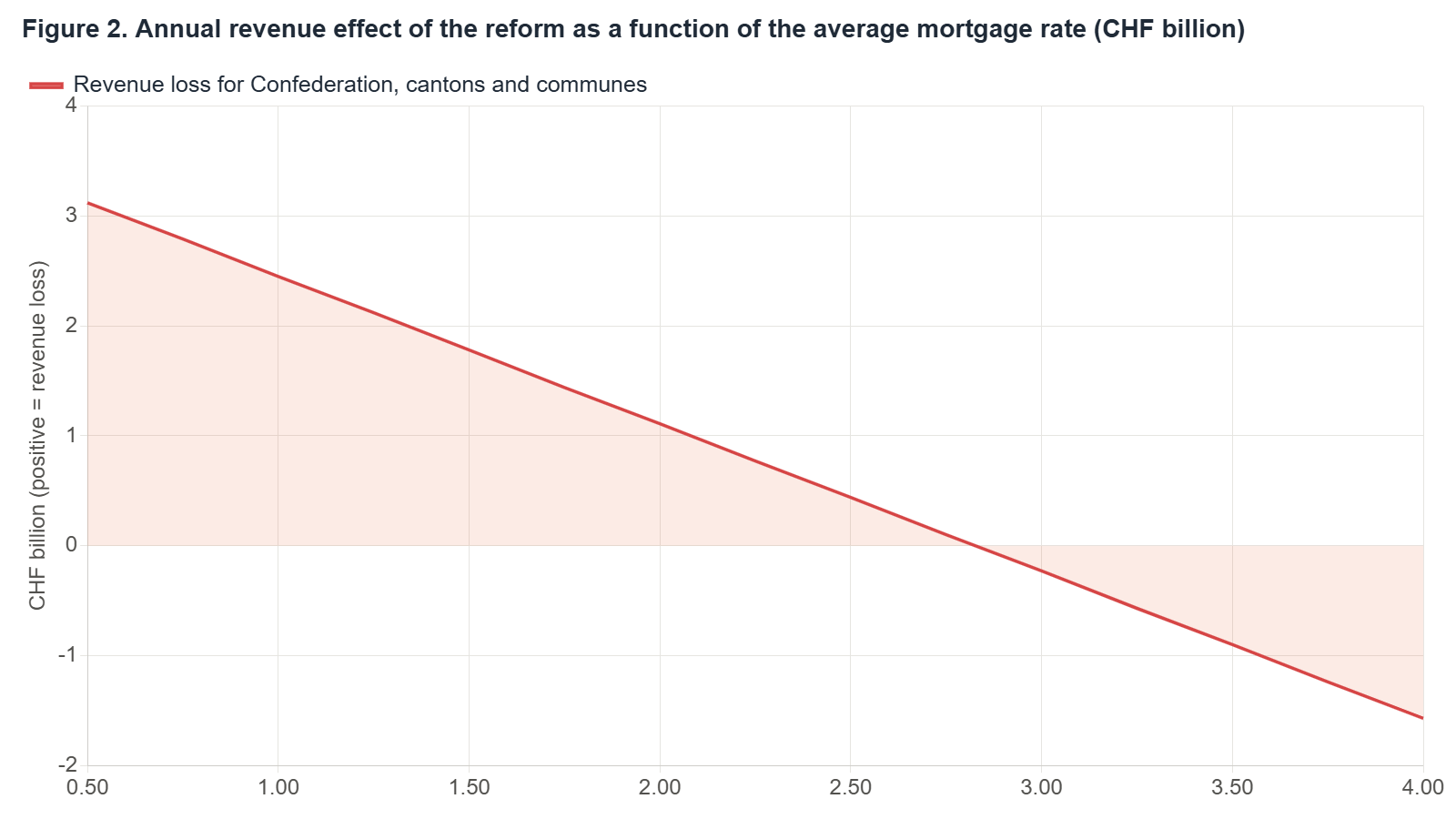
Table 2. Revenue effect of the reform by average mortgage rate (CHF billion a year)
| Average mortgage rate, % | Total effect | Direct federal tax | Cantons and communes |
|---|---|---|---|
| 0.50 | 3.12 | 0.70 | 2.42 |
| 1.00 | 2.45 | 0.55 | 1.90 |
| 1.37 | 1.95 | 0.44 | 1.51 |
| 1.50 | 1.78 | 0.40 | 1.38 |
| 2.00 | 1.11 | 0.25 | 0.86 |
| 2.50 | 0.44 | 0.10 | 0.34 |
| 2.83 | 0.00 | 0.00 | 0.00 |
| 3.00 | -0.23 | -0.05 | -0.18 |
| 3.50 | -0.90 | -0.20 | -0.70 |
| 4.00 | -1.57 | -0.35 | -1.22 |
Sources: Federal Tax Administration estimates at 1.0 and 1.5 percent; author's interpolation. Positive values are revenue losses.
The official estimates imply that each percentage point of the average mortgage rate changes the revenue effect by about CHF 1.34 billion a year. The reform costs CHF 3.79 billion a year at a hypothetical rate of zero, CHF 1.78 billion at 1.5 percent, nothing at 2.83 percent, and raises CHF 1.6 billion at 4 percent. The break-even rate of 2.83 percent is consistent with the official statement that the reform should raise revenue from an average rate of about 3 percent.
The slope has a simple interpretation. It is the tax value of one percentage point of interest on the mortgage debt of owner-occupiers: CHF 1.34 billion corresponds, at an average marginal tax rate of 25 percent, to about CHF 540 billion of deductible owner-occupier mortgage debt, roughly half of all Swiss mortgages. The intercept, CHF 3.79 billion, is the tax value of imputed rents net of maintenance deductions, corresponding at the same tax rate to about CHF 15 billion of net imputed rental income.
The average rate on outstanding mortgages, which determines deductions, was 1.37 percent in September 2025 according to the official calculation used for the reference rate for tenancies. At that level, the revenue loss is about CHF 1.95 billion a year.
5. Result Two: Why the Loss Will Last
The key question is how long the average mortgage rate will stay below the break-even level. Table 3 reports the estimated rate process and the simulation results.
Table 3. Simulated outstanding mortgage rate and revenue loss under four scenarios
| Scenario | Long-run new rate | Outstanding rate 2035, % | Loss 2029, CHF bn | Loss 2035, CHF bn | Cumulative 2029 to 2035, CHF bn |
|---|---|---|---|---|---|
| Central | 1.33% (estimated) | 1.38 | 1.92 | 1.95 | 13.5 |
| Normalisation | 2.5% | 1.93 | 1.77 | 1.20 | 10.4 |
| Low for long | 1.1% | 1.27 | 1.96 | 2.09 | 14.1 |
| Rate shock | 4.0% | 3.37 | 1.00 | -0.73 | 0.2 |
Source: author's calculations. AR(1) coefficient 0.9871, residual standard deviation 0.052; 50,000 simulations; medians and means.
The composite new-business rate is highly persistent: its monthly autoregressive coefficient is 0.987, which implies a half-life of shocks of about 53 months, and its long-run mean over the sample is 1.33 percent, with a monthly innovation of 0.05 percentage points. The average rate on outstanding mortgages adds a further layer of inertia, because only a fraction of mortgages is renewed each year. As a result, even a sharp rise in new-business rates takes years to feed through to the rate that determines tax deductions.
Figure 3 shows the distribution of the simulated average outstanding rate in the central scenario.

In the central scenario, the median outstanding rate stays close to 1.4 percent through 2040, and the 90th percentile rises only to about 1.65 percent. The break-even rate of 2.83 percent is far out of reach. The expected revenue loss is about CHF 1.9 billion a year from 2029, rising slightly over time as rates drift towards their long-run mean.
The central scenario extrapolates a period of exceptionally low rates, which may not be representative of the future. Figure 4 therefore compares four scenarios.
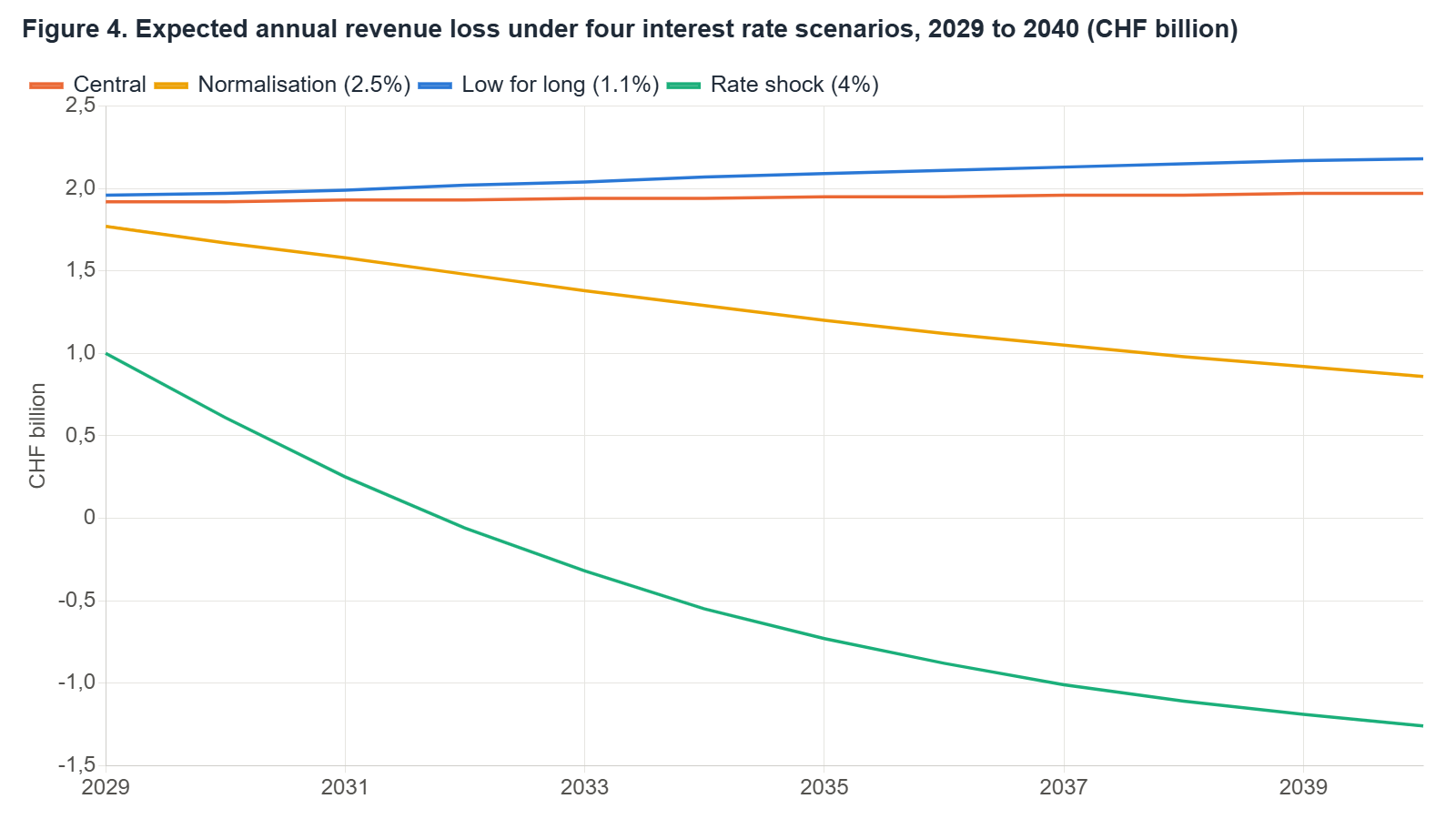

In the normalisation scenario, where new-business rates drift towards 2.5 percent, the outstanding rate reaches about 1.9 percent in 2035 and 2.2 percent in 2040; the loss shrinks from CHF 1.8 billion in 2029 to CHF 1.2 billion in 2035 and CHF 0.9 billion in 2040, but never turns into a gain. In the low-for-long scenario, the loss rises to about CHF 2.1 billion a year. Only in the rate shock scenario, where new-business rates move quickly to 4 percent from 2027, does the outstanding rate cross the break-even level, in 2032; from then on, the reform raises revenue, reaching about CHF 0.7 billion a year in 2035 and CHF 1.3 billion in 2040.
Over the period 2029 to 2035, the cumulative loss amounts to CHF 13.5 billion in the central scenario, CHF 10.4 billion with normalisation and CHF 14.1 billion if rates stay low. Even the rate shock scenario produces a cumulative balance close to zero over these seven years, because the early losses offset the later gains. For public budgets, the reform is a loss in all plausible scenarios for at least the first half of the 2030s.
6. Result Three: Who Pays
Table 4 splits the central loss between levels of government.
Table 4. Expected revenue loss by level of government, central scenario (CHF billion)
| Year | Total | Confederation (direct federal tax) | Cantons and communes |
|---|---|---|---|
| 2029 | 1.92 | 0.43 | 1.49 |
| 2030 | 1.92 | 0.43 | 1.49 |
| 2031 | 1.93 | 0.43 | 1.50 |
| 2032 | 1.93 | 0.43 | 1.50 |
| 2033 | 1.94 | 0.44 | 1.50 |
| 2034 | 1.94 | 0.44 | 1.50 |
| 2035 | 1.95 | 0.44 | 1.51 |
| 2029 to 2035 | 13.5 | 3.0 | 10.5 |
Source: author's calculations; split based on the official estimate at 1.5 percent.
According to the official estimates, about 22 percent of the loss falls on the direct federal tax and 78 percent on cantonal and communal taxes. In the central scenario, this means about CHF 0.43 billion a year for the Confederation and about CHF 1.5 billion for the cantons and communes. Part of the federal loss is itself shared with the cantons, which receive 21.2 percent of the direct federal tax. About CHF 260 million of the total loss at 1.5 percent comes from second homes, which the cantons can offset with the new special property tax.
For the cantons, the reform arrives at a delicate moment. Their revenue from SNB payouts, analysed in the eighth article of this series, is volatile and may well fall to zero in some years of the coming decade. Their share of the loss from the abolition of the imputed rental value, about CHF 1.5 billion a year, is more than half of their average expected SNB payout. Cantons with high homeownership rates and high property values will be most affected; cantons with many second homes can compensate partly through the new property tax.
7. Result Four: Winners and Losers Among Owners
Table 5 and Figure 6 show the annual tax change for four typical owners of a home worth CHF 1.2 million, with an imputed rent of CHF 23,400 a year (65 percent of a market rent of 3 percent of the value) and a flat-rate maintenance deduction of 20 percent of the imputed rent.
Table 5. Annual tax change for four owner households (CHF, positive = saving)
| Household | Mortgage, CHF | 1.0% | 1.5% | 2.0% | 3.0% | 4.0% | Break-even rate, % |
|---|---|---|---|---|---|---|---|
| Young family, bought 2024 (LTV 80%) | 960 000 | 4 236 | 2 796 | 1 356 | -1 524 | -4 404 | 1.95 |
| Mid-career owner (LTV 50%) | 600 000 | 3 816 | 2 916 | 2 016 | 216 | -1 584 | 3.12 |
| Retired, small mortgage (LTV 15%) | 180 000 | 4 230 | 4 005 | 3 780 | 3 330 | 2 880 | 10.40 |
| Retired, debt-free | 0 | 4 680 | 4 680 | 4 680 | 4 680 | 4 680 | none |
Source: author's calculations; home value CHF 1.2 million; break-even excludes the first-time buyer deduction.

The results are clear. The retired couple without a mortgage saves about CHF 4,700 a year, whatever the level of interest rates. A retired couple with a small mortgage of CHF 180,000 saves between CHF 2,900 and 4,200. The mid-career owner with a CHF 600,000 mortgage saves about CHF 2,900 at 1.5 percent, but the gain disappears around 3.1 percent. The young family with a CHF 960,000 mortgage saves about CHF 2,800 at 1.5 percent, largely thanks to the first-time buyer deduction, but would pay more tax from rates of about 2.5 percent, and its break-even rate without the transitional deduction is only 1.95 percent.

The reform thus redistributes the tax burden from older, wealthier owners with low debt towards younger, indebted owners, and above all from all owners towards the general taxpayer, as long as rates stay low. It also changes incentives: from 2029, repaying a mortgage no longer increases taxable income, which removes the long-standing incentive to stay indebted. Over time, this should reduce household mortgage debt, which is one of the stated objectives of the reform and a long-standing recommendation of the IMF and the SNB.
8. Result Five: House Prices
A permanent tax change is capitalised into the price of the asset it affects. For a buyer who finances a home with a 65 percent mortgage and faces a marginal tax rate of 30 percent, the reform changes the annual after-tax cost of ownership by the tax on the imputed rent net of maintenance minus the tax value of the interest deduction. Discounting the expected change at 3.5 percent gives the capitalised value shown in Figure 8.
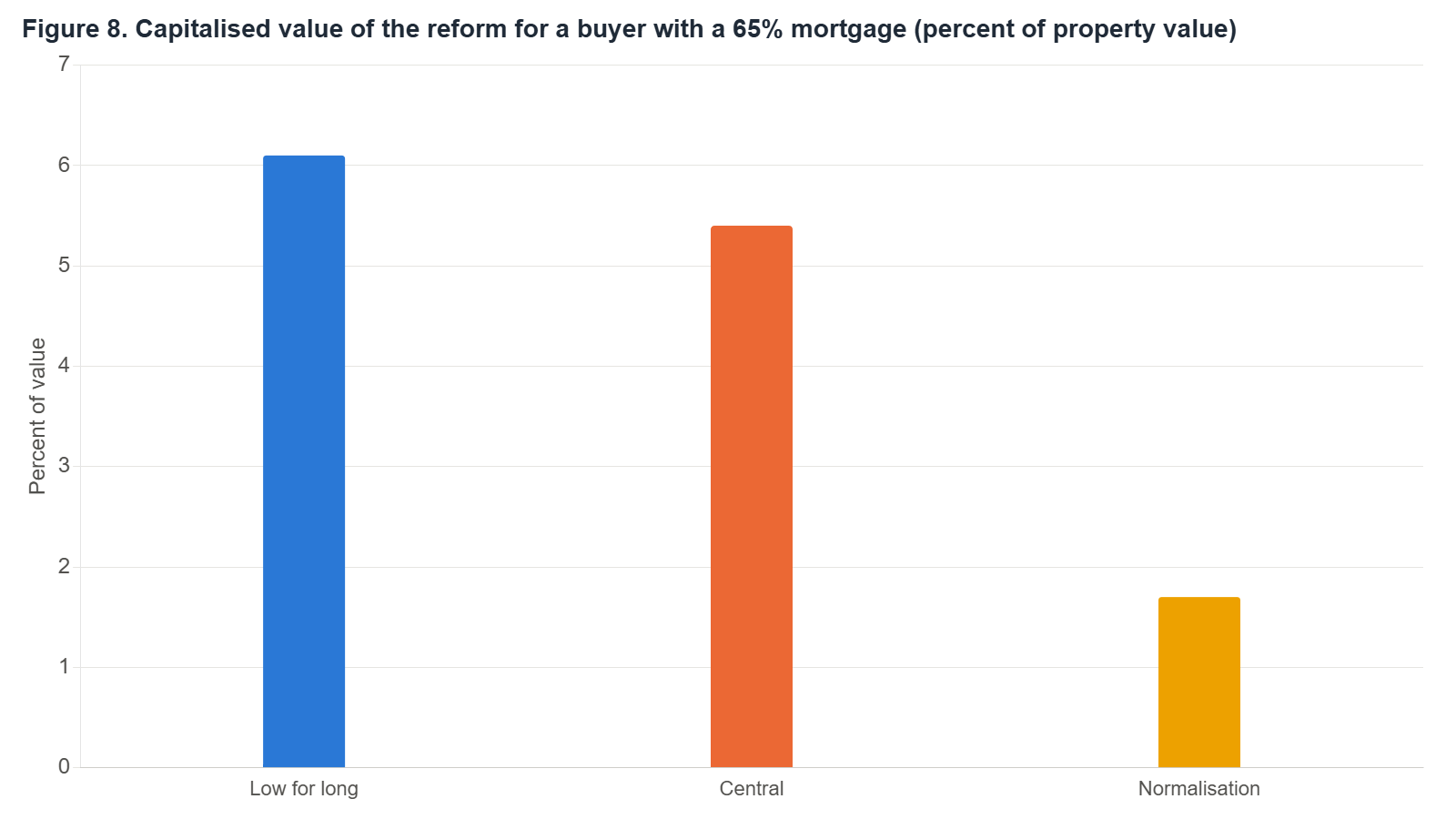
In the central scenario, the capitalised value of the reform is about 5.4 percent of the property's value; it is 6.1 percent if rates stay low and 1.7 percent if they normalise. These figures are upper bounds for the price effect. They assume that the marginal buyer has this profile, that the reform is expected to be permanent, and that supply does not respond. In practice, the housing supply responds slowly, which makes capitalisation more likely in the short run; but the mix of buyers includes investors who are unaffected, the affordability rules of banks limit price increases, and buyers may not fully anticipate the tax change.

The effect comes on top of a long rise in prices. According to the IAZI indices, prices of owner-occupied apartments rose by 32 percent and those of single-family houses by 36 percent between 2016 and 2025. A further increase of a few percent around 2029 would make ownership even less accessible for young households, the group that gains least from the reform.
9. Result Six: The Renovation Cliff
The abolition of the maintenance deduction creates a transitional incentive. Until the end of 2028, owners can deduct the actual costs of maintenance and many renovations; from 2029, they cannot, except for energy-saving and environmental investments where the cantons keep the deduction. For an owner with a marginal tax rate of 25 to 30 percent, a renovation of CHF 100,000 carried out in 2028 rather than 2029 saves CHF 25,000 to 30,000 of tax.
The aggregate implication is a bunching of renovation activity in 2027 and 2028, followed by a slump in 2029. Based on the official estimates, the tax value of maintenance deductions on owner-occupied homes is roughly CHF 1 billion a year, corresponding to several billion francs of deductible spending. Even a partial anticipation could shift billions of francs of construction activity from 2029 and 2030 into 2027 and 2028, with corresponding swings in employment in the building trades. The cantons can dampen the effect by retaining deductions for energy-related investments, which would also support the energy transition discussed in the next article of this series.
10. Policy Assessment
Table 6 summarises the policy options.
Table 6. Policy options around the reform
| Option | Who decides | Effect |
|---|---|---|
| Budget the loss of about CHF 2 billion a year, not neutrality | Cantons and Confederation | Avoids unpleasant surprises from 2029 |
| Keep deductions for energy-saving investments | Cantons | Smooths the renovation cliff, supports climate goals |
| Introduce a property tax on second homes | Cantons with many second homes | Recovers part of the CHF 260 million loss |
| Monitor prices and new mortgage lending | SNB, FINMA | Limits the capitalisation of the tax cut into debt |
| Review the first-time buyer deduction after 2035 | Parliament | Keeps support targeted at young households |
Source: author's assessment.
Three conclusions emerge. First, the cantons should budget for a loss, not for neutrality. The official break-even rate of about 3 percent is far above any plausible path of the average outstanding mortgage rate in the next decade, and the cantons bear 78 percent of the loss. Second, the cantons should use the room the law gives them: retaining energy-related deductions would smooth the renovation cliff and support climate goals, and a well-designed property tax on second homes would recover part of the loss where it is concentrated. Third, the Confederation and the SNB should monitor the effect on prices and household debt. The reform removes the tax incentive to stay indebted, which is welcome, but its capitalisation into prices could offset part of that benefit by raising the amounts that new buyers must borrow.
11. Implications
The first implication concerns tax fairness between tenants and owners. Switzerland is a country of tenants: only about 36 percent of households own their home. The reform gives owners a tax cut of about CHF 2 billion a year at current rates, financed by all taxpayers, most of whom are tenants. Whether this is fair depends on one's view of the old system, which already favoured owners through low imputed rents. What is certain is that the reform does not achieve neutrality: it replaces a system that favoured owners at low rates and penalised indebted owners at high rates with one that ignores the housing services enjoyed by owners altogether.
The second implication concerns the interaction with monetary policy. Under the old system, a rise in mortgage rates was partly cushioned for indebted owners by the interest deduction; under the new one, it will be felt in full. The reform therefore strengthens the transmission of monetary policy to households, a point the SNB will need to take into account when it next raises rates.
The third implication concerns the coherence of fiscal choices. The Confederation is adopting relief packages to respect the debt brake, and the cantons face volatile SNB payouts and the costs of an ageing population. Against that background, a reform that reduces revenue by about CHF 2 billion a year for the foreseeable future is a significant choice, even if it was democratically made.
12. Conclusion
The abolition of the imputed rental value ends a ninety-year-old tax that few defended and many disliked. Its fiscal effect depends on mortgage rates, and the evidence points in one direction: with average outstanding rates around 1.4 percent and highly persistent, the reform will cost the Confederation, cantons and communes about CHF 2 billion a year from 2029, and about CHF 13 to 14 billion over its first seven years. Only a sustained rise of new mortgage rates to around 4 percent would turn it into a source of revenue, and even then not before the early 2030s.
For homeowners, the reform is a gift that is largest for those who need it least: older owners with little debt. For the housing market, it is a modest additional push to prices and a temporary boom in renovations. For the cantons, it is a structural loss that should be planned for now, while there are still two years to prepare.
Methodological Appendix
A.1 Data
Monthly interest rates on new mortgage business, May 2009 to July 2026, SNB data portal, cube zikreddet: fixed-rate mortgages (FH) and mortgages linked to a base rate (MBB). Annual residential property price indices (IAZI transaction prices), cube plimoincha. Official estimates of the revenue effect from the Federal Department of Finance and the Federal Tax Administration: CHF 1.78 billion at 1.5 percent (direct federal tax CHF 0.4 billion), CHF 2.45 billion at 1 percent, about CHF 1.95 billion at 1.37 percent, of which about CHF 260 million from second homes at 1.5 percent; revenue gains from about 3 percent.
A.2 Revenue function
Revenue loss L(r) = 3.79 minus 1.34 times r, in CHF billion, with r the average mortgage rate in percent; break-even at 2.83 percent. The federal share is 0.4 / 1.78 = 22.5 percent.
A.3 Rate model
Composite new-business rate c = 0.8 FH + 0.2 MBB. AR(1) estimated by OLS on monthly data: c(t) = alpha + phi c(t-1) + e(t), phi = 0.987, long-run mean 1.33 percent, residual standard deviation 0.052. Outstanding rate: r(t) = r(t-1) + (c(t) minus r(t-1)) / 60, starting at 1.37 percent in September 2025. Scenarios replace the long-run mean by 2.5 percent (normalisation), 1.1 percent (low for long) and 4 percent with phi = 0.95 (rate shock). 50,000 simulations, October 2025 to December 2040; annual averages.
A.4 Households
Home value CHF 1.2 million; imputed rent 65 percent of a market rent of 3 percent of the value (CHF 23,400); flat maintenance deduction 20 percent of the imputed rent (CHF 4,680). Annual tax change = t times (imputed rent minus maintenance minus interest), plus, for first-time buyers, t times the transitional deduction (CHF 5,000 in the sixth year after a 2024 purchase). Marginal tax rate t = 30 percent for working households, 25 percent for retirees.
A.5 Capitalisation
Buyer with a 65 percent mortgage and t = 30 percent; annual tax change computed with the median simulated outstanding rate for 2029 to 2040 and held constant thereafter; discounted at 3.5 percent from 2029; expressed as a percentage of the home value.
A.6 Limitations
The revenue function is linear and calibrated on two official estimates; the true relationship depends on the distribution of debt and tax rates and on behavioural responses, such as debt repayment, which the official estimates partly ignore. The rate model is estimated on a period of unusually low rates. The household examples are illustrative. The price effect is an upper bound.
References
Federal Department of Finance, "Change of system in home ownership taxation", questions and answers, 2025.
Federal Council, decision on the entry into force of the reform of home ownership taxation, 1 April 2026.
Federal Chancellery, results of the popular vote of 28 September 2025.
Swiss National Bank, data portal, cubes zikreddet (interest rates on new business) and plimoincha (real estate price indices).
Federal Office for Housing, mortgage reference rate and average interest rate on mortgage claims, 2025.
Swiss Federal Tax Administration, estimates of the financial effects of the change of system, 2024 and 2025.
Global Strategy Files, Swiss Economy 2026 Series, Articles 1 to 8, November 2026.
Driss EFFINA, PhD
Independent Researcher, Global Strategy Files
The opening pages of our four country reports: United States, United Kingdom, Japan and China. A free PDF, sent to your inbox.
You will also receive occasional analysis from Global Strategy Files. Unsubscribe in one click, at any time.