The Slow Shield: How the Franc, Taxes and Structure Kept the 2026 Oil Shock out of Swiss Inflation

Executive Summary
At the end of February 2026, war in the Gulf and the closure of the Strait of Hormuz triggered the largest oil shock since 2022. Brent crude rose from about USD 71 a barrel in February to more than USD 117 in April, eased in the early summer and climbed again to USD 114 in September and to more than USD 120 in October. In the euro area, inflation rose to 3.3 percent in August and to nearly 4 percent in September, and the European Central Bank raised its deposit rate to 2.5 percent. In Switzerland, inflation rose to only 0.8 percent in August and about 1 percent in September, and the Swiss National Bank left its policy rate at zero.
The common explanation is that the strong franc shields Switzerland from imported inflation. This article tests that explanation with monthly data since 2000 on oil prices, exchange rates and consumer prices in Switzerland and the euro area. It combines a decomposition of oil prices by currency, pass-through regressions, a vector autoregression, rolling correlations, counterfactual simulations and scenarios for 2027. The main findings are the following.
- The franc is a slow shield, not a fast one. Since January 2000, the price of Brent has risen 4.5-fold in dollars and 3.9-fold in euros, but only 2.3-fold in francs. In September 2026, Brent was 7 percent below its June 2022 level in dollars, 15 percent below in euros and 21 percent below in francs. Two decades of appreciation have cut the cost of oil for Swiss consumers by half relative to Americans.
- In 2026, the franc did not shield Switzerland at all in the short run. Between February and September 2026, Brent rose by 61 percent in dollars and by 71 percent in francs, because the dollar, not the franc, was the safe haven of this crisis. The franc lost 6 percent against the dollar and 3 percent against the euro. The rolling correlation between oil prices and the franc, strongly favourable to Switzerland between 2008 and 2012, has turned unfavourable since 2019.
- Pass-through is not the difference either. A 10 percent rise in the price of crude raises Swiss pump and heating oil prices by about 3 to 4 percent over three months, about the same as in the euro area. Swiss petroleum prices rose by 34 percent between February and September 2026, almost exactly as much as in the euro area (35 percent).
- The difference lies in weights and in core inflation. Petroleum products weigh less than 3 percent in the Swiss consumer price index, and electricity and gas tariffs are set once a year by regulated suppliers; for 2027 they will even fall by 4 percent. In September 2026, petroleum products contributed 0.87 percentage points to Swiss inflation of 1.0 percent, while core inflation remained at 0.5 percent. In the euro area, core inflation was 2.5 percent.
- The level of the franc matters little for the CPI. Had the franc stayed at its January 2022 level against the dollar, Swiss petroleum prices would have been 4.5 percent higher in September 2026 and headline inflation only 0.12 percentage points higher. The vector autoregression confirms that a 10 percent oil shock raises Swiss petroleum prices by 4.4 percent but has a negligible effect on core inflation, and is accompanied by an appreciation of the franc against the dollar of only 0.5 percent.
- The risk for 2027 is not inflation but its disappearance. Under four scenarios for oil and the franc, Swiss inflation in 2027 ranges from 0.6 percent (oil falls back) to 1.2 percent (Brent at USD 150 and a strong franc). Even the extreme scenario keeps inflation well within the SNB's range of price stability. But the calm scenario, combined with a widening interest rate differential with the euro area and a return of safe-haven flows into the franc, would push inflation back towards zero.
The policy conclusion is that the SNB was right to look through the 2026 oil shock, and should continue to do so. The more relevant danger is a renewed appreciation of the franc once the dollar loses its role as the haven of this crisis, at a time when the ECB has started to raise rates and the SNB has no room left to cut. The shield that protects Switzerland from oil is also the force that pushes it towards deflation.
1. Introduction
Switzerland has a reputation for being immune to imported inflation. During the energy crisis of 2022, Swiss inflation peaked at 3.5 percent, against more than 10 percent in the euro area. In 2026, the pattern repeated itself: while euro area inflation rose towards 4 percent after the closure of the Strait of Hormuz, Swiss inflation barely reached 1 percent. The most common explanation, offered by commentators and sometimes by the SNB itself, is the strength of the franc, which lowers the cost of imported goods, including energy.
This explanation is plausible but incomplete, and in 2026 it is partly wrong. The franc did appreciate strongly against the euro during the first weeks of the war, to decade highs, prompting the SNB to intervene. But over the whole shock, it weakened against the dollar, the currency in which oil is priced. If the franc had been the main shield, Swiss petroleum prices should have risen less than in the euro area. They did not.
This article asks what actually protects Swiss inflation from oil shocks, and what that implies for the SNB. It distinguishes four possible channels: the long-run trend of the franc, the short-run reaction of the franc to oil shocks, the pass-through of crude prices to consumer prices, and the weight of energy and the behaviour of core inflation. It finds that the first and the last matter most, and that the second, the role of the franc as a hedge in the moment of crisis, has largely disappeared.
2. The 2026 Oil Shock
The war that began at the end of February 2026 disrupted shipping through the Strait of Hormuz, through which about a fifth of global energy supplies passed before the conflict. The monthly average price of Brent rose from USD 71 a barrel in February to USD 103 in March and USD 117 in April. It fell back to about USD 84 in June and July, as stocks were drawn down and some flows resumed, before rising again to USD 114 in September and USD 124 in October, as the impasse persisted. Banks repeatedly revised their forecasts; some warned of prices of USD 150 if the closure continued.
The macroeconomic consequences differed sharply on either side of the Swiss border. In the euro area, headline inflation rose to 3.3 percent in August and close to 4 percent in September, the highest since 2023, and the ECB raised its deposit rate to 2.5 percent on 10 September. In Switzerland, inflation rose from 0.6 percent in May to 0.8 percent in August. On 24 September the SNB left its policy rate at zero for the fifth consecutive meeting, raised its conditional inflation forecast to 0.7 percent for 2026 and 0.8 percent for 2027 and 2028, and noted that the higher short-term forecast was due to oil products and, for the medium term, to a weaker franc.
The franc's trajectory was unusual. In the first weeks of the war, safe-haven flows pushed it to decade highs against the euro, and the SNB sold francs: it bought CHF 3.9 billion of foreign currency in the first quarter of 2026, mostly in March, and a further CHF 1.4 billion in the second quarter. But as the crisis continued, the dollar became the main destination of safe-haven flows, US interest rates rose with oil, and the ECB began to tighten. By September, the franc had lost 6 percent against the dollar and 3 percent against the euro relative to February.
3. Four Channels
An oil shock reaches Swiss consumer prices through a chain of links, each of which can attenuate or amplify it.
The first link is the exchange rate. Oil is priced in dollars. Its cost in francs depends on the dollar price and on the franc-dollar exchange rate. Over the long run, the trend appreciation of the franc lowers the franc price of oil relative to its dollar price. In the short run, if the franc appreciates when oil prices rise, as a safe-haven currency might, it cushions the shock.
The second link is pass-through: how much a change in the franc price of crude moves the consumer prices of petrol, diesel and heating oil. Pass-through is less than one because consumer prices include refining and distribution margins and taxes. In Switzerland, as in most of Europe, a large part of the pump price consists of a fixed tax per litre, the mineral oil tax, which does not change with the price of crude.
The third link is the weight of energy in the consumption basket. The impact of higher petroleum prices on headline inflation is proportional to their weight. Electricity and gas prices, which in many European countries followed wholesale markets closely in 2022, are set in Switzerland by regulated local suppliers once a year, on the basis of procurement strategies that smooth market movements.
The fourth link is second-round effects: whether higher energy prices spill over into core inflation, through production costs, wage demands and expectations.
The rest of this article measures each link.
4. Data and Methods
The analysis uses monthly data from January 2000 to September or October 2026.
Oil prices are the monthly average of Brent in dollars from the US Energy Information Administration, via the Federal Reserve Bank of St. Louis (FRED). Exchange rates of the franc against the dollar and the euro are monthly averages from the SNB. Swiss consumer prices come from the SNB data portal, which republishes the indices of the Federal Statistical Office: the total index, the index of petroleum products, the total excluding petroleum products and core inflation 1. Euro area consumer prices come from Eurostat via FRED: the total HICP, the HICP excluding energy, food, alcohol and tobacco, and the indices for fuels for personal transport and liquid fuels, combined with weights of three quarters and one quarter to approximate the coverage of the Swiss petroleum products index.
The methods are the following. Oil prices are converted into euros and francs to compare their evolution in each currency. Pass-through is estimated by regressing the monthly change in the consumer price of petroleum products on current and lagged changes in the price of Brent in local currency. The weight of petroleum products in the Swiss CPI is estimated from the relationship between the total index and its two components, which allows a monthly measure of their contribution to inflation. A vector autoregression with four lags, estimated on monthly changes in the dollar price of Brent, the dollar-franc exchange rate, Swiss petroleum prices and Swiss core prices, traces the dynamic effects of an oil shock. Rolling correlations measure whether the franc acts as a hedge. Counterfactual simulations and scenarios apply the estimated parameters. Details are in the Methodological Appendix.
5. Result One: The Slow Shield
Figure 1 shows the price of Brent since January 2000 in dollars, euros and francs, indexed to 100 at the start.
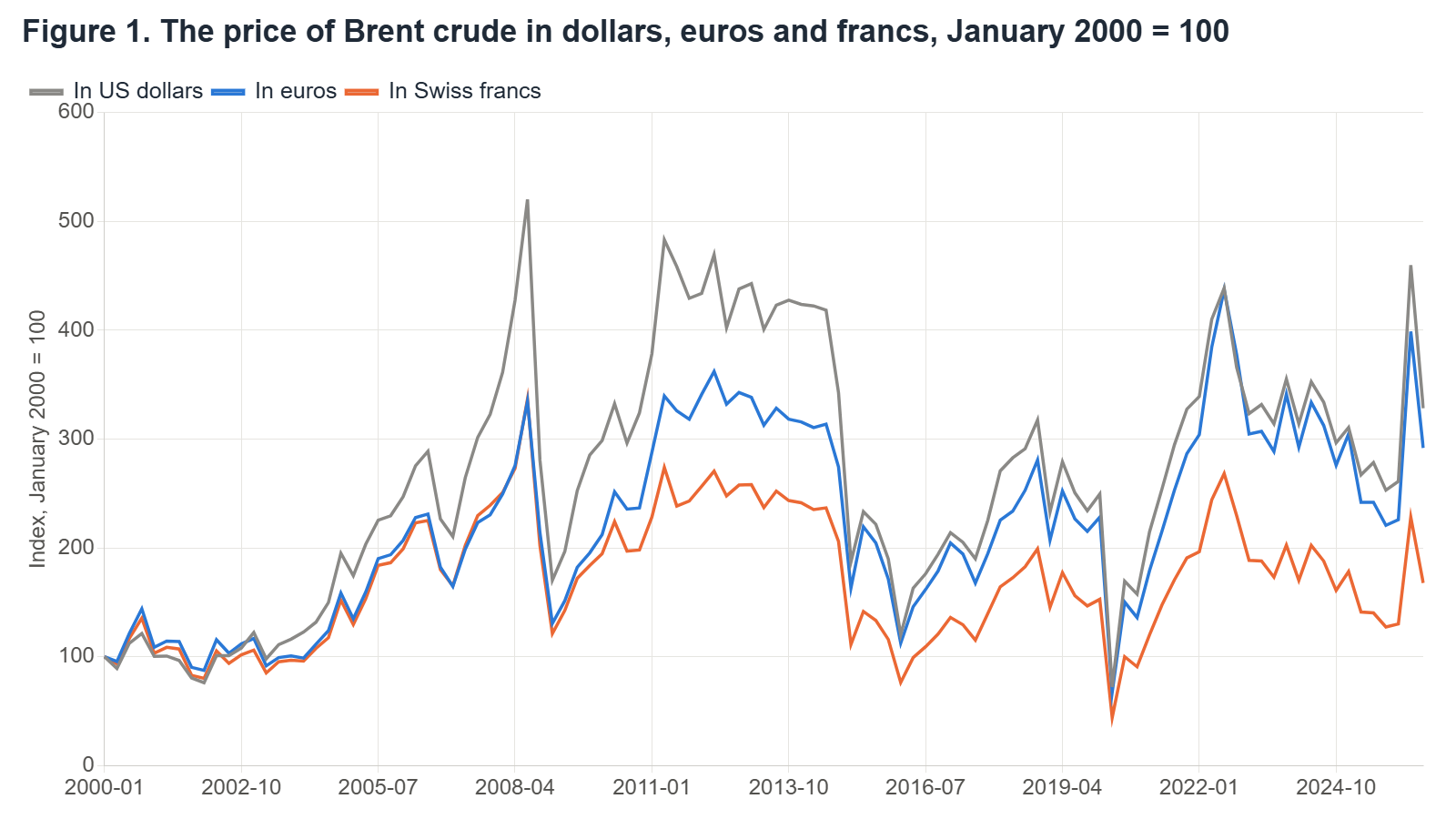
The divergence is striking. In dollars, the price of Brent in September 2026 was 4.5 times its level of January 2000; in euros, 3.9 times; in francs, only 2.3 times. Over a quarter of a century, the appreciation of the franc against the dollar has halved the cost of oil for Swiss consumers relative to American consumers, and reduced it by about 40 percent relative to euro area consumers.
The effect is visible in every oil shock. At the peak of 2008, the franc price of Brent was about 3.4 times its 2000 level, against 5.2 times in dollars. In 2012, when Brent in dollars was close to its 2008 peak, the franc price was 16 percent lower than in 2008, because the franc had appreciated strongly during the euro crisis. In 2022, the franc price at the peak was 2.9 times its 2000 level, against 4.8 times in dollars. And in September 2026, despite the new shock, Brent in francs was 21 percent below its June 2022 level, compared with 7 percent below in dollars and 15 percent below in euros.
The franc is therefore a powerful shield, but a slow one. Its effect accumulates over years, through the trend appreciation that reflects Switzerland's low inflation, its current account surpluses and its role as a safe haven. It is this cumulative effect, rather than any reaction in the moment of crisis, that explains why the franc price of oil remains far below its historical peaks.
6. Result Two: No Shield in the Moment of Crisis
The 2026 shock tells a different story in the short run.
Table 1. The 2026 oil shock compared with 2022 (percent change)
| Indicator | December 2021 to June 2022 | February to September 2026 |
|---|---|---|
| Brent, US dollars | 65.4 | 61.0 |
| Brent, euros | 76.9 | 65.5 |
| Brent, Swiss francs | 74.2 | 70.7 |
| Swiss petroleum products CPI | 36.1 | 33.5 |
| Euro area fuels and liquid fuels HICP | 34.5 | 35.0 |
| USD/CHF (positive = franc depreciation) | 6.0 | |
| EUR/CHF (positive = franc depreciation) | 3.2 |
Sources: FRED (Brent, euro area HICP); SNB (exchange rates, Swiss CPI); author's calculations.

Table 1 and Figure 2 compare the 2026 shock with the first phase of the 2022 shock. Between February and September 2026, Brent rose by 61 percent in dollars, by 66 percent in euros and by 71 percent in francs. The franc lost 6 percent against the dollar and 3 percent against the euro. In this crisis, the currency that rose with oil was the dollar: the United States is a net exporter of oil, US interest rates rose with inflation expectations, and global investors sought dollar liquidity. In 2022 the pattern was similar: Brent rose by 65 percent in dollars and by 74 percent in francs during the first half of the year.
The behaviour of consumer prices was almost identical on either side of the border. The Swiss index of petroleum products rose by 34 percent between February and September 2026; the corresponding euro area indices rose by 35 percent. If the franc had acted as a short-run shield, Swiss petroleum prices should have risen markedly less. They did not.
7. Result Three: Pass-Through Is Similar
The similarity is not a coincidence. Table 2 reports estimates of the pass-through of crude prices to consumer petroleum prices.
Table 2. Pass-through of crude oil prices to consumer prices of petroleum products
| Specification | Sum of coefficients, lags 0 to 3 | Std. error | R-squared | Observations |
|---|---|---|---|---|
| Switzerland, 2000 to 2026 (Brent in francs) | 0.39 | 0.06 | 0.57 | 317 |
| Euro area, 2000 to 2026 (Brent in euros) | 0.34 | 0.04 | 0.65 | 317 |
| Switzerland, 2015 to 2026 | 0.29 | 0.07 | 0.59 | 140 |
| Euro area, 2015 to 2026 | 0.30 | 0.06 | 0.56 | 140 |
Source: author's calculations. Monthly log changes; Newey-West standard errors (6 lags).
Over 2000 to 2026, a 10 percent rise in the price of Brent in francs raises Swiss petroleum product prices by 3.9 percent within three months; in the euro area, the corresponding figure, with Brent in euros, is 3.4 percent. Since 2015, both estimates are around 3 percent. Pass-through is fast, largely complete within a quarter, and well below one, because a large part of consumer prices consists of fixed taxes per litre and of margins. But it does not differ significantly between Switzerland and the euro area.

Figure 3 shows the two indices since 2019. They moved together through the pandemic and the 2022 shock. From 2023 onwards, Swiss petroleum prices fell further than euro area prices, reflecting the appreciation of the franc against the euro, and they remain about 15 percent lower relative to their 2019 level. This is the slow shield at work. But the profile of the 2026 shock is the same.
8. Result Four: Weights and Core Inflation
If the franc did not protect Swiss consumers in 2026, and pass-through is the same, why is Swiss inflation so much lower? Table 3 and Figure 4 answer the question.
Table 3. Inflation in Switzerland and the euro area (percent, year on year)
| Indicator | Switzerland | Euro area |
|---|---|---|
| Peak of the 2022 episode | 3.5 (2022-08) | 10.6 (2022-10) |
| Headline, September 2026 | 0.99 | 3.75 |
| Core, September 2026 | 0.50 | 2.50 |
| Weight of petroleum products in the CPI (estimated) | 2.8% | about 4% (fuels and liquid fuels) |
| Contribution of petroleum products, September 2026 | 0.87 | n.a. |
Sources: SNB; FRED (Eurostat HICP); author's calculations. Swiss core is core inflation 1 of the SFSO; euro area core excludes energy, food, alcohol and tobacco.

Two factors dominate. The first is the weight of energy. Petroleum products, petrol, diesel and heating oil, weigh about 2.8 percent in the Swiss CPI, according to our estimate, and electricity and gas tariffs are set once a year by regulated local suppliers. For 2027, the Federal Electricity Commission announced in September 2026 that household electricity tariffs would fall by an average of 4 percent, because suppliers had bought much of their energy in advance at lower prices. In the euro area, energy has a weight of nearly 10 percent and gas and electricity prices adjust more quickly to wholesale markets.
The second factor is core inflation. In September 2026, Swiss core inflation was 0.5 percent; euro area core inflation was 2.5 percent. The gap in core inflation alone, two percentage points, explains most of the gap in headline inflation. Swiss core inflation reflects the strength of the franc over many years, which keeps imported goods prices falling, the moderation of wages, and the credibility of the SNB's commitment to price stability.
The result is that the oil shock accounts for almost all of the modest rise in Swiss inflation in 2026. In September, petroleum products contributed 0.87 percentage points to headline inflation of 1.0 percent. Without them, Swiss inflation would have been close to zero.
9. Result Five: The Dynamics of an Oil Shock
A vector autoregression allows a more formal analysis of the dynamics. Table 4 and Figure 5 show the cumulative responses to a 10 percent increase in the dollar price of oil.
Table 4. Responses to a 10 percent oil price shock, monthly VAR (cumulative, percent)
| Variable | Impact | 3 months | 6 months | 12 months | 24 months |
|---|---|---|---|---|---|
| USD/CHF (negative = franc appreciation) | -0.25 | -0.41 | -0.48 | -0.51 | -0.51 |
| Swiss petroleum products CPI | 1.59 | 4.39 | 4.27 | 4.42 | 4.43 |
| Swiss core CPI | 0.001 | 0.017 | 0.016 | 0.016 | 0.015 |
Source: author's calculations. VAR(4) in monthly log changes of Brent (USD), USD/CHF, Swiss petroleum products CPI and Swiss core CPI, 2001 to 2026; recursive identification in that order.

The response of Swiss petroleum prices is fast: 1.6 percent on impact, 4.4 percent after three months, and stable thereafter. The franc appreciates slightly against the dollar, by 0.5 percent after a year, which reduces the shock by only about one twentieth. And the response of core inflation is negligible: 0.016 percentage points after a year. In Switzerland, oil shocks are first-round shocks. They raise the price level of petroleum products, and then they stop.
This absence of second-round effects is the most important finding for monetary policy. It means that the SNB can look through oil shocks, as it did in 2022 for longer than other central banks and as it did again in 2026, without risking a de-anchoring of inflation expectations.
10. Result Six: Is the Franc Still a Hedge?
Historically, the franc was regarded as a hedge against global shocks, including oil shocks. Figure 6 tests this proposition with rolling correlations between monthly changes in oil prices and in the franc exchange rates.

Between 2008 and 2012, the correlation between oil prices and the dollar-franc exchange rate was strongly negative, around minus 0.5: when oil rose, the dollar fell and the franc rose. Oil shocks were then associated with global risk and dollar weakness, and the franc was a hedge. Since 2019, the correlation has turned positive, around plus 0.25: when oil rises, the dollar rises against the franc. This reflects the transformation of the United States into a net oil exporter, whose terms of trade improve when oil prices rise, and the dollar's role as the haven in geopolitical crises in which the US is directly involved. Against the euro, the correlation has been mildly positive throughout. The franc's role as a hedge against oil shocks has therefore weakened, and in 2026 it was reversed.
11. Result Seven: How Much Did the Franc Matter?
To quantify the contribution of the franc's level, we compute what Swiss prices would have been had the franc not appreciated against the dollar.
Table 5. How much did the franc shield Swiss prices? Counterfactual levels of the franc
| Counterfactual for September 2026 | Petroleum products CPI | Headline CPI |
|---|---|---|
| Franc at its January 2022 level against the dollar | +4.5% | +0.12 points |
| Franc at its January 2015 level against the dollar | +5.4% | +0.15 points |
Source: author's calculations using the estimated pass-through and CPI weight.
If the franc had stayed at its January 2022 level against the dollar, the price of Brent in francs would have been about 12 percent higher in September 2026. With a pass-through of 0.39, Swiss petroleum prices would have been 4.5 percent higher, and, with a weight of 2.8 percent, headline inflation would have been 0.12 percentage points higher. With the franc at its January 2015 level, the effect would have been 0.15 points. These are small numbers. The level of the franc matters greatly for the franc price of crude oil, but, because pass-through is incomplete and the weight of petroleum products small, its effect on the CPI is modest. The franc's main contribution to low Swiss inflation operates through the broad range of imported goods and through core inflation, not through energy.
12. Result Eight: Scenarios for 2027
Where will Swiss inflation go in 2027? Table 6 and Figure 7 present four scenarios for oil and the franc.
Table 6. Swiss inflation in 2027 under four oil and franc scenarios
| Scenario | Brent in francs, CHF per barrel | Petroleum prices vs September 2026, % | Contribution to inflation, points | Headline inflation, % |
|---|---|---|---|---|
| Calm (Brent 80, USD/CHF 0.83) | 66 | -13.3 | 0.00 | 0.58 |
| Baseline (Brent 100, USD/CHF 0.82) | 82 | -5.1 | 0.24 | 0.82 |
| Prolonged closure (Brent 130, USD/CHF 0.80) | 104 | 4.1 | 0.53 | 1.11 |
| Extreme (Brent 150, USD/CHF 0.76) | 114 | 7.7 | 0.65 | 1.23 |
Source: author's calculations; core inflation of 0.6 percent assumed, consistent with the SNB's conditional forecast.
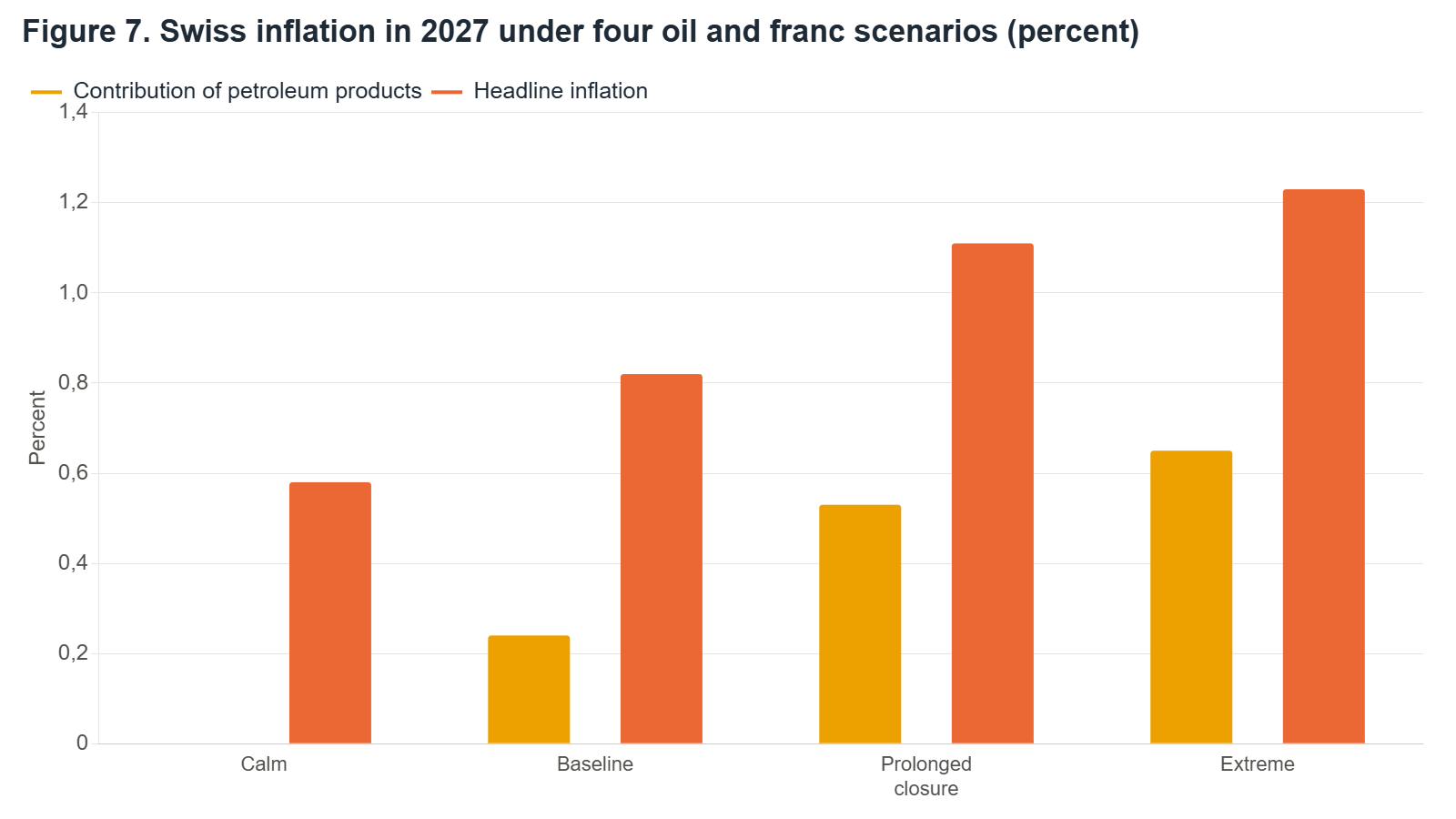
In a calm scenario, in which the strait reopens and Brent falls back to USD 80 with the dollar at 0.83 francs, petroleum prices in 2027 would be about 13 percent lower than in September 2026 and would contribute nothing on average to inflation in 2027; headline inflation would be about 0.6 percent. In the baseline scenario, with Brent at USD 100, inflation would be about 0.8 percent, in line with the SNB's forecast. In a prolonged closure scenario, with Brent at USD 130 and a slightly stronger franc, inflation would reach 1.1 percent. Even in an extreme scenario, with Brent at USD 150 and a franc appreciating to 0.76 per dollar, inflation would be about 1.2 percent.
All four scenarios keep Swiss inflation well within the range of 0 to 2 percent that the SNB defines as price stability. The asymmetry is clear: the upside risk from oil is small, while the downside risk, if oil falls and the franc strengthens, is a return to inflation close to zero.
13. Implications for the SNB
Table 7. The policy setting: interest rates, interventions and administered prices
| Item | Value |
|---|---|
| SNB policy rate (since June 2025) | 0% |
| ECB deposit rate (since 10 September 2026) | 2.50% |
| SNB foreign currency purchases, 2025 | CHF 5.2 billion (of which Q2: 5.1 billion) |
| SNB foreign currency purchases, Q1 2026 / Q2 2026 | CHF 3.9 billion / CHF 1.4 billion |
| SNB conditional inflation forecast (September 2026) | 0.7% (2026), 0.8% (2027), 0.8% (2028) |
| Household electricity tariffs 2027 (ElCom) | minus 4%, median 26.5 ct/kWh |
| Compulsory health insurance premiums 2027 (not in CPI) | +5.0% |
Sources: SNB; ECB; ElCom; FOPH; press reports.
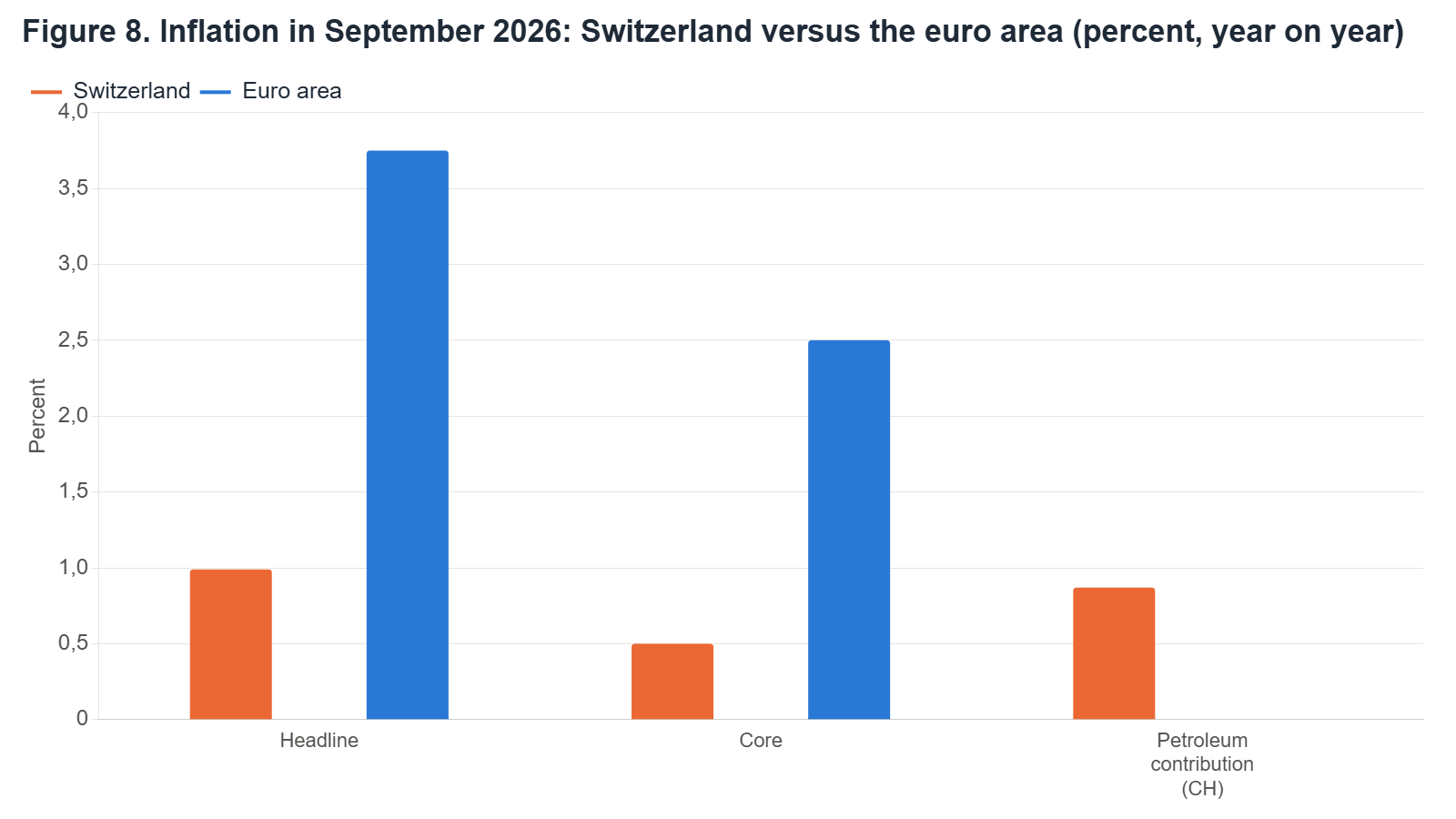
Table 7 summarizes the policy setting and Figure 8 the inflation gap with the euro area. Four implications follow from the analysis.
The first is that the SNB was right to look through the 2026 oil shock. Swiss core inflation did not move, second-round effects are negligible, and the impact of oil on headline inflation is limited to a few tenths of a percentage point. A rate hike in response to oil would have tightened monetary conditions in an economy whose underlying inflation is half a percent, and would have encouraged a further appreciation of the franc.
The second is that the franc should not be counted on as a short-run shield against oil. Its correlation with oil prices has turned unfavourable, and in 2026 it weakened just when oil rose. The SNB's interventions in the first quarter of 2026, which sold francs at the start of the war, were aimed at the franc's appreciation against the euro, not at oil. The relevant question for the SNB is the euro exchange rate, which drives most of Swiss imported inflation, not the dollar price of oil.
The third is that the main risk for 2027 is a new phase of franc strength. The ECB has raised its deposit rate to 2.5 percent while the SNB remains at zero. As long as the interest rate differential and the dollar's haven status hold, the franc is under little upward pressure. But if the crisis eases, oil prices fall and safe-haven demand returns to the franc, the SNB could face a combination of falling energy prices, falling electricity tariffs and an appreciating currency, at a time when it has no room to cut rates without returning to negative territory. Its willingness to intervene, which it softened in September 2026, would then have to be reaffirmed.
The fourth concerns the measurement of the cost of living. Swiss consumer price inflation is low partly because the CPI excludes compulsory health insurance premiums, which will rise by 5 percent in 2027, as discussed in the third article of this series. For households, the energy shock of 2026 is small compared with the premium shock. Monetary policy cannot address the latter, but it should not ignore the fact that the measured inflation rate understates the pressure on household budgets.
14. Conclusion
The franc protects Switzerland from oil shocks, but not in the way it is usually thought to. Its protection is slow and cumulative: over twenty-five years, the appreciation of the franc has halved the cost of oil for Swiss consumers relative to Americans, and in 2026 the franc price of Brent remained far below its 2022 peak. In the moment of crisis, however, the franc did not rise with oil; it fell against the dollar, and Swiss petroleum prices rose as much as in the euro area.
What kept the 2026 oil shock out of Swiss inflation was the structure of the economy: a small weight of petroleum products in consumption, regulated electricity tariffs that will fall in 2027, and, above all, core inflation of half a percent that does not react to energy prices. The oil shock raised Swiss inflation from about zero to about one percent, and it will fade with oil prices. The SNB was right to look through it. Its real challenge lies elsewhere: in the possibility that, once this crisis ends, the slow shield of the franc becomes once again a source of deflationary pressure that the SNB, with rates at zero, can counter only with interventions.
Methodological Appendix
A.1 Data
Brent crude, monthly average, USD per barrel (FRED series MCOILBRENTEU), January 2000 to October 2026. Exchange rates, monthly averages (SNB, cube devkum). Swiss CPI: total, petroleum products, total excluding petroleum products, core inflation 1 (SNB, cube plkoprex, December 2025 = 100). Euro area HICP: total (CP0000EZ19M086NEST), excluding energy, food, alcohol and tobacco (00XEFDEZ19M086NEST), fuels and lubricants for personal transport equipment (CP0722EZ19M086NEST) and liquid fuels (CP0453EZ19M086NEST), via FRED. The euro area petroleum index is a geometric average with weights of 0.75 and 0.25.
A.2 Pass-through
Delta log P_t = a + sum over k from 0 to 3 of b_k Delta log Brent_(t minus k) + e_t, where P is the consumer price of petroleum products and Brent is in local currency. The long-run pass-through is the sum of the b_k; standard errors are Newey-West with six lags.
A.3 CPI weight and contribution
Delta log CPI_t = w Delta log P_t + (1 minus w) Delta log X_t, where X is the CPI excluding petroleum products, estimated by least squares without constant over 2016 to 2026. The contribution of petroleum products to year-on-year inflation is w times their year-on-year change.
A.4 VAR
Variables: monthly log changes (percent) of Brent in dollars, USD/CHF, Swiss petroleum products CPI and Swiss core CPI, January 2001 to September 2026. Four lags; recursive identification in the order listed. Cumulative orthogonalized responses are rescaled to a 10 percent oil shock.
A.5 Counterfactuals and scenarios
Counterfactual franc price of Brent = dollar price in September 2026 times USD/CHF in the reference month. Effect on petroleum prices = pass-through times the log difference; effect on CPI = weight times the effect on petroleum prices. Scenarios: Brent and USD/CHF held at the stated levels throughout 2027; core inflation of 0.6 percent; contribution computed from the change in the average level of petroleum prices between 2026 and 2027.
A.6 Limitations
The weights of the euro area petroleum index are approximate. The VAR does not identify the source of oil shocks (supply or demand), which affects the response of the franc. The scenarios ignore indirect effects through import prices other than energy and through economic activity.
References
Swiss National Bank, monetary policy assessment of 24 September 2026; data portal (exchange rates, consumer prices); foreign exchange transactions statistics.
Federal Electricity Commission (ElCom), electricity tariffs 2027, press release, 8 September 2026.
Federal Reserve Bank of St. Louis, FRED: Brent crude oil price (EIA) and euro area HICP (Eurostat).
UBS, Brent forecast revisions, April 2026, as reported by The Globe and Mail; Goldman Sachs and Barclays oil notes, July 2026, as reported by Bloomberg and Reuters.
Keystone-SDA and Bloomberg, reports on SNB foreign exchange interventions, 2025 and 2026.
Global Strategy Files, Swiss Economy 2026 Series, Articles 1 to 4, November 2026.
Driss EFFINA, PhD
Independent Researcher, Global Strategy Files
The opening pages of our four country reports: United States, United Kingdom, Japan and China. A free PDF, sent to your inbox.
You will also receive occasional analysis from Global Strategy Files. Unsubscribe in one click, at any time.