The Winter Gap: Swiss Electricity Security, the Hormuz Gas Shock and the Value of the Electricity Agreement with the EU

Executive Summary
Switzerland exports electricity in summer and imports it in winter. Its dams and solar panels produce most in spring and summer, while demand peaks in the cold months, when rivers run low and the sun is weak. The last winter in which Switzerland covered its own needs was 2002/03. In the winter of 2025/26, with two nuclear reactors unexpectedly offline, net imports reached 6.8 TWh, almost a fifth of winter consumption. This structural winter gap makes Switzerland dependent on the electricity markets of its neighbours, and therefore on the price of the gas that sets electricity prices in Europe in winter.
In 2026, both dependencies were tested. The closure of the Strait of Hormuz from March removed about a fifth of the world's supply of liquefied natural gas, as Qatar's exports were halted. The European gas price rose from about EUR 32 per MWh in February to an average of EUR 76 in September, the highest since early 2023. At the same time, Switzerland and the EU signed, on 2 March 2026, an electricity agreement that would integrate Switzerland into the EU internal electricity market and prohibit EU member states from restricting electricity exports to Switzerland. The agreement is now before the Swiss parliament and will probably be put to a popular vote.
This final article of the series quantifies Switzerland's winter exposure. It combines a time-series model of European gas prices since 2015 with a Monte Carlo model of the Swiss winter electricity balance, built on the official electricity statistics and on the availability of nuclear plants, hydropower, solar and demand. The main findings are the following.
- Gas prices are likely to stay high this winter. A model of monthly gas prices since 2015 gives a median price of EUR 71 per MWh for the winter 2026/27, with an 80 percent range of EUR 50 to 104, twice the 2025 average. For the winter 2027/28 the median falls to EUR 59, but the range widens to EUR 27 to 126. The probability that this winter's average exceeds EUR 80 is 35 percent.
- Switzerland's import need is moderate in a normal winter, but highly sensitive to nuclear outages. With all reactors operating normally, net winter imports average about 2.7 TWh, with a 90th percentile of 5.8 TWh. If two reactors are offline, as in 2025/26, net imports average 8.4 TWh and exceed 10 TWh, the limit recommended by the electricity regulator, in one winter out of five.
- The import bill is modest; the price effect is not. At current gas prices, net winter imports cost about CHF 0.4 to 0.5 billion, and about CHF 1 billion in one winter out of ten. The larger effect is on prices: because about two thirds of the electricity in the regulated basic supply is bought on the market, a gas price of EUR 65 instead of EUR 35 would add about CHF 170 a year to the bill of a typical household in 2028, about 14 percent; at EUR 85, about CHF 280.
- Tariffs for 2027 do not yet reflect the shock. The electricity regulator announced in September a 4 percent fall in the median household tariff for 2027, to 26.45 centimes per kWh, because suppliers had hedged most of their purchases before the Hormuz crisis. If gas prices stay at their current level, the shock will appear in the 2028 tariffs.
- The structural gap will widen after 2032. When the two Beznau reactors are closed, as planned for 2032 and 2033, net winter imports would average about 4.7 TWh even with solar winter production rising to 4.5 TWh, and would exceed 8 TWh in about 9 percent of winters.
- The electricity agreement is an insurance policy. Its main value is not lower prices but the legal guarantee that neighbouring countries cannot cut cross-border capacity to Switzerland in a crisis. In the simulations, the probability that net imports exceed an effective ceiling of 8 TWh, which could apply if neighbours reduced capacity under EU rules, is about 2 percent in a normal winter but 57 percent in a winter with two reactors offline.
The conclusion is that Switzerland's winter electricity problem is less about energy than about risk. In most winters, the country can import what it needs at a manageable cost. In bad winters, when nuclear outages, low reservoirs or cold weather coincide with high gas prices and tight European markets, the gap can approach the limits of what neighbours can deliver. The Hormuz shock has shown how quickly those conditions can arise. The electricity agreement, domestic winter production and a credible reserve are complements, not alternatives.
Key results at a glance
| Indicator | Value |
|---|---|
| European gas price: 2025 average / September 2026 | EUR 36.3 / 75.6 per MWh |
| Simulated gas price, winter 2026/27: median (80% range) | EUR 71.4 (49.9 to 103.5) |
| Net winter imports 2026/27, base: mean / 90th percentile | 2.7 / 5.8 TWh |
| Probability net imports exceed 10 TWh: base / two reactors out | 0.4% / 20% |
| Expected import bill, winter 2026/27 (90th percentile) | CHF 0.46 billion (0.97) |
| Extra household cost in 2028 if gas stays at EUR 65 / 85 | CHF 167 / 279 a year |
| Mean net winter imports after the closure of Beznau | 4.7 TWh |
Source: author's calculations; see Sections 4 to 8.
1. Introduction
Electricity security was long taken for granted in Switzerland. The country's hydropower, built in the twentieth century, and its five nuclear reactors, commissioned between 1969 and 1984, provided abundant and cheap electricity, and the Swiss grid, at the heart of the European network, allowed it to export in summer and import in winter at little cost. The decision in 2011 to phase out nuclear power, the closure of the Mühleberg reactor in 2019, the failure of negotiations on an institutional framework with the EU in 2021 and the European energy crisis of 2022 changed that perception. The Federal Council now considers an electricity shortage one of the greatest risks facing the country.
The policy response has been threefold. First, Switzerland has accelerated the expansion of domestic renewables, notably solar, and created winter reserves: a hydropower reserve, in which reservoir operators are paid to hold back water for late winter, and reserve power plants, which can be started in an emergency. Second, it has negotiated an electricity agreement with the EU, as part of a broader package of bilateral agreements signed on 2 March 2026. Third, it has debated, but not yet decided, how to replace its nuclear plants when they close.
The year 2026 added a new element: a global gas shock. Europe's electricity prices in winter are set mostly by gas-fired power plants, and the blockade of the Strait of Hormuz, by halting Qatar's LNG exports, pushed European gas prices to their highest level since the 2022 crisis. Switzerland does not use much gas for electricity, but as part of the European market it imports electricity at European prices.
This article asks three questions. How large is Switzerland's winter import need, and how does it vary with nuclear availability, hydropower and weather? What does the gas shock mean for the cost of imports and for household tariffs? And what is the value of the electricity agreement in this context?
2. The Winter Gap
Swiss electricity production is highly seasonal. In the winter half-year, from October to March, hydropower produces about 15 to 17 TWh, nuclear power about 11 to 13 TWh when all reactors run, solar about 2 to 3 TWh and other sources about 2 TWh. Demand in the same period, including grid losses, is about 34 to 35 TWh and rising, as heat pumps and electric vehicles spread. The difference is imported.
Table 1. The Swiss winter electricity balance in the last two winters (TWh, October to March)
| Item | 2024/25 | 2025/26 |
|---|---|---|
| Imports | 17.0 | 19.3 |
| Exports | 16.3 | 12.5 |
| Net imports | 0.7 | 6.8 |
| National consumption including losses | 33.7 | 34.2 |
| Domestic production (consumption minus net imports) | 32.9 | 27.5 |
| Reactors with unplanned long outages | none | Beznau 2, Leibstadt |
Source: Swiss Federal Office of Energy, electricity statistics; author's calculations.
The official electricity statistics show how volatile this balance is. In the winter of 2024/25, net imports were only 0.7 TWh: imports of 17.0 TWh were almost matched by exports of 16.3 TWh. In the winter of 2025/26, imports rose to 19.3 TWh and exports fell to 12.5 TWh, so that net imports reached 6.8 TWh. Consumption rose by 1.7 percent, but the main reason was the unplanned outage of two reactors, Beznau 2 and Leibstadt. Solar panels produced about 2.3 TWh in that winter, without which net imports would have been close to 9 TWh. The long-term average of net winter imports is about 3.8 TWh.
The electricity regulator, ElCom, has recommended that net winter imports should not exceed 10 TWh, because the export capacity of neighbouring countries in winter is uncertain, especially when France's nuclear fleet or Germany's coal and gas plants are under strain. The import need is concentrated in the late winter, from January to March, when reservoirs are low and demand is high; it is in those weeks that the risk of shortage is greatest.
3. Data and Methods
The analysis uses monthly European gas prices from January 2015 to September 2026 (the Dutch TTF benchmark, published by the World Bank and distributed by FRED, converted from dollars per million British thermal units into euros per MWh), the official Swiss electricity statistics for the winters of 2024/25 and 2025/26, and public information on the capacity of Swiss nuclear plants, solar production and the electricity agreement.
Three models are combined. First, a first-order autoregressive model of the logarithm of the monthly gas price, estimated on 2015 to 2026, simulates 100,000 paths of gas prices from October 2026 to March 2028. Second, a Monte Carlo model of the Swiss winter balance draws demand, the availability of each nuclear reactor, hydropower, solar and other production, calibrated on recent winters, and computes net imports as the difference between demand and production. Third, a price model translates gas prices into winter power prices through the cost of a gas-fired plant, and power prices into import bills and household tariffs. Details are in the Methodological Appendix.
4. Result One: The Gas Shock
Figure 1 shows European gas prices since 2015.
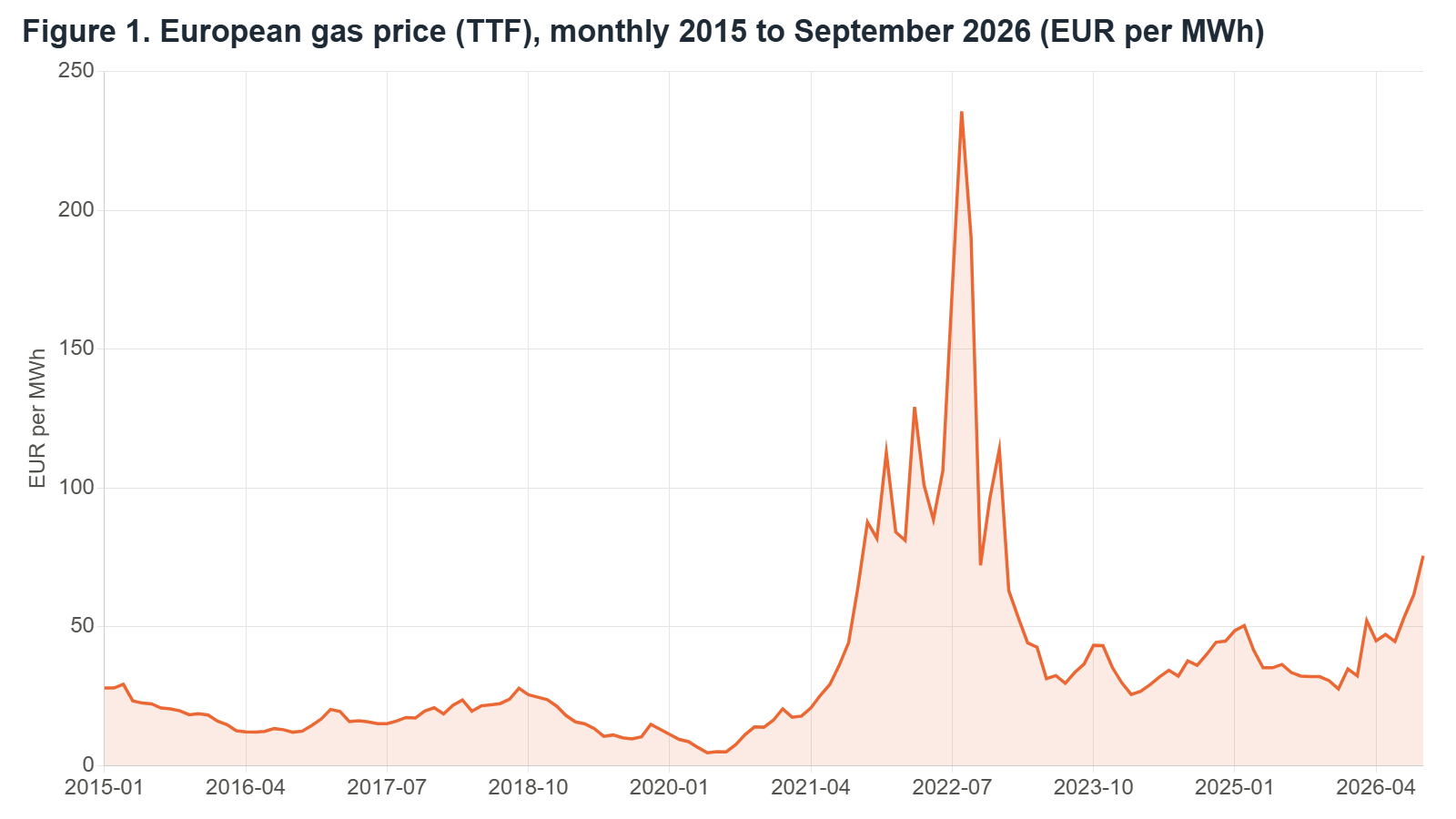
Before 2021, European gas cost about EUR 10 to 25 per MWh. The recovery from the pandemic and then Russia's invasion of Ukraine drove the price to a monthly peak of EUR 236 in August 2022. It fell back to EUR 30 to 40 in 2023 to 2025, with an average of EUR 36 in 2025. In February 2026, it stood at EUR 32. The closure of the Strait of Hormuz at the beginning of March sent it up by more than half within a month; after a partial easing in late spring, concerns about winter storage pushed it to EUR 62 in August and EUR 76 in September.
Table 2. European gas prices and the simulated outlook (EUR per MWh)
| Indicator | Value |
|---|---|
| Average 2015 to 2019 | 17.9 |
| Monthly peak, August 2022 | 235.7 |
| Average 2025 | 36.3 |
| February 2026, before the Hormuz closure | 32.3 |
| September 2026 | 75.6 |
| AR(1) coefficient / half-life in months | 0.973 / 25.6 |
| Implied long-run level | 34.2 |
| Winter 2026/27: 10th / 50th / 90th percentile | 49.9 / 71.4 / 103.5 |
| Winter 2027/28: 10th / 50th / 90th percentile | 27.4 / 58.7 / 126.1 |
| Probability winter 2026/27 average exceeds EUR 80 | 35% |
Sources: World Bank via FRED; author's calculations.
The gas price is persistent but mean-reverting. The estimated monthly autoregressive coefficient of 0.973 implies a half-life of about 26 months, and the long-run level implied by the 2015 to 2026 sample is about EUR 34 per MWh. The monthly volatility of 19 percent is high. Starting from the September level, the model gives the distribution shown in Figure 2.
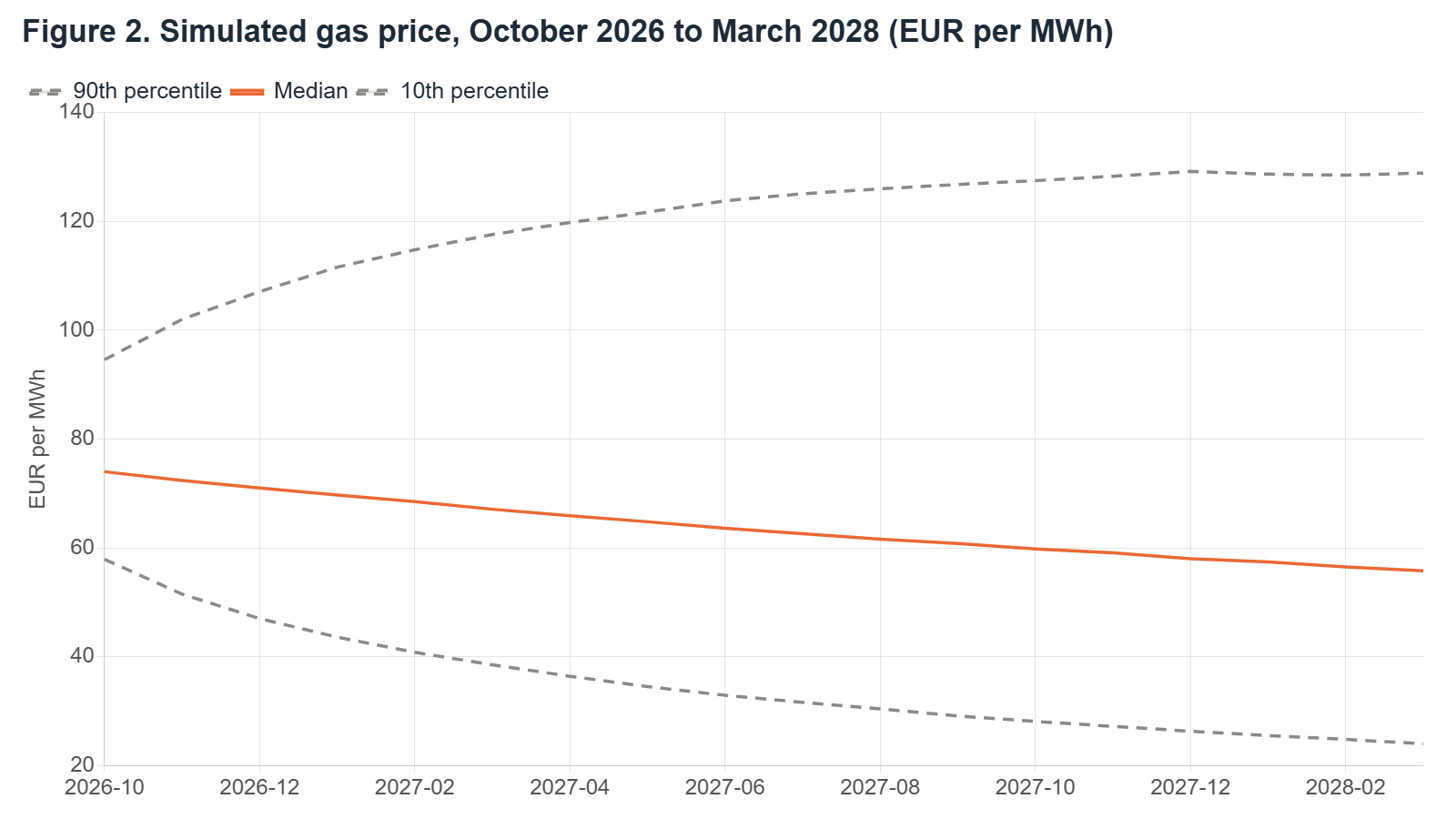
For the winter 2026/27, the median average gas price is EUR 71 per MWh, with an 80 percent range of EUR 50 to 104. The probability that the winter average exceeds EUR 80 is 35 percent. For the winter 2027/28, the median falls to EUR 59, but the range widens to EUR 27 to 126, reflecting the uncertainty about whether the Strait will reopen and Qatar's production will recover. These figures are broadly in line with the forecasts of market analysts, which put the price in the second half of 2026 in a range of EUR 50 to 65 with upside risks.
5. Result Two: The Winter Balance in 2026/27
Figure 3 shows the expected winter balance for 2026/27 in the base scenario, in which all five factors are drawn from their normal distributions.

Table 3. Inputs of the winter balance model, 2026/27 (TWh, October to March)
| Component | Mean | Variation |
|---|---|---|
| Demand including losses | 34.8 | standard deviation 0.6 |
| Hydropower | 16.5 | standard deviation 1.5 |
| Nuclear, four reactors at full availability | 12.8 | 12% outage risk per reactor |
| Nuclear, expected | 10.8 | |
| Solar | 2.8 | standard deviation 0.3 |
| Other (thermal, wind, biomass) | 2.0 | standard deviation 0.2 |
| Net imports, expected | 2.69 | 90th percentile 5.81 |
Source: author's calibration based on SFOE statistics for 2024/25 and 2025/26.
Demand, including losses, is expected at about 34.8 TWh, 1.7 percent more than in 2025/26. On the supply side, hydropower contributes about 16.5 TWh, nuclear about 10.8 TWh in expectation (12.8 TWh if all four reactors run at full availability), solar about 2.8 TWh and other sources about 2 TWh. Expected net imports are about 2.7 TWh.
Figure 4 shows the full distribution.

The distribution is wide. In about 11 percent of simulations, Switzerland would be a net exporter over the winter, as almost happened in 2024/25. In the median simulation, net imports are 2.5 TWh. In one winter out of ten they exceed 5.8 TWh, and in one out of twenty 6.9 TWh. The probability of exceeding 8 TWh is about 2 percent, and that of exceeding ElCom's limit of 10 TWh less than half a percent. In a normal winter, the import need is well within what neighbouring countries have historically been able to supply.
6. Result Three: Bad Winters
The risk lies in the combination of adverse factors. Table 4 and Figures 5 and 6 compare five scenarios.
Table 4. Net winter imports under five scenarios
| Scenario | Mean, TWh | 90th percentile, TWh | Above 8 TWh, % | Above 10 TWh, % |
|---|---|---|---|---|
| Base | 2.69 | 5.81 | 2.3 | 0.4 |
| Low hydro | 4.19 | 7.35 | 6.7 | 1.5 |
| Two reactors out | 8.43 | 10.98 | 56.9 | 20.0 |
| Cold winter | 3.68 | 6.78 | 4.7 | 1.0 |
| After Beznau closure (2033) | 4.70 | 7.75 | 8.6 | 2.1 |
Source: author's calculations; 100,000 simulations per scenario.
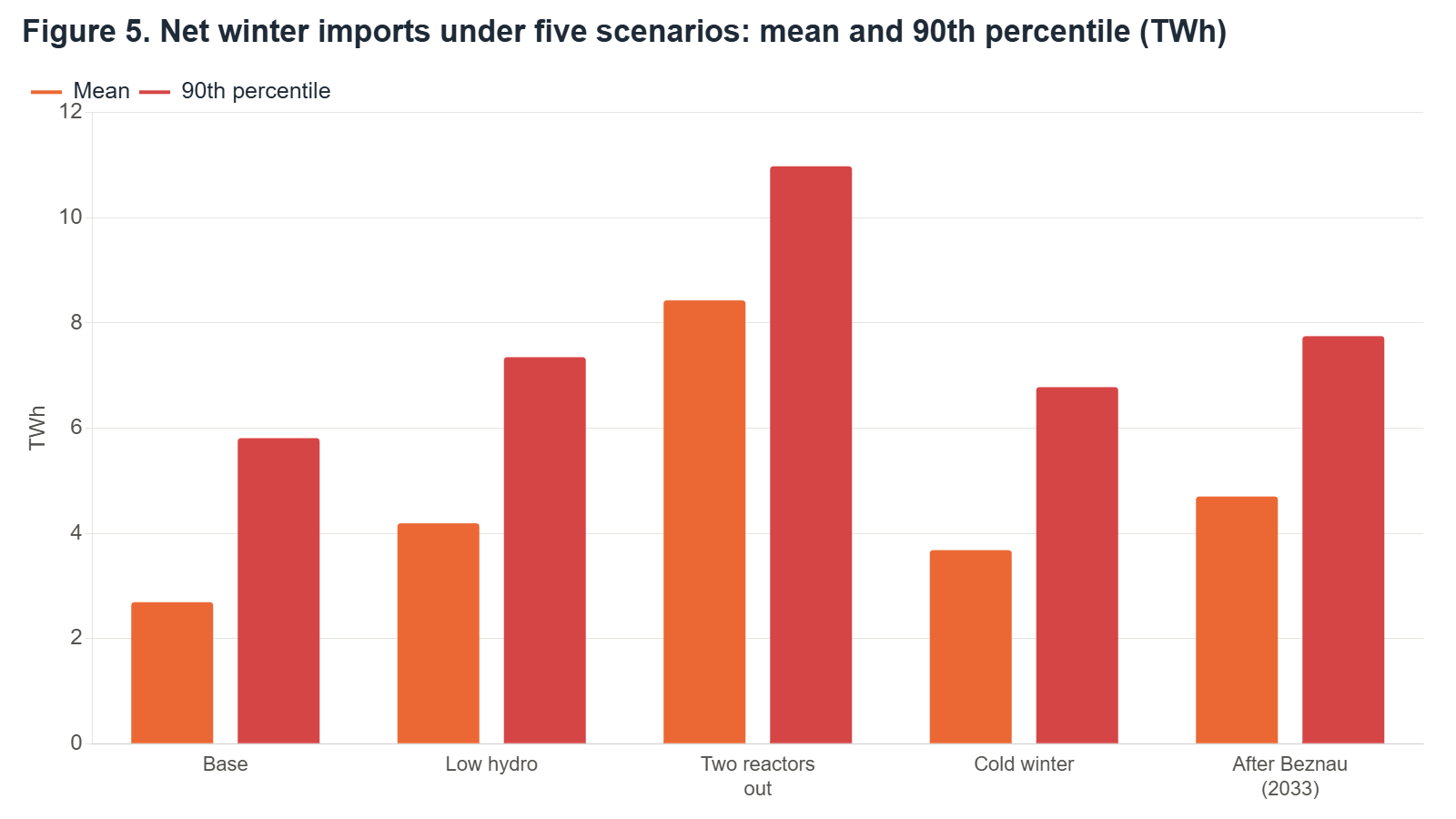
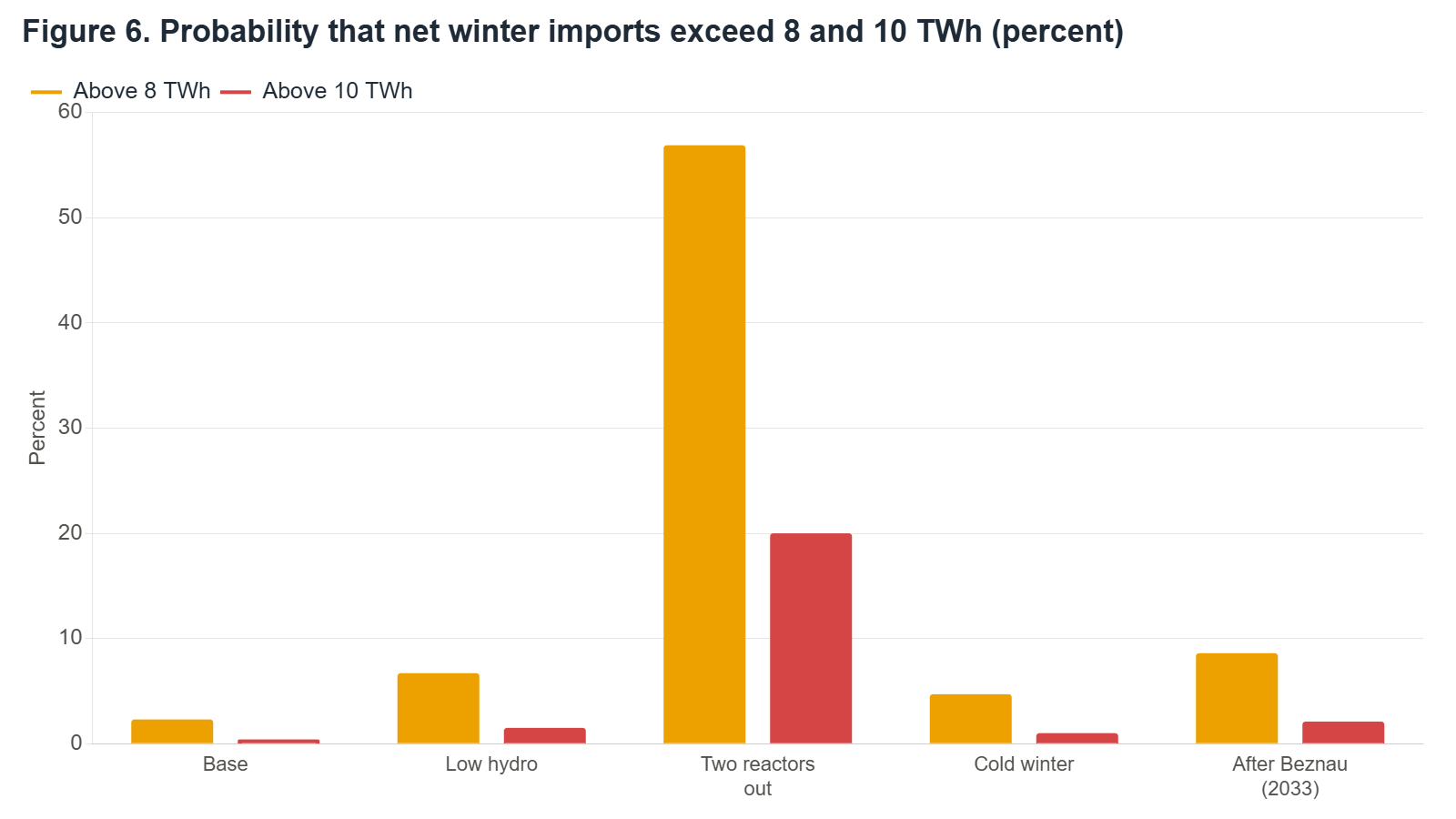
Nuclear availability is by far the most important factor. If two reactors are offline for the whole winter, as Beznau 2 and Leibstadt were in 2025/26, expected net imports rise to 8.4 TWh, the probability of exceeding 8 TWh to 57 percent and the probability of exceeding 10 TWh to 20 percent. A dry year with low reservoirs adds about 1.5 TWh to the need, and a cold winter about 1 TWh; each roughly doubles or triples the probability of exceeding 8 TWh compared with the base scenario.
The longer-term outlook is more worrying. When Beznau 1 and 2 close in 2032 and 2033, Switzerland will lose about 3 TWh of winter production. Even if solar winter output rises to 4.5 TWh, expected net imports would rise to 4.7 TWh and exceed 8 TWh in about 9 percent of winters, with demand growing as heating and transport are electrified. Without a substantial increase in winter production, from alpine solar, wind, storage hydropower or new thermal capacity, the winter gap will become structural.
7. Result Four: What the Gas Shock Costs
The cost of the winter gap depends on the price of electricity in neighbouring markets, which in winter is set mostly by gas-fired plants. A combined-cycle gas plant with an efficiency of 50 percent needs 2 MWh of gas to produce 1 MWh of electricity and emits about 0.37 tonnes of CO2; at a carbon price of EUR 75 per tonne, the marginal cost of electricity is about twice the gas price plus EUR 28 per MWh.
Table 5. Gas prices, winter power prices, import bills and household costs
| Gas price, EUR/MWh | Power price, EUR/MWh | Import bill, CHF bn | Extra household cost, CHF a year |
|---|---|---|---|
| 35 | 98 | 0.24 | 0 |
| 50 | 128 | 0.32 | 84 |
| 65 | 158 | 0.39 | 167 |
| 85 | 198 | 0.49 | 279 |
| 120 | 268 | 0.67 | 474 |
Source: author's calculations; expected net imports of 2.7 TWh; household consuming 4,500 kWh with two thirds of supply bought on the market.

At a gas price of EUR 35, as in 2025, the winter power price would be about EUR 98 per MWh; at EUR 75, as in September 2026, about EUR 178; at EUR 120, about EUR 268. With expected net imports of 2.7 TWh, the import bill ranges from CHF 0.24 billion at EUR 35 to CHF 0.67 billion at EUR 120. Combining the distributions of gas prices and net imports, the expected bill for the winter 2026/27 is CHF 0.46 billion, with a 90th percentile of CHF 0.97 billion and a 99th percentile of CHF 1.67 billion. These are small sums for an economy of CHF 880 billion.
The larger effect is on prices paid by all consumers. Swiss wholesale prices move with those of neighbouring countries, and about two thirds of the electricity sold in the regulated basic supply is bought on the market rather than produced by the supplier itself. A rise in the gas price therefore feeds into tariffs with a lag, as suppliers renew their hedges.

For a typical household consuming 4,500 kWh a year, a gas price of EUR 50 instead of EUR 35 adds about CHF 84 a year to the electricity bill; EUR 65 adds about CHF 167, or 14 percent of the 2027 median bill of CHF 1,194; EUR 85 adds about CHF 279, or 23 percent; EUR 120 adds about CHF 474, or 40 percent. These amounts are upper bounds for a year in which the high prices persist for the whole procurement period, since many suppliers hedge two to three years ahead and the gas price affects mainly winter prices.
The 2027 tariffs, announced by ElCom on 8 September 2026, show the lag clearly. The median household tariff will fall by 4 percent, to 26.45 centimes per kWh, the third consecutive decrease after the sharp rises of 2023 and 2024. The energy component falls, the grid component rises, and the charge for the winter reserve falls from 0.41 to 0.17 centimes per kWh. ElCom itself warned that the conflict in the Middle East could push prices up again. If gas prices remain near EUR 70 through 2027, the 2028 tariffs are likely to rise by 10 to 15 percent for households in the basic supply.
8. Result Five: The Value of the Electricity Agreement
The electricity agreement signed on 2 March 2026 would integrate Switzerland into the EU internal electricity market. Swiss companies would gain access to EU trading platforms and market coupling, Swissgrid would participate fully in European grid coordination, the Swiss retail market would be opened to competition, and Switzerland would adopt the EU rules on state aid for renewables. The provision that matters most for security of supply is that EU member states would no longer be allowed to restrict cross-border capacity or exports to Switzerland, even in an energy crisis.
Without the agreement, Switzerland faces a gradual erosion of its position. Since 2020, EU rules have required member states to make at least 70 percent of cross-border transmission capacity available for trade between EU countries; Switzerland, as a third country, is not covered, and its neighbours may reduce the capacity available for flows with Switzerland to meet their obligations within the EU. In a crisis, an EU country facing shortages could also restrict exports to a non-member.
Table 6. Probability that net winter imports exceed alternative import ceilings (percent)
| Effective import ceiling | Base scenario | Two reactors out |
|---|---|---|
| 12 TWh (agreement, full market integration) | 0.0 | 4.6 |
| 10 TWh (ElCom recommendation) | 0.4 | 20.0 |
| 8 TWh (capacity restrictions in a crisis) | 2.3 | 56.9 |
Source: author's calculations. Ceilings are illustrative.
The model cannot predict how neighbours would behave, but it can show how much the risk depends on the effective import ceiling. In the base scenario, the probability that net imports exceed 12 TWh is practically zero, that they exceed 10 TWh 0.4 percent and that they exceed 8 TWh 2.3 percent. In a winter with two reactors offline, the probabilities rise to about 5, 20 and 57 percent respectively. If the absence of an agreement lowered the effective ceiling from about 12 TWh to 8 TWh in a crisis, a bad nuclear winter would turn from a manageable situation into a likely shortage. The agreement is therefore best understood as insurance against a correlated shock: a bad Swiss winter coinciding with tight European markets, as in 2022 or potentially in 2026/27 if gas supply remains constrained.
The agreement also has costs and risks. The full opening of the retail market would expose households to market prices if they leave the basic supply. The adoption of EU state aid rules would constrain support schemes, and the reserves would have to be aligned with EU law within six years. And the agreement is part of a broader package, whose institutional provisions, including the dynamic adoption of EU law, are politically contested and will probably be decided in a popular vote.
9. Policy Assessment
Table 7 summarises the policy options.
Table 7. Policy options for winter electricity security
| Option | Main effect | Assessment |
|---|---|---|
| Ratify the electricity agreement with the EU | Legal guarantee of import capacity in a crisis | Valuable insurance |
| Reliable operation of existing reactors until closure | Largest single factor in winter balance | Priority |
| Size the winter reserve for bad winters | Covers coincident outages and tight markets | Needed |
| Support winter production (alpine solar, wind, storage hydro) | Reduces the gap after Beznau closes | Needed |
| Decide on replacement of nuclear capacity | Determines the gap after 2035 | Urgent decision |
| Hedging and tariff smoothing by suppliers | Spreads the gas shock over time | Useful |
Source: author's assessment.
Four conclusions emerge. First, nuclear availability is the single largest determinant of winter security in the next decade. Ensuring that the existing reactors are maintained and operated reliably until their planned closure, and planning their replacement, matters more for winter security than any other single measure. Second, the winter reserve should be sized for bad winters, not average ones: the fall in the reserve charge for 2027 is welcome for consumers, but the scenarios show that the reserve is needed precisely when nuclear outages coincide with high gas prices. Third, the electricity agreement is valuable insurance and should be assessed on that basis, alongside the broader political questions of the package. Fourth, domestic winter production, from alpine solar, wind, storage hydropower and flexible thermal capacity, is needed to keep the import need below 8 to 10 TWh after Beznau closes.
10. Implications
The first implication concerns inflation. As the fifth article of this series showed, the franc protects Swiss consumers from much of the oil shock. Electricity is different: tariffs are regulated, adjusted once a year and based on procurement over several years, so the gas shock will reach Swiss consumers with a delay of one to two years. The SNB will need to look through a rise in electricity tariffs in 2028, which could add a few tenths of a percentage point to measured inflation.
The second implication concerns public finances. The costs of the winter reserve, of support for winter production and of possible new capacity will be borne by consumers through grid charges or by the Confederation. Together with the fiscal pressures examined in the eighth and ninth articles, this adds to the demands on public budgets in the coming decade.
The third implication concerns Switzerland's position in Europe. Switzerland is a hub of the European grid, with 41 cross-border lines, and its pumped-storage plants are valuable to its neighbours. In 2024 Switzerland net exported almost 25 TWh to Italy and net imported about 12 TWh from France. This interdependence is a source of strength if it is governed by binding rules, and a source of vulnerability if it is not.
11. Conclusion
Switzerland's winter electricity gap is real but, in most winters, manageable: about 3 TWh of net imports at a cost of CHF 0.4 to 0.5 billion, even at the high gas prices caused by the Hormuz crisis. The danger lies in the tail, when nuclear outages, low reservoirs or cold weather push the import need towards 10 TWh at a time when European markets are tight and gas is expensive. The winter of 2025/26 came close to that situation, and the gas shock of 2026 has shown how quickly European markets can tighten.
The electricity agreement with the EU, domestic winter production and a robust reserve are three layers of the same insurance. None alone is sufficient. As the series on the Swiss economy in 2026 concludes, the common thread of these ten papers emerges clearly: Switzerland's prosperity rests on openness to the world, in trade, finance, commodities and energy, and the shocks of 2026, from US tariffs to the closure of the Strait of Hormuz, have shown both the value and the risks of that openness. The policy challenge is not to retreat from it, but to insure against its risks with rules, buffers and institutions that work when they are needed.
Methodological Appendix
A.1 Data
Monthly European natural gas price (TTF, World Bank, FRED series PNGASEUUSDM), January 2015 to September 2026, in dollars per MMBtu, converted to euros per MWh with the monthly dollar to euro exchange rate (FRED DEXUSEU) and a factor of 3.412 MMBtu per MWh. Swiss electricity statistics for the winter half-years 2024/25 and 2025/26 from the Swiss Federal Office of Energy: imports, exports, net imports and national consumption. ElCom tariff statistics for 2027 and Swissgrid tariffs.
A.2 Gas price model
AR(1) on the logarithm of the monthly gas price in euros: phi = 0.973, implied long-run level EUR 34.2 per MWh, residual standard deviation 0.191. 100,000 simulations from October 2026 to March 2028, starting from the September 2026 level of EUR 75.6. Winter averages: October to March.
A.3 Winter balance model
Demand including losses: normal with mean 34.8 TWh and standard deviation 0.6. Nuclear: Beznau 1 and 2 at 1.6 TWh each, Gösgen at 4.4 TWh and Leibstadt at 5.2 TWh per winter half-year at full availability; each reactor has a 12 percent probability of a long outage (availability uniform between 0 and 50 percent), otherwise availability uniform between 85 and 100 percent. Hydropower: normal with mean 16.5 TWh and standard deviation 1.5. Solar: normal with mean 2.8 TWh and standard deviation 0.3. Other production: normal with mean 2.0 TWh and standard deviation 0.2. Net imports = demand minus production. 100,000 simulations.
A.4 Prices and costs
Winter power price = 2 times the gas price plus 0.37 times EUR 75 per tonne of CO2. Import bill = maximum of net imports and zero, times the winter power price, times 0.93 franc per euro. Household effect = change in the power price relative to a gas price of EUR 35, times 0.93, times 4.5 MWh, times two thirds (the share of basic supply bought on the market).
A.5 Limitations
The winter balance is modelled for the half-year as a whole and does not capture the intra-winter profile, in which the risk is concentrated in late winter. The import ceilings are illustrative and do not model the network or the behaviour of neighbouring countries. Hydropower output depends on reservoir management and on prices, which the model treats as exogenous. The power price model ignores periods when other technologies set the price. The household effect is an upper bound that ignores hedging strategies and the gradual passage of procurement costs into tariffs.
References
Swiss Federal Office of Energy, electricity statistics, winter half-years 2024/25 and 2025/26; electricity agreement Switzerland to EU, 2026.
Federal Electricity Commission (ElCom), "Slightly lower electricity prices in 2027", press release, 8 September 2026.
Swissgrid, "Swissgrid will reduce tariffs again in 2027", press release, 17 March 2026.
Council of the European Union and Swiss Federal Council, signature of the Switzerland to EU package, 2 March 2026.
World Bank, Commodity Price Data (Pink Sheet), European natural gas, via FRED.
Swissolar, fact sheet on photovoltaics and winter electricity, March 2026.
Axpo, "Energy Reports" and European Energy Markets Monthly, 2026.
economiesuisse, "Hormuz strait blockade drives the cost of Europe's energy supply", 2026.
Global Strategy Files, Swiss Economy 2026 Series, Articles 1 to 9, November 2026.
Driss EFFINA, PhD
Independent Researcher, Global Strategy Files
The opening pages of our four country reports: United States, United Kingdom, Japan and China. A free PDF, sent to your inbox.
You will also receive occasional analysis from Global Strategy Files. Unsubscribe in one click, at any time.