The Second Windfall: Commodity Trading Profits, Geneva’s Public Finances and the Fiscal Echo of the 2026 Oil Shock


Executive Summary
Between 2021 and 2023, the commodity trading houses headquartered around Lake Geneva earned the largest profits in their history. Energy markets were thrown into turmoil by the pandemic recovery and the war in Ukraine, and the firms that buy, ship, store and sell oil, gas, metals and grains captured the price gaps. For the canton of Geneva, the result was a series of fiscal surprises without precedent: tax revenue exceeded the budget by CHF 1.8 billion in both 2022 and 2023, and the canton recorded surpluses of CHF 1.3 and 1.4 billion when it had budgeted deficits. The Confederation, which receives most of the federal profit tax, is still collecting the proceeds: in 2025 it booked CHF 1.5 billion of unbudgeted receipts from Geneva.
This article measures that windfall, explains how it travels through the tax system, and shows that a second one is already forming. It uses quarterly balance of payments data on merchanting since 2000, oil prices, the accounts of the State of Geneva and the federal financial statements. The main findings are the following.
- Merchanting is a large and volatile part of the Swiss economy. Net merchanting receipts, the margin earned by Swiss-based traders on goods bought and sold abroad, reached CHF 94 billion in 2022, 11.5 percent of GDP, before falling back to CHF 64 billion, 7.2 percent of GDP, in 2025.
- The windfall can be measured. Relative to their pre-2020 trend, merchanting receipts were CHF 74 billion higher than normal between 2021 and 2024, with a peak of CHF 39 billion in 2022 alone.
- Oil prices drive the cycle. Over 2000 to 2026, a 10 percent rise in the price of oil raises merchanting receipts by about 9 percent, holding the trend constant; since 2015 the elasticity is about 0.5. Volatility adds to the effect.
- Each franc of windfall yields about 8.6 centimes of tax. Combining Geneva's revenue overruns with the additional federal receipts, the 2021 to 2024 windfall produced about CHF 6.4 billion of extra taxes, spread over 2021 to 2028. This implies that about 60 percent of the windfall margin was taxed as profit.
- A second windfall has begun. In the first half of 2026, merchanting receipts reached CHF 43.5 billion, a record for a half-year, CHF 12 billion above trend. If the second half continues at the same intensity, the 2026 windfall will be about CHF 24 billion, and it will generate about CHF 2.1 billion of additional taxes, CHF 1.3 billion for Geneva and CHF 0.8 billion for the Confederation, mainly in 2028 and 2029.
- The fiscal system turns a volatile base into budgetary surprises. Geneva's revenue forecast errors reached 15 and 19 percent in 2022 and 2023. A simple rule that set aside half of the tax overruns above 3 percent of revenue would have accumulated about CHF 2 billion between 2021 and 2024, enough to smooth the decline in corporate tax revenue that followed.
The conclusion is that the Hormuz shock, which raises costs for Swiss households and firms, will also raise Swiss tax receipts, with a lag of two to three years. The authorities, cantonal and federal, should plan for this second windfall now, and avoid treating it as a structural improvement in public finances.
1. Introduction
Switzerland is the world's largest hub for commodity trading. According to the Federal Statistical Office, firms engaged in commodity trading generated value added of CHF 19.2 billion in 2024, 2.3 percent of Swiss value added. The sector is concentrated in Geneva, where oil, agricultural and shipping companies dominate, and in Zug and Lugano, where metals and mining traders are based. Its activity is largely invisible: the goods it trades never cross the Swiss border, and its employees, a few tens of thousands, work in offices rather than ports. But its profits pass through Swiss tax returns, and in the past five years they have reshaped the finances of the canton of Geneva and, to a lesser extent, of the Confederation.
The fiscal consequences of commodity trading have three features that make them difficult to manage. They are large, because a few companies with very high profits can account for a large share of the corporate tax base. They are volatile, because trading profits depend on price movements and dislocations in commodity markets. And they are lagged, because corporate profits are taxed on the basis of provisional bills, final assessments and corrections that arrive over several years.
This article quantifies these features. Section 2 describes merchanting and its place in the Swiss economy. Section 3 explains how trading profits reach public budgets. Sections 5 to 11 present the results: the size and drivers of the merchanting windfall, its effects on Geneva's accounts, the fiscal yield of a franc of windfall, the second windfall that began in 2026, and the policy options.
2. Merchanting in the Swiss Economy
In the balance of payments, merchanting is the purchase of goods from non-residents and their resale to non-residents without the goods entering Switzerland. A Geneva trader that buys a cargo of crude oil from a West African producer and sells it to an Asian refinery records the purchase and the sale; the difference, the trading margin, is recorded as a net export of goods. This margin covers the trader's costs, including freight, storage, financing and hedging, and its profit.
Net merchanting receipts have grown spectacularly. They amounted to about CHF 12 billion in 2005 and CHF 42 billion in 2010, reached CHF 51 billion in 2019, and then jumped to CHF 74 billion in 2021 and CHF 94 billion in 2022. They fell back to CHF 68 billion in 2023, CHF 62 billion in 2024 and CHF 64 billion in 2025. Merchanting is now larger than the net exports of all Swiss goods excluding gold, as the fourth article of this series showed, and it is the second largest component of the Swiss current account surplus after goods trade.
The growth reflects the relocation of trading activities to Switzerland over two decades, favoured by low taxes, a stable legal environment, access to trade finance and the presence of large firms that attract others. The volatility reflects the business model of trading: margins widen when prices are volatile, when supply chains are disrupted and when price differences open between regions, all of which happened on a large scale in 2021 and 2022.
3. From Trading Profits to Public Budgets
Trading profits reach public budgets through corporate profit taxes, levied by the Confederation and by the cantons and communes. Since the 2020 corporate tax reform, the combined statutory rate on profits in Geneva is about 14 percent, made up of the federal direct tax, at an effective rate of about 7.8 percent, and the cantonal and communal taxes. The Confederation keeps 78.8 percent of the federal direct tax and transfers 21.2 percent to the cantons.
The timing of receipts is complex. Companies pay provisional tax during the year, based on the most recent assessment. After the end of the fiscal year they file returns, and the tax authority issues a final assessment, often one or two years later, followed by corrections. When profits jump, the provisional bills, based on earlier and lower profits, are too low, and the difference is collected later. The Federal Finance Administration explained in 2026 that the profits made by energy and commodity trading companies in 2022 and 2023 accrued to the Confederation only with the final tax bills, because the provisional bills issued by the canton were based on earlier assessments and were much too low. It booked CHF 1.5 billion of unbudgeted receipts from Geneva in 2025, and expects CHF 600 to 800 million more over 2025 to 2028.
For the canton, the lags are shorter, because Geneva estimates the profit tax for its accounts on the basis of a survey of large companies twice a year. But its forecasts were repeatedly overtaken: Geneva's accounts show revenue forecast errors of 15.3 percent in 2022 and 18.8 percent in 2023, against 5.7 percent in 2024 and 2.8 percent in 2025.
Commodity trading is also concentrated. According to the canton, wholesale trade, finance and watchmaking account for 70 to 80 percent of the profit tax in Geneva, and 36 percent of companies paid no tax in 2024. A handful of large taxpayers can move the cantonal accounts by hundreds of millions of francs.
4. Data and Methods
The analysis uses quarterly balance of payments data from the SNB on net merchanting receipts from 2000 to the second quarter of 2026, monthly Brent prices from the US Energy Information Administration via FRED, SECO's quarterly nominal GDP, the accounts of the State of Geneva for 2019 to 2025, and the federal financial statements.
Three methods are used. First, a regression of log quarterly merchanting receipts on the log oil price, oil price volatility and a time trend measures the cyclical drivers of trading margins. Second, a log-linear trend fitted on 2010 to 2019 and extrapolated defines the normal level of merchanting, so that the windfall is the difference between actual receipts and this trend. Third, the fiscal yield of the windfall is calibrated by comparing the cumulative windfall of 2021 to 2024 with the additional tax receipts of Geneva and the Confederation, and this yield is applied to the 2026 windfall. Details are in the Methodological Appendix.
5. Result One: The Size of the Windfall
Figure 1 shows quarterly merchanting receipts since 2010 and their trend over 2010 to 2019, extrapolated.

Table 1. Net merchanting receipts, their trend and the windfall (CHF billion)
| Year | Merchanting receipts | Pre-2020 trend | Windfall |
|---|---|---|---|
| 2019 | 51.4 | 49.7 | 1.6 |
| 2020 | 50.4 | 51.5 | -1.0 |
| 2021 | 73.5 | 53.2 | 20.3 |
| 2022 | 94.1 | 55.1 | 39.0 |
| 2023 | 68.2 | 57.0 | 11.2 |
| 2024 | 62.5 | 59.0 | 3.6 |
| 2025 | 63.6 | 61.0 | 2.6 |
| 2026 H1 | 43.5 | 31.3 | 12.2 |
Source: SNB, balance of payments; author's calculations. Trend: log-linear fit over 2010Q1 to 2019Q4, extrapolated.
Between 2010 and 2019, merchanting receipts grew along a trend of about 3.5 percent a year, with fluctuations of a few billion francs around it. From 2021 they broke away from the trend. In the first quarter of 2022, after the Russian invasion of Ukraine, they reached CHF 27.6 billion in a single quarter, nearly double the trend. Over 2021 to 2024, the cumulative excess over trend was CHF 74 billion: CHF 20 billion in 2021, CHF 39 billion in 2022, CHF 11 billion in 2023 and CHF 4 billion in 2024. In 2025, receipts were close to trend.
In the first half of 2026, the pattern returned. Receipts reached CHF 21.6 billion in the first quarter and CHF 21.9 billion in the second, CHF 43.5 billion in total, slightly above the first half of 2022 and the highest half-yearly figure on record. The excess over trend was CHF 12 billion in six months.
6. Result Two: What Drives Trading Margins?
Figure 2 compares merchanting receipts with the price of oil.

Table 2. What drives merchanting receipts? Quarterly regressions of log receipts
| Variable | 2000 to 2026 | Std. error | 2015 to 2026 | Std. error |
|---|---|---|---|---|
| Log of Brent price (USD) | 0.91 | 0.13 | 0.48 | 0.13 |
| Oil price volatility (quarterly, percent) | 0.0047 | 0.0025 | 0.0013 | 0.0011 |
| Time trend (per quarter) | 0.0215 | 0.0022 | 0.0085 | 0.0028 |
| R-squared | 0.90 | 0.65 |
Source: author's calculations; Newey-West standard errors (4 lags).
The two series move closely together since 2015, and the regressions in Table 2 confirm the relationship. Over 2000 to 2026, holding the trend constant, the elasticity of merchanting receipts with respect to the price of oil is 0.91: a 10 percent increase in the oil price raises receipts by about 9 percent. Since 2015 the elasticity is lower, 0.48, but still large and precisely estimated. Oil price volatility has an additional positive effect, small but significant over the full sample: traders earn more when prices move.
Two mechanisms explain the link. Part of the merchanting margin is proportional to the value of the goods traded: when prices rise, the same percentage margin yields more francs. And part is a return to volatility and dislocation: when supply chains are disrupted, as in 2022 with the reorganization of Russian oil and gas flows and in 2026 with the closure of the Strait of Hormuz, the price differences between regions and over time widen, and traders with ships, storage and credit lines can capture them.
7. Result Three: The Anatomy of the Windfall
Figure 3 shows the windfall year by year.

The windfall was concentrated in time. More than half of the 2021 to 2024 excess, CHF 39 billion, was earned in 2022. The 2023 windfall was less than a third of the 2022 one, and by 2024 and 2025 receipts had almost returned to trend. This profile matters for public finances, because the tax receipts arrived with a lag and with a different profile: Geneva's revenue overruns were as large in 2023 as in 2022, and the federal receipts peaked only in 2025.
The windfall was also large relative to the economy. At its peak in 2022, the excess over trend amounted to almost 5 percent of Swiss GDP. It contributed to the record current account surplus of that year and, through wages, bonuses and dividends, to the income of Geneva residents. The Geneva accounts for 2025 note that the income tax on individuals exceeded the budget, in part because of dividends and bonuses paid in sectors that had performed well in previous years, which is the second stage of the windfall.
8. Result Four: Geneva's Accounts
Table 3 and Figure 4 show how the windfall appeared in the accounts of the canton of Geneva.
Table 3. The Geneva windfall in the cantonal accounts (CHF million)
| Year | Budgeted result | Actual result before allocation | Tax revenue above budget | Revenue forecast error, % |
|---|---|---|---|---|
| 2019 | n.a. | 188 | 255 | n.a. |
| 2021 | -847 | 49 | 999 | n.a. |
| 2022 | -93 | 1 333 | 1 761 | 15.3 |
| 2023 | -476 | 1 398 | 1 780 | 18.8 |
| 2024 | -48 | 541 | 580 | 5.7 |
| 2025 | -256 | 50 | 166 | 2.8 |
Sources: State of Geneva, accounts 2019 to 2025; author's compilation.

Between 2021 and 2023, Geneva budgeted deficits of CHF 847 million, 93 million and 476 million. It recorded surpluses of CHF 49 million, 1.3 billion and 1.4 billion. Tax revenue exceeded the budget by CHF 1.0 billion in 2021, 1.8 billion in 2022 and 1.8 billion in 2023. In 2023, revenue from corporate taxes was 60 percent higher than budgeted, and CHF 544 million of it came from corrections relating to earlier years. The canton used the surpluses to amortize the recapitalization of its pension fund, to build a budget reserve, to reduce its debt and to finance a cut in personal income tax.
From 2024 the tide turned. Corporate tax revenue fell by CHF 483 million, or 19 percent, in 2024, and by a further CHF 232 million, or 11 percent, in 2025. Figure 5 shows the level of cantonal corporate tax revenue in the years for which comparable figures are available.

Corporate tax revenue was about CHF 1.6 to 1.8 billion in 2018 and 2019, rose to about CHF 2.6 billion in 2023, and fell back to about CHF 1.9 billion in 2025. The 2025 accounts closed with a small surplus of CHF 50 million only thanks to a stronger than expected personal income tax and the return of SNB distributions, CHF 117 million, and the canton's debt rose again, to CHF 11.3 billion, the highest of any canton.
9. Result Five: The Fiscal Yield of a Windfall
How much tax does a franc of trading windfall generate? Table 4 calibrates the answer.
Table 4. Calibrating the fiscal yield of a merchanting windfall
| Item | Value |
|---|---|
| Merchanting windfall 2021 to 2024, CHF billion | 74.1 |
| Geneva tax overruns 2021 to 2024 above a normal overrun of CHF 255 million, CHF million | 4 100 |
| Additional federal receipts from Geneva traders (2025 and expected 2026 to 2028), CHF million | 2 300 |
| Fiscal yield, centimes per franc of windfall | 8.6 |
| Implied share of the windfall taxed as profit at a 14 percent combined rate | about 61% |
Sources: State of Geneva; Federal Finance Administration; author's calculations.
Between 2021 and 2024, Geneva's tax revenue exceeded the budget by a cumulative CHF 5.1 billion. Part of any overrun is normal, since budgets are prudent; taking the 2019 overrun of CHF 255 million as a benchmark of a normal year, the exceptional overrun was about CHF 4.1 billion. To this must be added the federal receipts: CHF 1.5 to 1.6 billion booked in 2025 and an expected CHF 0.6 to 0.8 billion over the following years. In total, the windfall produced about CHF 6.4 billion of additional public revenue, against a merchanting windfall of CHF 74 billion. The yield is therefore about 8.6 centimes per franc of windfall.
This yield is consistent with the structure of the tax system. At a combined profit tax rate of about 14 percent, it implies that roughly 60 percent of the windfall margin ended up as taxable profit in Geneva, which is plausible since most of a trader's costs are fixed in the short run, and since part of the yield comes from personal taxes on bonuses and dividends. It is a conservative estimate, because it ignores the receipts of the communes and of other cantons, notably Zug, and the withholding tax on dividends.
10. Result Six: The Second Windfall
The calibrated yield allows a projection of the fiscal consequences of the 2026 boom.
Table 5. The second windfall: scenarios for 2026 merchanting and the resulting tax receipts
| Scenario | Windfall 2026, CHF bn | Total tax, CHF m | Canton of Geneva, CHF m | Confederation, CHF m |
|---|---|---|---|---|
| H2 2026 normal | 12.2 | 1 050 | 673 | 377 |
| H2 2026 at H1 intensity | 24.4 | 2 100 | 1 345 | 755 |
| Windfall persists into 2027 | 36.6 | 3 150 | 2 018 | 1 132 |
Source: author's calculations using the fiscal yield of Table 4.

Table 5 and Figure 6 present three scenarios. If merchanting receipts return to trend in the second half of 2026, the 2026 windfall amounts to CHF 12 billion and generates about CHF 1.05 billion of additional tax: CHF 670 million for the canton of Geneva and CHF 380 million for the Confederation. If the second half continues at the intensity of the first, which the persistence of high and volatile oil prices in the third quarter makes plausible, the windfall reaches CHF 24 billion and the additional tax CHF 2.1 billion, CHF 1.35 billion for Geneva and CHF 0.75 billion for the Confederation. If the boom persists into 2027, the total could exceed CHF 3 billion.
The timing follows the pattern of the first windfall. For the canton, which estimates profits from surveys of large companies, part of the receipts will appear in the 2026 and 2027 accounts. For the Confederation, which receives the federal profit tax only with the final assessments, most of the receipts will arrive in 2028 and 2029. The 2026 windfall will therefore coincide with the first years of the federal relief package 27 and with the period in which the Confederation expects structural deficits.
11. Result Seven: A Sector Too Large to Ignore
Figure 7 places merchanting in the context of the Swiss economy.

Net merchanting receipts have risen from 5 percent of GDP in 2009 to between 7 and 8 percent in normal years, with a peak of 11.5 percent in 2022. No other activity of comparable size is as volatile, apart from pharmaceuticals, whose influence on GDP was examined in the second article of this series. Yet merchanting is not monitored as a macroeconomic or fiscal indicator. The SNB publishes it quarterly in the balance of payments, with a lag of about three months, which makes it a two-year leading indicator of federal profit tax receipts. Neither the federal financial plan nor Geneva's budget refers to it explicitly.
12. Result Eight: Managing the Next Windfall
What could Geneva have done differently? Table 6 and Figure 8 simulate a simple stabilisation rule.
Table 6. A stabilisation rule for Geneva: half of tax overruns above 3 percent of tax revenue set aside (CHF million)
| Year | Tax revenue above budget | Amount set aside |
|---|---|---|
| 2021 | 999 | 364 |
| 2022 | 1 761 | 746 |
| 2023 | 1 780 | 755 |
| 2024 | 580 | 155 |
| 2025 | 166 | 0 |
| Total | 2 020 |
Source: author's calculations. Threshold: CHF 270 million, about 3 percent of tax revenue.
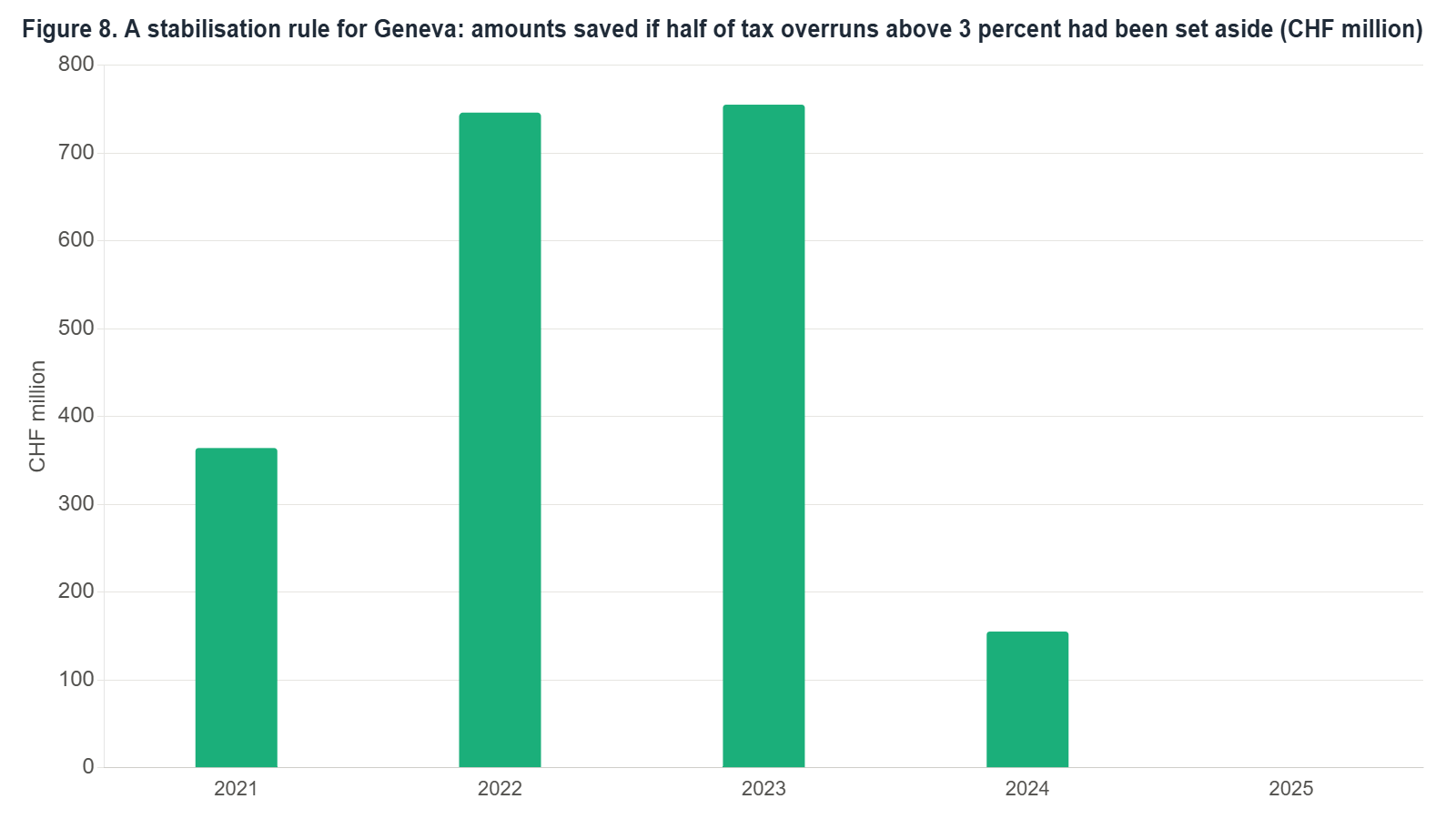
Under a rule that sets aside half of the tax overrun above 3 percent of tax revenue, Geneva would have saved CHF 364 million in 2021, 746 million in 2022, 755 million in 2023 and 155 million in 2024, about CHF 2 billion in total. This is roughly the cumulative decline in corporate tax revenue between 2023 and 2025, CHF 0.7 billion a year by 2025 relative to 2023. The canton did put part of its surpluses aside, CHF 541 million in a budget reserve in 2024, and used most of the rest to amortize its pension liabilities, which is also a form of saving. But it also cut personal income tax and increased spending, commitments that remain after the windfall has gone.
Table 7. Policy options for managing commodity windfalls
| Option | Level | Effect | Main difficulty |
|---|---|---|---|
| Budget on a smoothed corporate tax base | Canton | Fewer surprises, fewer spending ratchets | Requires discipline in good years |
| Stabilisation fund for windfall revenue | Canton | Smooths spending over the cycle | Political pressure to spend or cut taxes |
| Earlier final assessments for large traders | Canton and AFC | Shorter lag between profit and receipts | Administrative capacity |
| Explicit windfall line in federal planning | Confederation | Avoids counting temporary receipts as structural | None significant |
| Use the OECD minimum tax top-up transparently | Confederation and cantons | Captures part of the windfall at 15 percent | Distribution of receipts |
| Monitor merchanting as a leading fiscal indicator | SNB, FFA, canton | Two-year early warning | Data timeliness |
Source: author's assessment.
Table 7 summarizes the policy options. The most important is to recognize the windfall as temporary in budgeting. For the canton, this means basing budgets on a smoothed corporate tax base and placing exceptional receipts in a stabilisation fund. For the Confederation, it means booking the expected receipts from the 2026 windfall explicitly as temporary in the financial plan, as it did for the first windfall, rather than using them to justify permanent spending or to soften the relief package. For both, it means monitoring merchanting receipts as a leading indicator.
The OECD minimum tax, which Switzerland introduced in 2024 through a national top-up tax, adds a further element. Large trading groups with an effective rate below 15 percent in Switzerland now pay a top-up, which raises the fiscal yield of a windfall slightly and shifts part of the revenue to the Confederation and the cantons according to the distribution key adopted for the top-up tax.
13. Implications
Four implications follow.
The first is that the 2026 oil shock is not only a cost for Switzerland. As the fifth article of this series showed, it raises petroleum prices for Swiss households and firms only modestly; this article shows that it also raises the profits of the trading sector and, with a lag, tax receipts. For the Swiss economy as a whole, the oil shock of 2026, like that of 2022, may well be a net positive in fiscal terms.
The second is that the fiscal gains are concentrated in Geneva, Zug and the Confederation, while the costs of higher energy prices are spread across all cantons. This distribution, combined with the federal fiscal equalization system, will raise the question of how much of the second windfall should benefit Geneva.
The third is that the windfall creates risks as well as opportunities. Commodity trading is exposed to sanctions, to the reputational risks of dealing with producing countries, to regulatory changes such as the proposals for a sector supervisory authority, and to competition from Dubai and Singapore. A sharp fall in trading profits, or the relocation of a few large firms, would affect Geneva's finances as strongly as the windfall did.
The fourth concerns the reading of the federal finances. The Confederation closed 2025 with a small surplus of CHF 0.3 billion thanks to the Geneva receipts. Its financial plan for 2027 to 2029 still shows deficits. A second windfall in 2028 and 2029 could again produce better than expected results, and again create the temptation to conclude that the structural problem has been solved. It will not have been.
14. Conclusion
Commodity trading has become one of the main sources of volatility in Swiss public finances. The windfall of 2021 to 2024, CHF 74 billion of trading margins above trend, produced about CHF 6.4 billion of additional taxes, turned Geneva's deficits into record surpluses and is still flowing into the federal budget. In the first half of 2026, merchanting receipts reached a new record, and a second windfall of CHF 1 to 3 billion in taxes is already in the pipeline, most of it due in 2028 and 2029.
The lesson of the first windfall is that the authorities consistently underestimated the receipts and then treated part of them as permanent. The second windfall offers a chance to do better: to forecast it, to book it as temporary and to save it. The data to do so already exist. They are published every quarter by the SNB.
Methodological Appendix
A.1 Data
SNB, balance of payments, quarterly, merchanting (net receipts), 2000Q1 to 2026Q2. Brent, monthly average (FRED, MCOILBRENTEU). SECO, quarterly nominal GDP. State of Geneva, accounts 2019 to 2025 (budgeted and actual results, tax revenue above budget, corporate tax revenue, forecast errors). Federal Finance Administration, financial statements 2025 and press releases.
A.2 Regression
Log merchanting receipts (quarterly) on a constant, the log of the quarterly average Brent price, the quarterly volatility of monthly log changes (standard deviation times the square root of three, in percent) and a linear trend; samples 2000Q1 to 2026Q2 and 2015Q1 to 2026Q2; Newey-West standard errors with four lags.
A.3 Windfall
Normal level: log-linear trend fitted on 2010Q1 to 2019Q4 and extrapolated. Windfall: actual minus normal, summed by year.
A.4 Fiscal yield
Yield = (sum over 2021 to 2024 of Geneva tax revenue above budget minus CHF 255 million a year, plus CHF 2.3 billion of additional federal receipts) divided by the 2021 to 2024 windfall. Split between canton and Confederation in the same proportions. Scenarios multiply the first-half 2026 windfall by 1, 2 and 3.
A.5 Stabilisation rule
Amount saved in year t = 0.5 times max(0, tax revenue above budget minus CHF 270 million).
A.6 Limitations
Merchanting receipts are a gross margin, not a profit, and include activities outside Geneva. Geneva's revenue overruns include personal taxes and corrections for earlier years, and the 2019 benchmark of a normal overrun is a simplification. The federal receipts from Geneva are reported in aggregate and include sectors other than commodity trading. The scenarios do not model the effect of sanctions, relocations or the minimum tax.
References
Swiss National Bank, data portal: balance of payments (bopcurrq).
Federal Statistical Office, "Commodity trading generated CHF 19.2 billion in value added in 2024", press release, 18 November 2025.
Federal Finance Administration, "5 questions and answers on the 2025 financial statements", 18 February 2026; press releases on additional receipts from the canton of Geneva, 2025.
State of Geneva, accounts 2019, 2021, 2022, 2023, 2024 and 2025, explanatory statements of the Council of State and presentations.
S&P Global Ratings, research update on the Canton of Geneva, 2024.
Global Strategy Files, Swiss Economy 2026 Series, Articles 1 to 5, November 2026.
Driss EFFINA, PhD
Independent Researcher, Global Strategy Files
The opening pages of our four country reports: United States, United Kingdom, Japan and China. A free PDF, sent to your inbox.
You will also receive occasional analysis from Global Strategy Files. Unsubscribe in one click, at any time.