The Stablecoin Bid That Stalled: Dollar Tokens, the Treasury Bill Market and the Rate Paradox

Abstract
When the GENIUS Act was signed in July 2025, it was presented as more than a framework for regulating dollar stablecoins. By requiring issuers to back every token with cash, short-dated Treasury bills, repurchase agreements or government money market funds, the law turned the stablecoin industry into a structural buyer of American government debt. The Treasury Secretary called it a potential feature of financing the United States government, and Standard Chartered projected that stablecoins could reach 2 trillion dollars by 2028 and absorb 800 billion to 1 trillion dollars of Treasury bills. Eighteen months later, the bid has stalled. Total stablecoin capitalization peaked at 322.5 billion dollars in May 2026 and fell to about 302 billion in October, with Tether recording its first contraction since 2022 and USDC losing 4.7 billion dollars in a single month. This study places the stablecoin bid in the twenty-year history of the Treasury bill market and measures what it has actually contributed. We find that stablecoin issuers hold about 140 billion dollars of bills directly and about 200 billion including repurchase agreements and funds, about 2 percent of bills outstanding. Their share of the net increase in bill supply rose from about 6 percent in 2024 to about 10 percent in 2025 and fell to almost zero in 2026, precisely when the Treasury pushed the bill share of marketable debt to 22.2 percent, above the 15 to 20 percent range recommended by its advisory committee. We argue that the stall is not a temporary accident of the crypto cycle but a consequence of the design of the law: because issuers may not pay interest to holders, a stablecoin is a zero-yield asset whose opportunity cost rises with interest rates. With three-month bill yields near 4 percent, holders forgo about 12 billion dollars a year, which issuers capture as private seigniorage. Tighter monetary policy therefore shrinks the stablecoin bid exactly when the Treasury needs it most. Our scenarios for 2028 put stablecoin bill demand between about 100 billion and 300 billion dollars, against the 1 trillion of the optimistic projections, and our stress test shows that a 25 percent redemption run would force sales of about 35 billion dollars of bills, manageable for the market but large enough to move short-term yields by about 12 basis points.
Key findings
- Treasury bills rose from 0.94 trillion dollars in 2006 to about 6.9 trillion in 2026, and from 22 percent of marketable debt to 22.2 percent, after falling to 11 percent in 2014. The share is above the 15 to 20 percent range recommended by the Treasury Borrowing Advisory Committee.
- Stablecoin capitalization rose from about 5 billion dollars in 2019 to a peak of 322.5 billion in May 2026, then fell to about 302 billion in October 2026.
- Stablecoin issuers hold about 2 percent of outstanding bills. Their contribution to the net increase in bill supply was about 6 percent in 2024, 10 percent in 2025 and about 0.5 percent in 2026.
- At current yields, stablecoin holders forgo about 12 billion dollars of interest a year, which accrues to issuers and their distribution partners. The opportunity cost of holding stablecoins has risen with interest rates.
- In 2028, stablecoin demand for bills would reach about 940 billion dollars under the optimistic projection, about 300 billion if 2024 to 2025 growth resumed, and 100 to 155 billion under stagnation or contraction.
- A 25 percent redemption of stablecoins within a week would force sales of about 35 billion dollars of bills and could raise short-term yields temporarily by about 12 basis points, based on IMF elasticities.
1. Introduction: a new buyer for the shortest debt
The United States government finances an annual deficit of about 2 trillion dollars, and its financing strategy has shifted toward the short end of the curve. Since 2023, the Treasury has increased the share of bills, securities with a maturity of one year or less, in its marketable debt, partly because demand for long-term bonds is uncertain and partly because the money market fund industry, with assets of nearly 8 trillion dollars, has an apparently insatiable appetite for short-dated government paper. In its refunding announcement of August 2026, the Treasury kept coupon issuance unchanged and relied on bills for most of its incremental financing: about 409 billion dollars of the 739 billion dollars it borrowed from private investors in the July to September quarter.
In this strategy, stablecoins were supposed to play a growing role. The GENIUS Act requires that reserves be held in a narrow list of assets, including bills with a remaining maturity of 93 days or less, and prohibits issuers from paying interest to holders. Every new dollar of stablecoin therefore creates roughly a dollar of demand for short-term government debt or its close substitutes, and the demand is insensitive to price: issuers must hold the assets whatever the yield. The Bank for International Settlements estimated that dollar stablecoins bought nearly 35 billion dollars of bills in 2025, comparable to the largest government money market funds. Market analysts described the industry as a new sovereign-scale buyer of Treasury debt.
This study asks how large that buyer really is, how it compares with the other forces in the bill market over twenty years, why its growth stalled in 2026, and what it could plausibly contribute to the financing of the federal government by 2028. Section 2 traces the history of the bill market and of money market funds since 2006. Section 3 measures the stablecoin bid. Section 4 explains its stall. Section 5 estimates the private seigniorage created by the interest prohibition. Section 6 presents scenarios and a stress test. Section 7 draws implications for debt management, monetary policy and regulation.
2. Twenty years of the Treasury bill market
2.1 Supply: from 11 to 22 percent of marketable debt
Figure 1 shows the share of bills in marketable Treasury debt from 2006 to 2026. The share was about 22 percent in 2006 and 2007, jumped to 32 percent in 2008 when the Treasury financed the response to the financial crisis with bills, and then fell steadily to a low of about 11 percent in 2014 and 2015, as the Treasury deliberately extended the maturity of the debt to lock in low long-term rates. It rose modestly in the late 2010s, jumped to about 24 percent in 2020 when pandemic spending was financed with bills, fell back to about 15 percent in 2022, and has risen since 2023 to about 22 percent. At the end of July 2026 it stood at 22.2 percent, above the range of 15 to 20 percent that the Treasury Borrowing Advisory Committee recommended in 2020 as a medium-term norm.

In dollar terms, bills outstanding rose from about 0.94 trillion dollars in 2006 to 6.69 trillion at the end of June 2026 and close to 7 trillion by the autumn. This is the market into which stablecoin issuers place their reserves.
2.2 Demand: the rise of money market funds
The dominant buyer of bills is the money market fund industry. Figure 2 compares the assets of money market funds with bills outstanding. Fund assets were about 2.4 trillion dollars in 2006, peaked near 3.8 trillion during the financial crisis, fell back to about 2.7 trillion during the zero-rate years of 2010 to 2015, and then grew rapidly as rates rose: to 4.8 trillion in 2022, 5.9 trillion in 2023, 6.9 trillion in 2024 and close to 8 trillion in 2026. Money funds held about 2.7 trillion dollars of bills in March 2026.
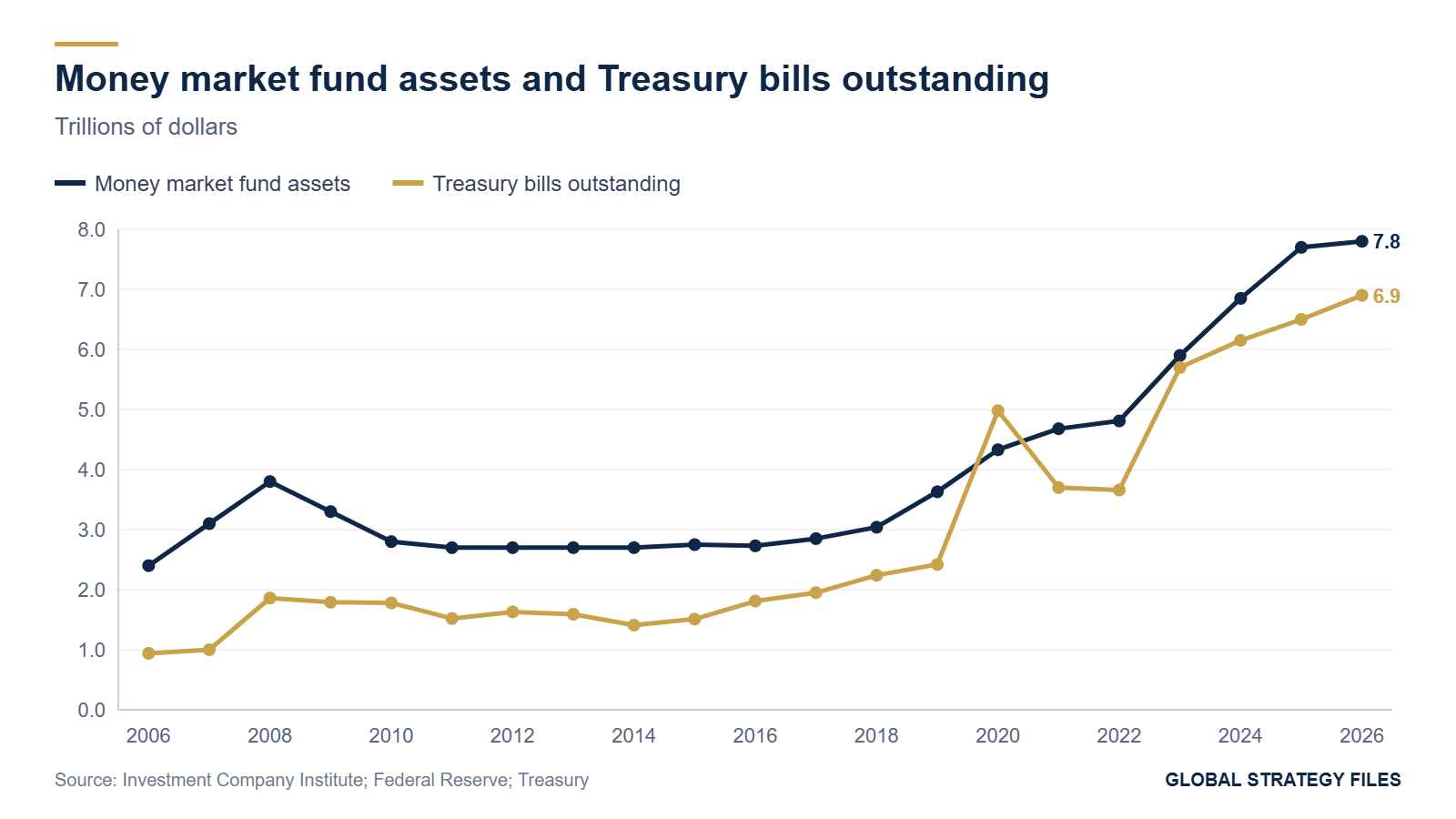
The relationship between the two lines is the key to the bill market. When rates are high relative to bank deposit rates, money flows into money funds, which buy bills; the Treasury can then issue bills at yields close to the policy rate. The stablecoin industry is, in this sense, a smaller and more volatile cousin of the money fund industry: a pool of dollar balances that must be invested at the very short end of the curve. The difference is that money fund investors receive the interest earned on the bills, while stablecoin holders do not.
2.3 The Federal Reserve returns
A third actor re-entered the bill market in December 2025, when the Federal Reserve began purchasing bills in its open market operations to maintain an ample level of bank reserves after the end of quantitative tightening. The Treasury noted in its February 2026 refunding that these purchases meant that, although the bill share of total debt was rising, the share of privately held debt represented by bills was broadly unchanged. The Federal Reserve thus absorbs part of the increase in bill supply that stablecoins were expected to absorb.
3. Measuring the stablecoin bid
3.1 The growth of dollar tokens
Stablecoins are tokens issued on blockchains and redeemable at par for dollars. Their total capitalization was about 1.4 billion dollars in 2017, 5 billion in 2019, 28 billion in 2020 and 160 billion in 2021, at the height of the crypto boom. It fell to about 130 to 140 billion dollars in 2022 and 2023 after the collapse of the Terra algorithmic stablecoin, recovered to about 205 billion in 2024 and reached about 300 billion at the end of 2025. Figure 3 shows the trajectory. The peak came in May 2026, at 322.5 billion dollars, a figure larger than the foreign exchange reserves of 95 countries. Since then, the market has contracted: to about 308 billion dollars in August and about 302 billion in mid-October, when USDT accounted for 183.4 billion dollars and USDC for 72.7 billion, together more than 85 percent of the total.
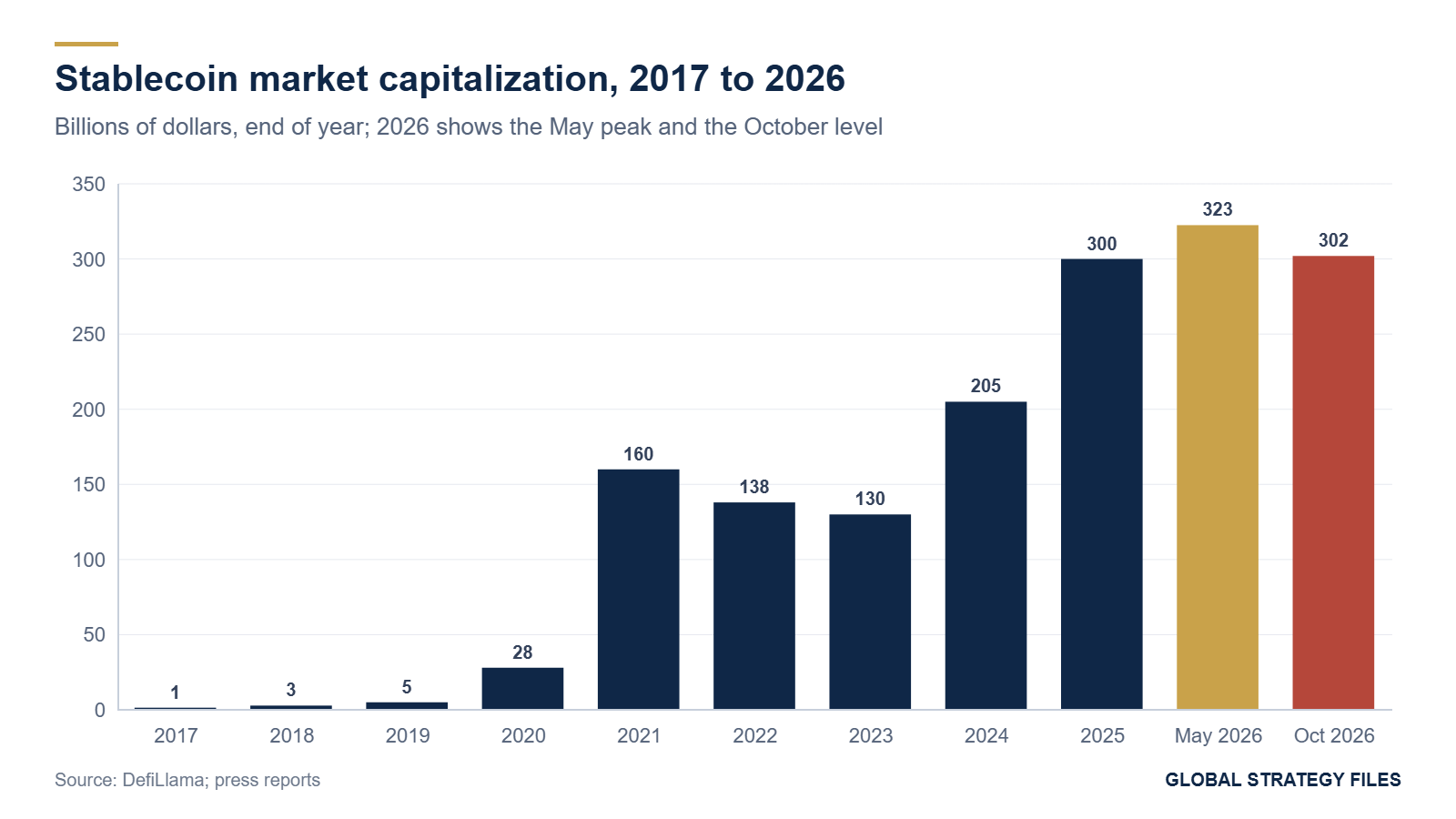
The two leading issuers have followed different paths. Circle's USDC, which accounts for 97 percent of United States-domiciled stablecoin supply and has positioned itself as the regulated, compliant token, doubled its supply in 2025 and reached about 78 billion dollars in March 2026, before losing about 4.7 billion dollars in October. Tether's USDT, based outside the United States and used heavily on the Tron blockchain and in emerging markets, recorded its first quarterly contraction since 2022 in the first quarter of 2026 and fell by nearly 3 billion dollars in the first half of the year.
3.2 How much of the bill market do stablecoins hold?
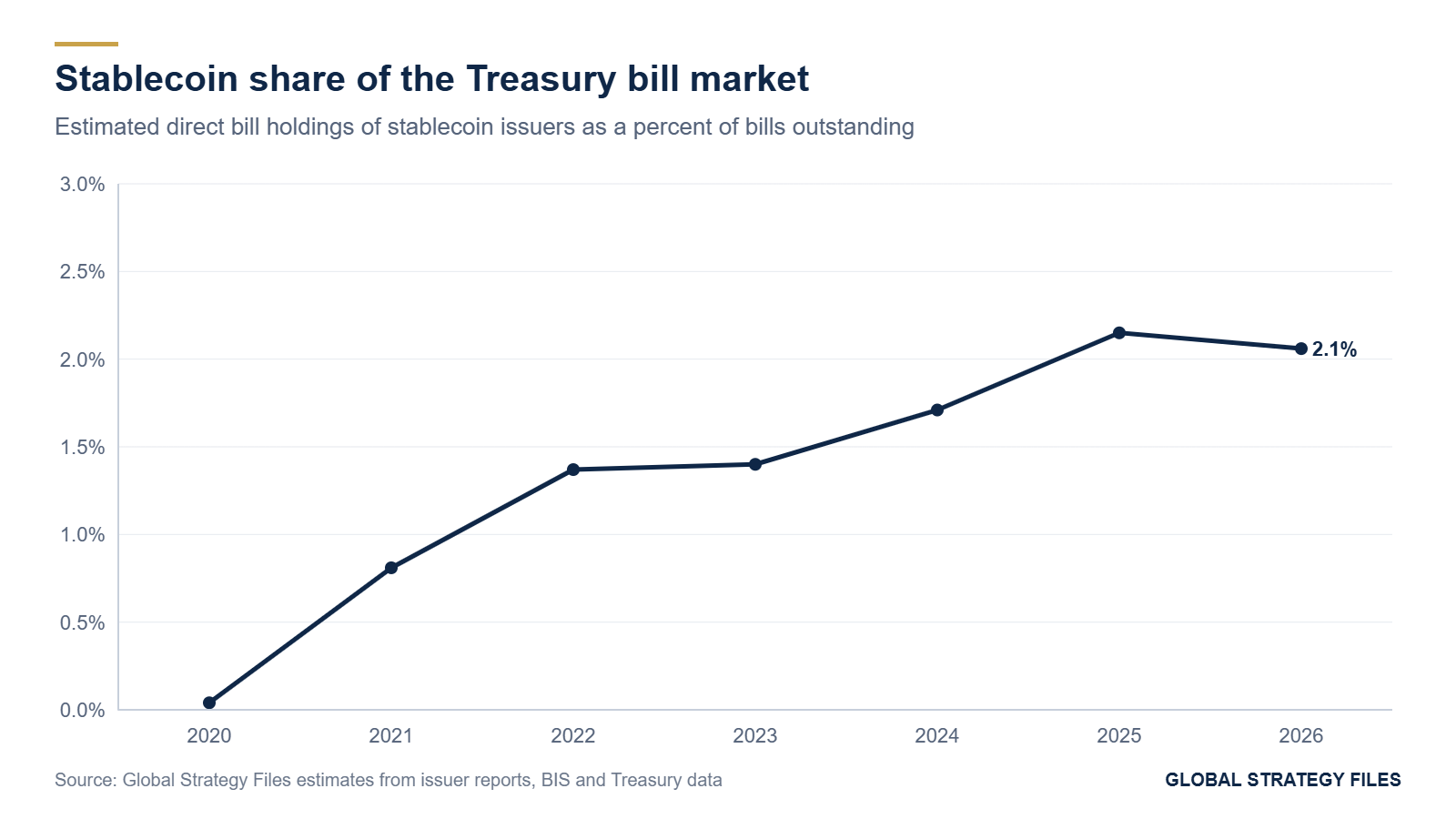
Not every dollar of stablecoin is invested in bills. Issuers also hold bank deposits, repurchase agreements, shares of government money market funds and, in Tether's case, a portfolio of other assets including gold and Bitcoin. According to Tether's attestations and Circle's transparency reports, the two issuers held more than 130 billion dollars of one-to-three-month bills in the first quarter of 2026, and about 200 billion dollars of Treasury-linked reserves including repos and funds. We estimate direct bill holdings for the whole industry at about 142 billion dollars in 2026, or about 47 percent of total capitalization.
Table 1 and Figure 4 compare these holdings with the size of the bill market. In 2020, when Tether held most of its reserves in commercial paper, stablecoins owned a negligible share of bills. Their share rose to about 0.8 percent in 2021, 1.4 percent in 2022 and 2023, 1.7 percent in 2024 and 2.1 percent in 2025, and was about 2.1 percent in 2026. On the narrower segment of bills with less than three months to maturity, where the GENIUS Act concentrates their reserves, the share is two to three times higher.
Table 1. Stablecoins in the Treasury bill market, 2020 to 2026
| Year | Bills outstanding (trillion dollars) | Stablecoin capitalization (billion dollars) | Stablecoin bill holdings, estimated (billion dollars) | Share of bills outstanding (%) |
|---|---|---|---|---|
| 2020 | 4.98 | 28 | 2 | 0.04 |
| 2021 | 3.70 | 160 | 30 | 0.8 |
| 2022 | 3.66 | 138 | 50 | 1.4 |
| 2023 | 5.70 | 130 | 80 | 1.4 |
| 2024 | 6.15 | 205 | 105 | 1.7 |
| 2025 | 6.5 | 300 | 140 | 2.2 |
| 2026 (October) | 6.9 | 302 | 142 | 2.1 |
Source: Treasury monthly statements of the public debt; DefiLlama; issuer attestations; Bank for International Settlements; Global Strategy Files estimates for holdings.
3.3 The marginal buyer
The share of the stock is less important for yields than the share of the flow. A buyer that absorbs a large part of new supply can lower the yield at which the Treasury issues, even if its holdings are a small fraction of the market. We therefore compare the annual change in stablecoin bill holdings with the net increase in bills outstanding. In 2024, stablecoin issuers added about 25 billion dollars of bills while the net supply of bills rose by about 450 billion: a marginal share of about 6 percent. In 2025, they added about 35 billion dollars, consistent with the Bank for International Settlements estimate, against net supply of about 350 billion: about 10 percent. In 2026, their holdings were almost unchanged while net bill supply rose by about 400 billion dollars: a marginal share of about 0.5 percent. Figure 5 shows the collapse of the marginal contribution.
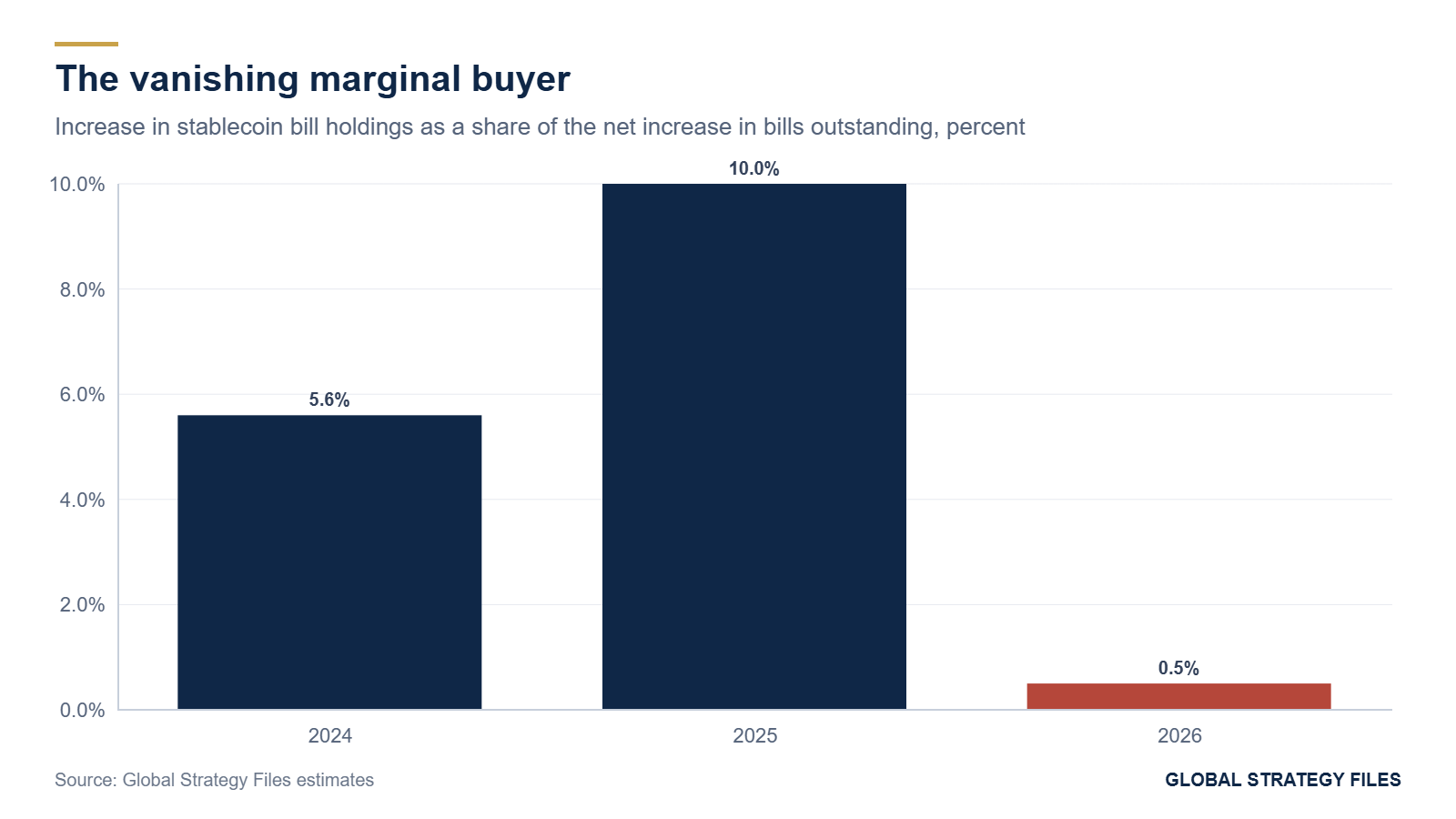
The timing is unfortunate for the Treasury. The year in which the stablecoin bid disappeared is the year in which the Treasury pushed the bill share above its recommended range, and in which money market funds, the main buyers, reduced their bill holdings by 365 billion dollars in the first half. The slack was taken up by the Federal Reserve's reserve management purchases and by higher yields.
4. Why the bid stalled
4.1 The crypto cycle
The most obvious explanation is the crypto market. Stablecoins are used mainly as settlement assets and collateral in crypto trading and decentralized finance. When crypto prices fall, trading volumes decline, leveraged positions are unwound and demand for stablecoins falls. Bitcoin was trading near 80,000 dollars in October 2026, far below its record of about 126,000 dollars in October 2025. The 2022 contraction of stablecoins followed the same pattern.
4.2 The opportunity cost of a zero-yield dollar
A second explanation is structural and has received less attention. The GENIUS Act prohibits issuers of payment stablecoins from paying interest to holders. A stablecoin is therefore a zero-yield dollar, while the assets backing it earn the bill rate. When interest rates are near zero, as they were in 2020 and 2021, holding a stablecoin costs nothing relative to holding a bill or a money fund share. When rates are 4 percent, holding a stablecoin costs 4 percent a year.
The opportunity cost has risen sharply. Three-month bill yields averaged less than 0.1 percent in 2021, about 5 percent in 2023 and 2024, about 4.2 percent in 2025 and about 3.9 percent in 2026; with the Federal Reserve tightening again in the autumn, the three-month yield stood near 4.1 percent in mid-September. Holders who keep stablecoins as a store of value, rather than as a transaction balance, have every incentive to move to yield-bearing alternatives: tokenized money market funds, which grew rapidly in 2025 and 2026, or yield-bearing synthetic dollars, which grew fifteen times faster than the overall stablecoin market in the six months to March 2026. The growth of the regulated, non-yielding stablecoin is therefore capped by the level of interest rates.
This creates what we call the rate paradox of the stablecoin bid. The Treasury needs more bill buyers when deficits are large and rates are high. But high rates are precisely the condition that makes zero-yield stablecoins least attractive to hold. A Federal Reserve that tightens to fight inflation therefore shrinks one of the sources of demand for the government's short-term debt. Conversely, the stablecoin bid would be strongest in an environment of low rates, when the Treasury needs it least.
4.3 Distribution costs and the economics of issuers
A third factor is the cost of distribution. To grow, issuers must persuade exchanges, wallets and payment companies to hold and promote their tokens. Circle disclosed that about 819 million dollars, or about 59 cents of each dollar of its roughly 1.4 billion dollars of revenue in the first half of 2026, went to distribution partners and transaction costs. Because the law forbids paying interest directly to holders, issuers compete by paying intermediaries, which raises the cost of growth and limits the share of the reserve income that issuers can retain.
4.4 A simple test of the rate paradox
Is the rate paradox visible in the data? With only eight annual observations since 2019, any test is fragile, but the pattern is suggestive. We regressed the annual growth of stablecoin capitalization (in log points) on the average three-month bill yield and on the annual change in the price of Bitcoin, a proxy for the crypto cycle, over 2019 to 2026. Both variables have the expected sign and are statistically significant. Each percentage point of bill yield is associated with about 28 log points less growth in stablecoin capitalization (standard error 6.7), holding the crypto cycle constant, and each log point of Bitcoin return with about 0.5 log points more growth (standard error 0.18). Together the two variables explain 84 percent of the variation in growth. On its own, the bill yield explains 58 percent, with a correlation of minus 0.76.
Table 2. Stablecoin growth, interest rates and the crypto cycle, 2019 to 2026
| Year | Growth of capitalization (log points) | Three-month bill yield (%) | Bitcoin price change (log points) |
|---|---|---|---|
| 2019 | 58 | 2.1 | 67 |
| 2020 | 172 | 0.37 | 140 |
| 2021 | 174 | 0.05 | 47 |
| 2022 | -15 | 2.0 | -103 |
| 2023 | -6 | 5.1 | 94 |
| 2024 | 46 | 5.0 | 79 |
| 2025 | 38 | 4.2 | -6 |
| 2026 (to October) | 1 | 3.9 | -10 |
Source: DefiLlama; Treasury; Global Strategy Files calculations. Bitcoin prices are approximate year-end values.
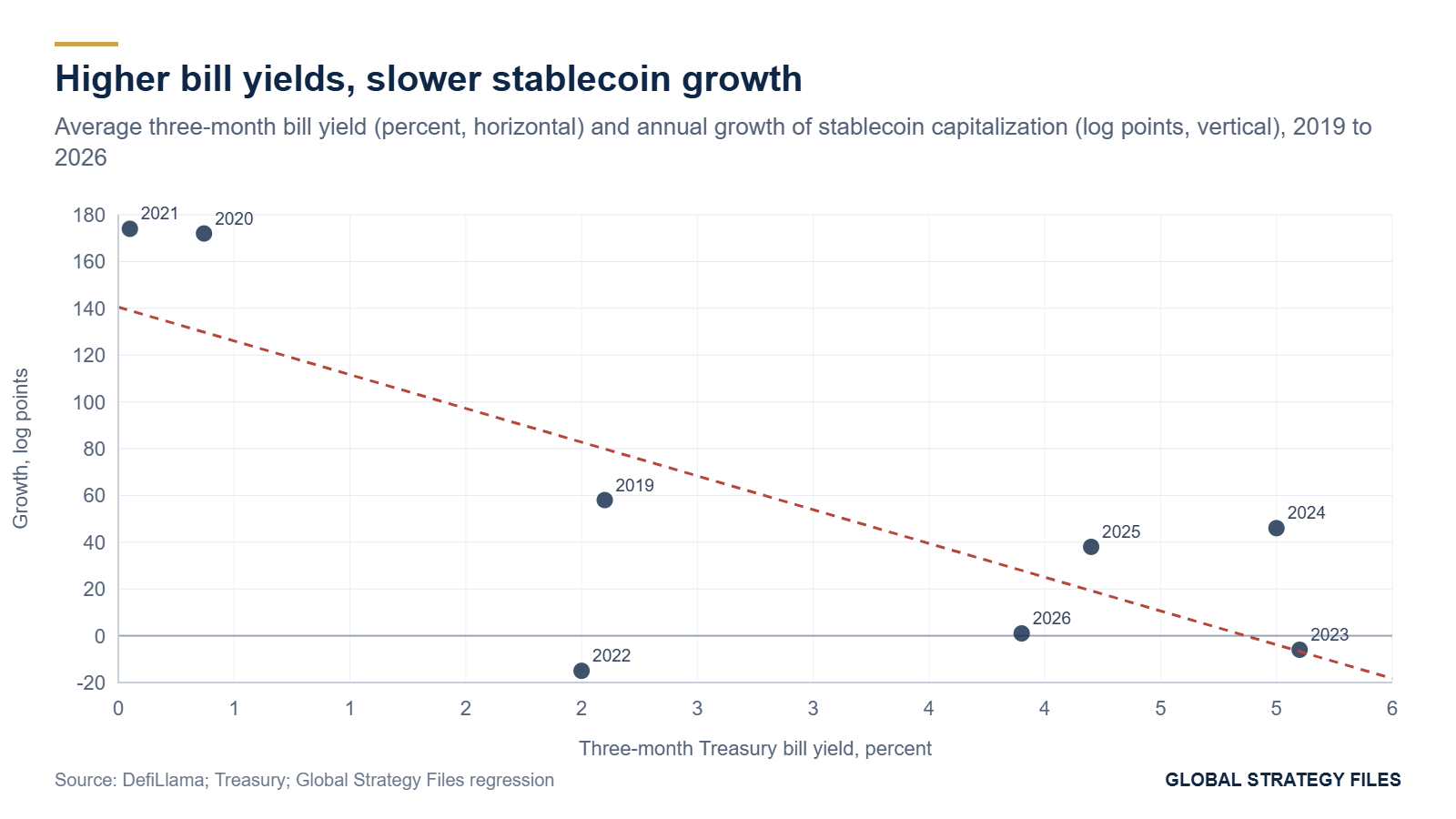
The most telling observation is 2023, a year in which Bitcoin more than doubled but stablecoin capitalization fell, while bill yields exceeded 5 percent. In 2020 and 2021, with yields near zero, stablecoins grew by about 170 log points a year. The data are consistent with the view that the opportunity cost of holding a zero-yield token is a first-order determinant of the growth of the regulated stablecoin market, alongside the crypto cycle. With only eight observations, we treat this as evidence for the hypothesis, not as a precise estimate.
5. Private seigniorage
5.1 How much interest do holders forgo?
The interest prohibition transfers income from holders to issuers and their partners. We estimate the annual interest forgone by holders as the average stablecoin capitalization of the year times the average three-month bill yield. The result, shown in Figure 7, was negligible in 2020 and 2021, about 3 billion dollars in 2022, 6.5 billion in 2023, 8.5 billion in 2024, 10.9 billion in 2025 and about 12.1 billion in 2026.
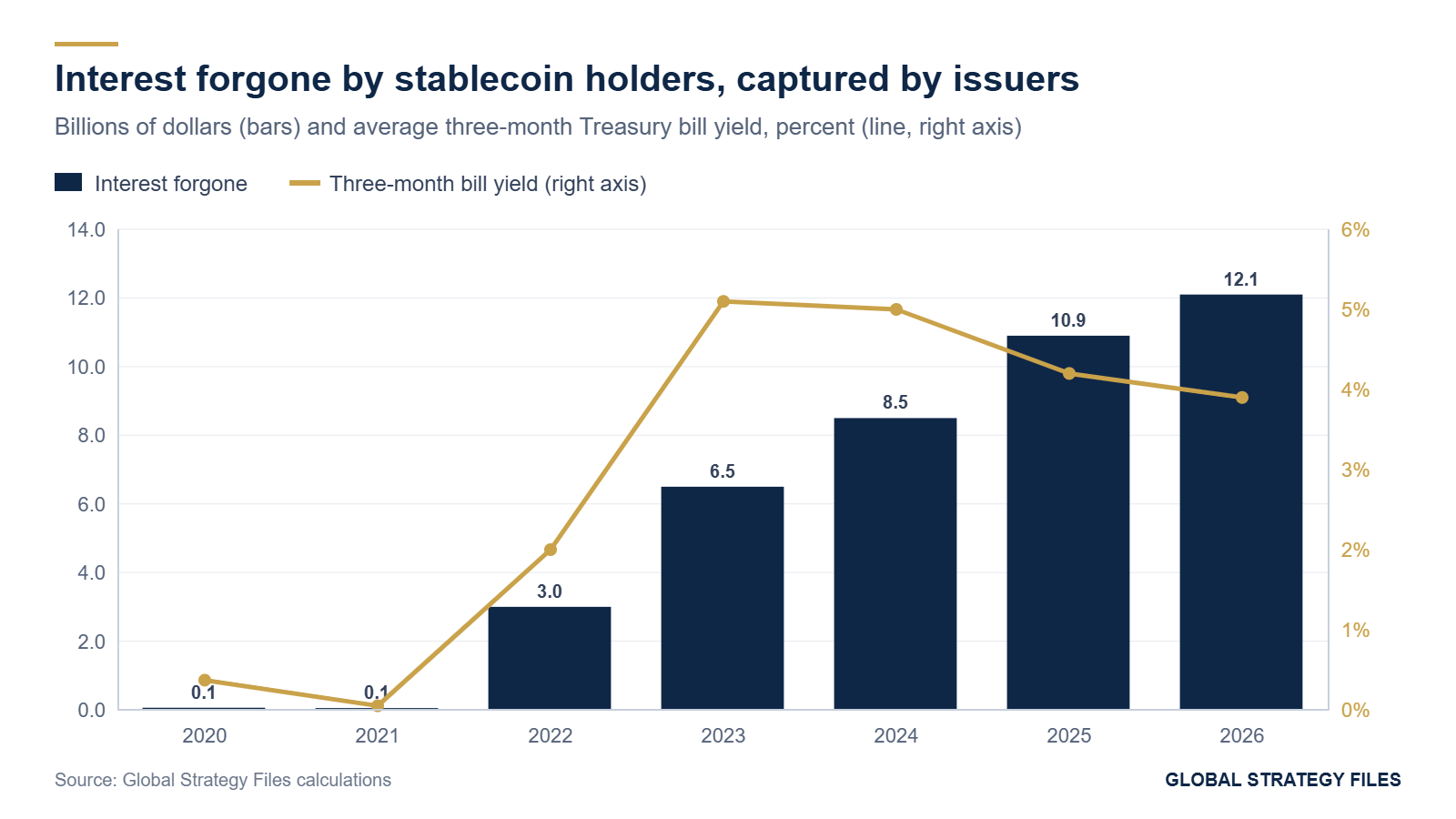
Table 3. Interest forgone by stablecoin holders, 2020 to 2026
| Year | Average capitalization (billion dollars) | Average three-month bill yield (%) | Interest forgone (billion dollars) |
|---|---|---|---|
| 2020 | 15 | 0.37 | 0.06 |
| 2021 | 100 | 0.05 | 0.05 |
| 2022 | 150 | 2.0 | 3.0 |
| 2023 | 128 | 5.1 | 6.5 |
| 2024 | 170 | 5.0 | 8.5 |
| 2025 | 260 | 4.2 | 10.9 |
| 2026 | 310 | 3.9 | 12.1 |
Source: Global Strategy Files calculations from DefiLlama capitalization data and Treasury bill yields.
5.2 A transfer from the public to the issuers
This income is a form of seigniorage: the revenue that accrues to the issuer of money from the difference between the return on its assets and the zero interest paid on its liabilities. Traditionally, seigniorage accrues to the central bank and is remitted to the Treasury. Since 2022, the Federal Reserve has made no remittances, because the interest it pays on reserves has exceeded the income on its portfolio, and it has accumulated a deferred asset. Private stablecoin issuers, by contrast, earned in 2026 a seigniorage of about 12 billion dollars, which is retained by Tether, Circle and their distribution partners, or paid out in fees.
The policy question is whether this transfer is the price of a useful payment innovation or a rent created by regulation. The interest prohibition was intended to prevent stablecoins from competing with bank deposits, which are insured and support lending. It has succeeded in that respect. But it has also made the regulated stablecoin a less attractive asset than its unregulated or synthetic competitors in a world of positive rates, and it has transferred to private issuers an income that, in a central bank digital currency or in a money market fund, would have accrued to the public or to holders.
6. Scenarios and stress test
6.1 Four paths to 2028
We project stablecoin demand for bills at the end of 2028 under four scenarios, assuming that issuers continue to hold about 47 percent of their capitalization in bills directly and that bills outstanding reach about 8 trillion dollars.
The optimistic scenario follows the Standard Chartered projection of a 2 trillion dollar market by the end of 2028, driven largely by demand from emerging markets. The trend scenario assumes that the market resumes the growth rate of 2024 to 2025, about 45 percent a year, from 300 billion dollars. The stagnation scenario assumes modest growth to about 330 billion dollars. The contraction scenario assumes that higher rates and competition from yield-bearing alternatives shrink the regulated market to about 220 billion dollars.
Table 4. Stablecoin demand for Treasury bills in 2028 under four scenarios
| Scenario | Stablecoin capitalization (billion dollars) | Direct bill holdings (billion dollars) | Share of bills outstanding (%) |
|---|---|---|---|
| Optimistic (2 trillion by 2028) | 2,000 | 940 | 11.8 |
| Trend (45 percent a year) | 631 | 296 | 3.7 |
| Stagnation | 330 | 155 | 1.9 |
| Contraction | 220 | 103 | 1.3 |
Source: Global Strategy Files projections; bills outstanding of 8 trillion dollars assumed for 2028.
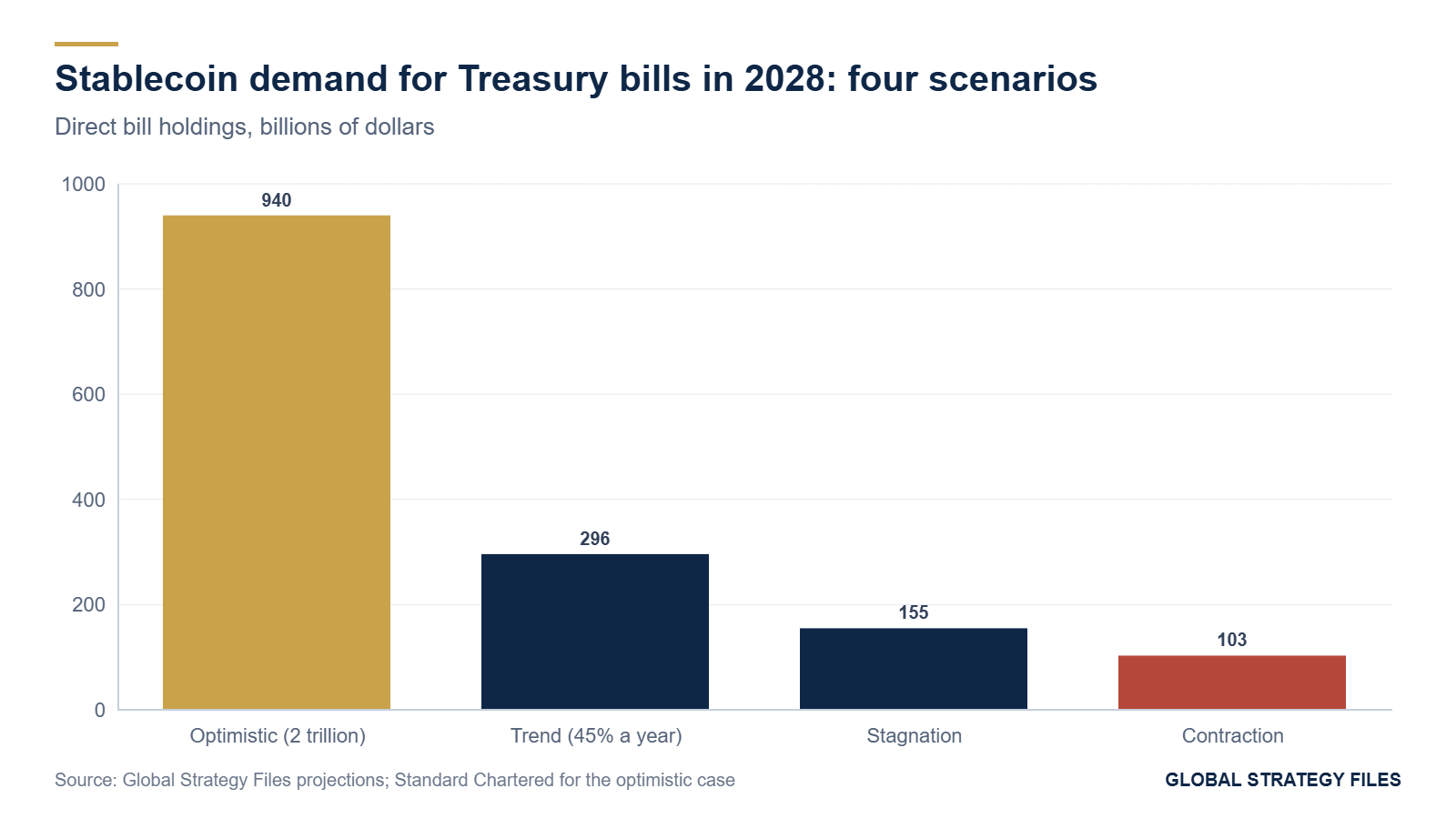
The optimistic scenario requires a sevenfold increase in capitalization in about two years, which would be the fastest growth in the history of the industry outside the 2020 to 2021 boom. Given the stall of 2026 and the rate paradox described above, we regard it as unlikely without a change in the interest prohibition or a much lower level of interest rates. The trend scenario is possible but would require a return of the crypto cycle. The stagnation and contraction scenarios are consistent with the data of 2026. In those cases, stablecoins would remain a niche buyer, holding less than 2 percent of bills, smaller than any of the large government money market funds.
6.2 What would happen in a run?
A stablecoin is only as stable as its reserves and its redemption mechanism. The GENIUS Act addresses credit risk by restricting reserves to high-quality assets, but it does not eliminate liquidity risk: if holders redeem a large share of tokens in a short period, the issuer must sell bills or draw down deposits to pay them. The mechanism runs both ways. Issuance means buying bills; redemption means selling them.
We consider a severe but plausible run in which holders redeem 25 percent of outstanding stablecoins in one week, comparable in relative terms to the outflows from prime money market funds in March 2020 or from USDC after the failure of Silicon Valley Bank in March 2023. With bill holdings of about 142 billion dollars, issuers would need to sell about 35 billion dollars of bills, assuming they use bills and deposits in proportion. This is a small amount relative to the daily turnover of the bill market, which is measured in hundreds of billions of dollars. But it would be concentrated in the shortest maturities and in a short period.
To estimate the price effect, we use the elasticity reported in an IMF working paper of March 2026 on stablecoin shocks, which found that a shock of 1 percent to stablecoin capitalization moves short-term Treasury yields by about 0.5 basis points. A 25 percent shock would therefore raise short-term yields by about 12 basis points, temporarily. The same paper found that stablecoin demand shocks also affect the dollar and spill over into crypto and equity markets. A run of this size would not threaten the Treasury market. It would, however, be a large shock for the crypto ecosystem, and its transmission to bill yields would be visible in the data. In a scenario where the market had reached 2 trillion dollars, the same run would require sales of about 235 billion dollars, a much more serious event, which is why the size of the market matters for financial stability as much as for debt management.
7. Implications
For debt management. The Treasury should not count on stablecoins as a significant source of bill demand in its medium-term planning. Our scenarios suggest that their contribution by 2028 is more likely to be in the range of 100 to 300 billion dollars than the 800 billion to 1 trillion of the most optimistic projections. The bill share of marketable debt, already above the recommended range, will have to be financed mainly by money market funds, banks, foreign official holders and, at the margin, by the Federal Reserve. A strategy of increasing bills on the assumption of a growing stablecoin bid would raise refinancing risk without a reliable buyer.
For monetary policy. The rate paradox implies that monetary tightening reduces demand for regulated stablecoins and therefore, slightly, demand for bills. The effect is small today but would grow with the size of the market. In a world where stablecoins were large, monetary policy would have an additional channel of transmission to the government's financing costs.
For regulation. The interest prohibition is the central design choice of the GENIUS Act. It protects banks and limits the competition between stablecoins and deposits, but it also caps the growth of regulated stablecoins in a positive-rate world, pushes holders toward less regulated yield-bearing alternatives and creates a private seigniorage of about 12 billion dollars a year. Policymakers should evaluate whether a regime that allowed regulated stablecoins to pass through part of the reserve income, under strict conditions, would serve the goals of financial stability and dollar dominance better than the current regime.
For the dollar. Stablecoins extend the reach of the dollar into economies where access to dollar bank accounts is limited, and about two thirds of the projected growth was expected to come from emerging markets. A stagnating stablecoin market means a slower expansion of this informal dollarization channel. The stall of 2026 therefore matters not only for the Treasury bill market but for the international role of the dollar.
8. What is new in this study
This study offers, to our knowledge, the first measurement of the marginal contribution of stablecoins to the net supply of Treasury bills over 2024 to 2026 (about 6, 10 and 0.5 percent), the identification of a rate paradox by which monetary tightening reduces the stablecoin bid, the first time series of the interest forgone by stablecoin holders and captured by issuers (about 12 billion dollars in 2026), and a set of 2028 scenarios that place the optimistic projections of 800 billion to 1 trillion dollars of bill demand in the context of the 2026 stall. The finding that stablecoins hold about 2 percent of bills confirms earlier estimates by the Bank for International Settlements and market analysts.
Methodological annex
Bill market data. Bills outstanding and marketable debt are from the Monthly Statement of the Public Debt (end of year, approximate values). The 2026 share of 22.2 percent is the Treasury figure for 31 July 2026. Money market fund assets are from the Investment Company Institute and the Federal Reserve Financial Accounts.
Stablecoin data. Capitalization is from DefiLlama and press reports of its data (end of year, and 17 October 2026 for the latest value). Bill holdings are Global Strategy Files estimates based on Tether attestations, Circle transparency reports and Bank for International Settlements estimates; they are approximate, especially for 2021 and 2022, when Tether's reserve composition was changing.
Marginal share. Change in estimated stablecoin bill holdings divided by the change in bills outstanding over the year: about 450 billion dollars in 2024, 350 billion in 2025 and 400 billion in 2026 (estimates).
Interest forgone. Average capitalization over the year times the average three-month bill yield. The calculation ignores the share of reserves held in non-interest-bearing deposits and the costs of issuers, so it is an upper bound on net seigniorage.
Run stress test. Redemption of 25 percent of capitalization in one week, met by selling bills in proportion to their share of reserves (47 percent). Yield effect from the IMF elasticity of about 0.5 basis points per 1 percent shock to capitalization, applied linearly.
Limitations. The stablecoin bill holdings are estimated, not observed, for the industry as a whole. The IMF elasticity was estimated on a period of relatively small shocks and may not apply linearly to large ones. The scenarios are illustrative and do not model the feedback between rates, crypto prices and stablecoin demand.
References
Bank for International Settlements (2026). Stablecoins and the Treasury bill market. BIS Bulletin and Quarterly Review, April and June 2026.
Brookings Institution (2026). Stablecoins after GENIUS. Washington, DC.
Liang, N. and B. Neiman (2026). Stablecoins after GENIUS: executive summary. Economic Strategy Group, August 2026.
International Monetary Fund (2026). Stablecoin Shocks. Working Paper WP/2026/044, March 2026.
Standard Chartered (2026). Stablecoins could drive 1 trillion dollars of T-bill demand. Research note reported by The Block, 23 February 2026.
U.S. Department of the Treasury (2026). Quarterly Refunding Statement and presentation to the Treasury Borrowing Advisory Committee, August 2026.
Treasury Borrowing Advisory Committee (2026). Bill purchases and the consolidated balance sheet. Charge, February 2026.
Reuters (2026). Investors pile into US Treasury bills. July 2026.
Coin Metrics (2026). Shake up in the stablecoin sector. State of the Network.
DefiLlama (2026). Stablecoin market capitalization data, accessed October 2026.
Circle Internet Financial (2026). Transparency reports and blog post on distribution economics, 16 October 2026.
Driss EFFINA, PhD
Independent Researcher, Global Strategy Files
The opening pages of our four country reports: United States, United Kingdom, Japan and China. A free PDF, sent to your inbox.
You will also receive occasional analysis from Global Strategy Files. Unsubscribe in one click, at any time.